

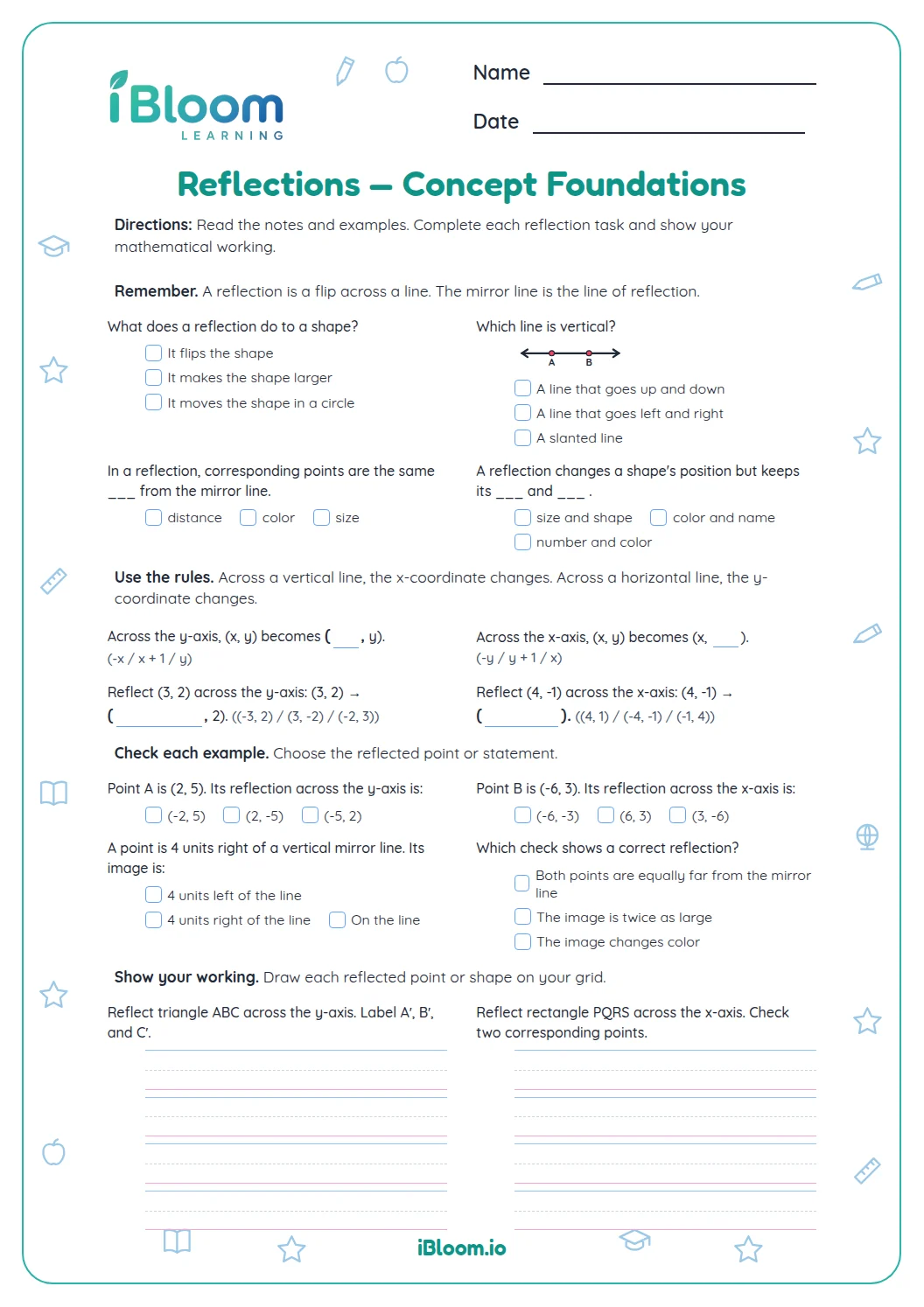
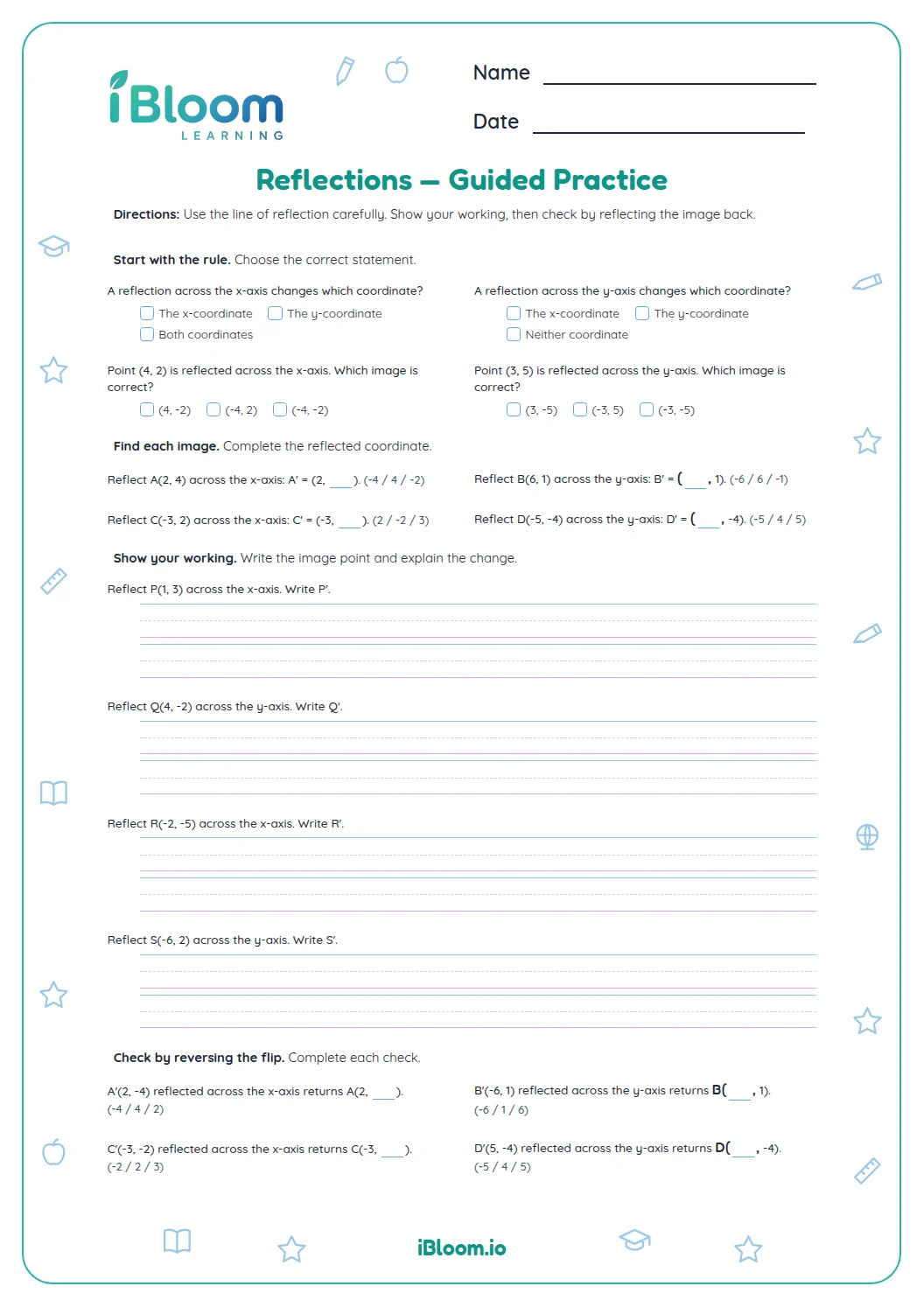
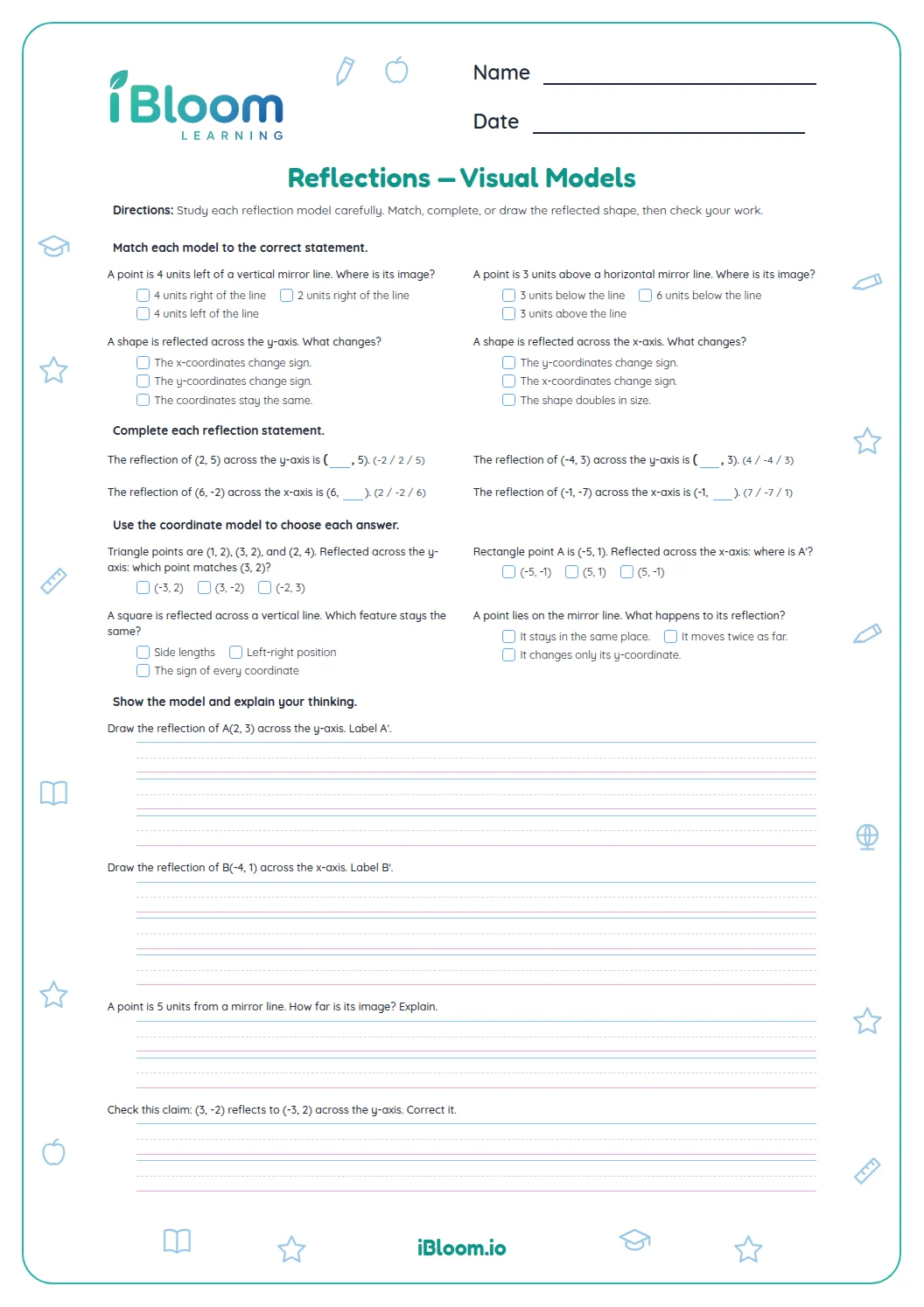
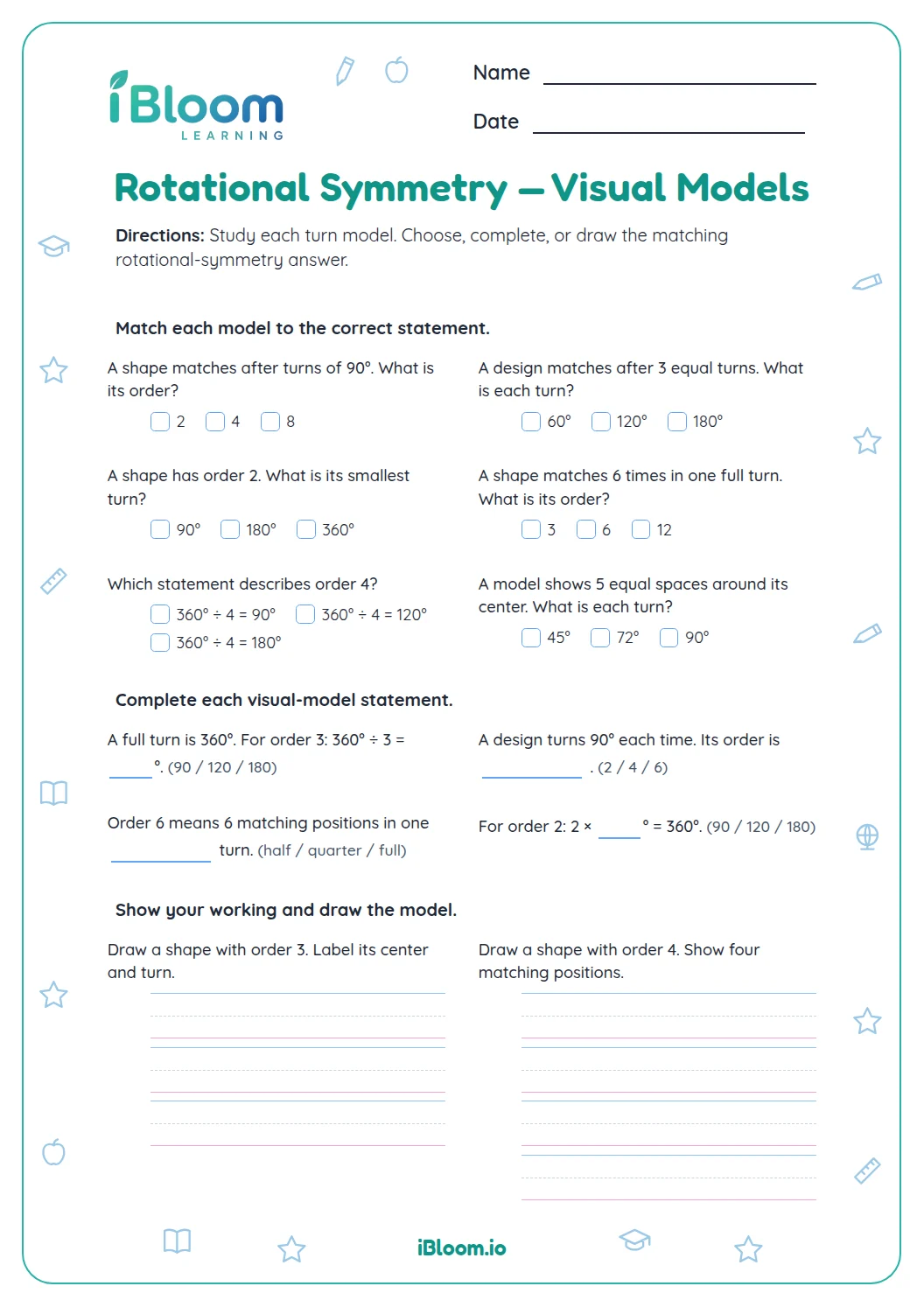

About this worksheet
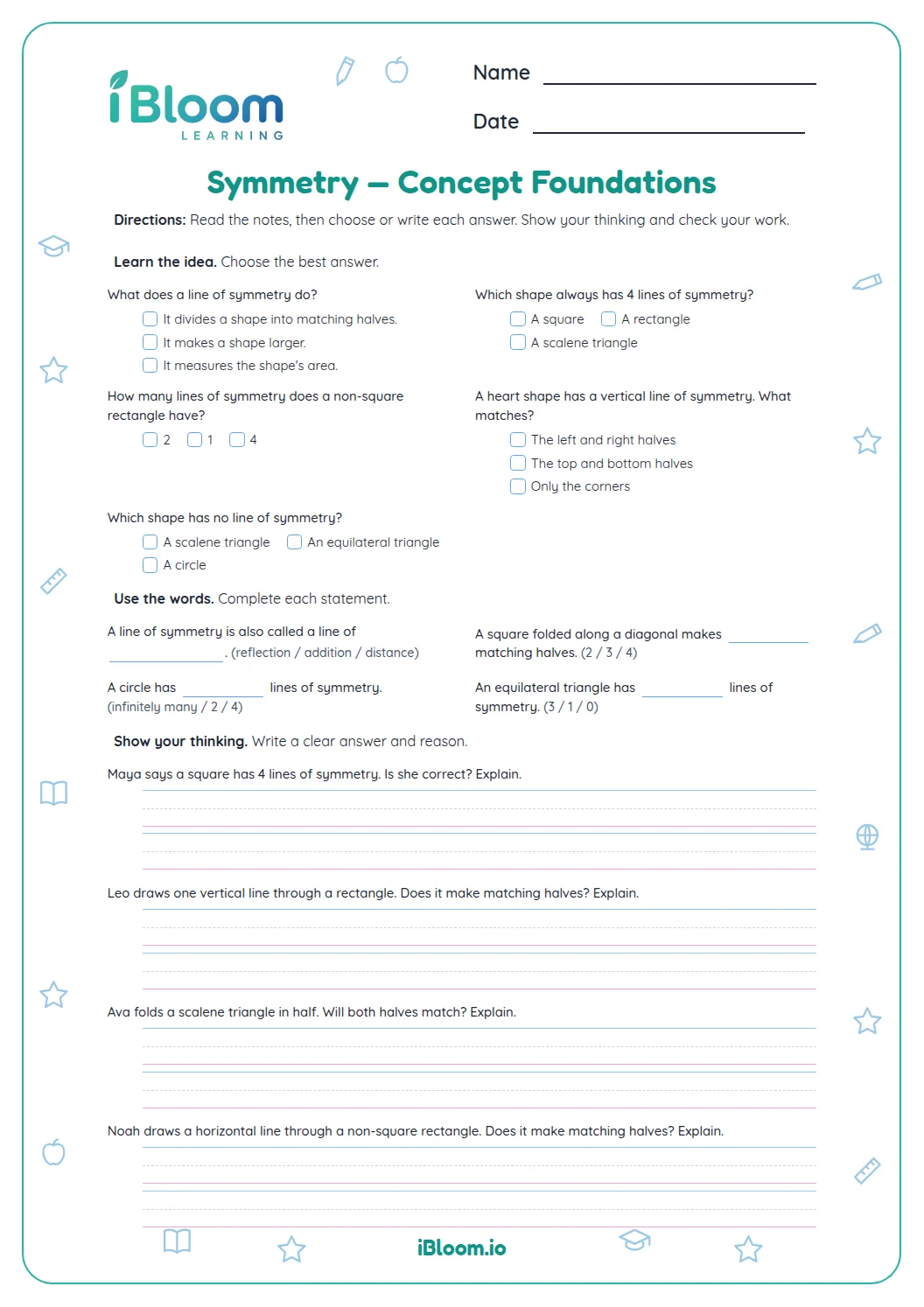
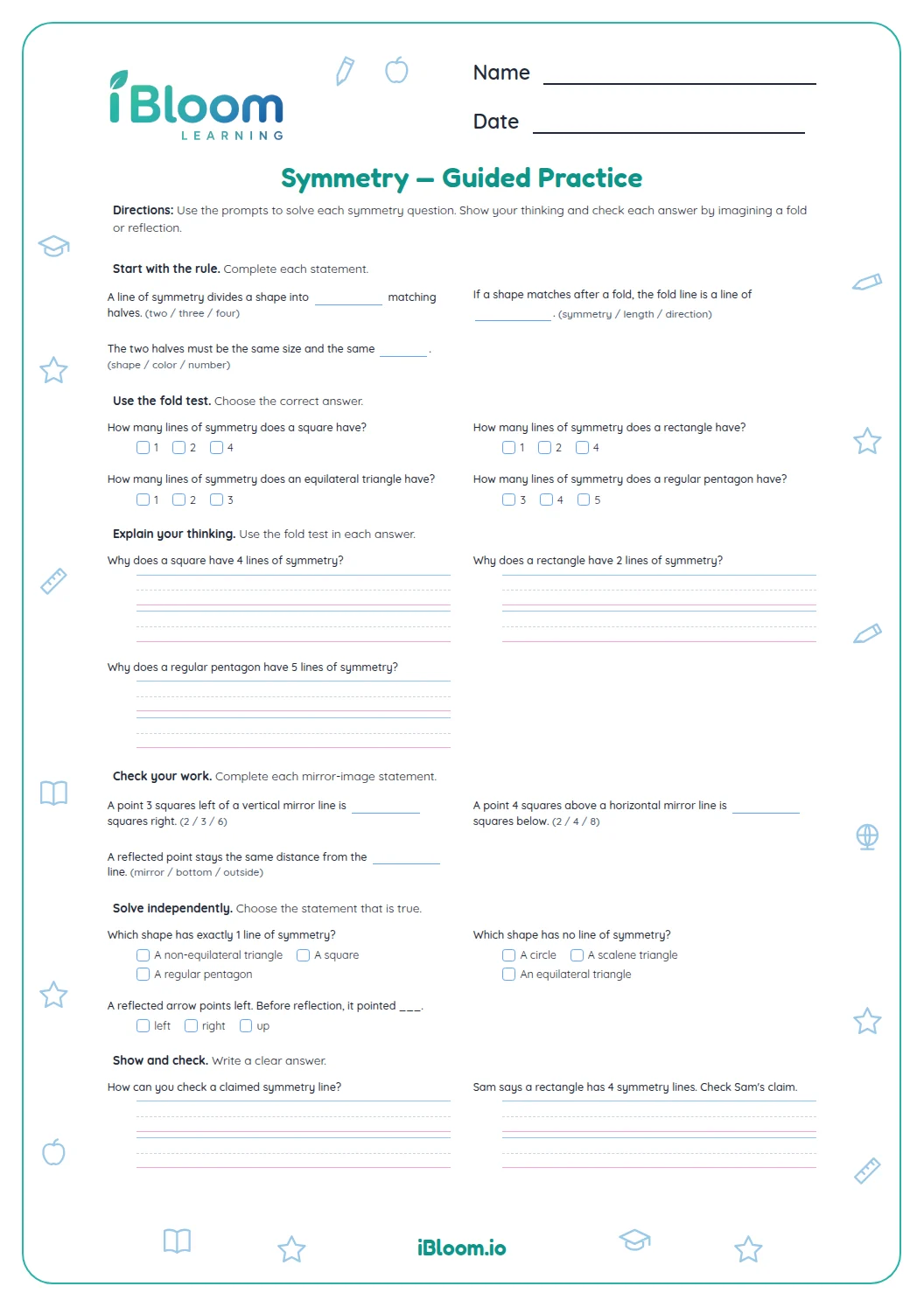
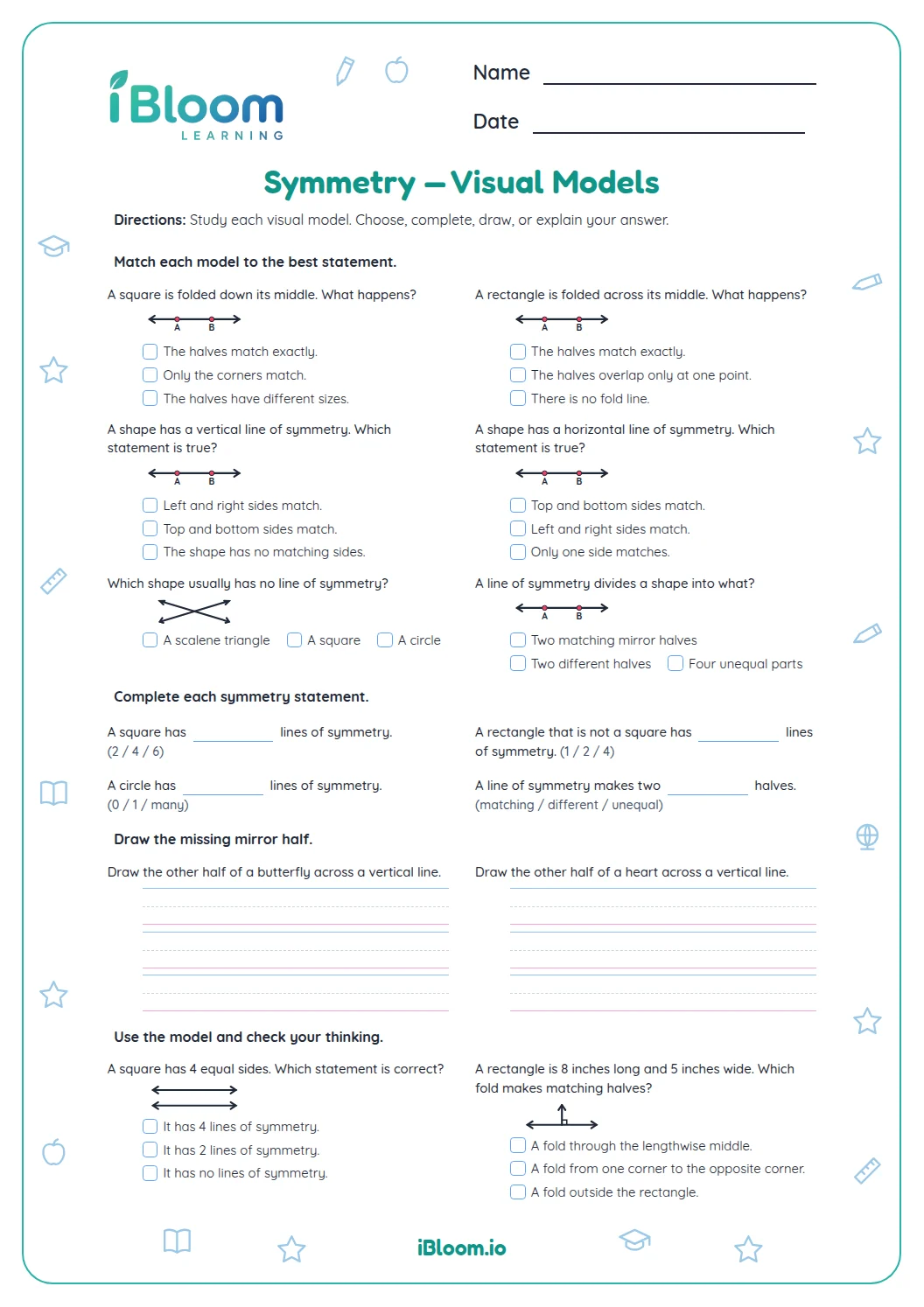
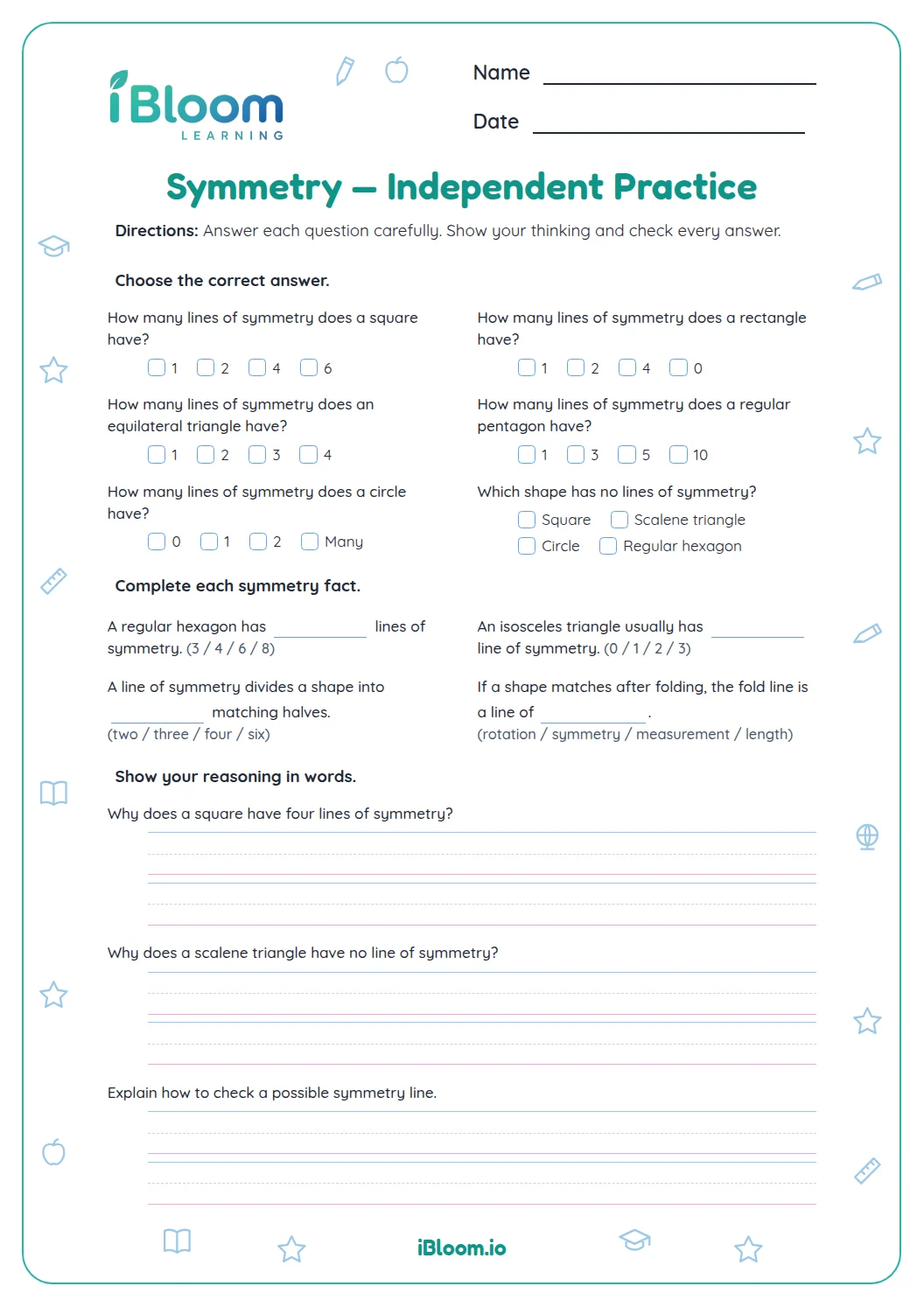
This free Grade 4 printable practices line symmetry through 14 short questions. Students connect folding to matching halves and identify how many symmetry lines familiar shapes have, including regular polygons, triangles, and quadrilaterals. The separate answer key supports checking each response. These tasks practice Common Core 4.G.A.3: recognizing line symmetry and identifying or drawing symmetry lines.
Aligned to 4.G.A.3
How can you tell whether a shape has line symmetry?
A line of symmetry divides a figure into matching parts. If you folded on that line, the two sides would cover each other. A square has four such lines: two through opposite side midpoints and two diagonals.
- 1A square has 4 lines of symmetry.
- 2Two folds cross opposite side midpoints.
- 3Two more folds follow the diagonals.
How do you count more than one symmetry line?
Check each possible direction through the center or vertices. A square, for example, has two diagonal folds and two folds through the midpoints of opposite sides.
How is the practice organized?
Part A moves from the meaning of a symmetry line to counts for triangles and quadrilaterals, then regular polygons. The key lists a concise answer for each blank.
How to use this worksheet
- 1Read the direction for the part before starting its first question.
- 2Look closely at each model and identify the quantities or features it represents.
- 3Work through one question at a time, showing a short calculation when it helps.
- 4For explanation questions, point to the detail or feature that supports the response.
- 5Use the separate key to check answers and revisit any missed reasoning.
Common mistakes and quick fixes
The mistake
Assuming every diagonal is a symmetry line.
The fix
Check whether both halves cover each other when folded.
The mistake
Giving a non-square rectangle four symmetry lines.
The fix
Test the two midline folds; its diagonals do not make matching halves.
The mistake
Confusing a turn with a fold.
The fix
A line of symmetry is tested by folding across a line, not rotating the shape.
Common Core alignment
This worksheet practices the Common Core skill named below through the printed questions and models.
Recognize line symmetry and identify or draw symmetry lines.
On this sheet: Students identify line-symmetric shapes and count matching fold lines.
Show the official wordingHide the official wording
Recognize a line of symmetry for a two-dimensional figure as a line across the figure such that the figure can be folded along the line into matching parts. Identify line-symmetric figures and draw lines of symmetry.
What to practice next
Make more practice
Further reading
Questions parents and teachers ask
What skill does this line symmetry worksheet practice?
Students complete 14 questions about what a line of symmetry does and how many such lines common shapes have. The items include squares, rectangles, triangles, and regular polygons. A separate answer key gives a response for each blank.
How should we use the visual models?
Ask the child to name what the drawing represents before calculating or choosing an answer. Then connect each number in the prompt to the drawing and check that the result makes sense. The visual is part of the question, so it should stay visible while the child works.
Is there an answer key?
Yes. A separate answer key is included with this printable worksheet. It lists the correct response for each selected-response and short-answer item, along with sample responses where a child may explain an idea in different words. Use it after the student has completed the page.
How many questions are on the grade 4 sheet?
There are 14 questions arranged across the worksheet, followed by a separate answer key. Students identify what symmetry means and count symmetry lines for familiar shapes, including the square and rectangle drawings. Allow about 20 minutes to work through and check them.
What can I do when an answer is incorrect?
Return to the exact drawing or sentence for that item and ask the child to show how the answer follows from it. Have them check one step at a time, then solve a similar example orally. This keeps the correction tied to the skill instead of turning it into a guessing exercise.