


About this worksheet
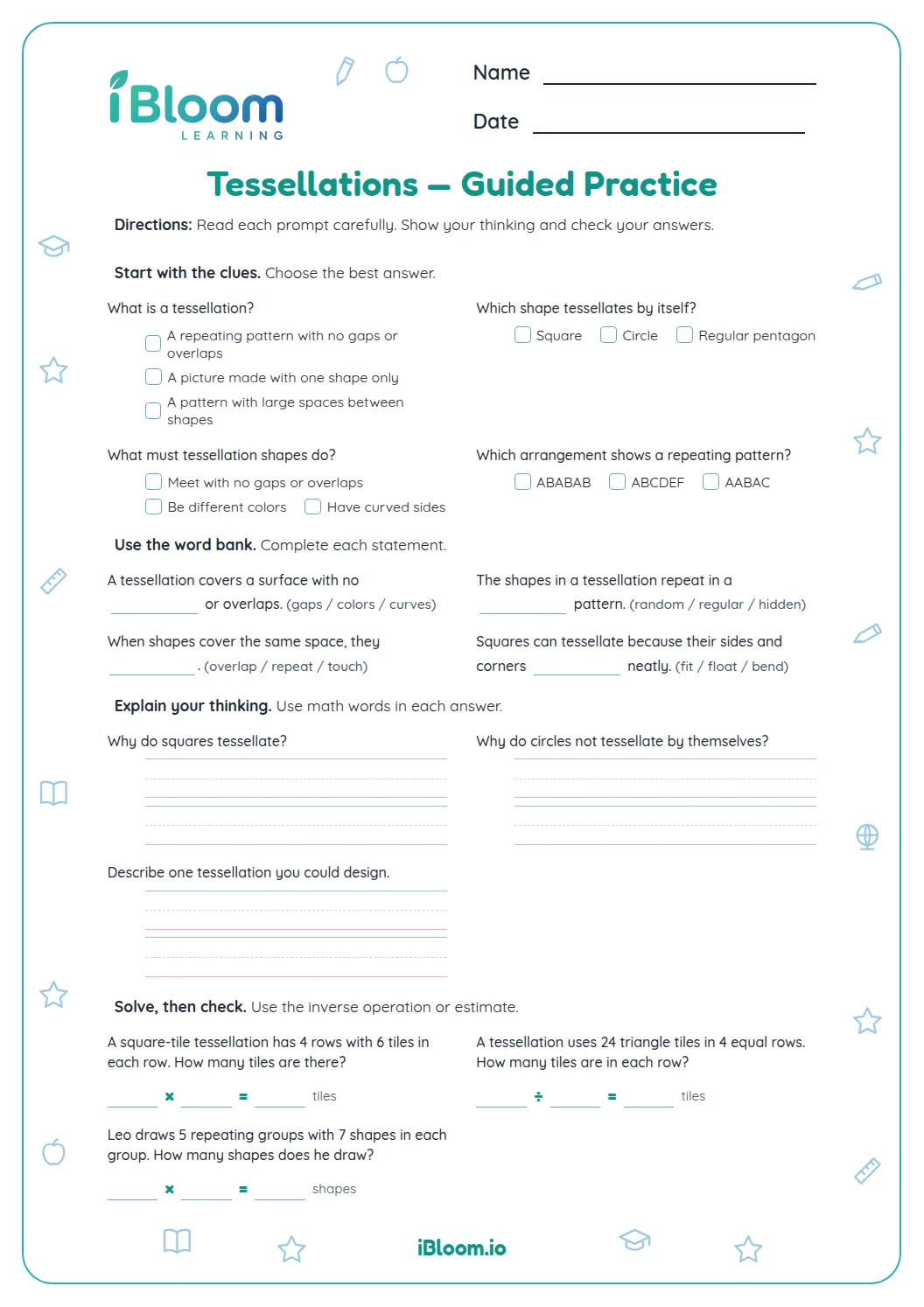
This free Grade 4 tessellation worksheet connects the properties of a tile with the patterns it can make. Part A has four questions with polygon drawings; students identify right angles, acute angles and parallel sides, practicing Common Core 4.G.A.2. Part B has four choices about tiling shapes, gaps and angles meeting at a point. Part C provides two drawing boxes for making small patches of repeating tiles. These 10 tasks move from studying a single shape to arranging shapes together. The separate answer key includes descriptions of successful drawings.
Aligned to 4.G.A.2
Which tile properties do students examine?
Part A shows a rectangle, an equilateral triangle, a parallelogram and a right triangle. Students use angle and side properties to choose a description for each tile. The marked rectangle and right triangle make their square corners visible.
A tile can be turned without changing its shape. Students should follow the edges and corners when classifying a tile, even if it is tilted or its longest side is not horizontal.
How do corners fit around a point?
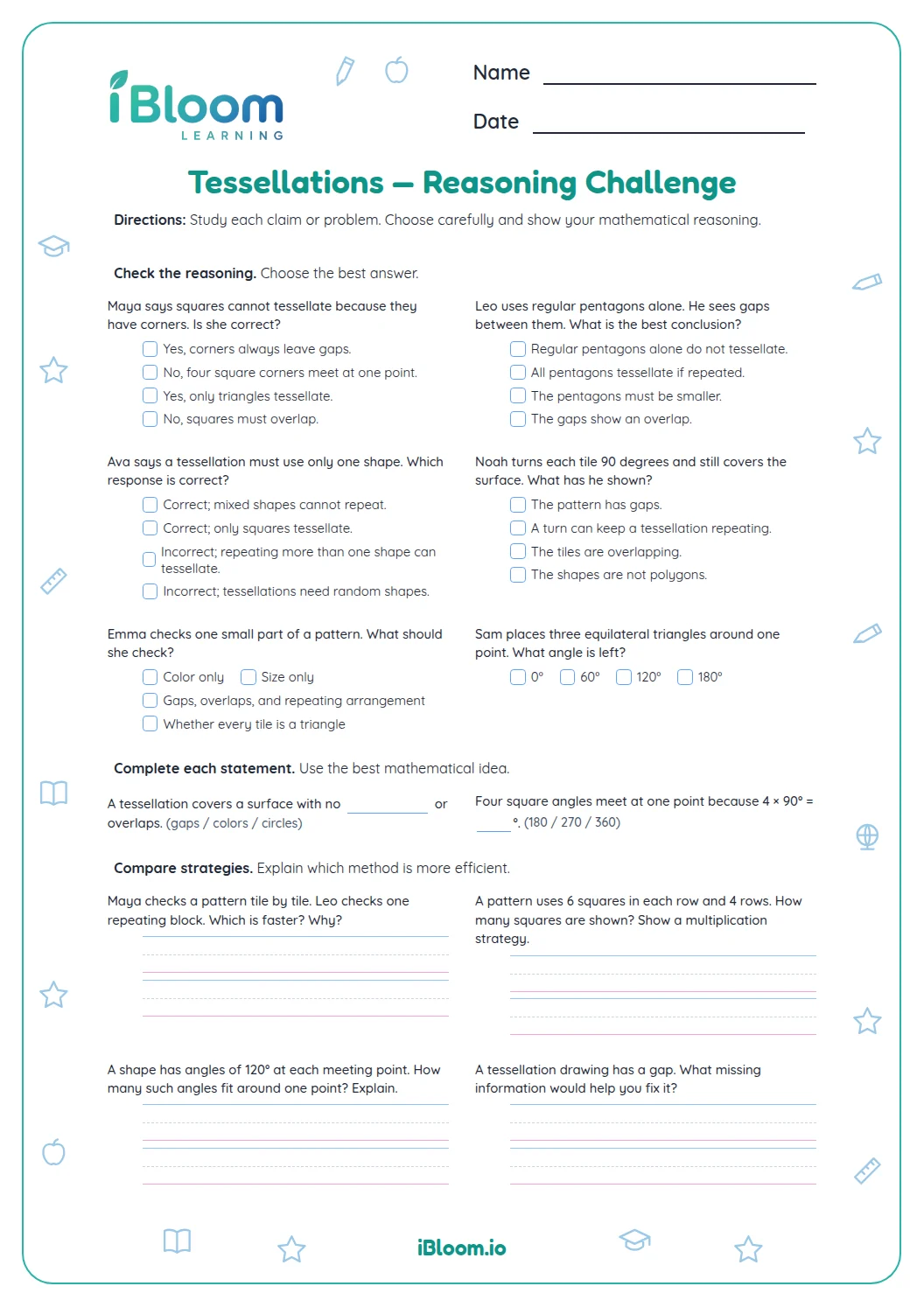
The angles around an interior point of a tiling must fill a complete turn, or 360°. Question 7 uses 90° corners, like those on a square, and asks how many such corners fit. Four corners fill the turn exactly.
Question 8 gives each regular hexagon corner as 120°. Three of those corners total 360°. Checking one vertex helps assess a proposed arrangement; students must also check the rest of the patch for gaps and overlaps.
- 1One square corner measures 90°.
- 290° + 90° + 90° + 90° = 360°.
- 3Four square corners meet at one interior point.
What should the two drawings look like?
Question 9 asks for two rows of three equal squares. The six squares share edges, making a rectangular patch. A ruler can help children keep the edges straight and the squares equal.
Question 10 starts with four equal rectangles in two rows of two. Students split each rectangle with a diagonal from its top-left corner to its bottom-right corner. The result is eight right triangles with no gaps or overlaps. The key describes both drawings so an adult can check the arrangement as well as the tile count.
Work from one tile to a repeating patch
- 1Name each polygon in Part A and inspect its marked angles or parallel sides.
- 2Choose the property that matches each drawing.
- 3In Part B, test each claim against the no-gaps, no-overlaps rule.
- 4Add the given corner angles to check a full 360° turn.
- 5Use a ruler to make both patches in Part C, then check every shared edge.
Mistakes to watch for
The mistake
Calling any repeated pattern a tessellation, even when spaces remain between tiles.
The fix
Check the spaces between tiles as well as the repetition. A tessellation has no uncovered gaps.
The mistake
Saying three square corners fill a point because three tiles touch.
The fix
Add the angles: three 90° corners total 270°, leaving a 90° gap.
The mistake
Drawing separate rectangles with spaces between them in question 10.
The fix
Make neighboring rectangles share an edge before drawing the diagonals. The eight triangles should fill one patch.
Common Core alignment
Classify polygon tiles by their angles and parallel sides, including right triangles.
On this sheet: Part A asks students to identify right and acute angles, parallel side pairs, and a right triangle.
Show the official wordingHide the official wording
Classify two-dimensional figures based on the presence or absence of parallel or perpendicular lines, or the presence or absence of angles of a specified size. Recognize right triangles as a category, and identify right triangles.
What to practice next
Make more practice
Further reading
Questions parents and teachers ask
What does “no gaps or overlaps” mean?
Every part inside the tiled patch must be covered exactly once. A gap is an empty space between tiles, while an overlap happens when one tile lies over another. In the drawing tasks, neighboring squares or triangles should share their edges without leaving a strip of empty space.
Why do four square corners meet at a point?
Each square corner measures 90°, and four of them add to 360°, a complete turn. Question 7 uses this fact to check how square tiles fit around an interior point. Three square corners would leave a gap; five would need more room than a full turn.
Does my child need a ruler?
A ruler is helpful for the two drawing tasks because equal lengths and straight shared edges make the tiling easier to check. Pencil is useful for adjusting a line. Judge whether the arrangement works, and allow small drawing inaccuracies that do not change the intended pattern.
Are the drawings complete tessellations?
The drawings are small patches that show how a tessellation can continue. Question 9 has six equal squares, and question 10 has eight triangles made from four rectangles. Ask the child to point to an outside edge and describe how another row of the same tiles could fit.
How do I check the drawing answers?
Use the descriptions in the answer key and inspect the child’s edges. The first patch should have two rows of three equal squares. The second should have four equal rectangles, each split along the stated diagonal, producing eight right triangles. Both patches should have no internal gaps or overlaps.