

About this worksheet
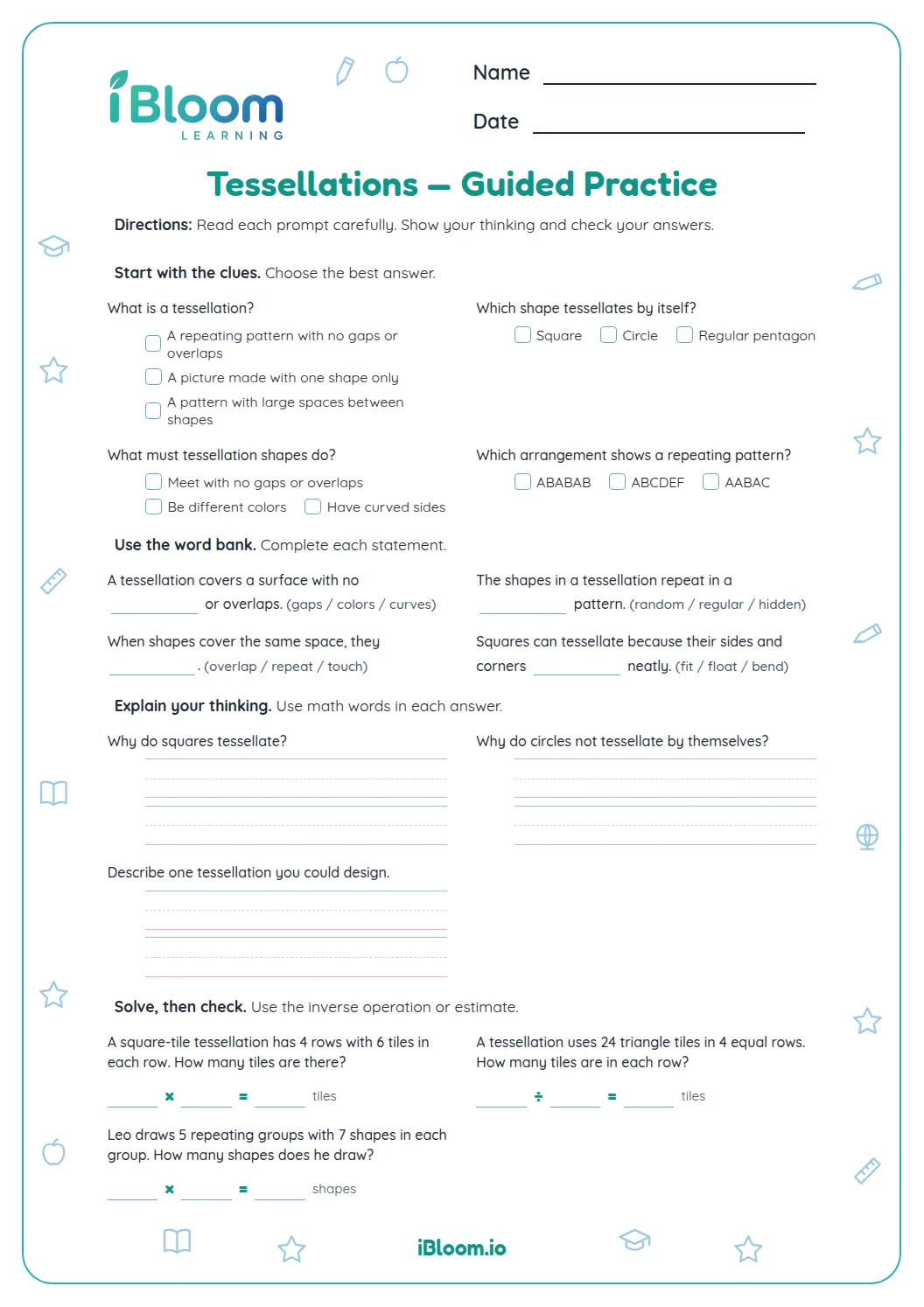
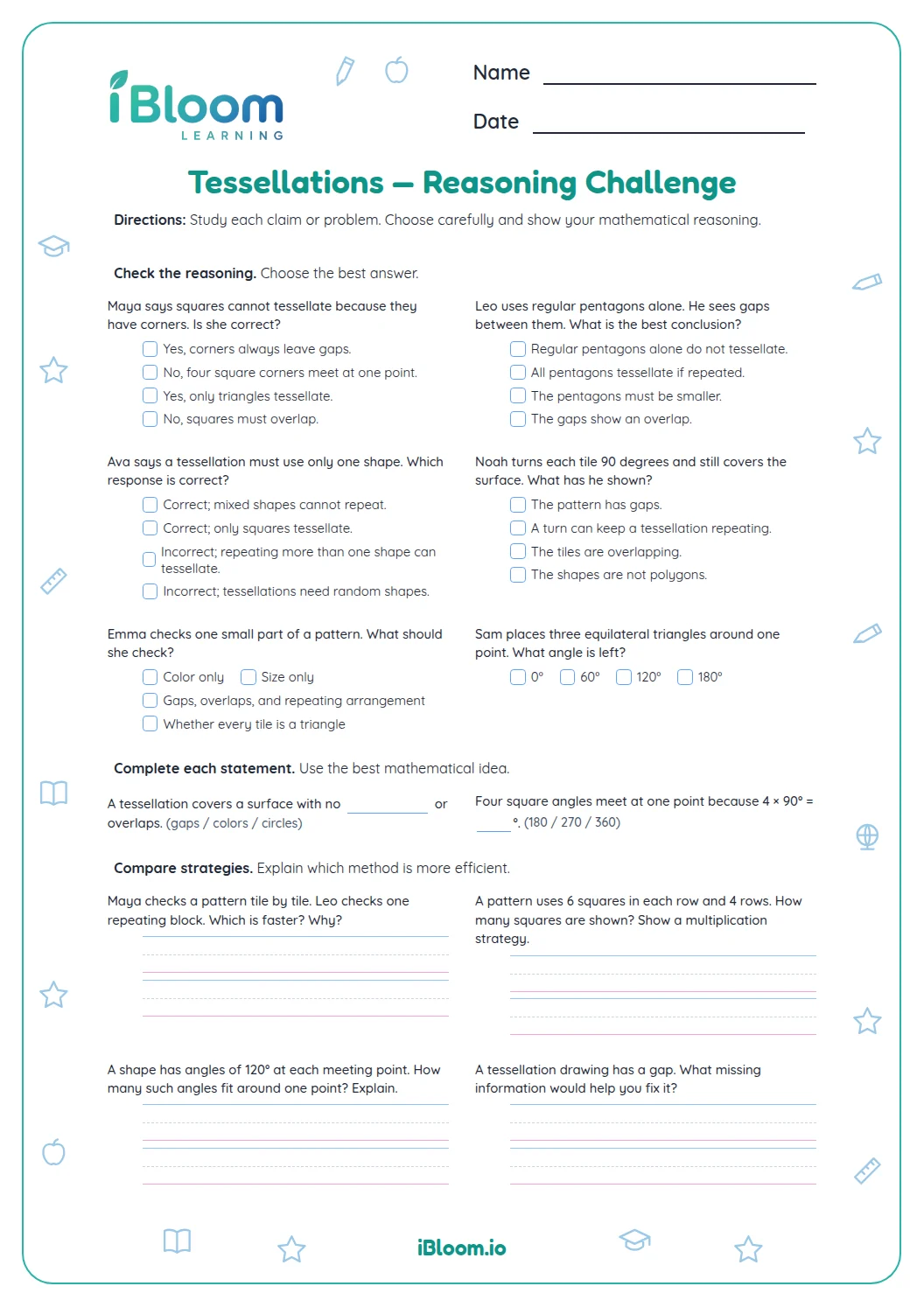
This free printable Grade 4 worksheet connects tessellations with floors, walls, paths, and murals. A tessellation repeats shapes to cover a surface without gaps or overlaps. Part A has four choices about tiles and fit. Parts B and C include three tile-fit checks and six area problems, including a missing floor width and a count of triangular pieces. Part D asks whether a gap leaves a surface uncovered and counts tiles in a 3-by-4 rug. The area problems practice Common Core 4.MD.A.3 by applying rectangular area in real settings.
Aligned to 4.MD.A.3
What makes a tile arrangement a tessellation?
The shapes cover the surface without leaving holes or lying on top of one another. A repeated color pattern alone does not establish a tessellation; the edges must fit. Imagine the arrangement continuing past the boundary of a small sample.
Part A compares square and circular tiles, then asks about right triangles. Two identical right triangles can join along their longest sides to make a rectangle. Copies of that rectangle can continue in rows.
How does area help count square floor tiles?
Question 8 describes a 6-foot by 4-foot floor covered by 1-foot square tiles. Four rows of six tiles cover it, so the area and the number of unit tiles are both 24.
- 1Length: 6 ft; width: 4 ft.
- 2Area = 6 × 4 = 24 square feet.
- 3Each tile covers 1 square foot.
- 424 square tiles cover the floor.
How do the later problems extend the tile plan?
The mural problem uses the same area idea. The floor-width problem reverses it: 7 × width = 35, so the width is 5 feet. The path problem asks for a shortage: 5 × 3 = 15 tiles in all, and 15 − 12 = 3 more.
Question 12 changes the tile shape. Four rows of six squares make 24 squares; splitting each into two triangles makes 48 triangular tiles. The surface stays covered because the two triangles fill each original square. Question 13 returns to square tiles: a 2 ft by 6 ft wall needs 12 unit tiles.
Question 15 asks for the count in a 3-by-4 rectangular rug. Four groups of three make twelve square tiles.
How to use this worksheet
- 1Define a tessellation using the words gaps and overlaps.
- 2Inspect the tile shapes in Part A and discuss how copies could meet.
- 3For each coverage problem, identify rows, dimensions, or the area of one tile.
- 4Write an equation before calculating and include tiles or feet in the answer.
- 5Use a ruler for the final square pattern and check all twelve tiles against the key’s description.
Mistakes to check and how to help
The mistake
Calling any repeated pattern a tessellation even when gaps remain.
The fix
Check whether the tiles cover every part of the surface and whether any overlap.
The mistake
Adding 6 and 4 to count the tiles for a 6 ft by 4 ft floor.
The fix
Think of four rows of six unit tiles and multiply 6 × 4.
The mistake
Answering 24 triangle tiles in question 9.
The fix
First count 24 squares, then account for two triangle tiles in every square: 24 × 2 = 48.
Common Core alignment
Use rectangular area to plan tile coverage and find missing floor dimensions.
On this sheet: Floor and mural problems use rectangular area to find unit-tile counts or a missing side length.
Show the official wordingHide the official wording
Apply the area and perimeter formulas for rectangles in real world and mathematical problems. For example, find the width of a rectangular room given the area of the flooring and the length, by viewing the area formula as a multiplication equation with an unknown factor.
What to practice next
Make more practice
Further reading
Questions parents and teachers ask
What is the rule for a tessellation on this sheet?
The repeated shapes must cover a surface without gaps or overlaps. Part A asks students to apply that rule to square and triangular tiles. Question 15 counts the twelve tiles in a 3-by-4 rug. The repeated squares fit edge to edge across the rectangular surface.
Can right triangles make a tessellation?
Yes, two identical right triangles can be joined along their longest sides to form a rectangle. Repeating those rectangles covers a surface, with the diagonal edges marking the triangular tiles inside. Question 2 asks about this arrangement, and question 12 counts two triangles for each square in a panel.
Why does the 6-foot by 4-foot floor need 24 tiles?
Each tile measures 1 foot by 1 foot, so it covers 1 square foot. The floor has four rows with six tiles in each row, giving 6 × 4 = 24 tiles. Multiplying the floor dimensions gives the same area of 24 square feet.
How many tiles are in the 3-by-4 rug?
There are twelve square tiles: three rows with four tiles in each row. Multiply 3 × 4 to find the total. A tessellation arranges those equal squares edge to edge so they cover the rectangular rug without leaving gaps or stacking tiles on top of one another.
How do I check answers with different units?
Use tiles when a question asks how many pieces cover a surface, and feet when it asks for a floor’s width. Question 10 needs 5 ft, while question 12 needs 48 triangular tiles. Ask students to reread the final question sentence before labeling each numerical answer.