


About this worksheet
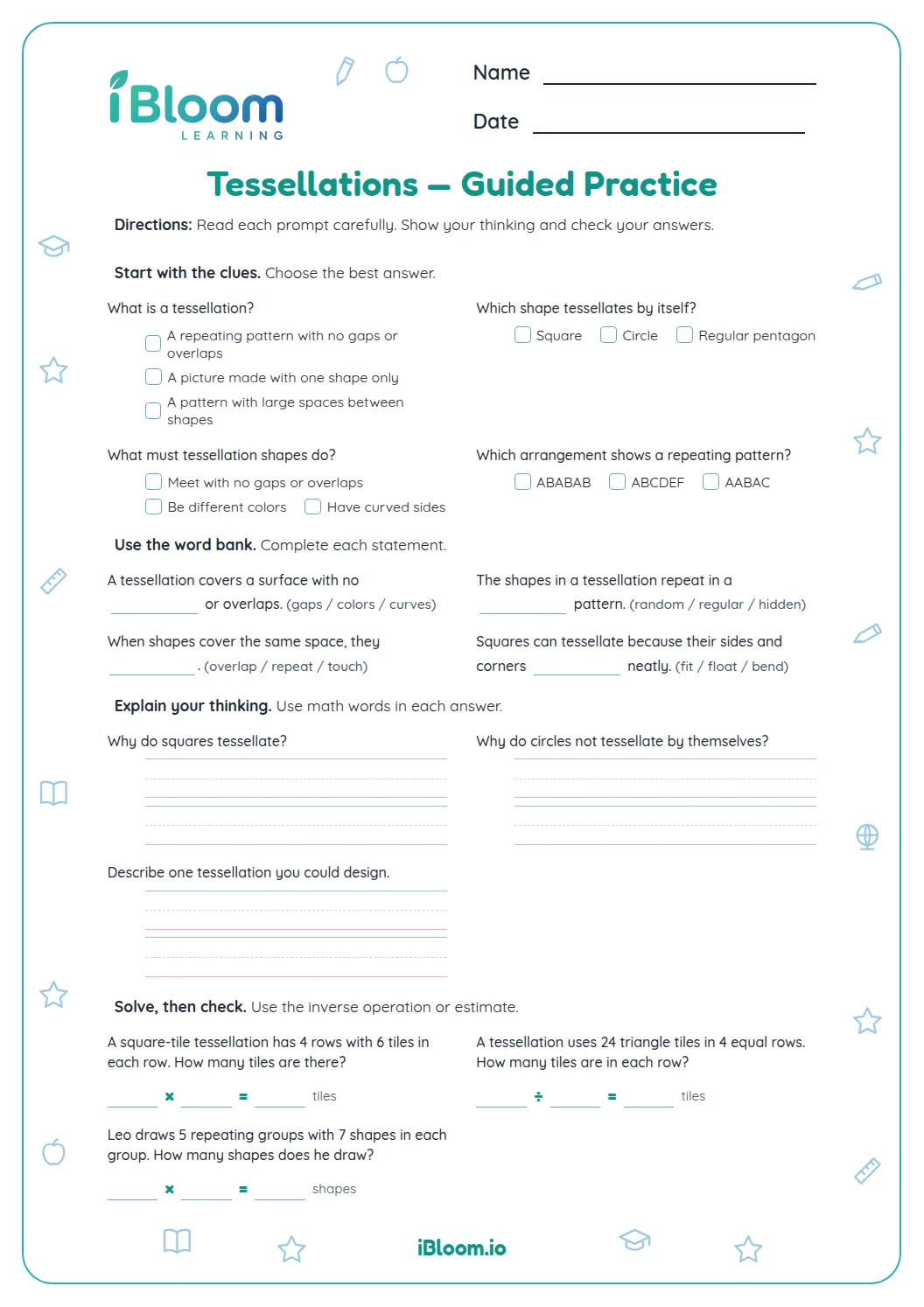
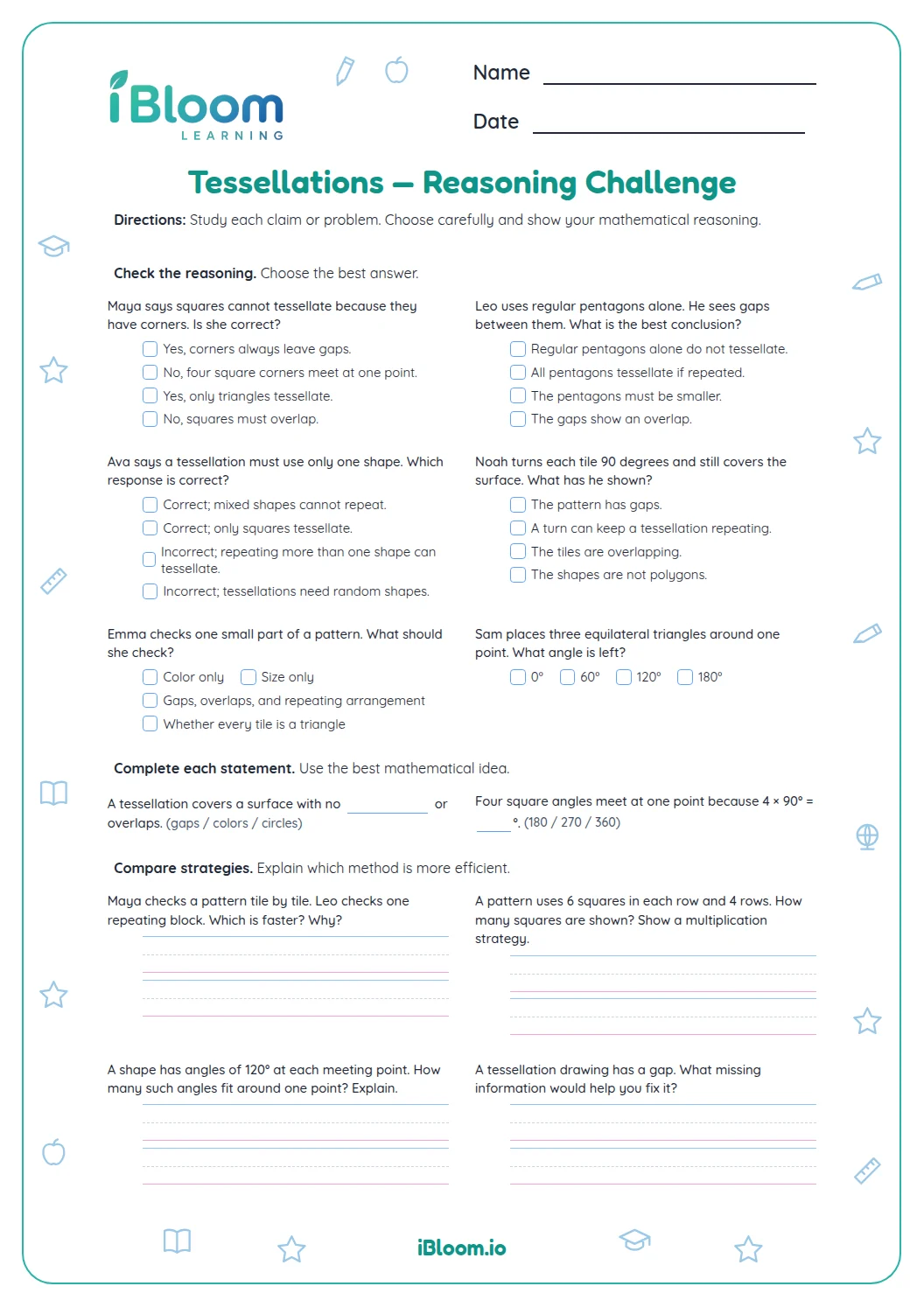
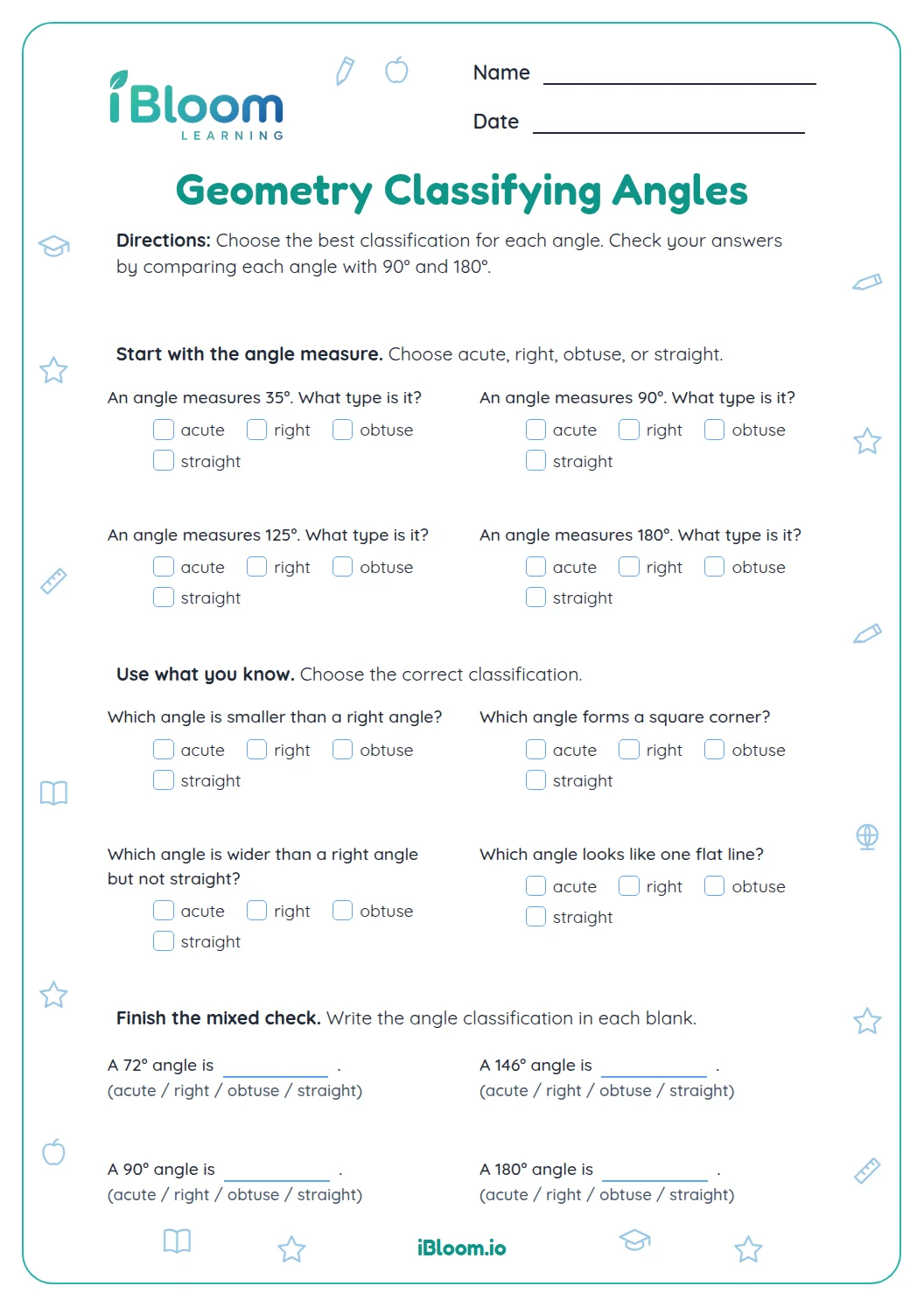
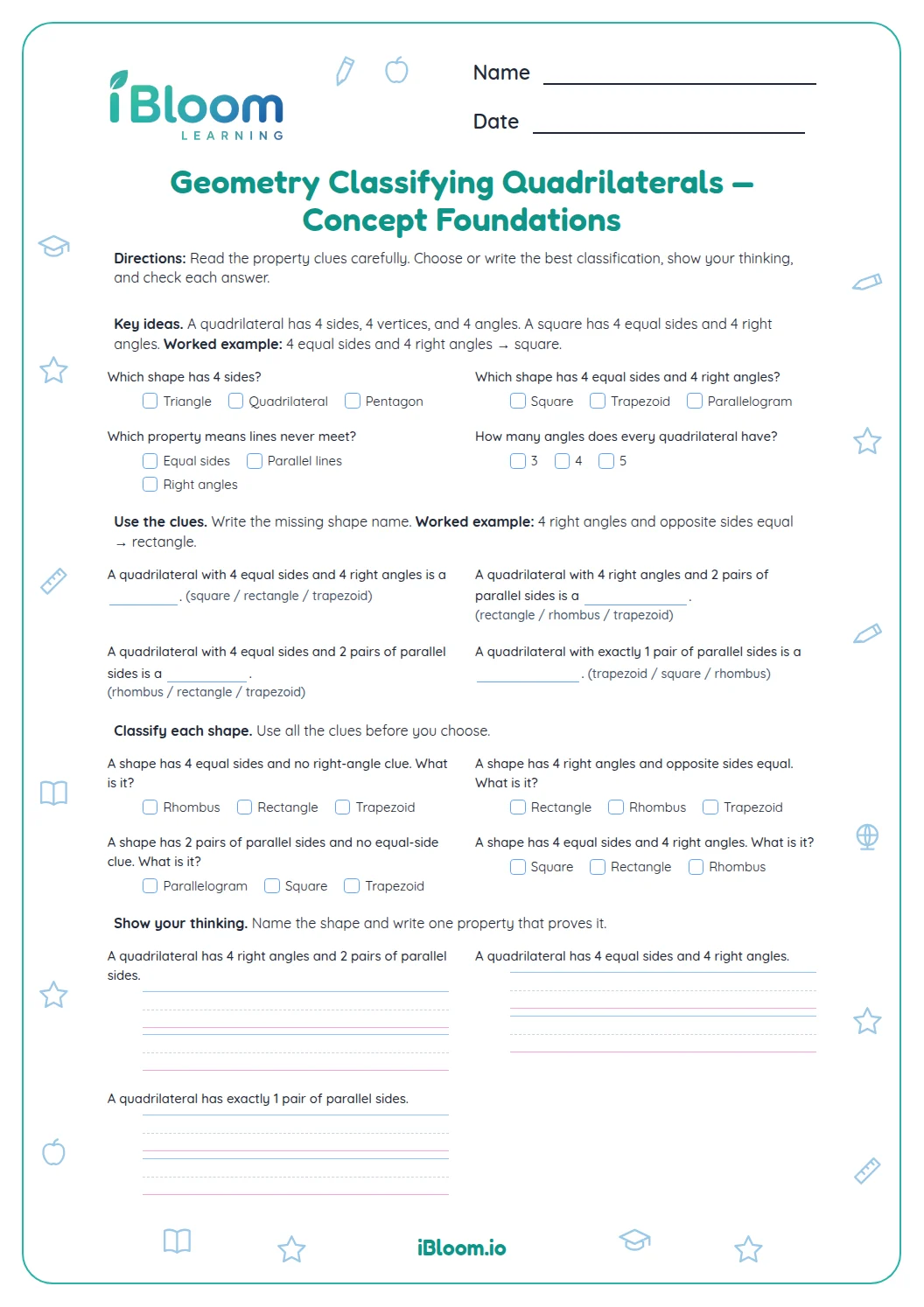
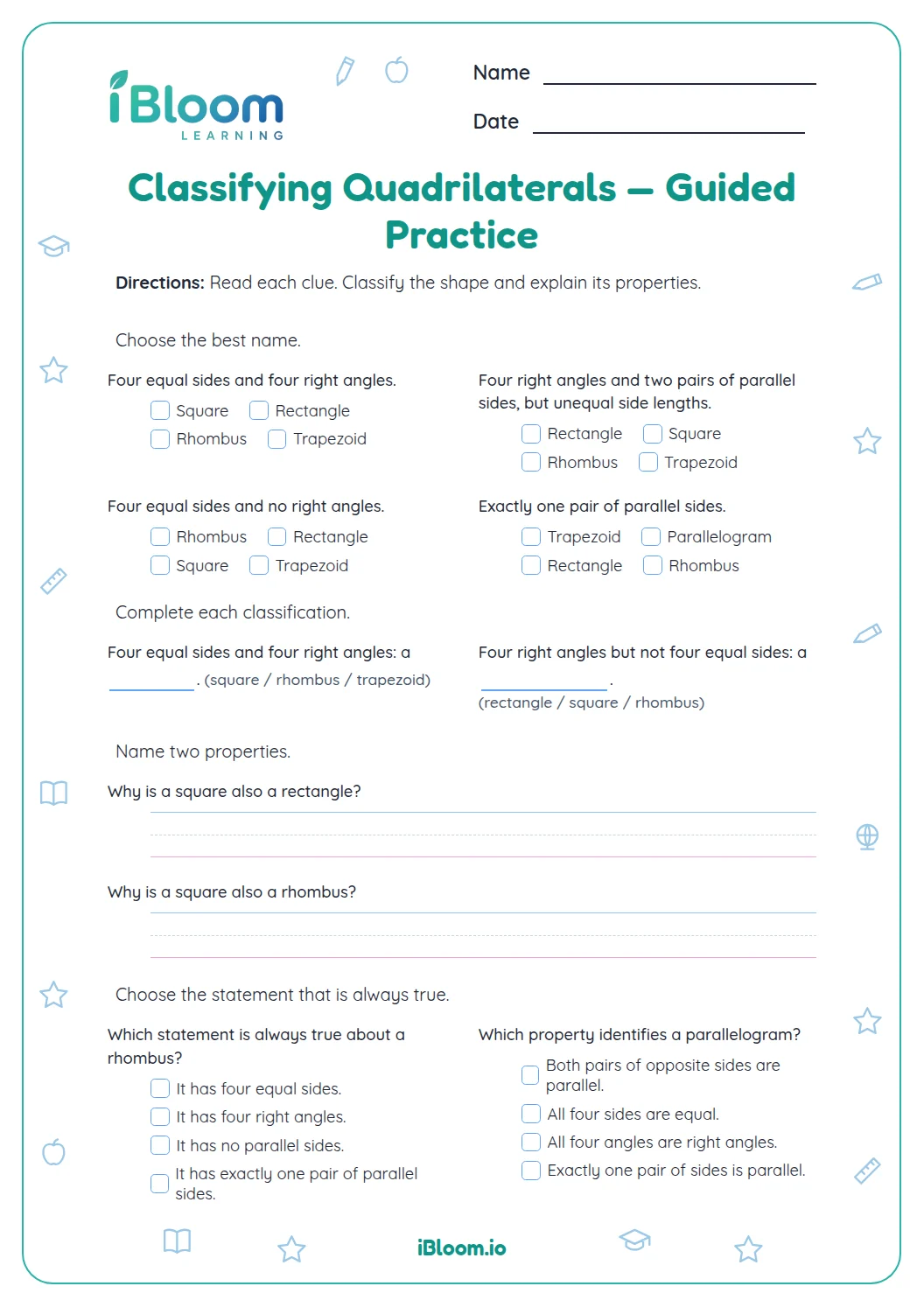
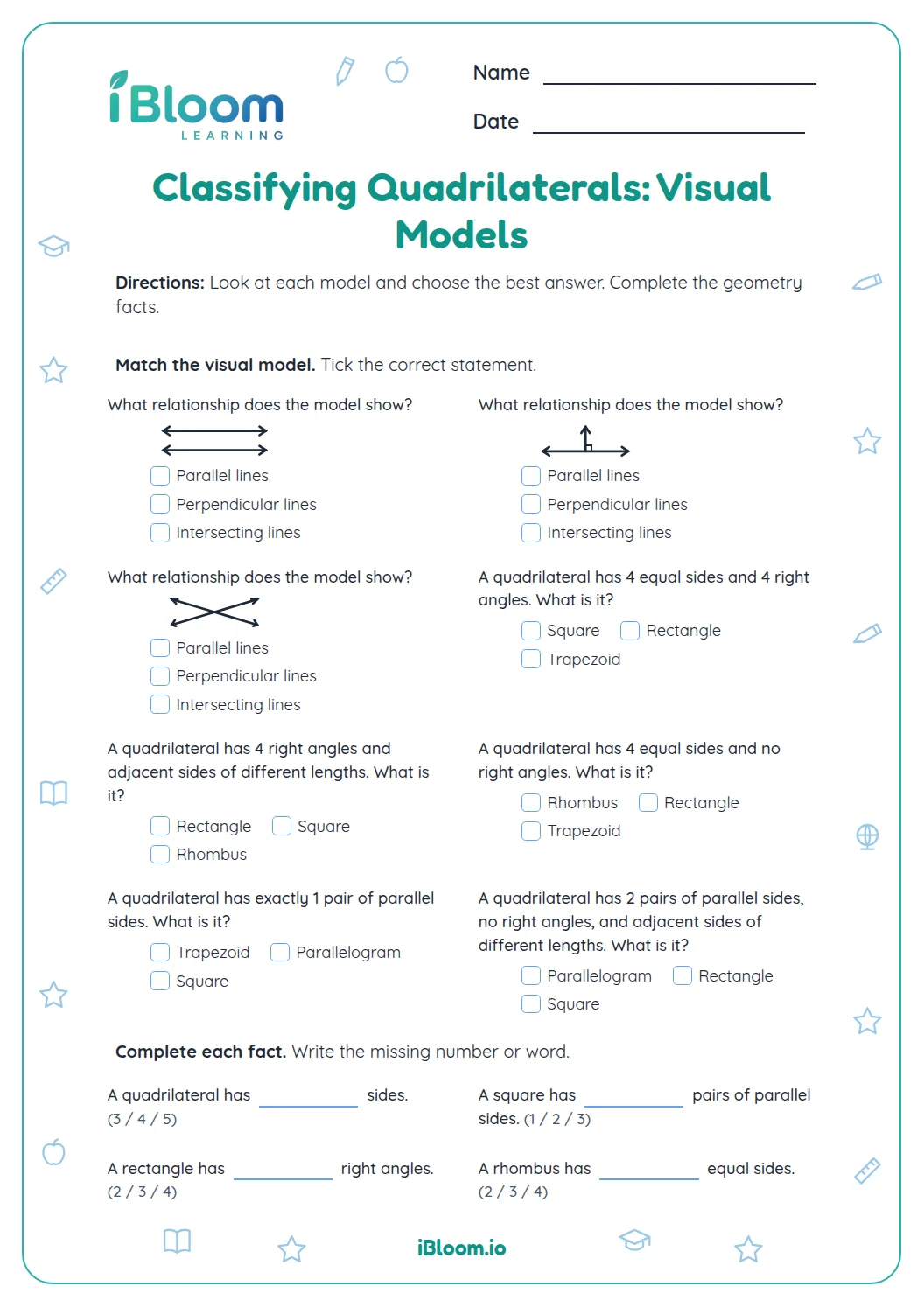
This free printable Grade 4 worksheet explores tessellations through square grids, tile outlines, and two drawing tasks. Children inspect how square tiles meet without gaps, count a grid’s tiles, and identify properties of rectangles and right triangles. They then draw a rectangular tiling and divide square tiles into right triangles. Ten tasks connect the repeating pattern to the shapes that form it. The shape classification work practices Common Core 4.G.A.2. A separate answer key gives the selected answers and describes the features to look for in each drawing.
Aligned to 4.G.A.2
What makes a pattern a tessellation?
The shapes cover a surface without leaving holes or lying on top of one another. A printed grid is a small patch of a square tessellation: the same arrangement can continue beyond the outside edges.
A row of separated shapes may repeat, but the spaces keep it from covering the surface. Ask children to look at how the edges meet, especially where several tiles share a corner.
How do the models connect shapes and numbers?
The first grid has square tiles that meet edge to edge. Another grid makes a multiplication structure visible: ten rows each contain ten tiles. Four small squares meet at each interior grid intersection.
Part B begins with individual tile outlines. A small corner square marks a right angle. Children identify a right triangle and count the parallel-side pairs in a rectangle.
Part C has two row-count questions: find the total in three rows of four tiles, then find the number per row when eighteen tiles fill three equal rows. Part D uses row arrangements in drawing tasks.
- 1There are 10 rows.
- 2Each row contains 10 tiles.
- 310 × 10 = 100 tiles in the patch.
What should the two drawings show?
Question 9 asks for two rows of four identical rectangular tiles, giving eight tiles. Shared edges should meet so the rectangular patch has no holes or overlaps. The rectangles may be drawn wider or taller as long as all eight match.
Question 10 begins with six equal squares in two rows of three. A corner-to-opposite-corner diagonal divides each square into two right triangles. All twelve triangles fill exactly the same patch, so the tiling still has no gaps.
How to use this worksheet
- 1Trace a small square in the first grid and follow its shared edges.
- 2Count rows and tiles in a row before selecting the calculation.
- 3Point to an interior grid intersection to count the four meeting tiles.
- 4Identify the right triangle and parallel sides, then solve the two row-count questions.
- 5Draw each patch with a ruler and count the completed tiles.
- 6Compare drawings with the key’s descriptions and check every shared edge.
Mistakes to notice and repair
The mistake
Calling any repeated row of separated shapes a tessellation.
The fix
Check whether the shapes actually cover the space between them.
The mistake
Counting 10 + 10 tiles in a ten-by-ten grid.
The fix
Count one row as a group of ten; ten such rows give 100 tiles.
The mistake
Splitting a square from a corner to the middle of a side.
The fix
Join opposite corners. A corner-to-side cut makes a triangle and a quadrilateral; a diagonal makes two right triangles.
Common Core alignment
Identify square, rectangular, and right-triangle tiles by sides and angles.
On this sheet: Children examine tile shapes, identify right angles and parallel sides, and construct right-triangle tiles.
Show the official wordingHide the official wording
Classify two-dimensional figures based on the presence or absence of parallel or perpendicular lines, or the presence or absence of angles of a specified size. Recognize right triangles as a category, and identify right triangles.
What to practice next
Make more practice
Further reading
Questions parents and teachers ask
Why does the sheet use a square grid?
A square grid makes a complete tiling patch visible. Every small square touches its neighbors along shared edges, and there are no spaces inside the patch. Children can inspect the corners, count rows, and connect the model to a multiplication sentence before drawing their own tiles.
Does a tessellation have to use squares?
No, other shapes can also tile a flat surface. This sheet asks children to make a patch with matching rectangles and another with right triangles formed by splitting squares. In both drawings, the important check is whether the tiles cover the patch without gaps or overlaps.
How many triangles belong in the final drawing?
The final drawing should contain twelve right triangles. Children first draw two rows of three squares, which makes six squares. Splitting each square along a diagonal produces two triangles per square. Six groups of two make twelve, and the triangles still cover the entire original patch.
What should I look for when checking the drawing boxes?
Look for the requested arrangement, shared edges, and the correct total. Question 9 needs eight matching rectangles in two rows. Question 10 needs six joined squares split into twelve right triangles. Accept either diagonal direction, provided every square is divided from one corner to its opposite corner.
What does the answer key show for drawing tasks?
The key describes the required features of each drawing. It gives the tile count and arrangement, including six joined squares split into twelve right triangles. Use those descriptions to assess the child’s model, checking that edges meet without gaps or overlaps and that the requested totals are labeled.