




About this worksheet
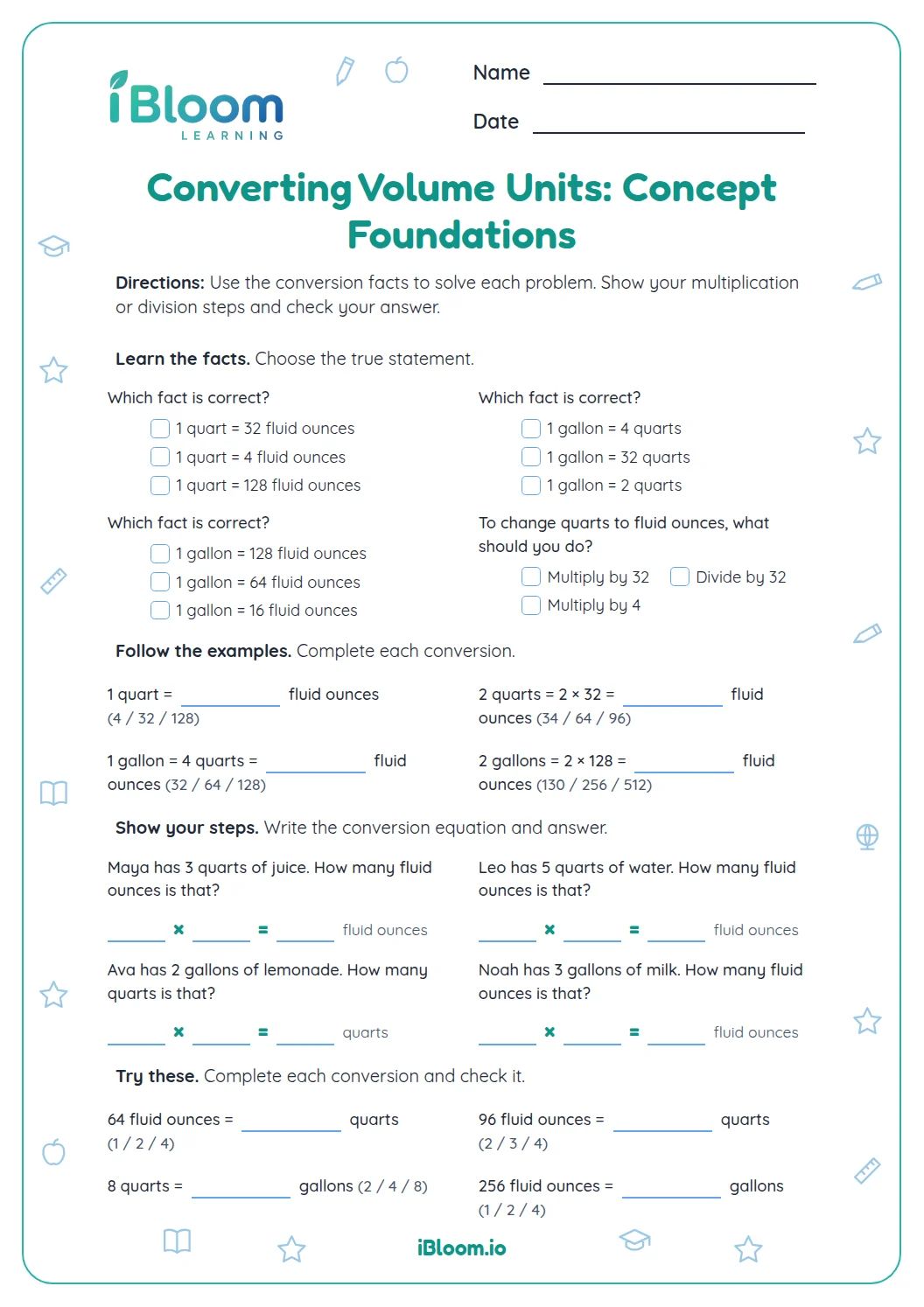
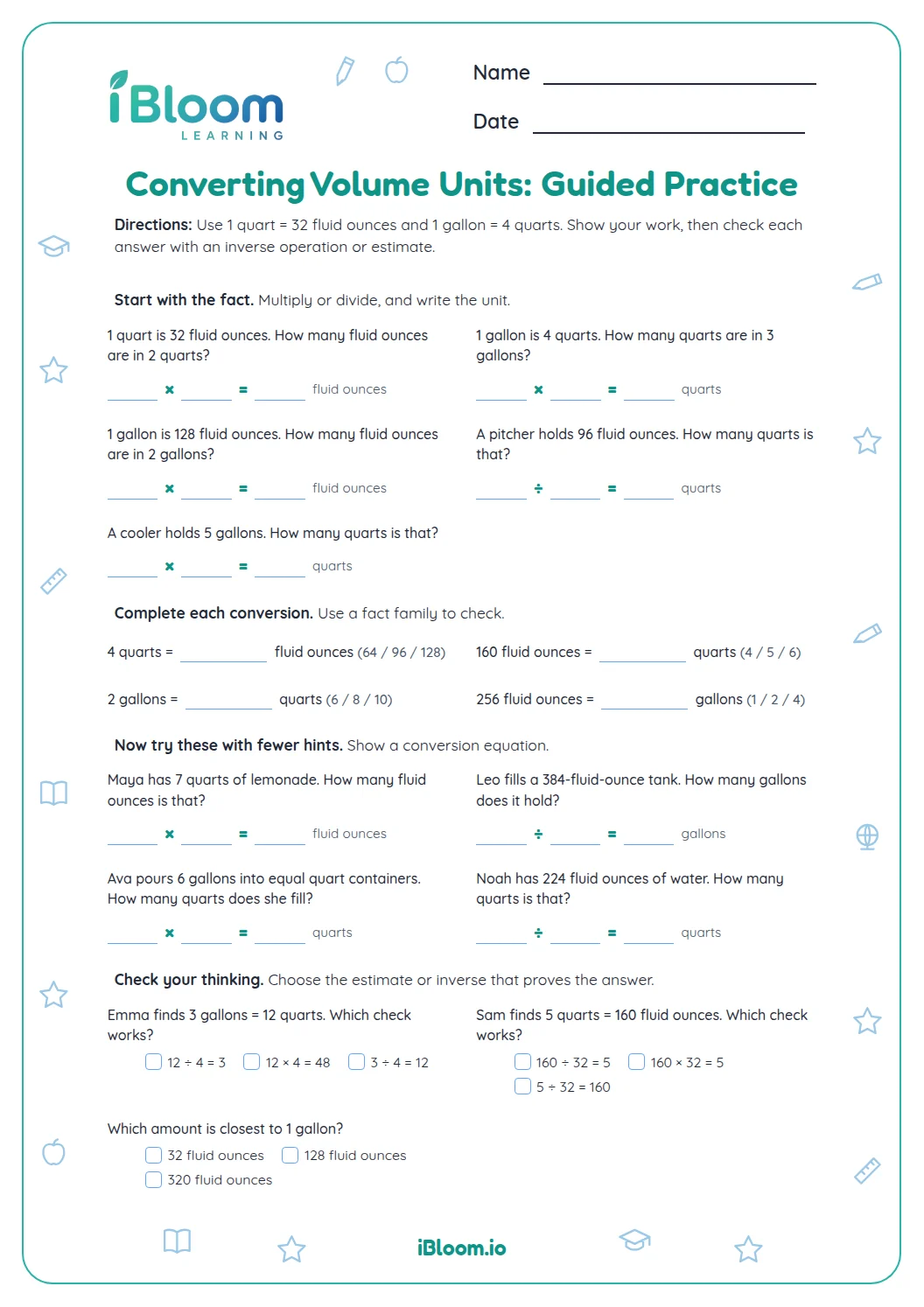
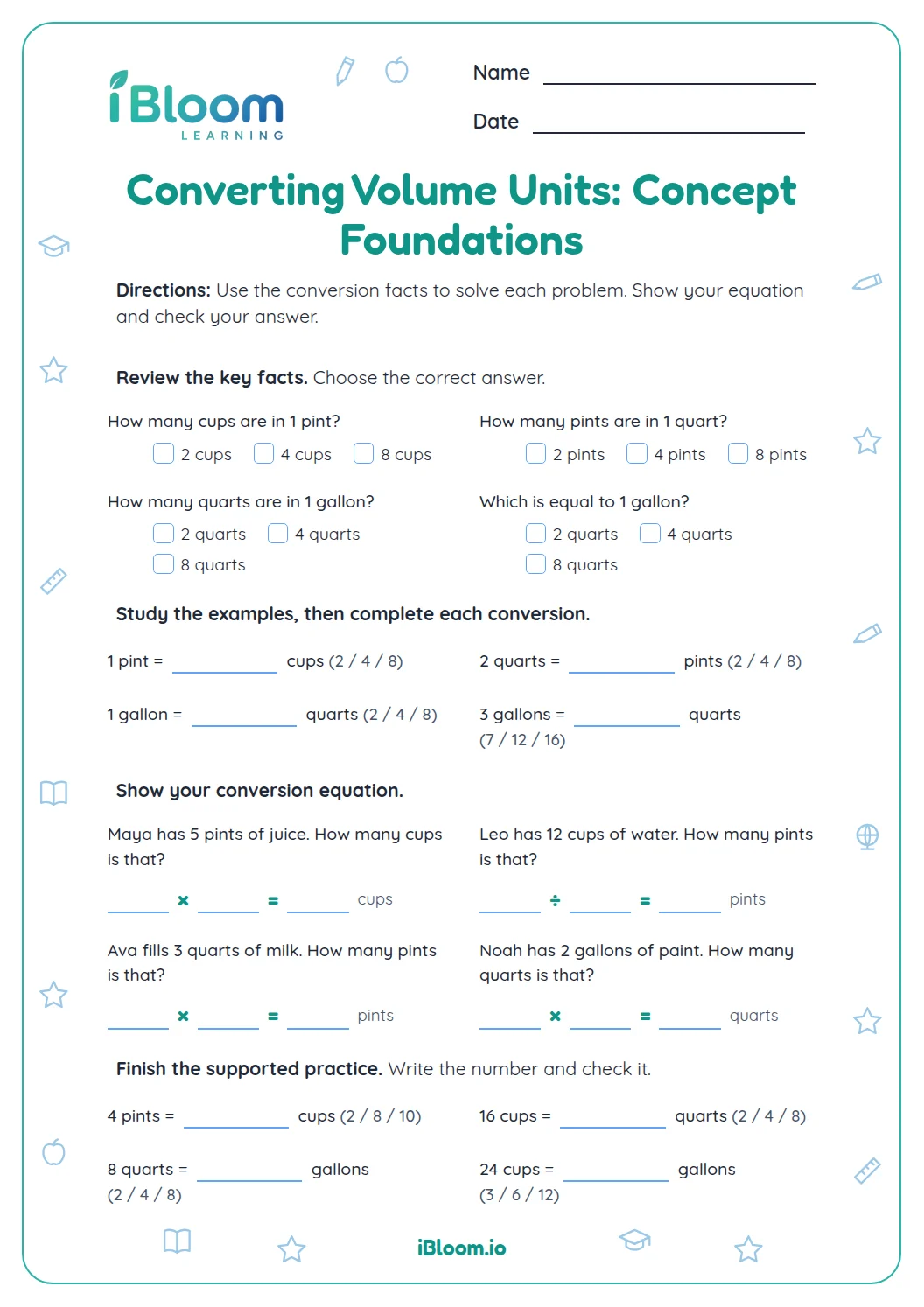
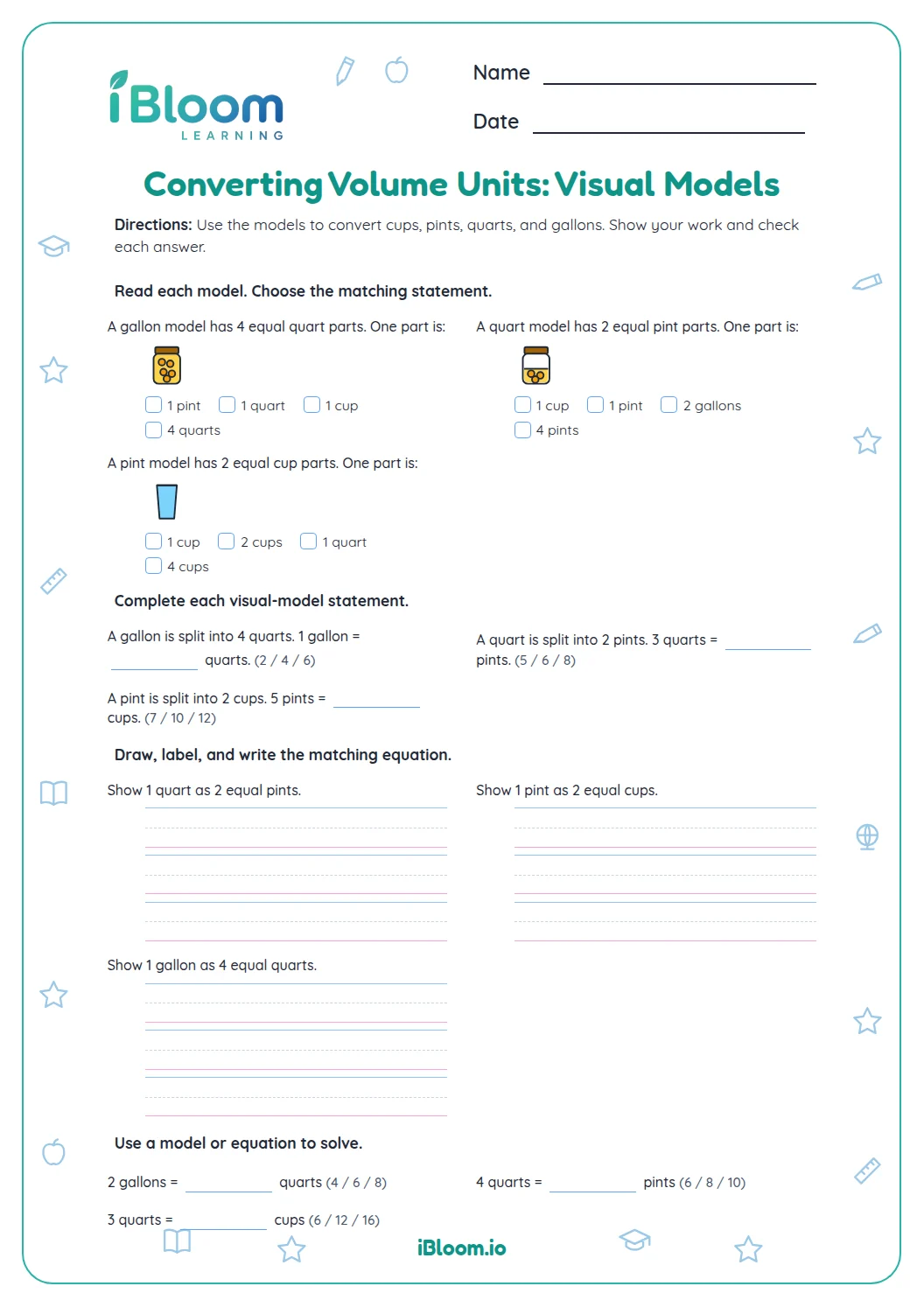
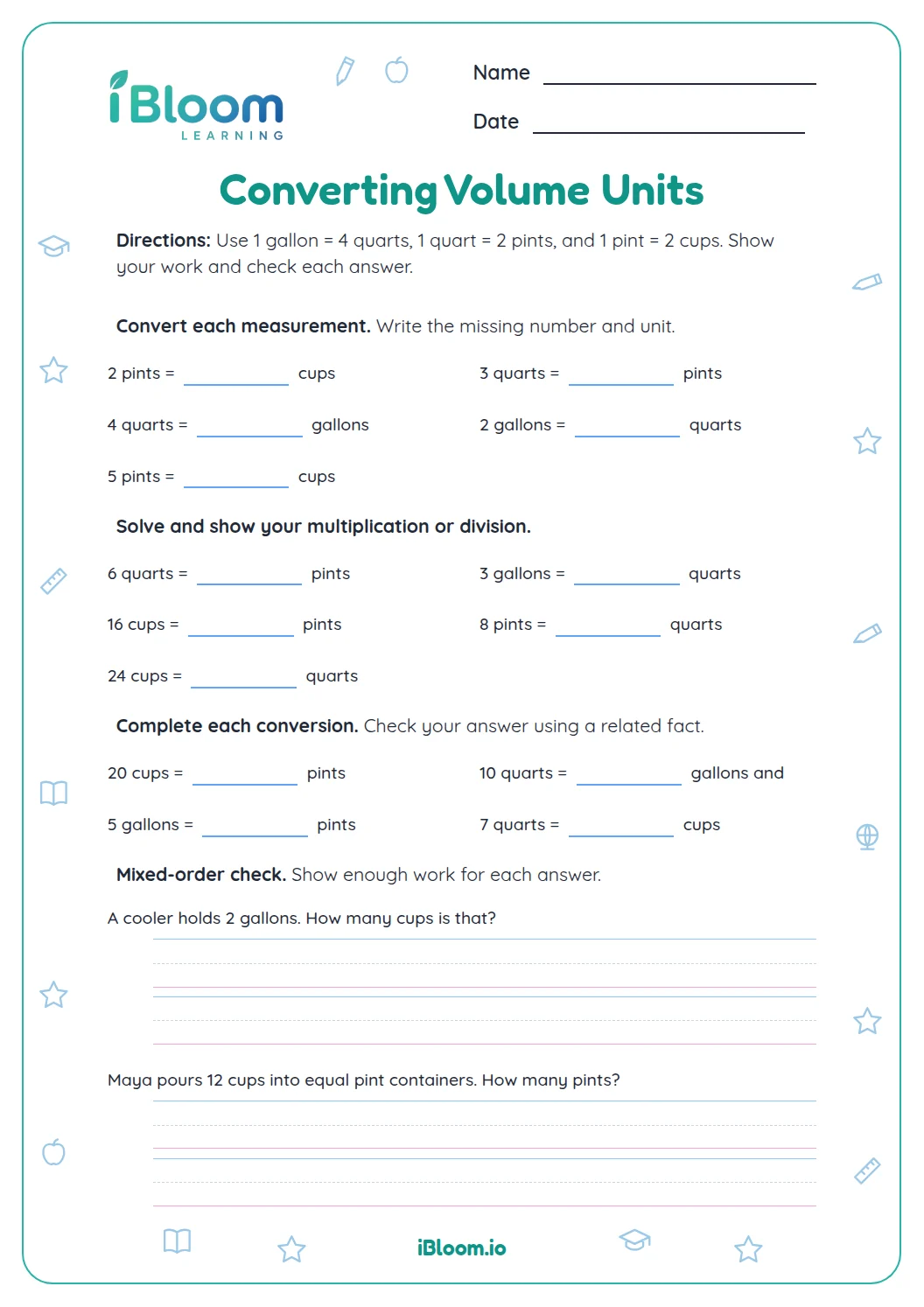
This free Grade 4 worksheet practices customary liquid-volume conversions among fluid ounces, quarts and gallons. Students use a four-part gallon model to connect quarts to gallons, recall that a quart holds 32 fluid ounces, and solve direct conversions and capacity situations. The answer key includes units for each story answer, so families can check both the computation and what the number measures.
Aligned to 4.MD.A.1 and 4.MD.A.2
Which customary capacity facts do students use?
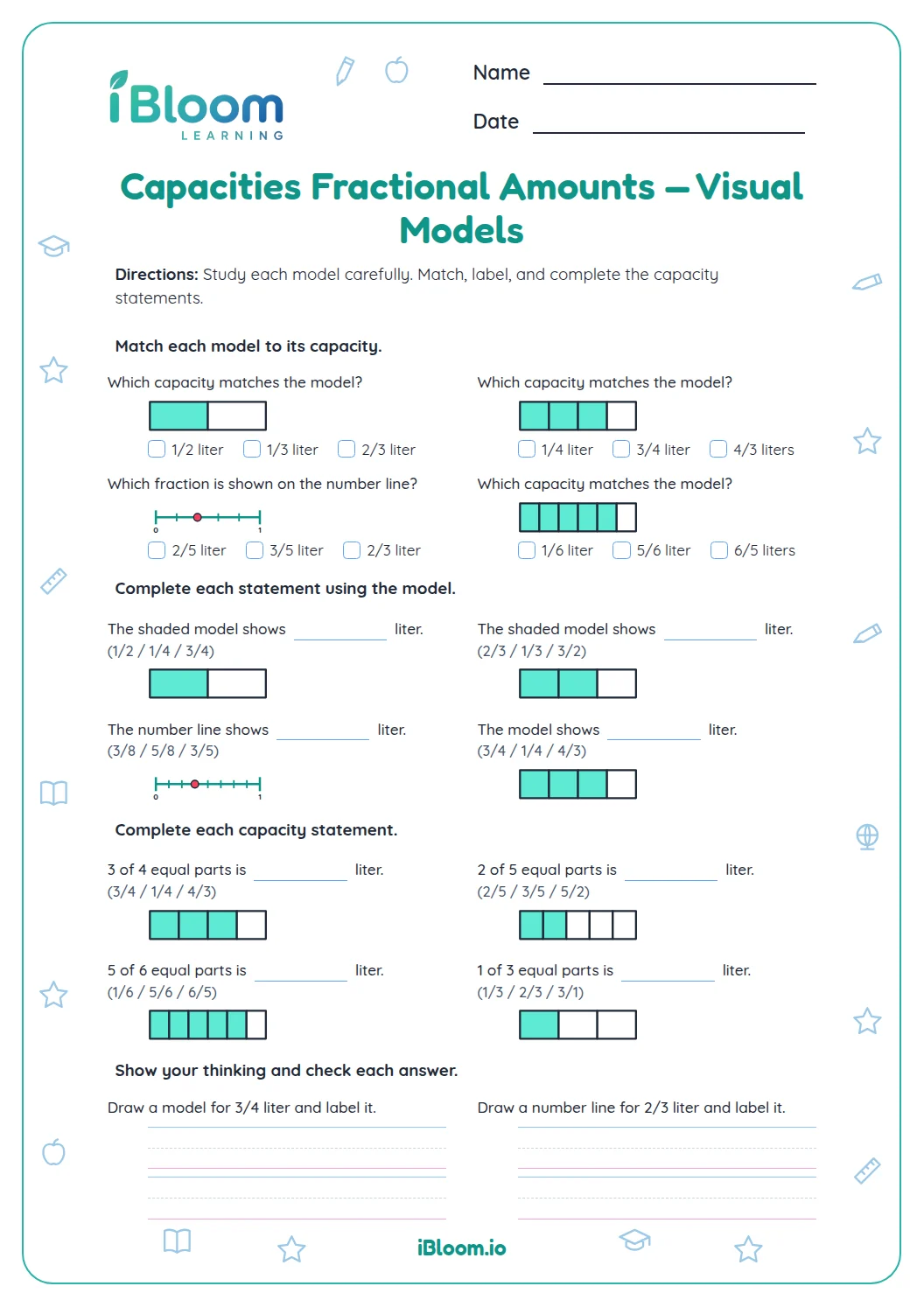
The model splits each gallon into four equal quart parts. One quart is therefore one of four equal parts of a gallon. A quart also holds 32 fluid ounces, so 4 × 32 = 128 fluid ounces in one gallon.
Keep the unit attached to each number. A conversion changes how the same amount is named; it does not change the amount of liquid.
How does a conversion help solve a capacity problem?
Question 11 shows two full gallon models, each split into four quart parts. That is 2 × 4 = 8 quarts.
For fluid ounces and quarts, use 32 fluid ounces per quart. For example, 96 fluid ounces ÷ 32 = 3 quarts.
What practice is on the two pages?
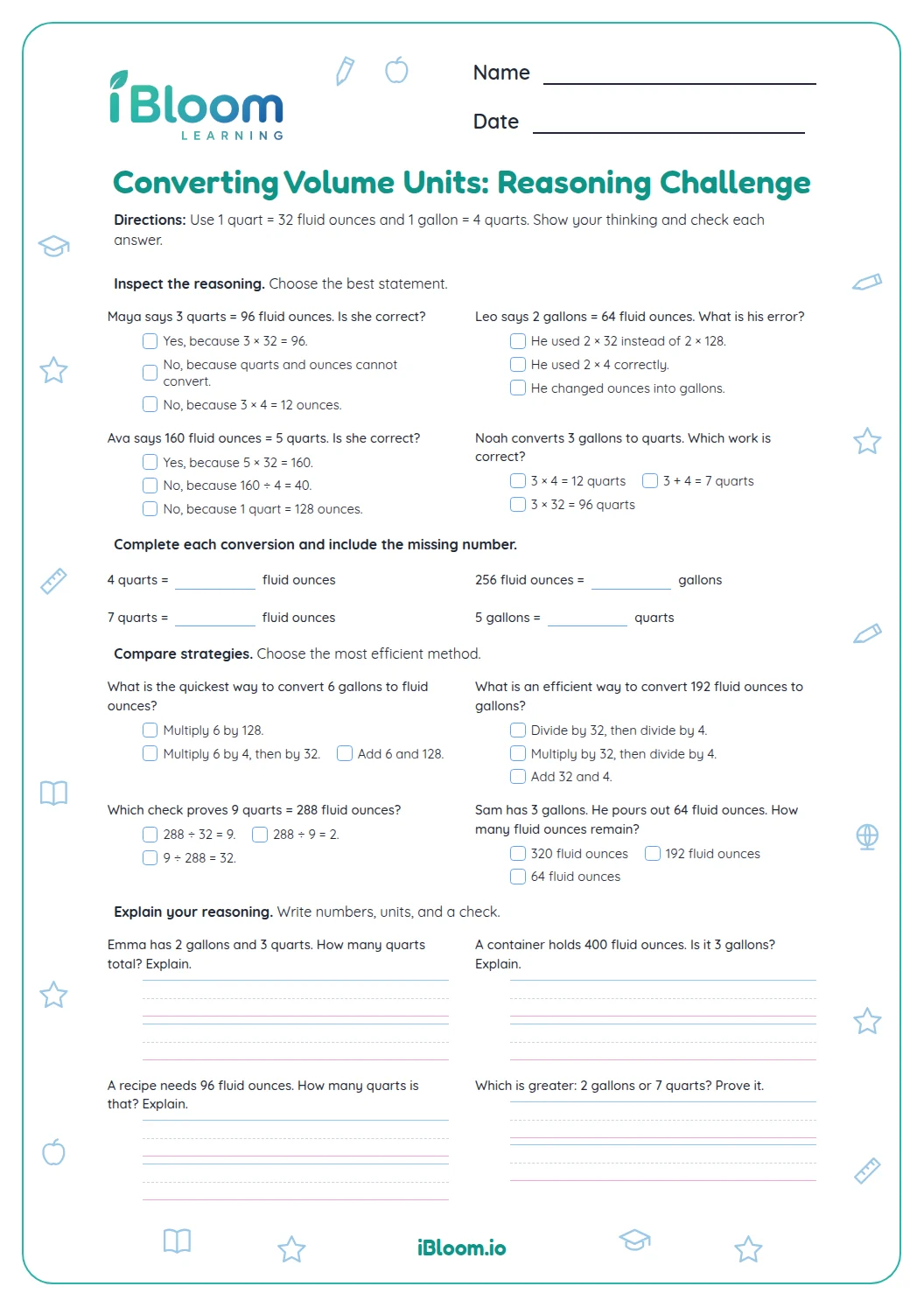
The 16 questions move from unit facts to conversions and short capacity situations.
How to use this worksheet
- 1Review 4 cups = 1 quart and 4 quarts = 1 gallon before starting.
- 2Write the relationship that matches the units in the question.
- 3Multiply when converting to a smaller unit and divide when converting to a larger unit.
- 4For a story problem, write an equation and label the answer.
- 5Use the answer key to check the unit as well as the number.
Common mistakes and quick fixes
The mistake
Multiplying in the wrong direction when changing to a larger unit.
The fix
Ask whether the new unit is smaller or larger; larger units mean fewer of them.
The mistake
Using 16 instead of 32 fluid ounces in a quart.
The fix
Say the chain aloud: 1 cup is 8 fluid ounces and 1 quart is 4 cups.
The mistake
Giving a number without its unit in a story problem.
The fix
Reread what the question asks to count and write that unit after the number.
Common Core alignment
This worksheet practices customary unit relationships and liquid-volume problems.
Use familiar customary capacity relationships to express a larger unit in smaller units.
On this sheet:
Show the official wordingHide the official wording
Know relative sizes of measurement units within one system of units including km, m, cm; kg, g; lb, oz.; l, ml; hr, min, sec. Within a single system of measurement, express measurements in a larger unit in terms of a smaller unit. Record measurement equivalents in a two-column table. For example, know that 1 ft is 12 times as long as 1 in. Express the length of a 4 ft snake as 48 in. Generate a conversion table for feet and inches listing the number pairs (1, 12), (2, 24), (3, 36), ...
Solve liquid-volume word problems, including conversion to a smaller unit.
On this sheet:
Show the official wordingHide the official wording
Use the four operations to solve word problems involving distances, intervals of time, liquid volumes, masses of objects, and money, including problems involving simple fractions or decimals, and problems that require expressing measurements given in a larger unit in terms of a smaller unit.
What to practice next
Make more practice
Further reading
Questions parents and teachers ask
What customary units does this worksheet convert?
The worksheet converts among fluid ounces, quarts and gallons. Students use 32 fluid ounces in a quart and 4 quarts in a gallon, then connect those facts to conversions and capacity situations. The four-part gallon model helps make the quart relationship visible before students work with the numbers.
How many fluid ounces are in a quart?
There are 32 fluid ounces in 1 quart. For example, 96 fluid ounces divided by 32 fluid ounces per quart equals 3 quarts. The worksheet asks students to use this relationship in direct conversions and in a capacity situation, then label each answer with its unit.
How many questions are on the worksheet?
There are 16 questions across two worksheet pages, followed by a separate answer key. Ten questions practice unit facts and direct conversions; six apply those relationships to capacity situations. The order moves from recalling a conversion to using it in a short story problem.
Should students multiply or divide to convert?
Use the conversion relationship that matches the units. Multiply a quart amount by 32 to find fluid ounces; divide fluid ounces by 32 to find quarts. For gallons and quarts, multiply gallons by 4 or divide quarts by 4 when the amount is a whole number of gallons.
What does the answer key include?
The answer key lists each conversion and story answer with its unit. Students can compare both the number and unit with their work, including quarts, gallons or fluid ounces. For a story problem, checking the unit helps confirm that the answer responds to what the question asked.