





About this worksheet
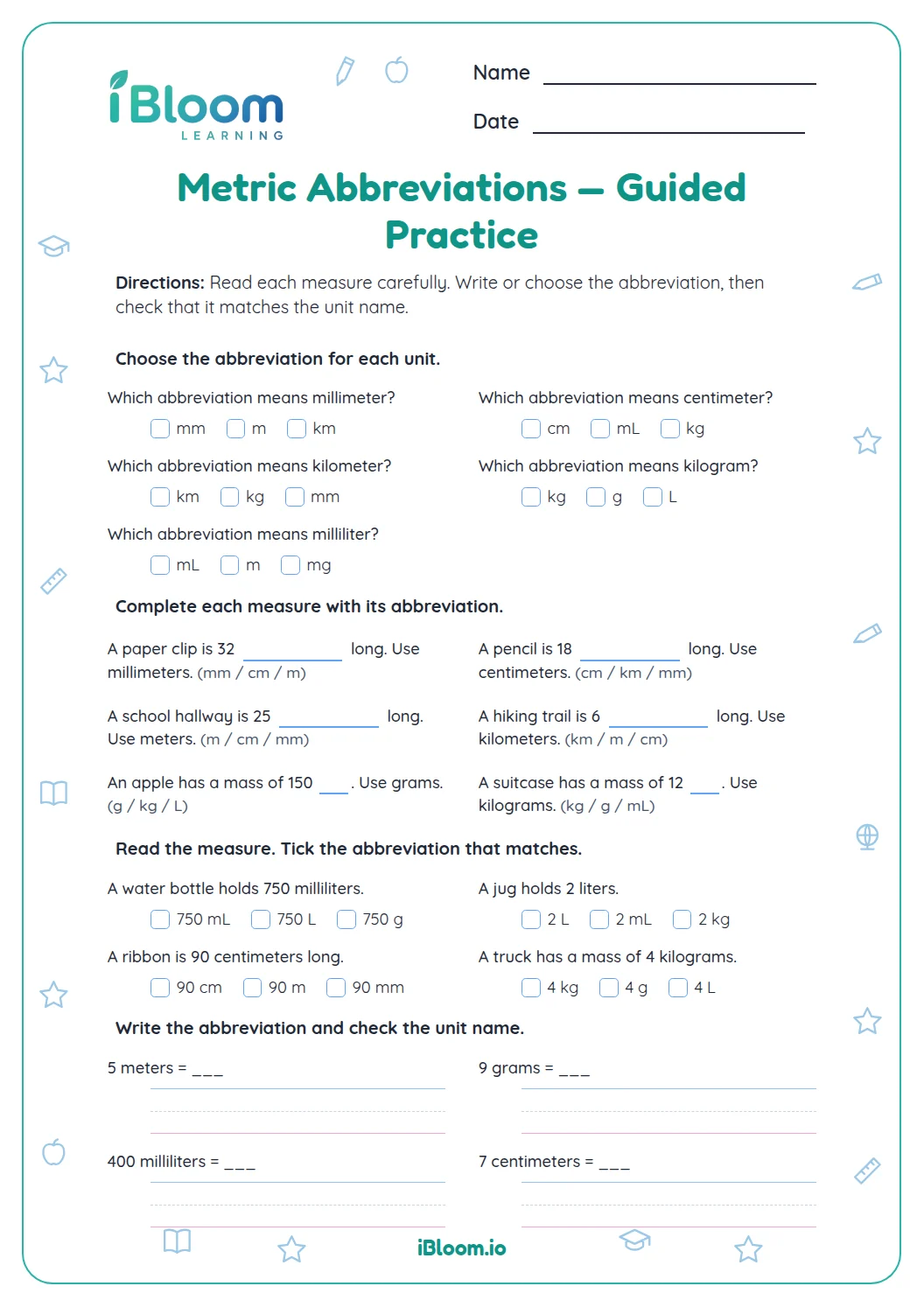
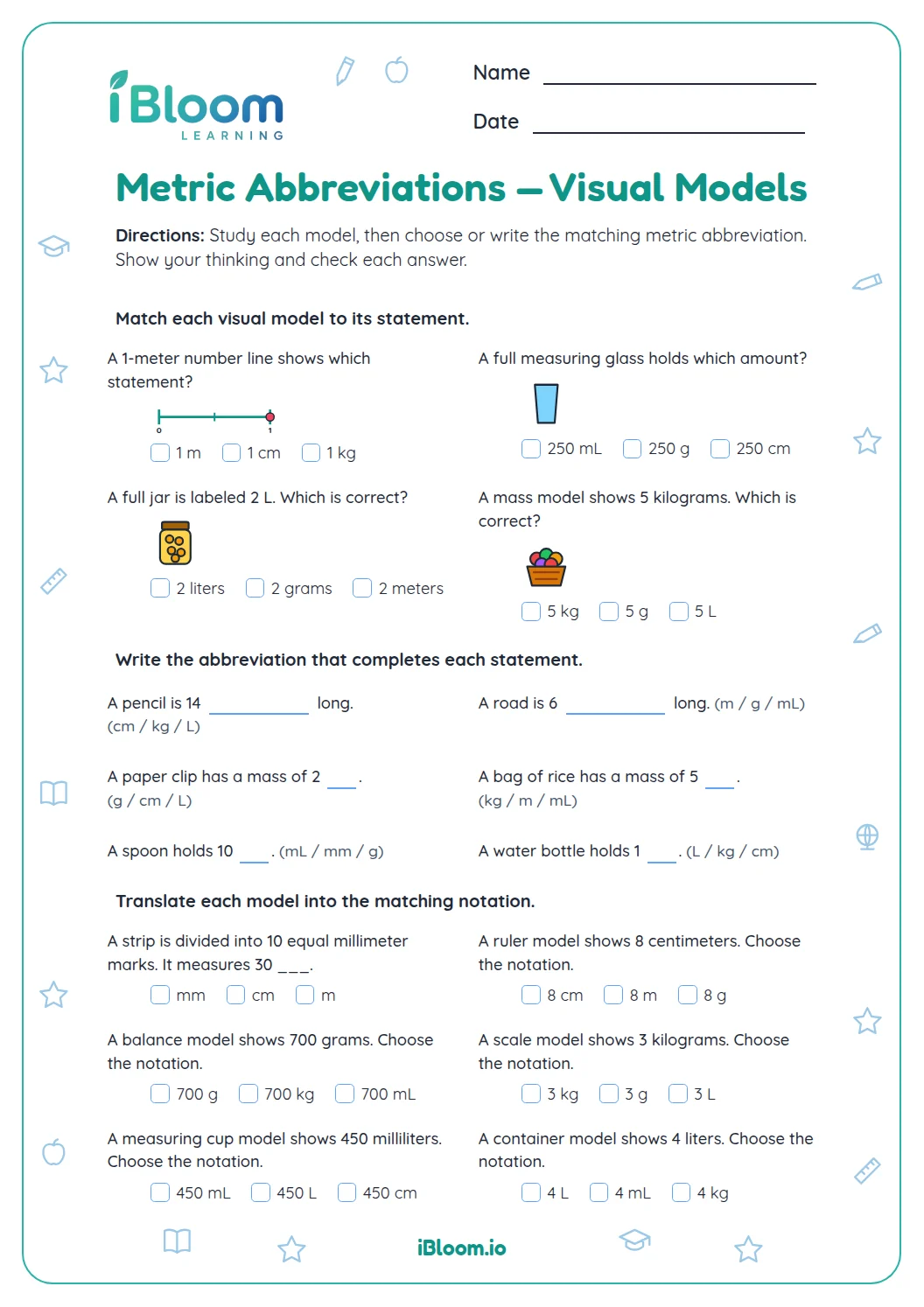
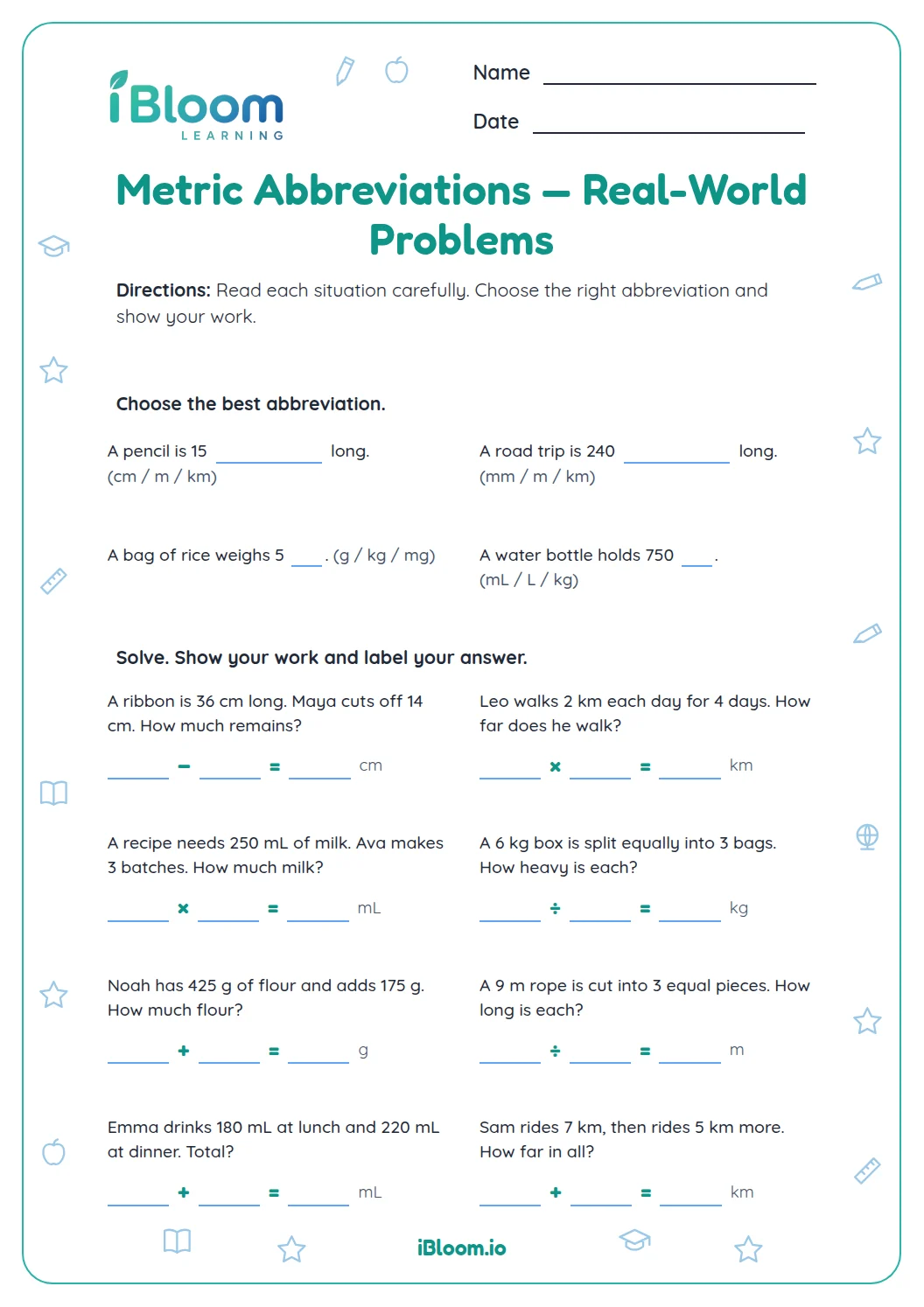
This free Grade 4 metric abbreviations worksheet gives children independent practice with mm, cm, m, km, g, kg, mL, and L. In Part A, students write symbols for eight unit names. Part B asks them to choose sensible units for eight familiar measurements. Part C connects symbols with unit size through four metric equivalents. The 20 questions practice reading and writing measurement notation and support Common Core 4.MD.A.1. A separate answer key supplies every symbol and number, so families and teachers can check whether an error comes from naming a unit or converting its size.
Aligned to 4.MD.A.1
Which metric abbreviations are on the sheet?
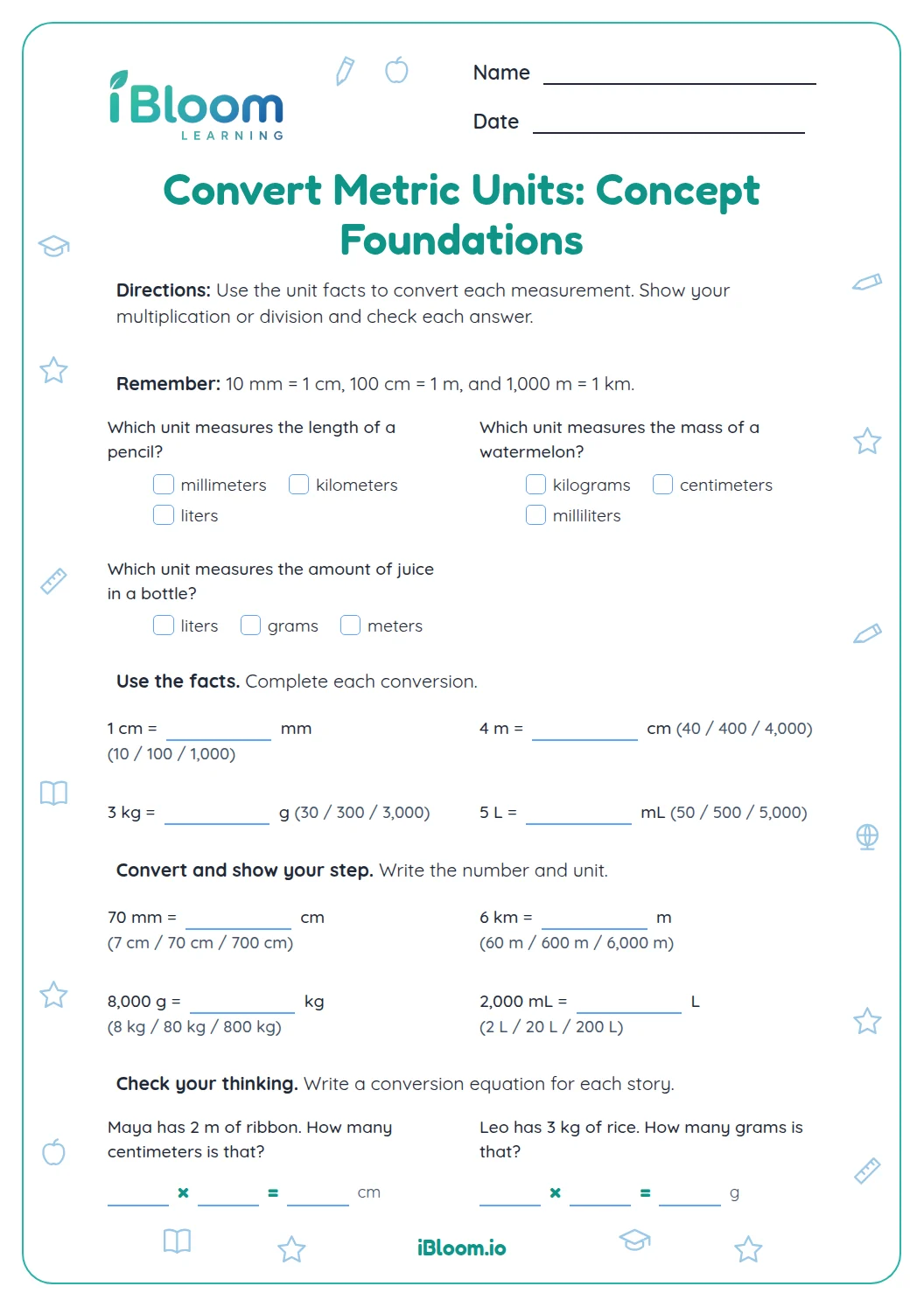
Part A includes eight symbols: mm for millimeters, cm for centimeters, m for meters, km for kilometers, g for grams, kg for kilograms, mL for milliliters, and L for liters. Children write the symbol beside the full unit name.
Use lowercase letters in mm, cm, m, km, g, and kg. This worksheet uses uppercase L in L and mL. Keep the symbol unchanged for a plural measurement: 5 kg, with no added s or period.
How do students choose a sensible metric unit?
First identify the measurement: length, mass, or capacity. Then compare the number with the object. A pencil about 18 units long is reasonably measured in centimeters; kilometers would describe a much greater distance.
Part B includes a pencil, rice, juice, a road trip, a paper clip, a door, an apple, and a pitcher. The choices make children attend to both the kind of measurement and the size of the unit.
How do the final questions connect unit names and sizes?
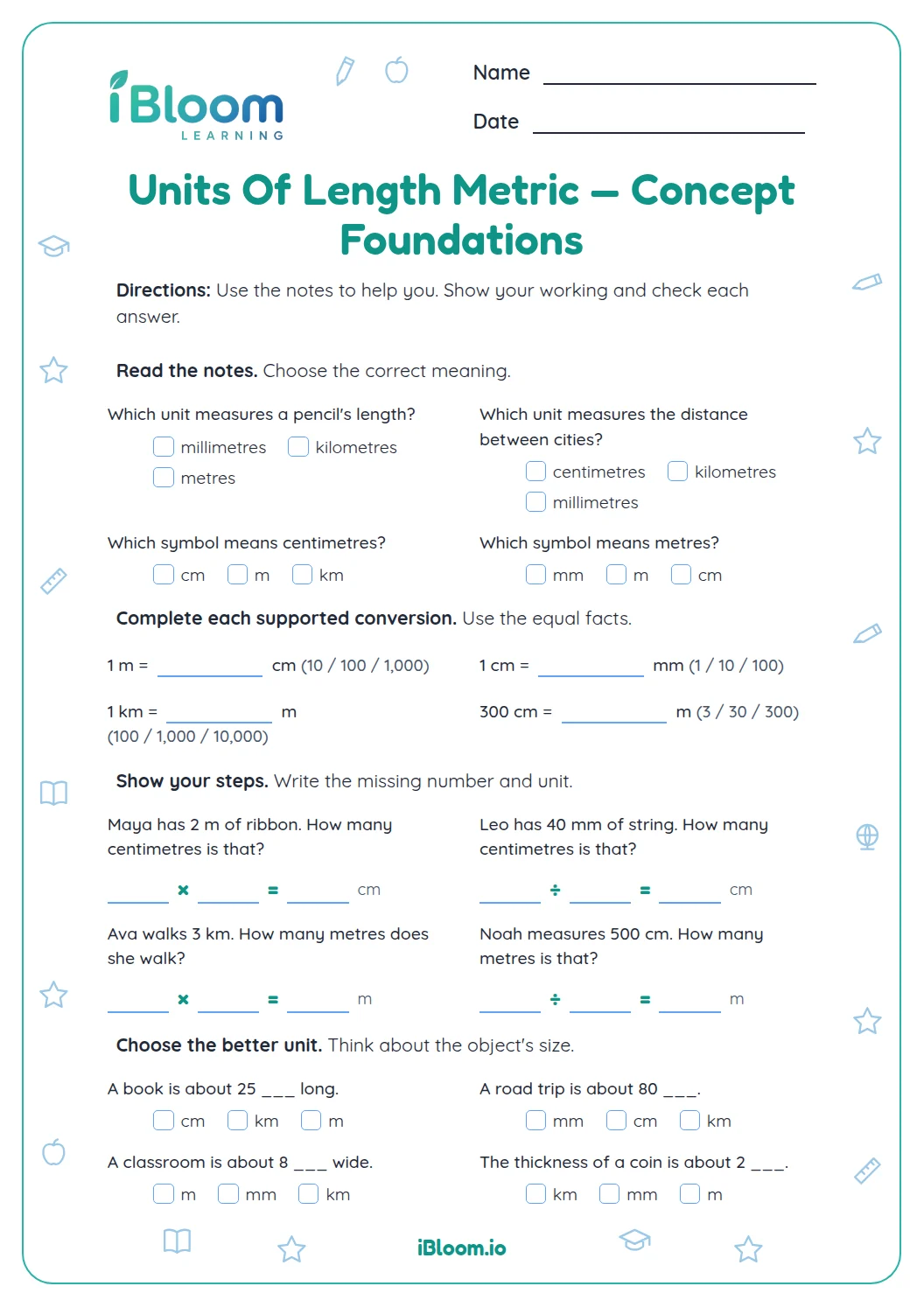
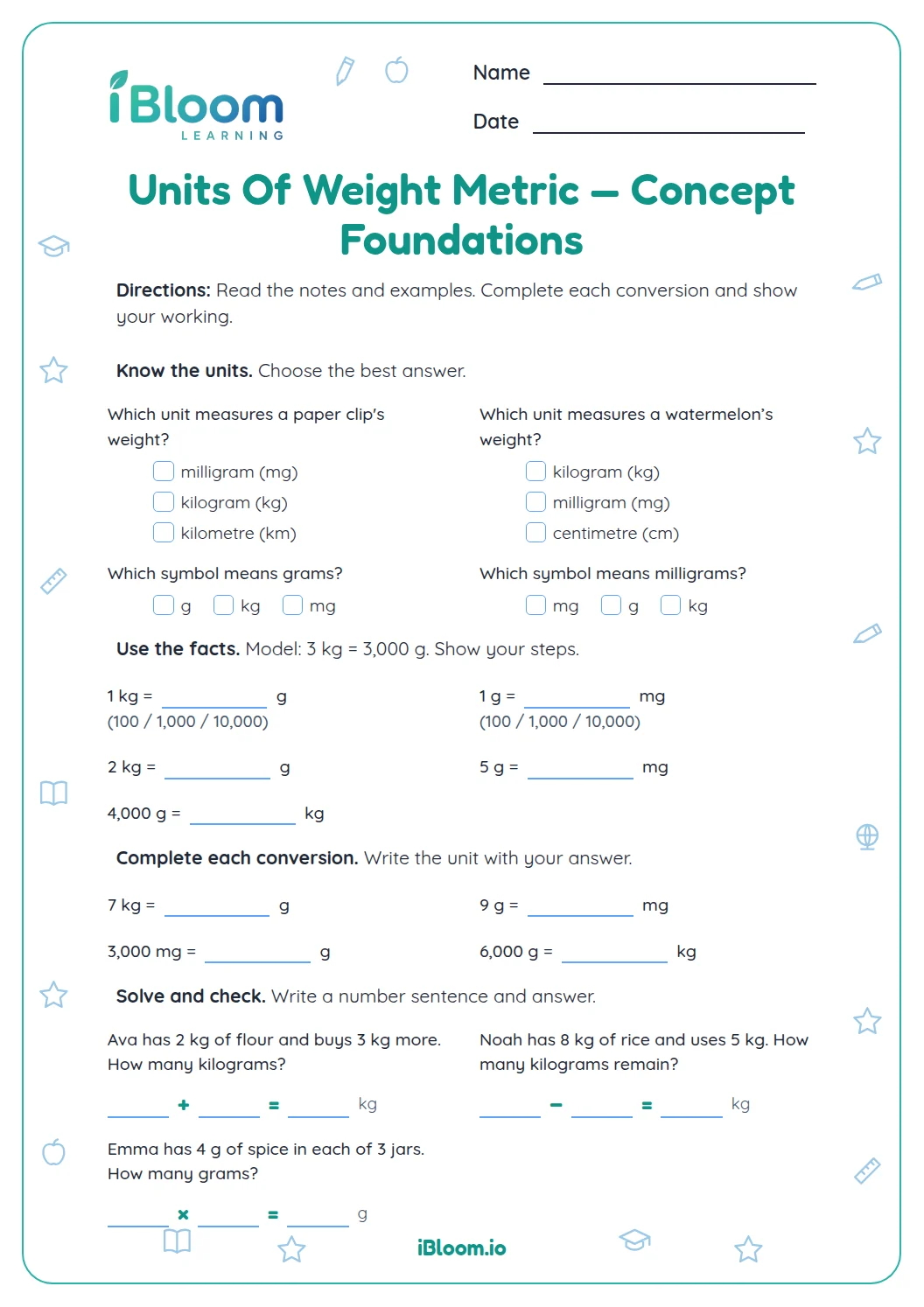
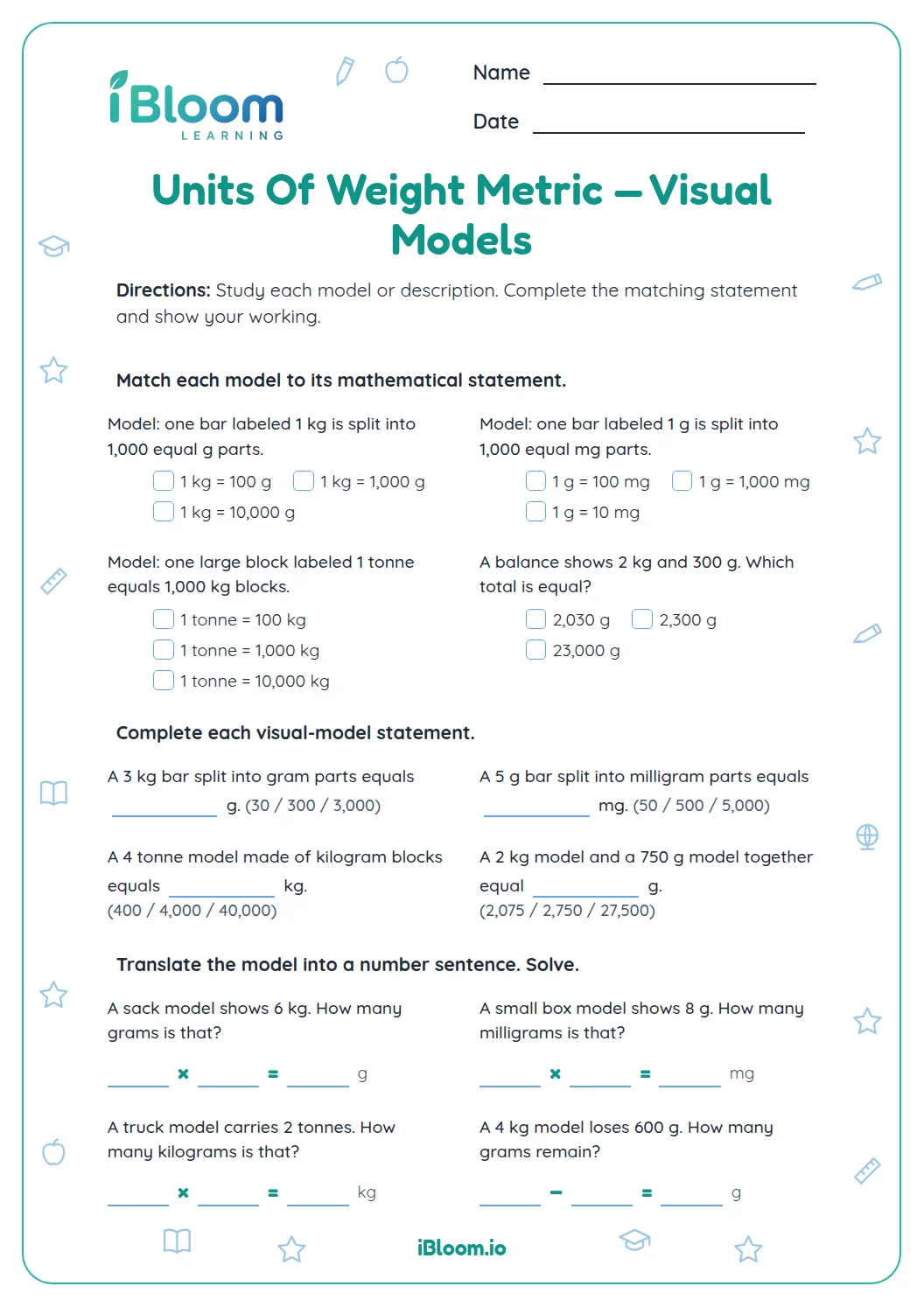
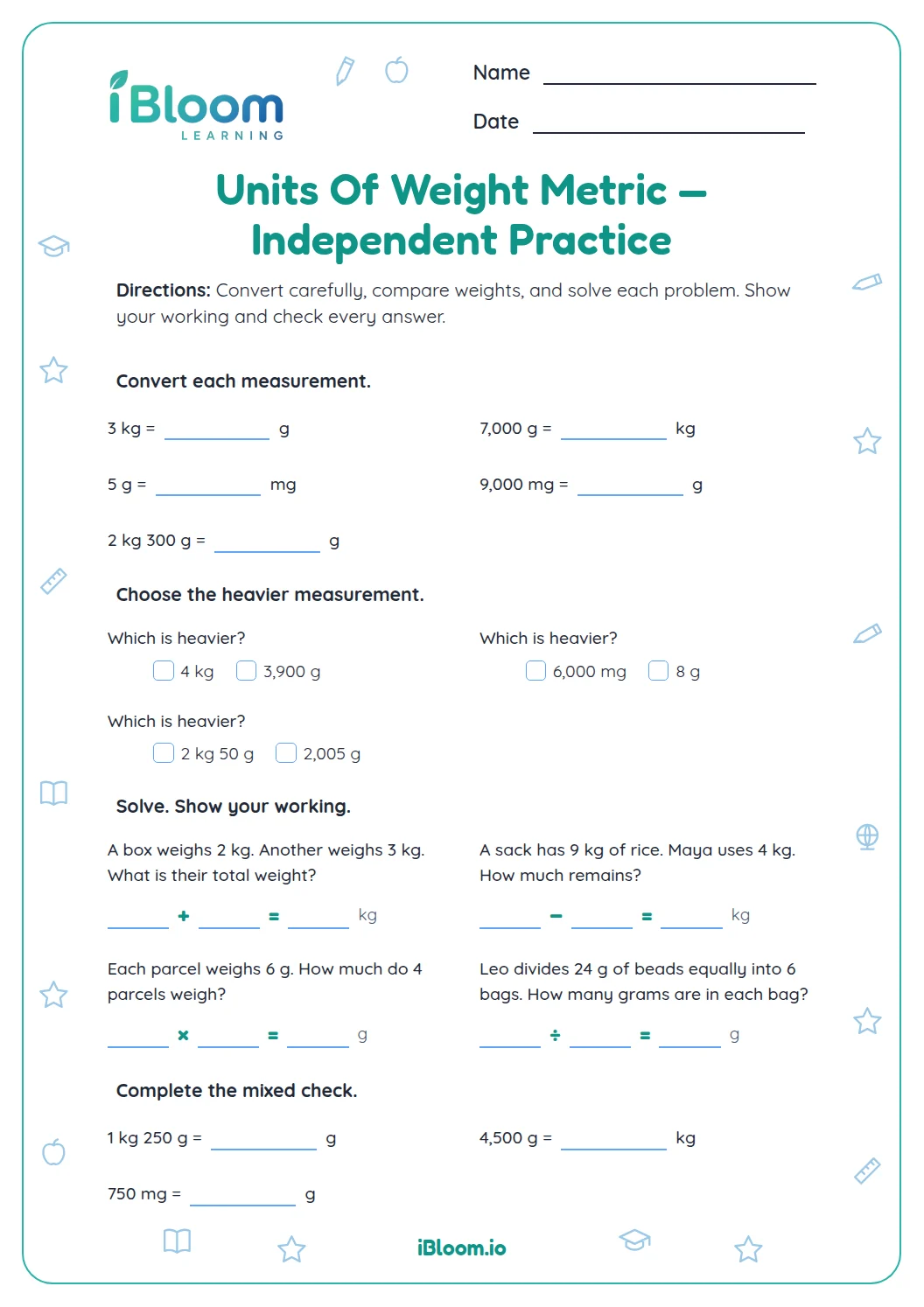
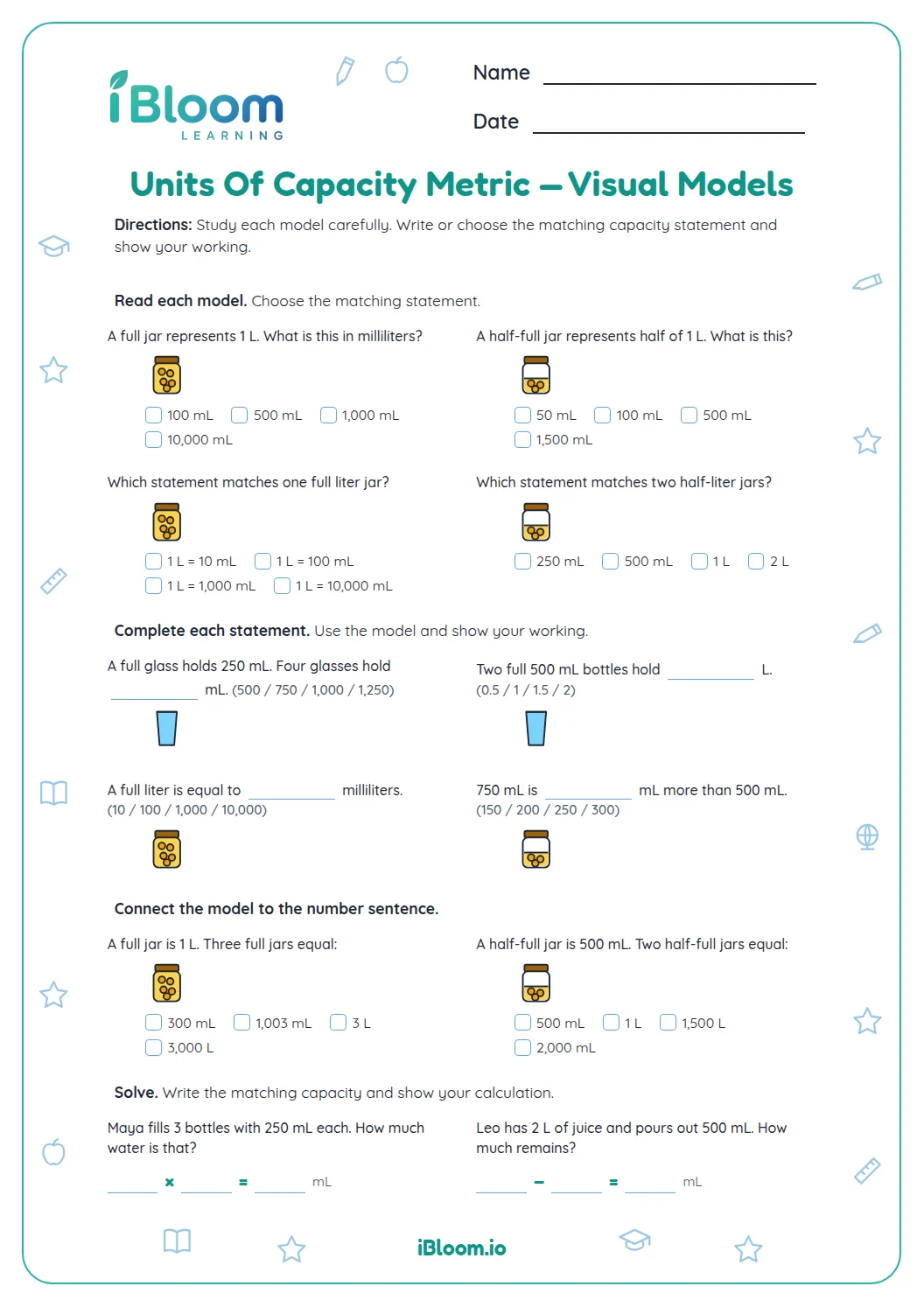
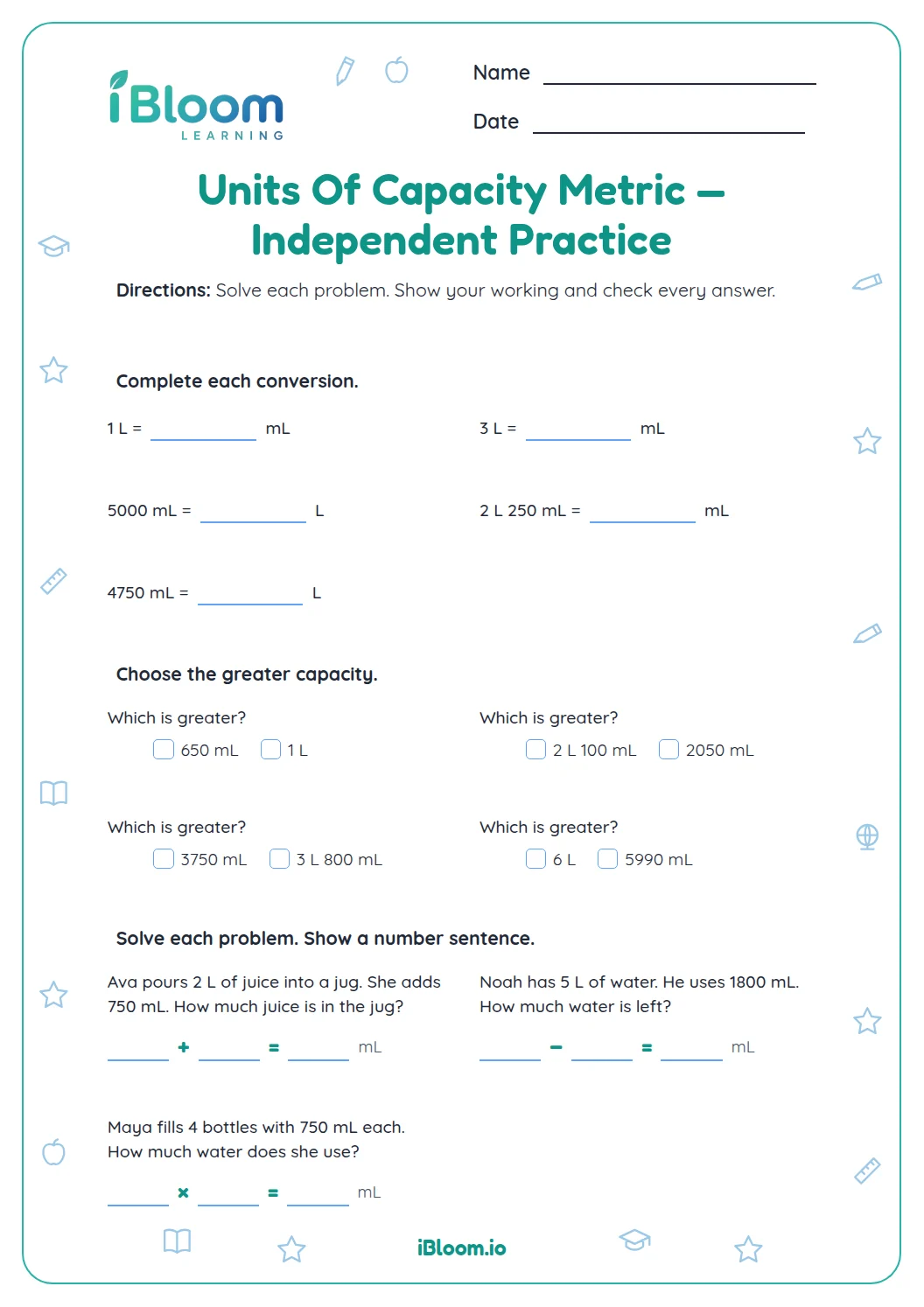
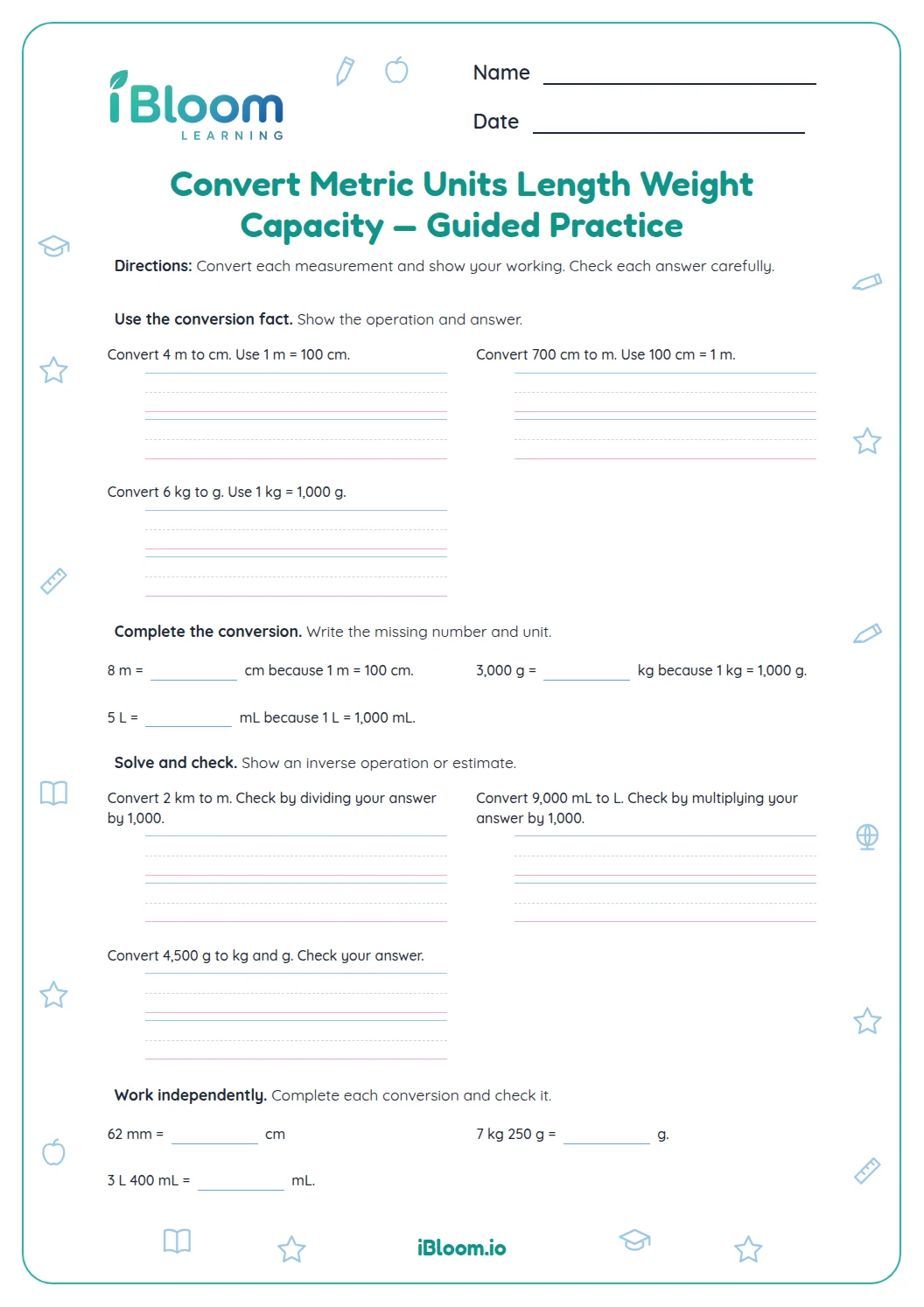
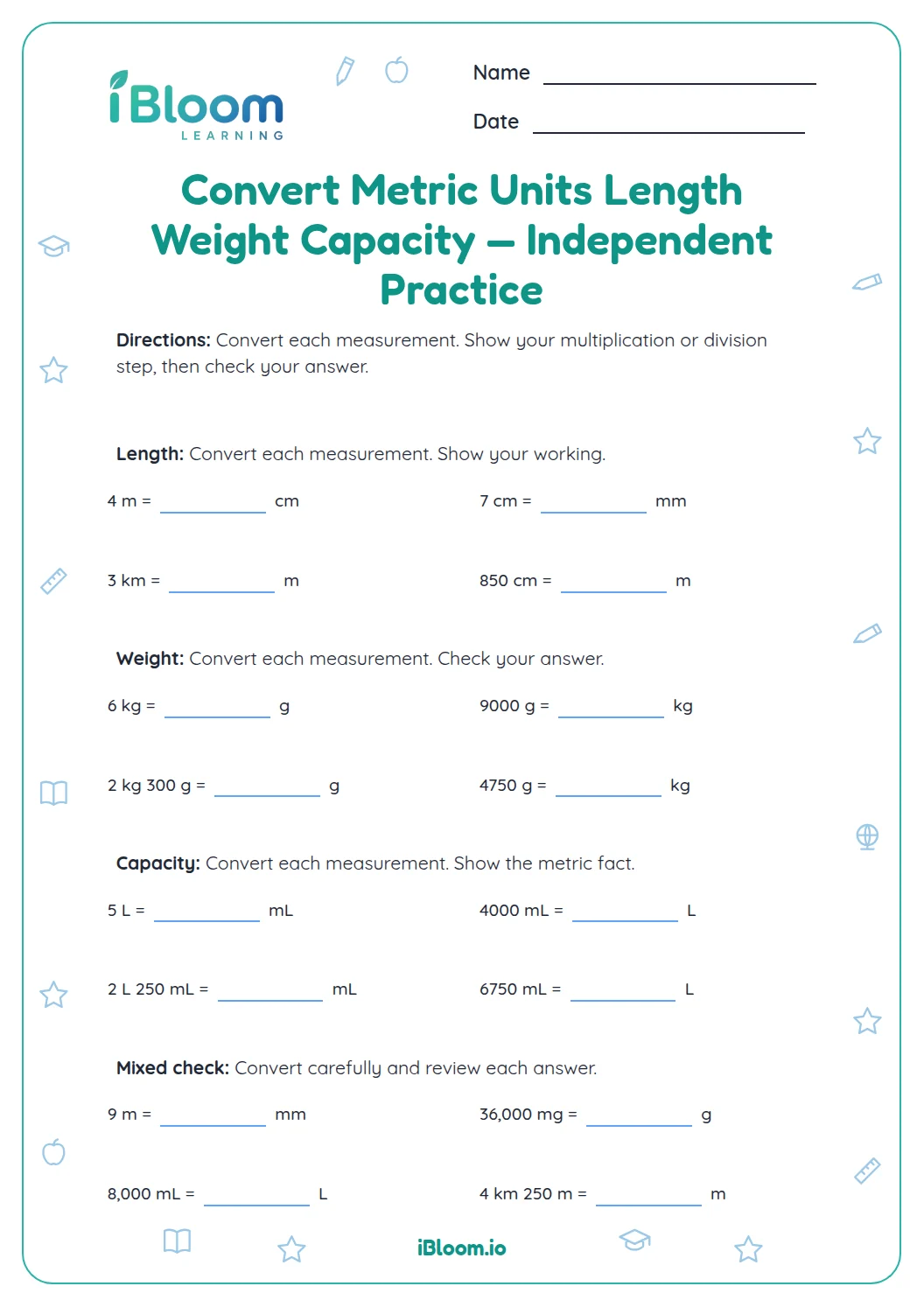
Part C keeps the same measurement while changing the unit used to describe it. A larger unit contains several smaller units, so its equivalent uses a larger number of those smaller units.
For question 17, each meter contains 100 centimeters. Three groups of 100 make 300. Apply the same reasoning to liters and milliliters, kilograms and grams, and kilometers and meters.
- 1Convert 3 m to centimeters.
- 23 m = ___ cm
- 31 m = 100 cm
- 43 × 100 = 300
- 53 m = 300 cm
How to use this worksheet
- 1Ask the child to complete all eight symbol blanks without a reference list.
- 2Have the child read each Part B measurement with the chosen unit aloud.
- 3Before calculating Part C, identify how many smaller units make one larger unit.
- 4Check the answer key, separating symbol mistakes from conversion mistakes.
- 5Rewrite one missed measurement with both its full unit name and its symbol.
Mistakes to notice and fix
The mistake
Writing “cms” or “kgs” for plural units.
The fix
Keep the symbol the same: 18 cm and 5 kg. Symbols do not take a plural s.
The mistake
Using m for milliliters.
The fix
Say the full word. Meters use m; milliliters use mL.
The mistake
Writing 3 m = 30 cm.
The fix
Use 100 centimeters per meter, then multiply 3 × 100 to get 300 centimeters.
Common Core alignment
Read metric units and express larger metric units as smaller ones.
On this sheet: Children identify length, mass, and capacity units and complete four metric equivalents.
Show the official wordingHide the official wording
Know relative sizes of measurement units within one system of units including km, m, cm; kg, g; lb, oz.; l, ml; hr, min, sec. Within a single system of measurement, express measurements in a larger unit in terms of a smaller unit. Record measurement equivalents in a two-column table. For example, know that 1 ft is 12 times as long as 1 in. Express the length of a 4 ft snake as 48 in. Generate a conversion table for feet and inches listing the number pairs (1, 12), (2, 24), (3, 36), …
What to practice next
Make more practice
Further reading
Questions parents and teachers ask
Which abbreviations should my child know for this page?
The eight symbols are mm, cm, m, km, g, kg, mL, and L. They represent four length units, two mass units, and two capacity units. Part A asks for all eight from their full names, while Parts B and C reuse selected symbols in measurements and equivalents.
Why does this worksheet use a capital L?
The worksheet uses L for liters and mL for milliliters so the letter is easy to distinguish from the numeral 1. Keep the small m in mL because it stands for milli. When checking, ask children to read the complete unit name as well as the symbol.
Does independent practice mean children should work without help?
Let children attempt the questions on their own first, then use the key to guide a short review. If a symbol is unfamiliar, give its full name and have the child try again. For Part C, ask for the one-unit relationship before supplying a multiplication fact.
Are there conversion questions as well as abbreviations?
Yes, Part C has four equivalents using meters and centimeters, liters and milliliters, kilograms and grams, and kilometers and meters. Students write each equivalent with its requested unit. This connects knowing a unit’s name and symbol with understanding how its size relates to another unit.
How can I check whether a wrong answer is a unit mistake?
Ask the child to say what is being measured before redoing the problem. Length needs a length unit, mass needs a mass unit, and capacity needs a capacity unit. Then check the size: 750 mL makes sense for a juice bottle, whereas 750 L describes a much larger amount.