

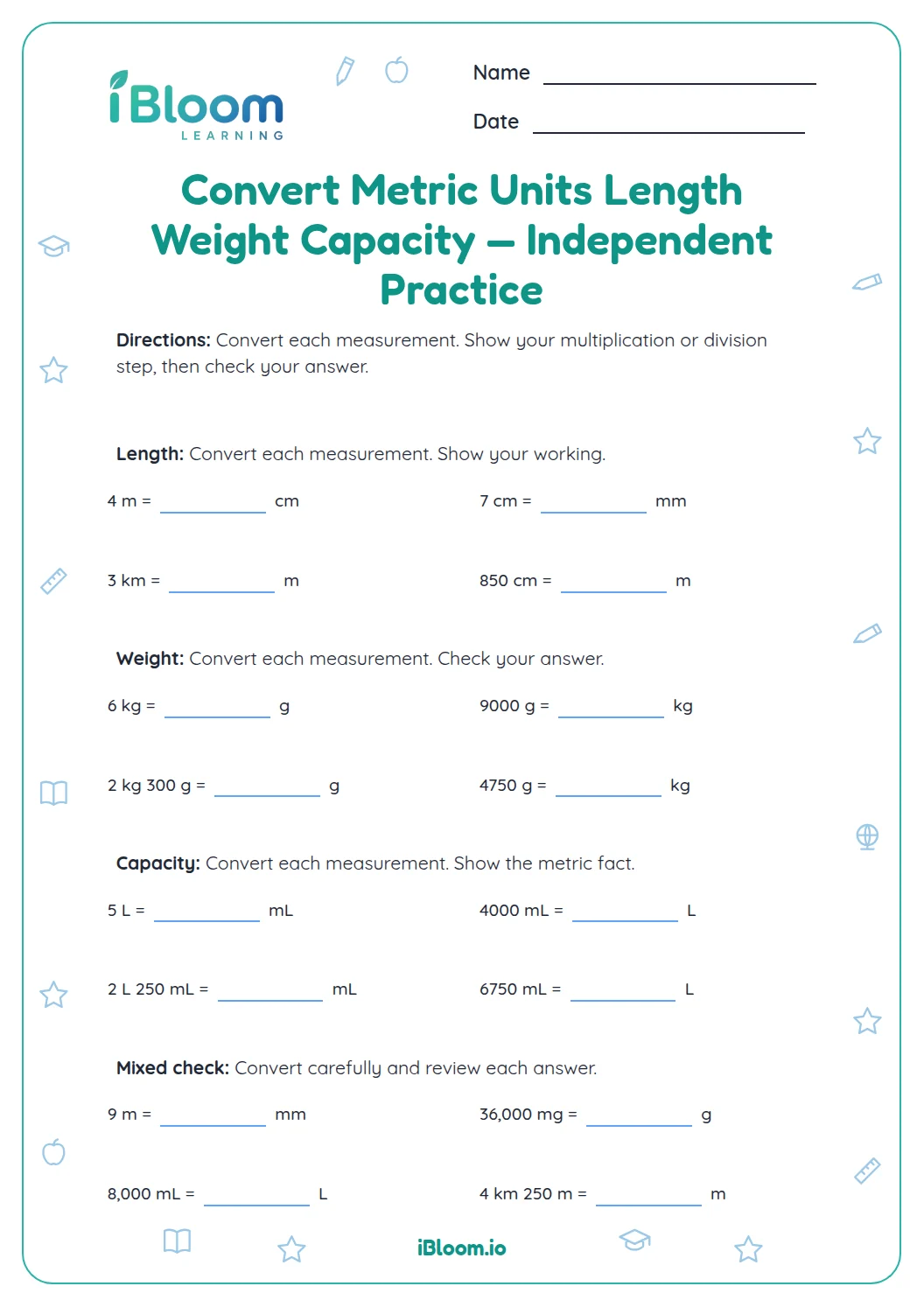
About this worksheet
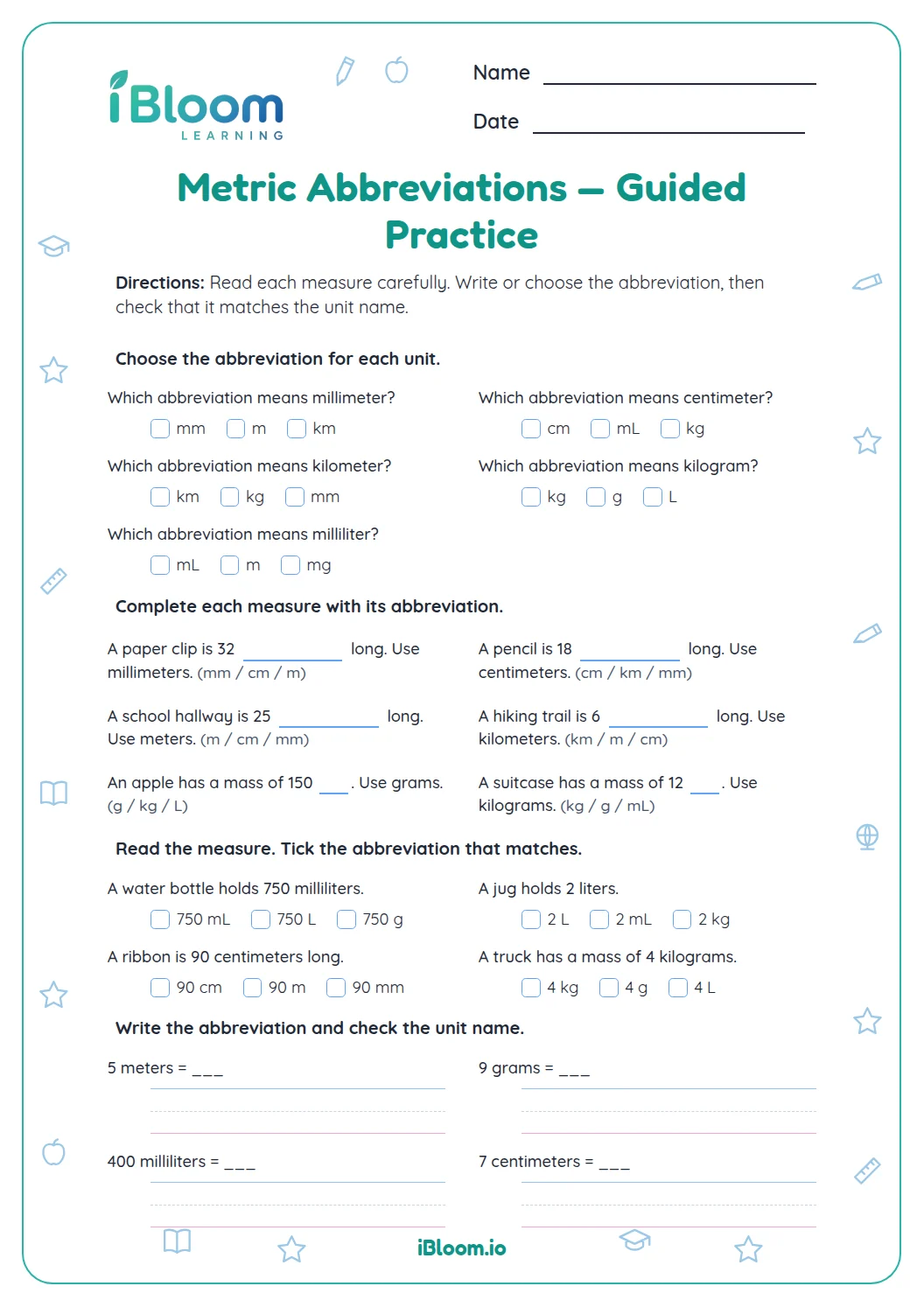
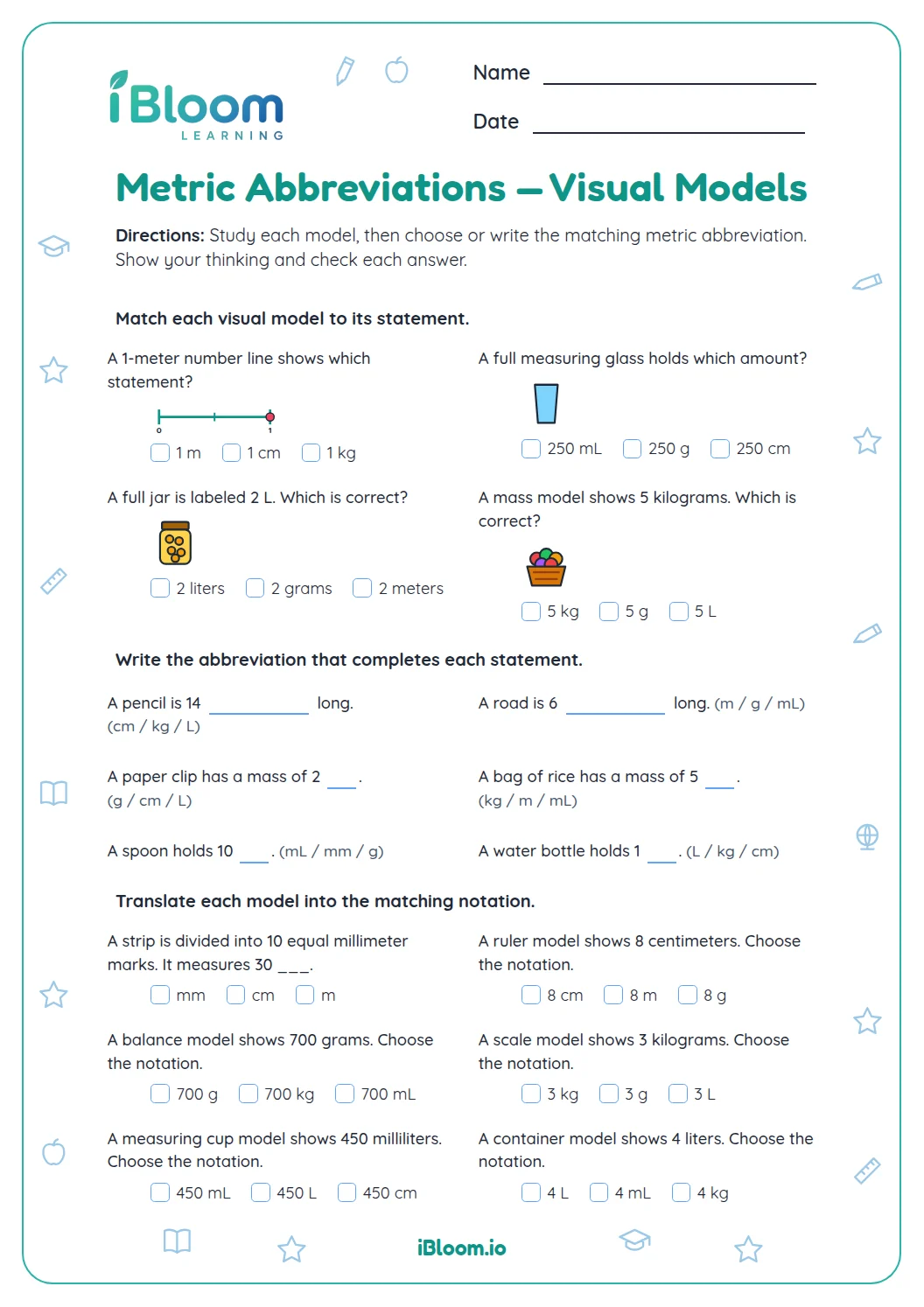
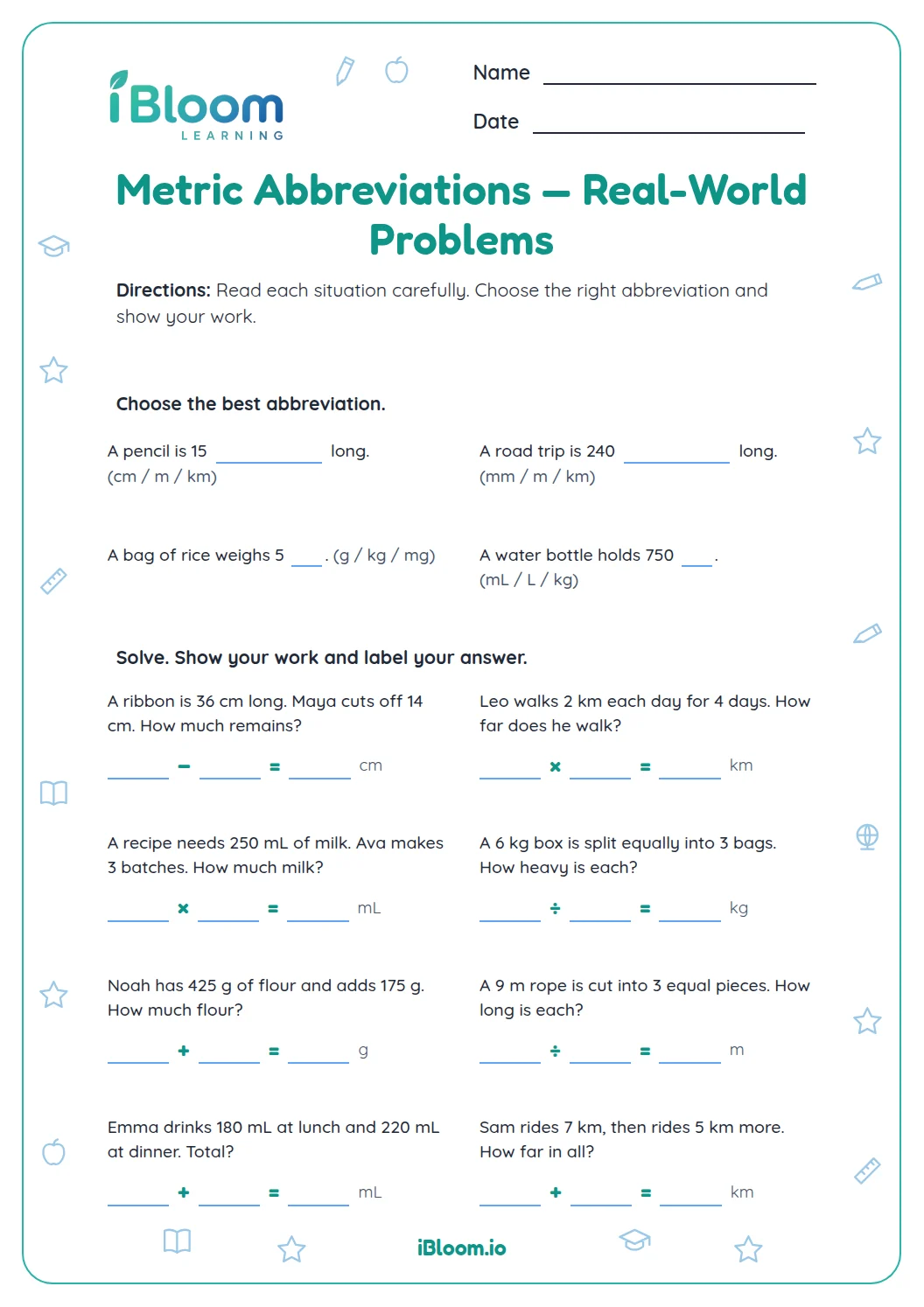
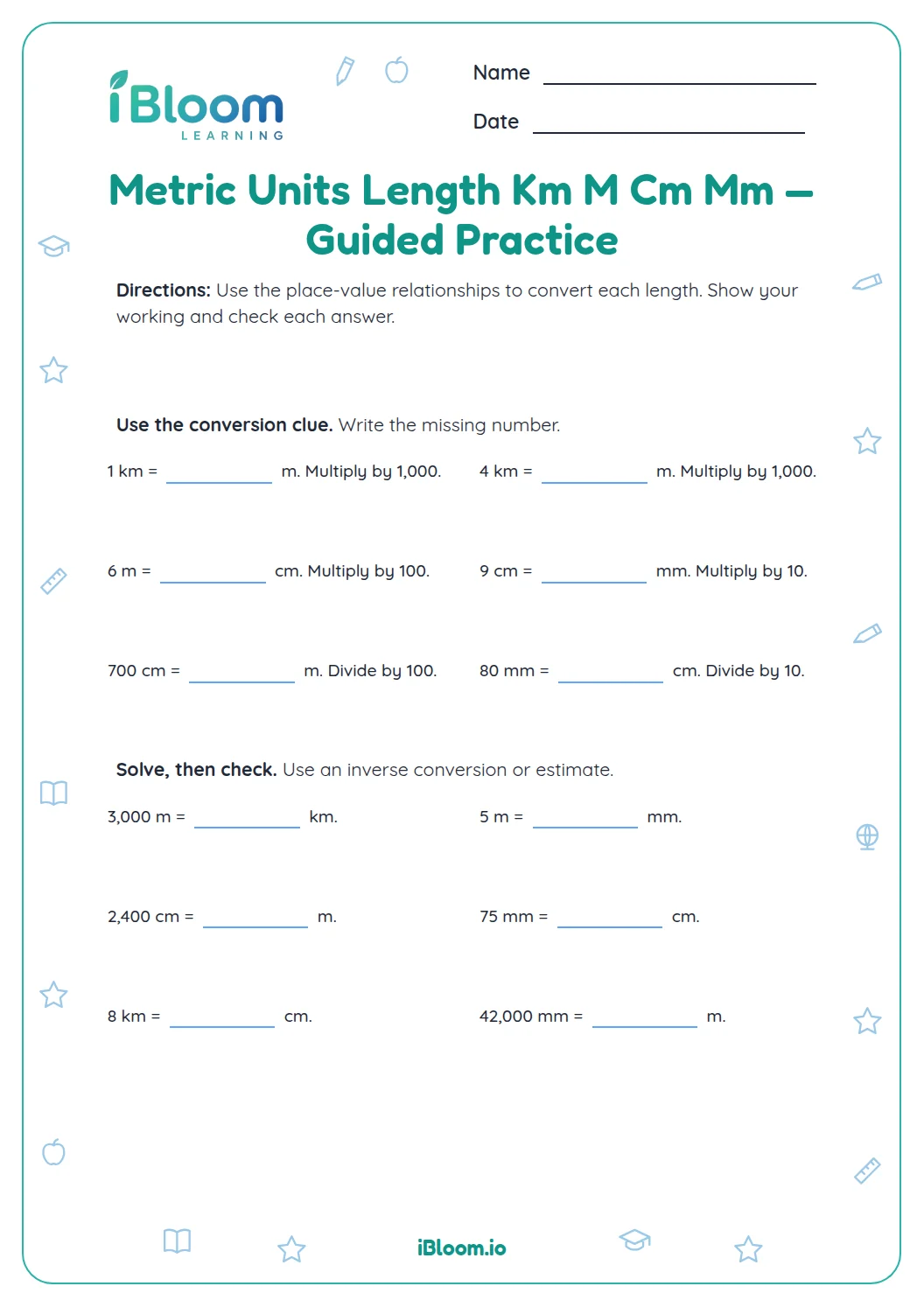
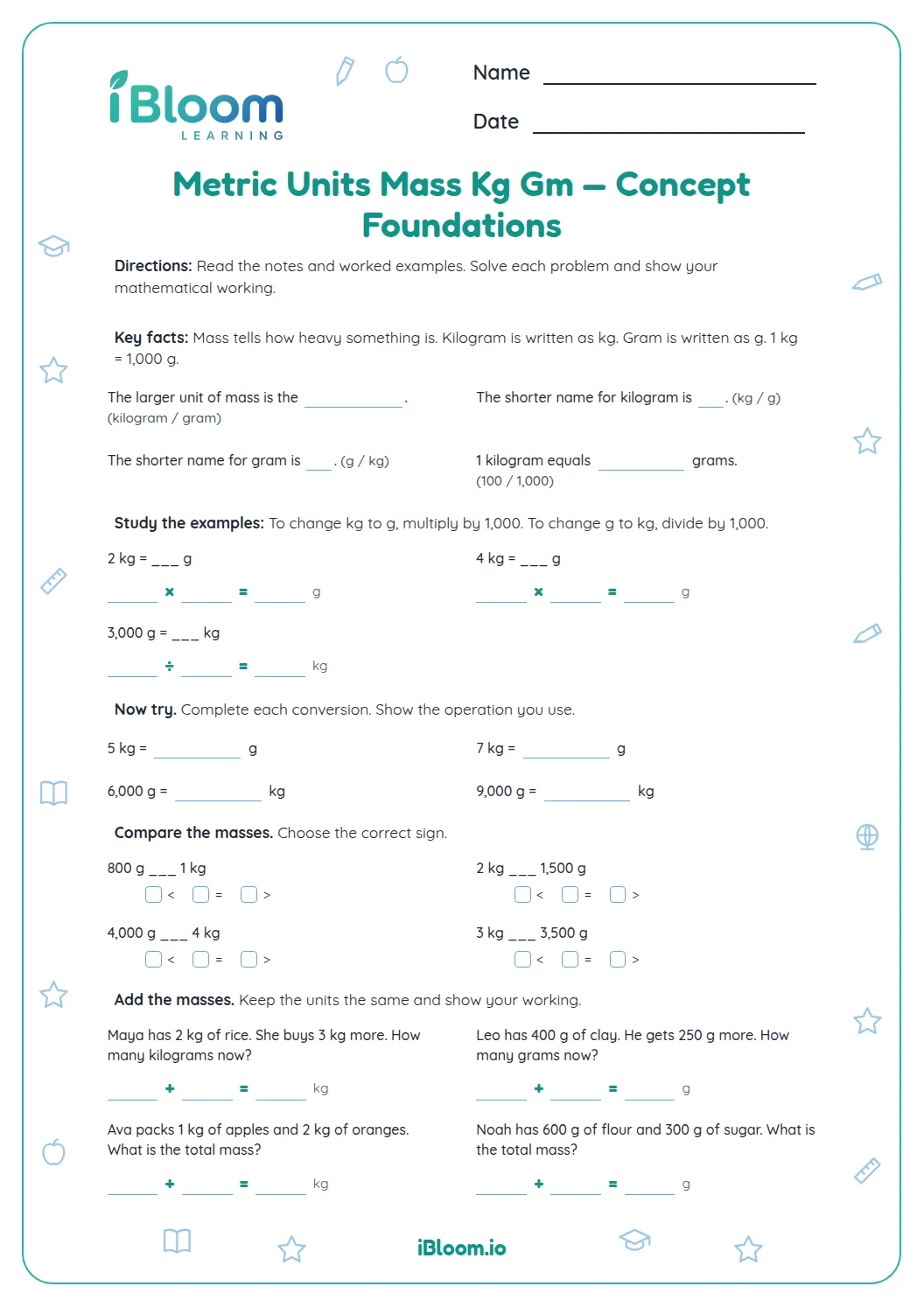
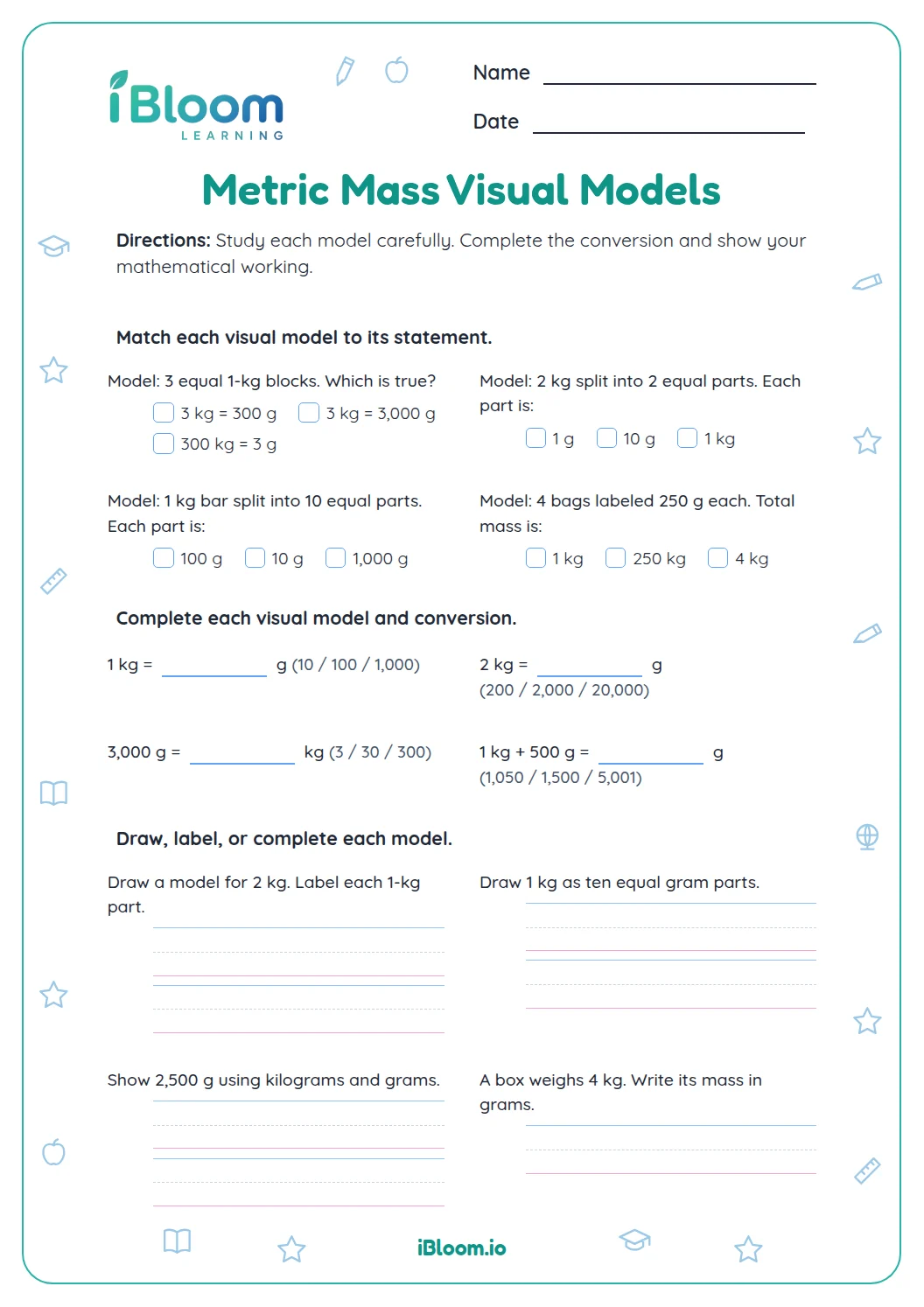
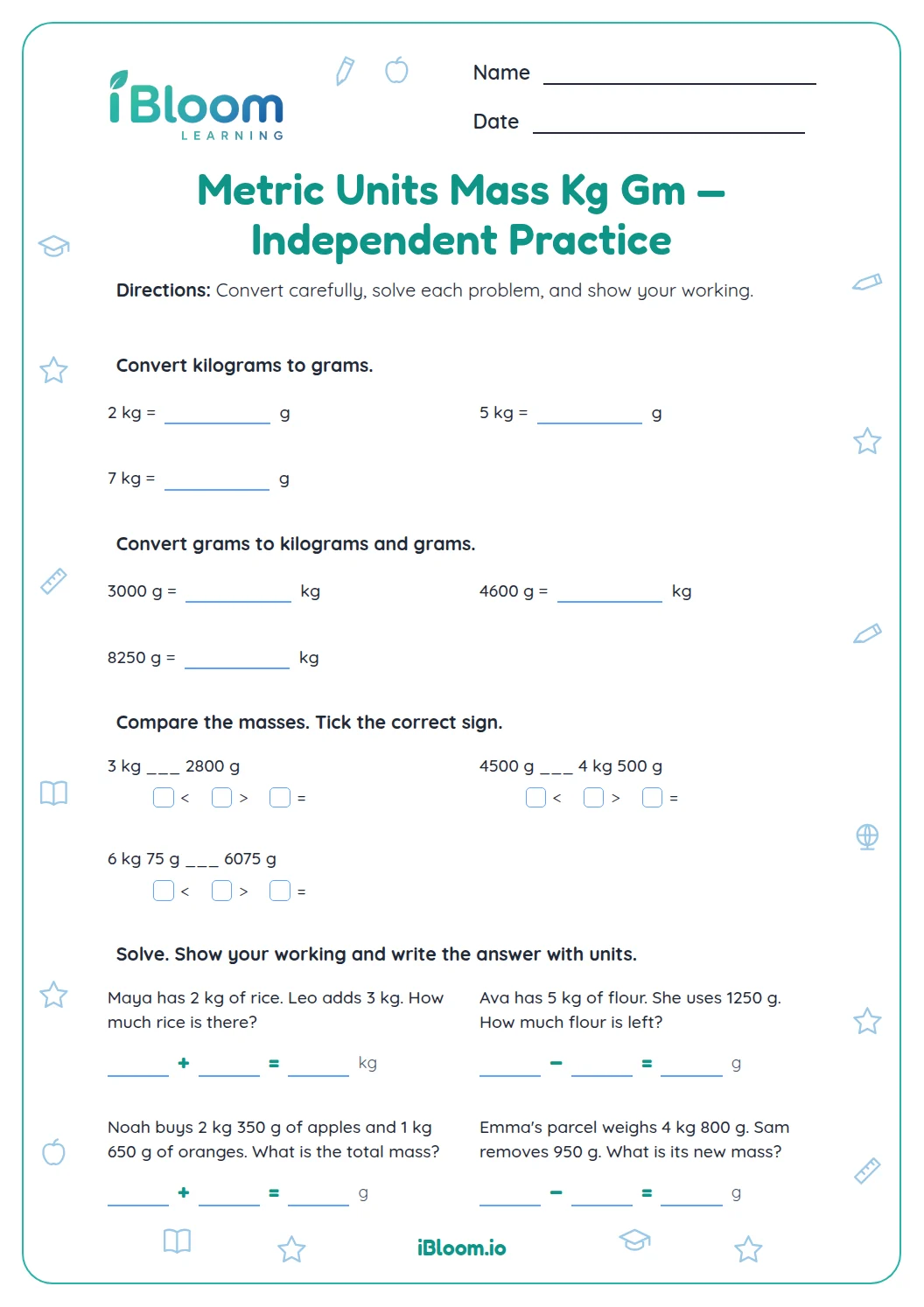
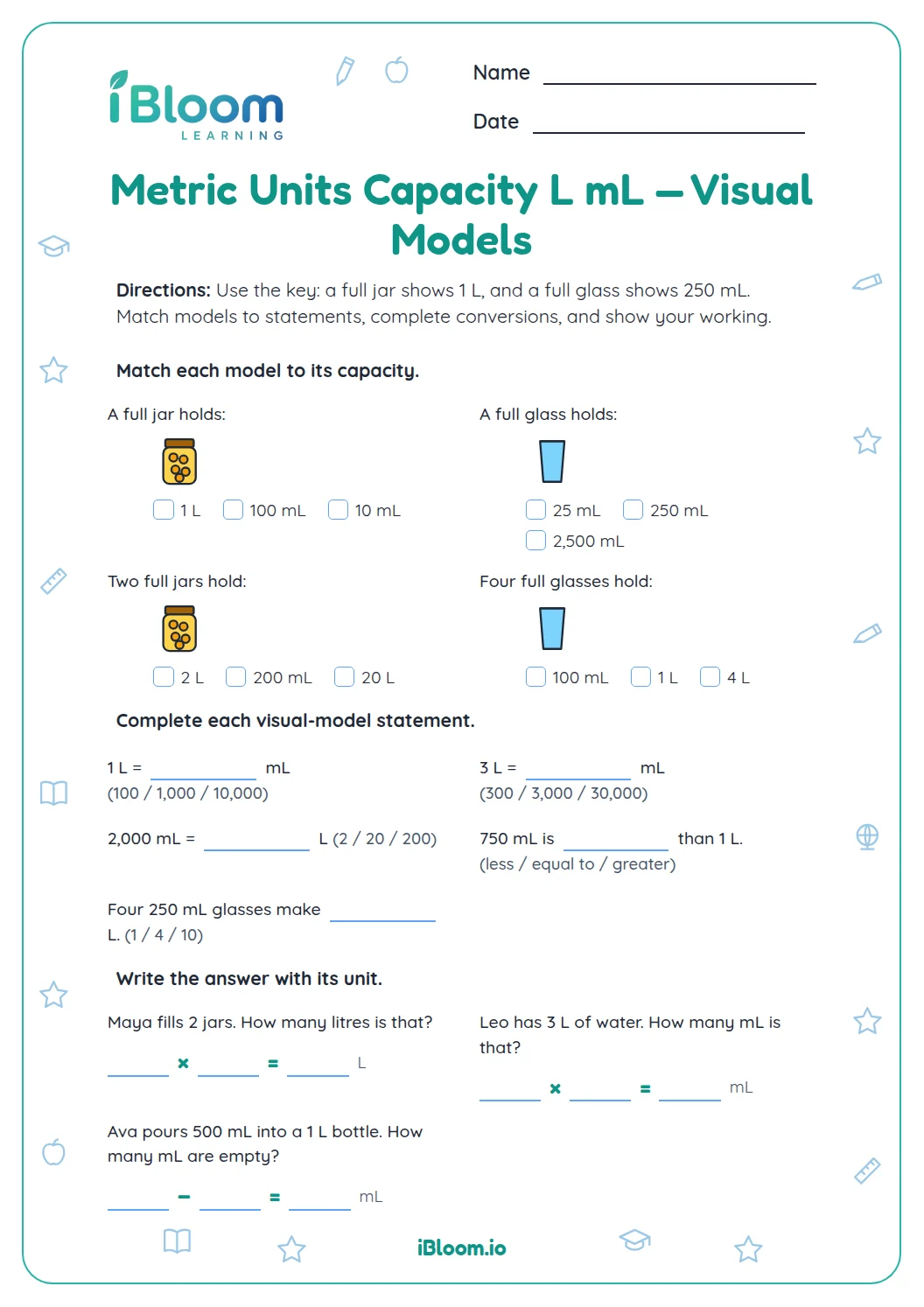
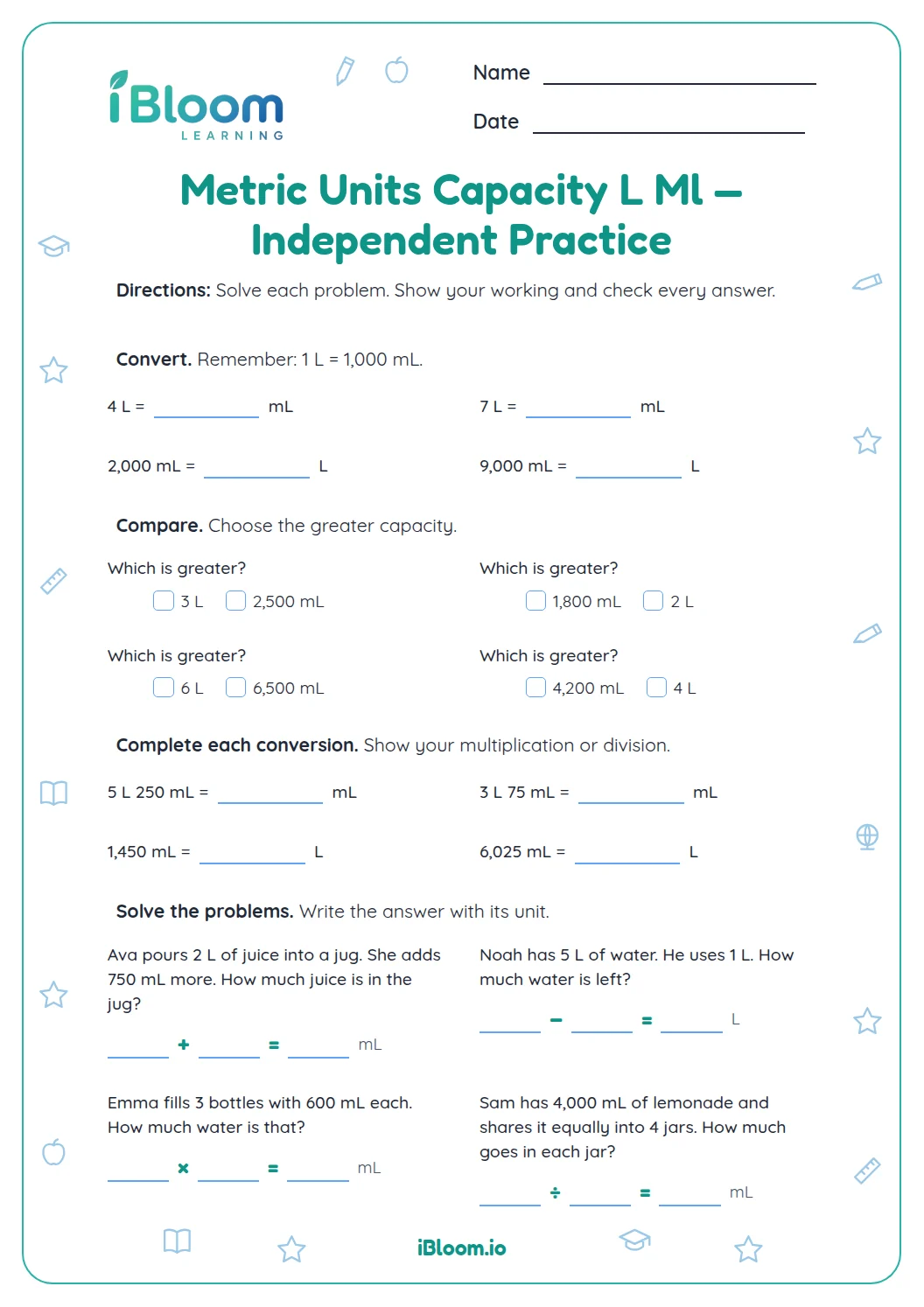
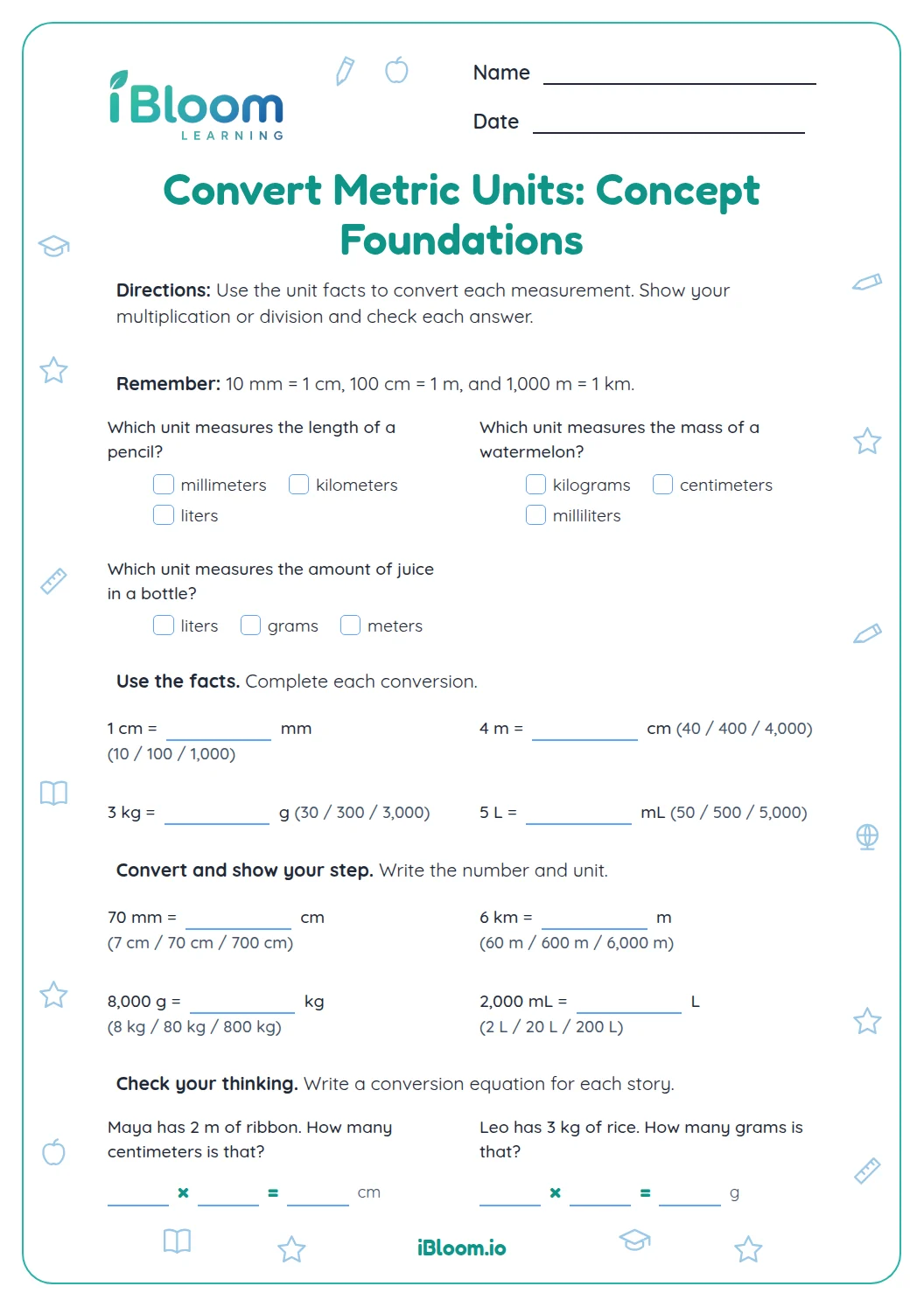
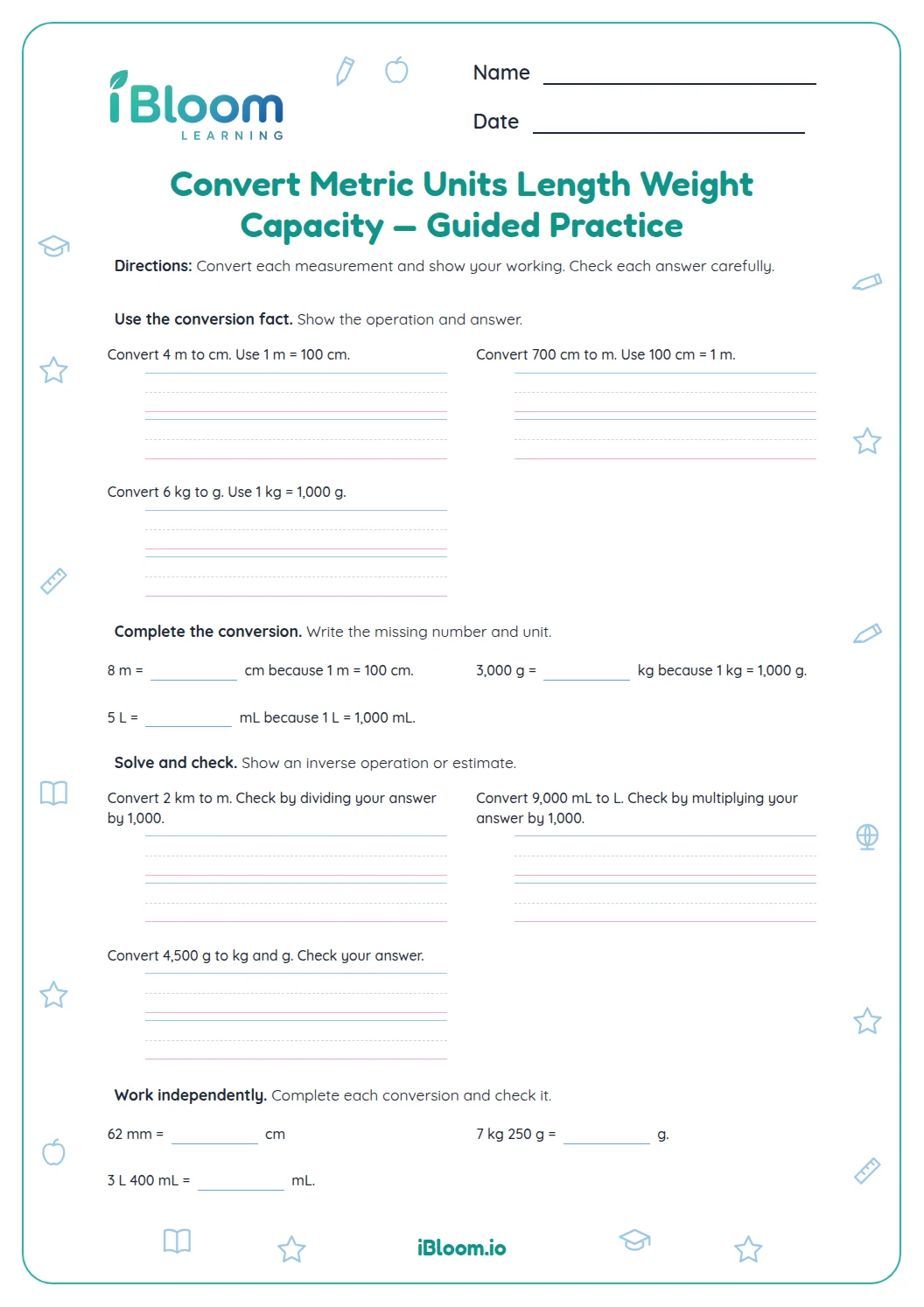
This free Grade 4 worksheet helps students read and choose metric abbreviations in familiar measurement contexts. Part A identifies unit symbols; Part B uses clues such as distance, mass, or capacity; Part C compares unit sizes and selects labels. Students work with km, m, cm, mm, kg, g, L, and mL. The questions connect to CCSS 4.MD.A.1, which includes relative sizes of metric units.
Aligned to 4.MD.A.1
How do students recognize a metric abbreviation?
Read the unit name first, then match its standard symbol. For example, a kilometer is written km and a gram is written g. Part A makes students distinguish symbols that may look similar but represent different kinds or sizes of units.
- 1Question 1 asks for kilometers.
- 2The correct abbreviation is km, not cm or mm.
How does context help choose a unit?
Ask what is being measured and how large the amount is. A bead’s width is a tiny length, while a trail is a long distance; a juice box holds milliliters, while a bathtub holds liters. Part B asks students to use those clues.
How are unit size and abbreviation connected?
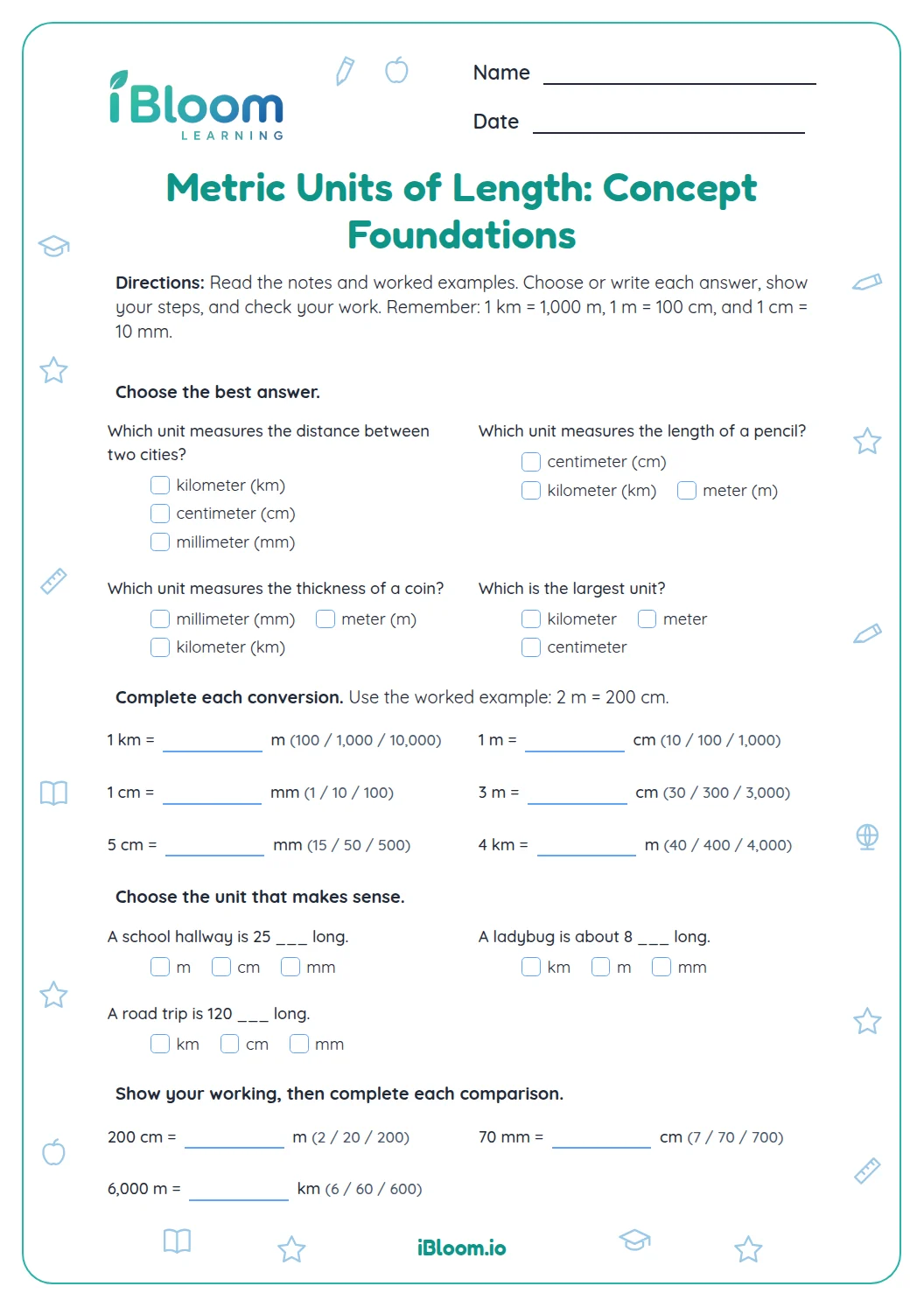
Metric prefixes signal relative size: kilo- means a larger unit, while centi- and milli- indicate smaller subdivisions. Part C asks students to use stated comparisons and familiar units. These questions practice matching the label; they do not ask students to calculate a conversion table.
- Length: km, m, cm, mm
- Mass: kg, g
- Capacity: L, mL
- Check both the quantity and unit family
How to use this worksheet
- 1Read the unit word before looking at the choices.
- 2Name whether the measurement is length, mass, or capacity.
- 3Use the context to estimate whether a large or small unit fits.
- 4Write symbols with the correct capital and lowercase letters.
- 5For comparison questions, identify the larger and smaller unit first.
Common mistakes and quick fixes
The mistake
Choosing a length abbreviation for a capacity measurement.
The fix
Name what is being measured before selecting the symbol.
The mistake
Writing “cms” or “kgs” as if the abbreviation takes a plural s.
The fix
Use the same unit symbol for one unit or many; write cm or kg.
The mistake
Confusing cm with km because both end in m.
The fix
Read the prefix: centi- is small, kilo- is large.
Common Core alignment
These standards describe the writing or math work practiced on this page.
Connect metric unit names and abbreviations to relative unit sizes.
On this sheet: Students identify metric abbreviations and reason about the relative sizes of the units they name.
Show the official wordingHide the official wording
Know relative sizes of measurement units within one system of units including km, m, cm; kg, g; lb, oz.; l, ml; hr, min, sec. Within a single system of measurement, express measurements in a larger unit in terms of a smaller unit. Record measurement equivalents in a two-column table. For example, know that 1 ft is 12 times as long as 1 in. Express the length of a 4 ft snake as 48 in. Generate a conversion table for feet and inches listing the number pairs (1, 12), (2, 24), (3, 36), ...
What to practice next
Make more practice
Questions parents and teachers ask
What abbreviations are practiced?
Students use km, m, cm, and mm for length; kg and g for mass; and L and mL for capacity. The page asks students to identify each symbol and apply it to simple everyday examples. The answer key lists the intended abbreviation for every question.
Why does the worksheet use both L and mL?
The uppercase L makes the liter symbol easy to distinguish from the numeral 1. The lowercase m before L means milliliters, a smaller capacity unit. Students should copy the capital and lowercase letters carefully so each written abbreviation names the intended unit.
Should a unit abbreviation have an s for plural?
No. Standard unit abbreviations do not add an s for plural amounts. Write 5 cm, not 5 cms, and 2 kg, not 2 kgs. This worksheet focuses on choosing the right abbreviation; the answer key shows the symbol in its standard form.
How does context help choose a metric unit?
Context gives a sense of scale and tells which quantity is measured. A trail is a long distance, a bead is very small, and a drink carton holds a modest amount of liquid. Those clues help students decide among kilometer, millimeter, liter, and milliliter.
What do students practice before converting metric units?
Students first connect unit symbols with the quantities and scales they measure. This sheet asks them to read abbreviations, choose units for familiar examples, and compare metric unit sizes. A related conversion worksheet can build on that knowledge by expressing measurements in equivalent units.
What should students practice next?
After recognizing the symbols, students can apply them in focused metric length, mass, and capacity worksheets. A conversion page then connects the abbreviations to equivalent amounts. That sequence moves from reading the unit label to using the relationship between units.