


About this worksheet
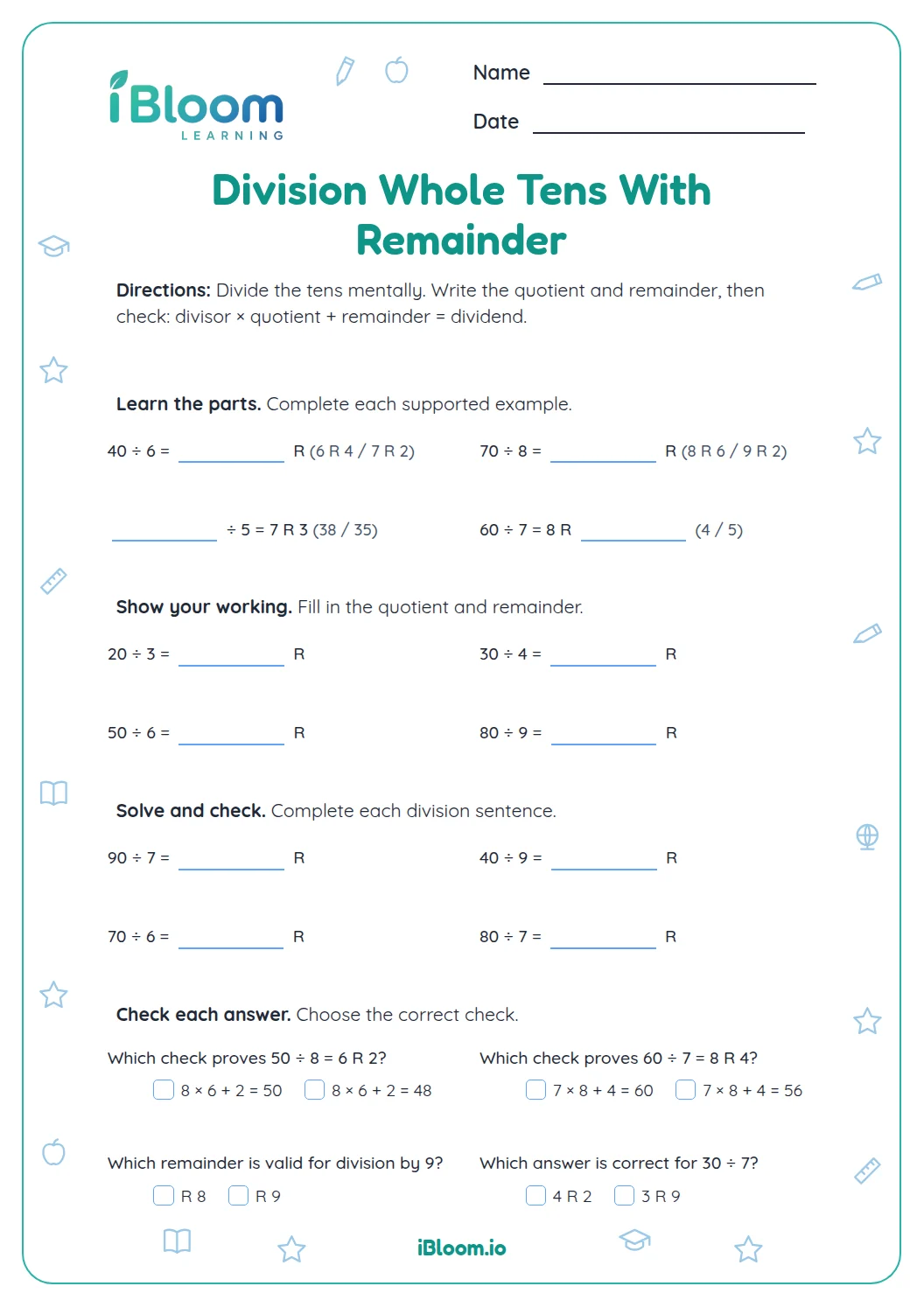
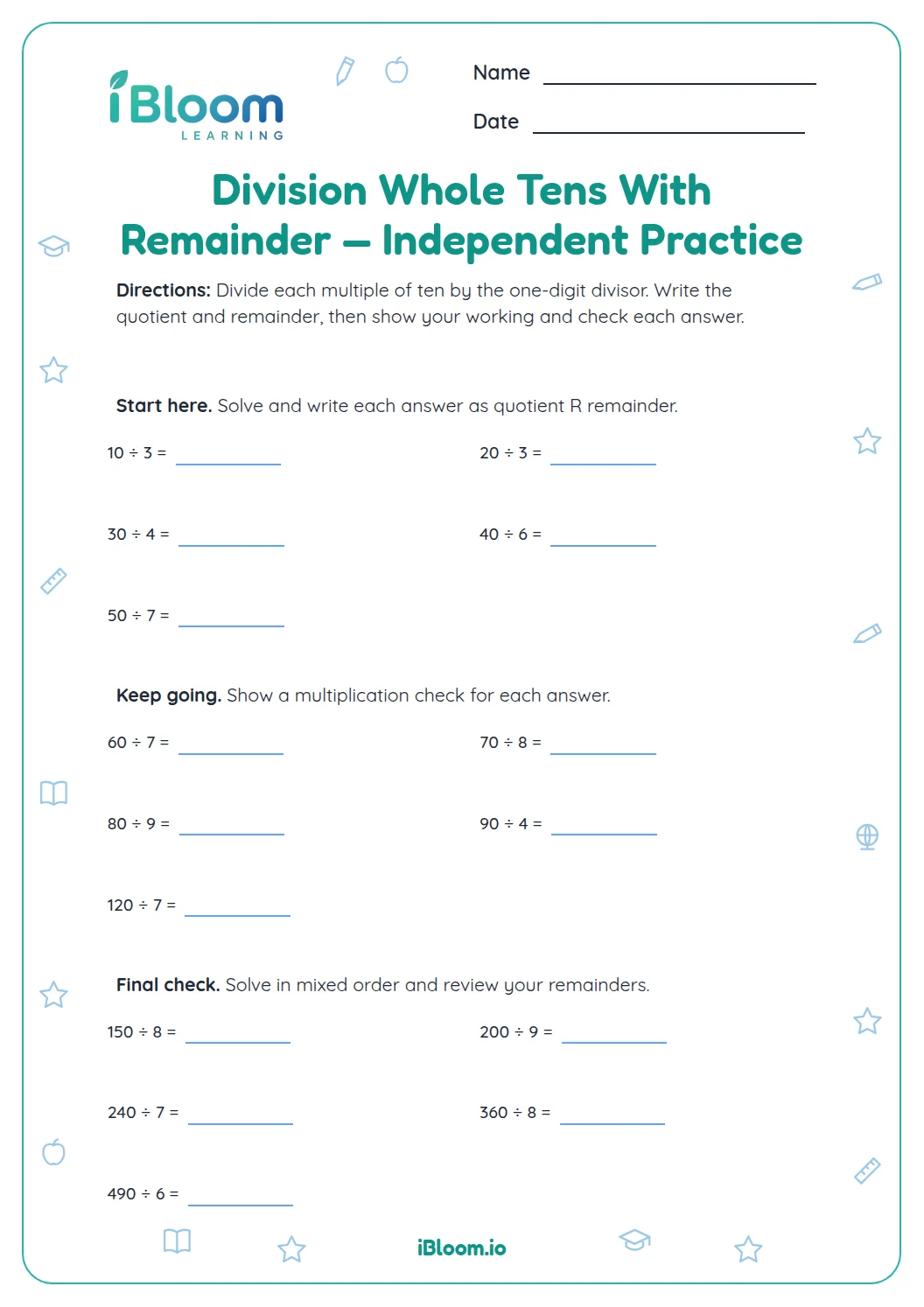
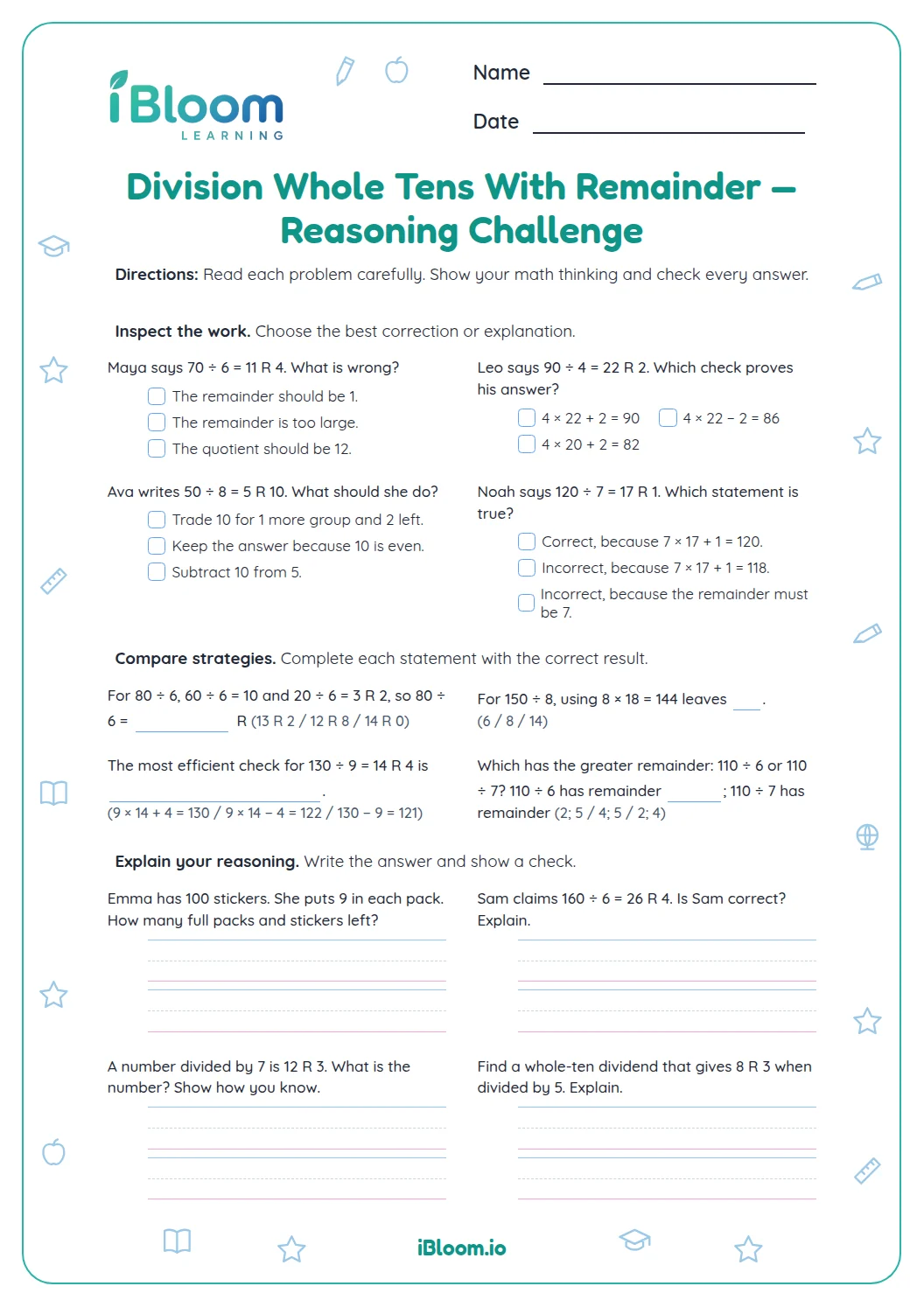
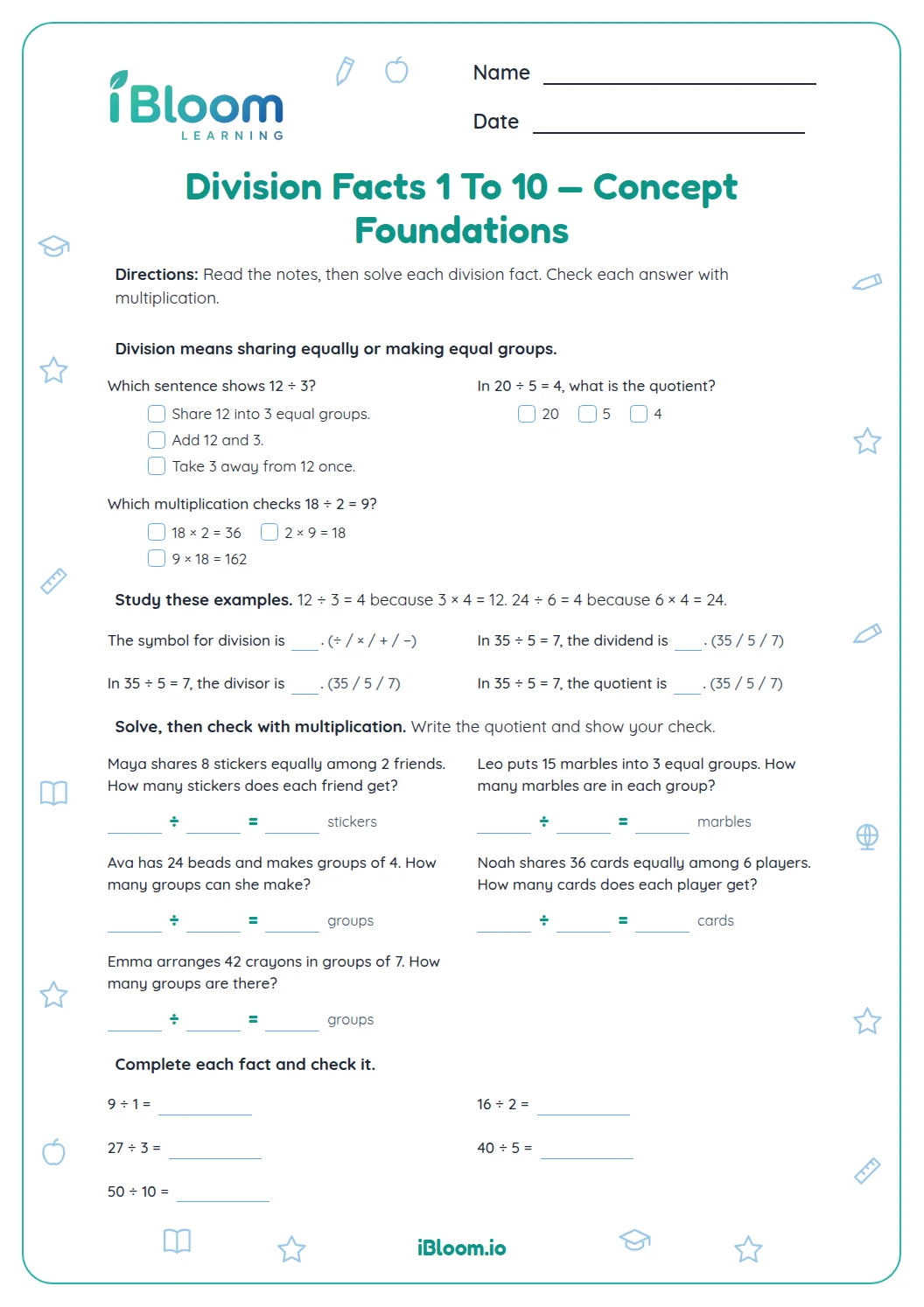
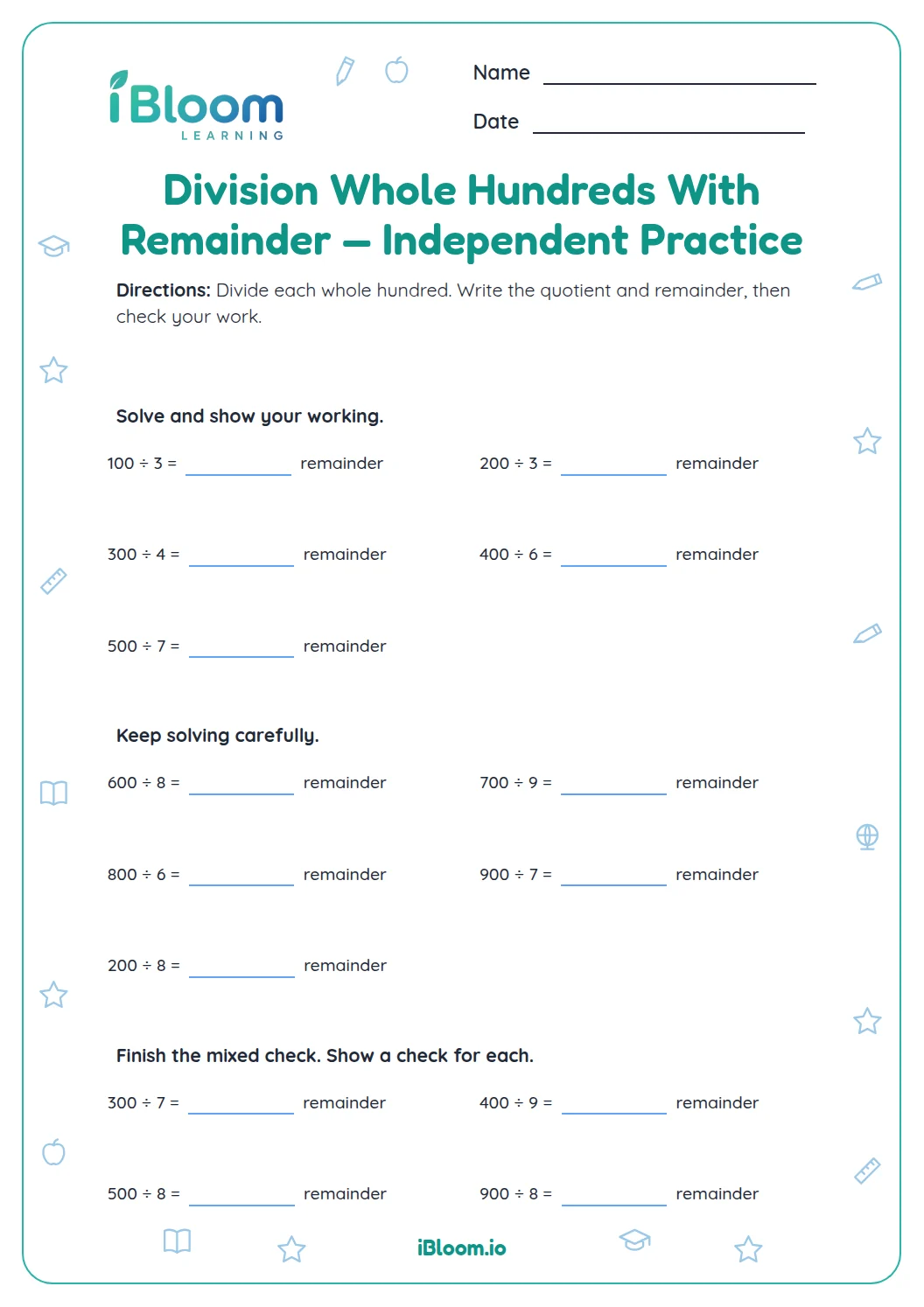
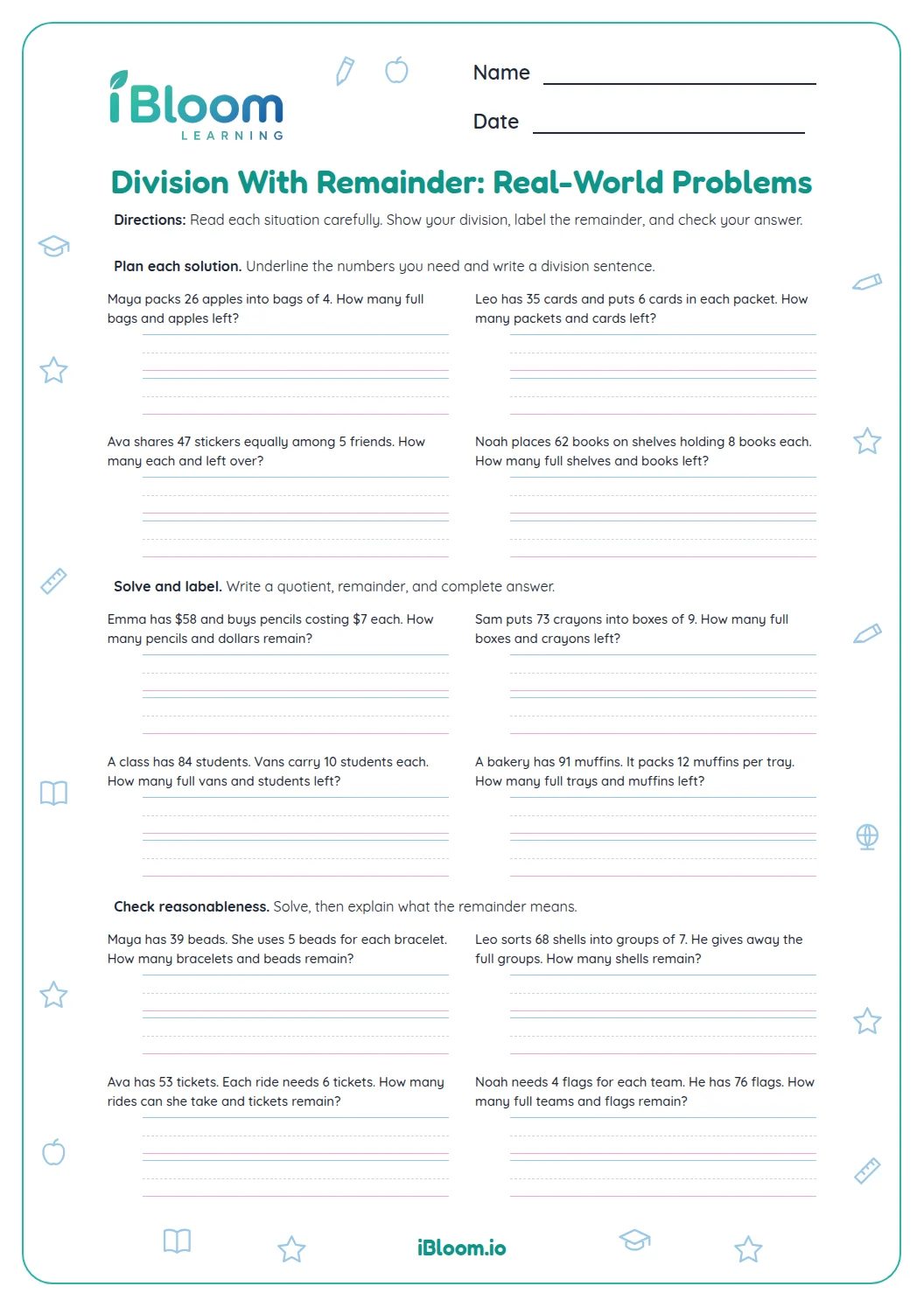
This free Grade 4 worksheet builds mental division strategies with multiples of ten and one-digit divisors. Students find each quotient and remainder, write multiplication checks, and solve sharing and grouping problems with units. It supports CCSS 4.NBT.B.6, which connects division strategies with multiplication and equations. A separate answer key includes the quotient, remainder and sample checks.
Aligned to 4.NBT.B.6
How do you find the quotient and remainder?
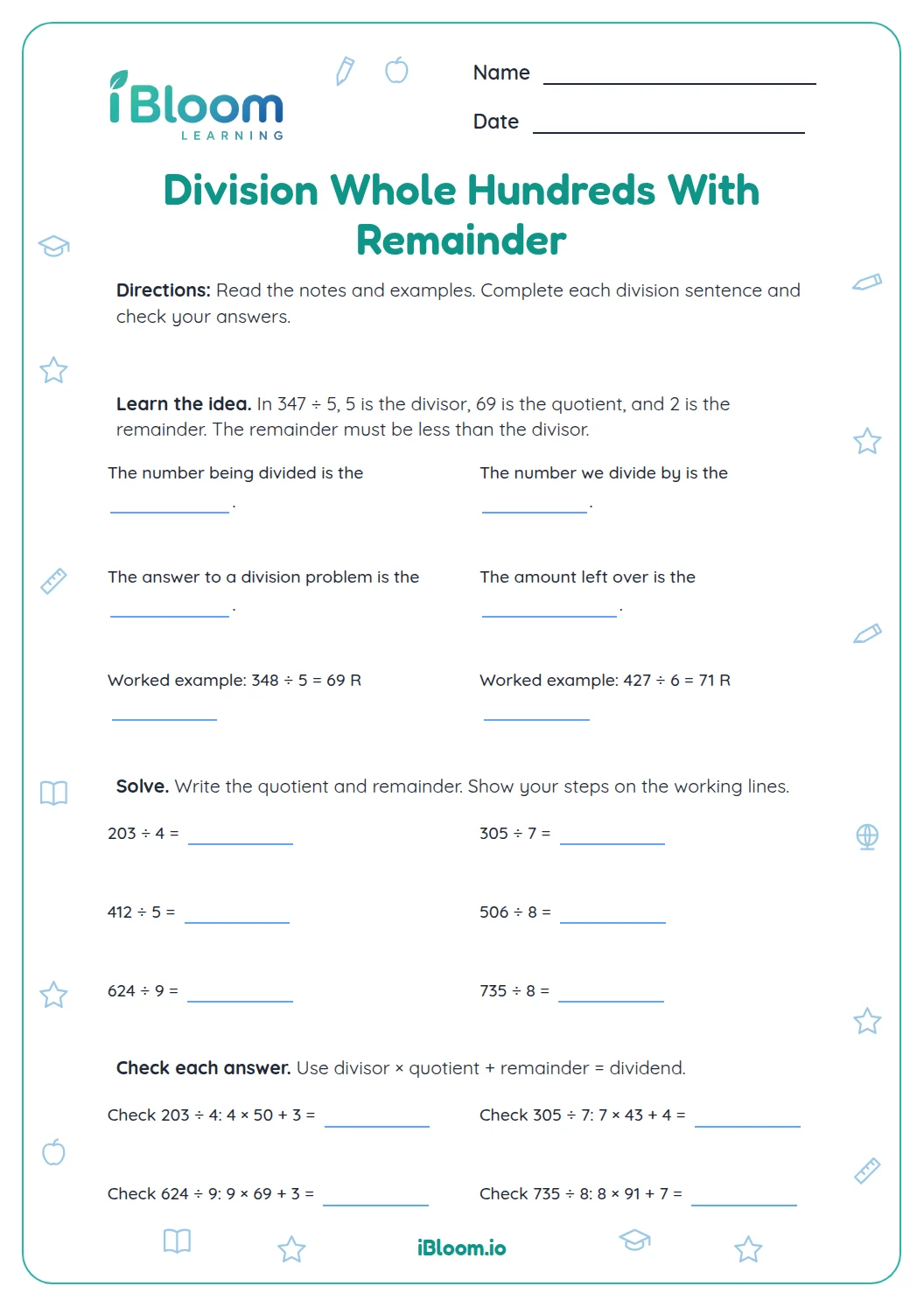
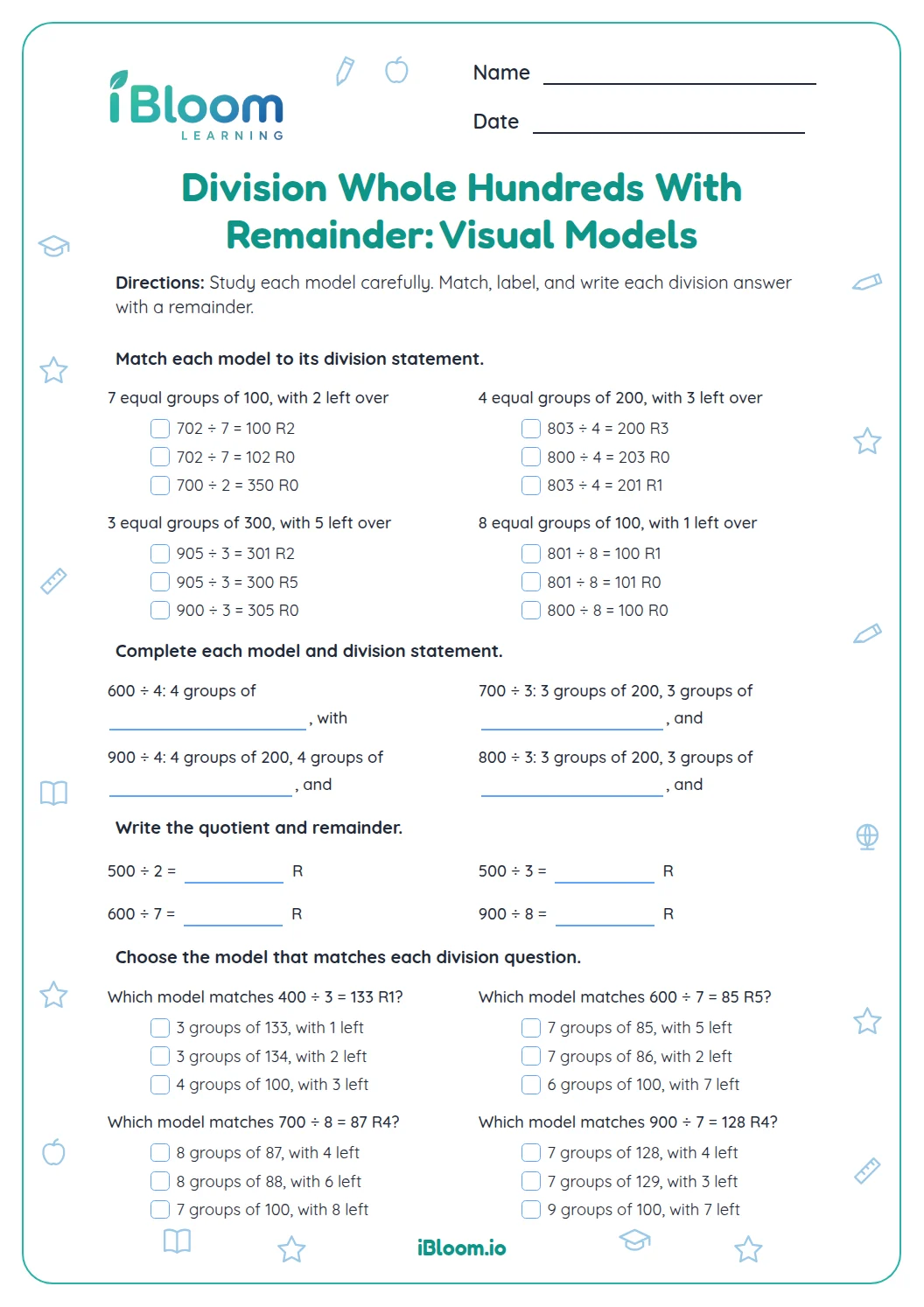
Find a multiple of the divisor that is close to the dividend without going over. The number of groups is the quotient; the amount left is the remainder. For 20 ÷ 3, six groups use 18, leaving 2.
A remainder must be smaller than the divisor. If 3 or more were left when dividing by 3, another group could be made.
- 120 ÷ 3 = 6 R 2
- 23 × 6 = 18; 20 − 18 = 2.
How can multiplication check a division answer?
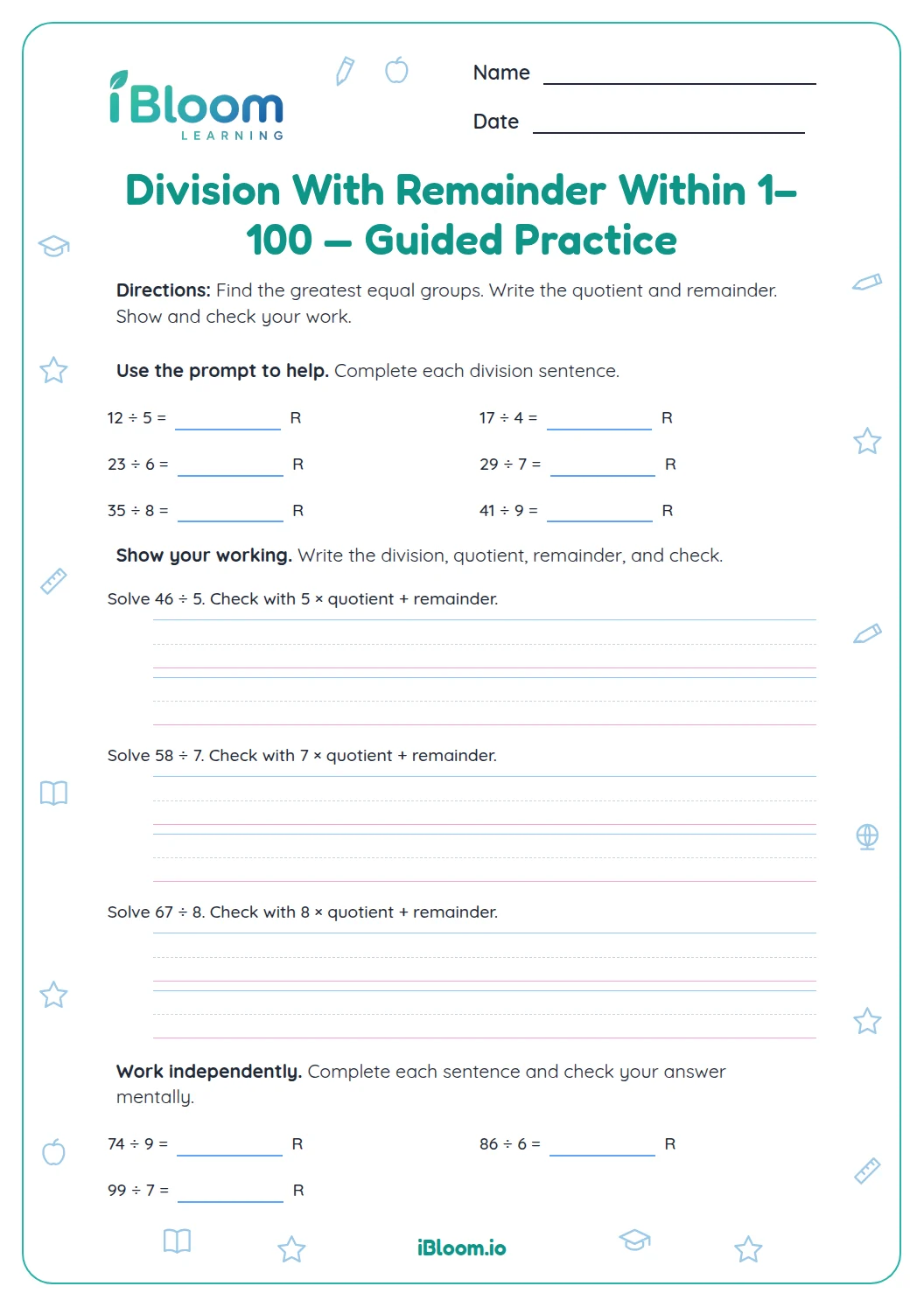
Multiply the divisor by the quotient, then add the remainder. The result should be the dividend. For 50 ÷ 4 = 12 R 2, 4 × 12 + 2 = 50. If the check is too small or too large, revisit the quotient or remainder.
This check also confirms that the remainder has not been carried into a new full group and that the quotient matches the original dividend.
- 14 × 12 + 2 = 50
- 2The equation returns to the starting dividend.
How do you explain a remainder in a story?
The quotient counts the full groups. The remainder tells how many items are left after those groups are made. Include both amounts and name what they count.
If 60 cones go into bags of 7, eight full bags use 56 cones and 4 cones remain. The 4 cannot fill another bag because a full bag needs 7.
How to use this worksheet
- 1Write the divisor and dividend in the division sentence.
- 2Find a nearby multiplication fact that stays at or below the dividend.
- 3Subtract the product to find what is left.
- 4Check that the remainder is less than the divisor.
- 5For a story, label both the full groups and leftover items.
Common mistakes and quick fixes
The mistake
Choosing a quotient whose product is greater than the dividend
The fix
Use the largest product that is still less than or equal to the dividend.
The mistake
Forgetting the remainder in the multiplication check
The fix
Add the remainder after multiplying divisor by quotient.
The mistake
Writing a remainder equal to or larger than the divisor
The fix
If that many are left, another group can be made; increase the quotient and subtract again.
Common Core alignment
The quotient, remainder and inverse check connect to Grade 4 strategies for whole-number division.
Find quotients and remainders with one-digit divisors using multiplication and place value.
On this sheet: Students divide multiples of ten by one-digit divisors, check the remainder and solve grouping stories.
Show the official wordingHide the official wording
Find whole-number quotients and remainders with up to four-digit dividends and one-digit divisors, using strategies based on place value, the properties of operations, and/or the relationship between multiplication and division. Illustrate and explain the calculation by using equations, rectangular arrays, and/or area models.
What to practice next
Make more practice
Further reading
Questions parents and teachers ask
What does R mean in a division answer?
R means remainder, the amount left after making as many complete groups as possible. In 20 ÷ 3 = 6 R 2, six groups of three use 18, and two remain. The remainder is less than the divisor, so another full group cannot be made; it is the leftover count from the original problem and check.
How can a student check a quotient and remainder?
Multiply the divisor by the quotient and add the remainder. For 90 ÷ 8 = 11 R 2, calculate 8 × 11 + 2. The result is 90, so the quotient and remainder fit the original dividend exactly.
How should a remainder be written in a word problem?
Name the full groups and the items left over. For example, 60 cones in bags of 7 makes 8 full bags with 4 cones left. The story helps decide whether the leftover amount should stay as a remainder or be described another way.
Why must a remainder be smaller than the divisor?
The divisor tells how many items are needed for one more full group. If 3 items remain when making groups of 3, the student can make another group, so the quotient was too small. A correct remainder is always less than the group size.
What does the answer key show?
The separate key lists all 16 quotient and remainder answers, the inverse checks, and the results for each grouping story. It also labels what is left over, which helps students connect the written remainder to the objects in the situation at a glance for quick checking by the student.