


About this worksheet
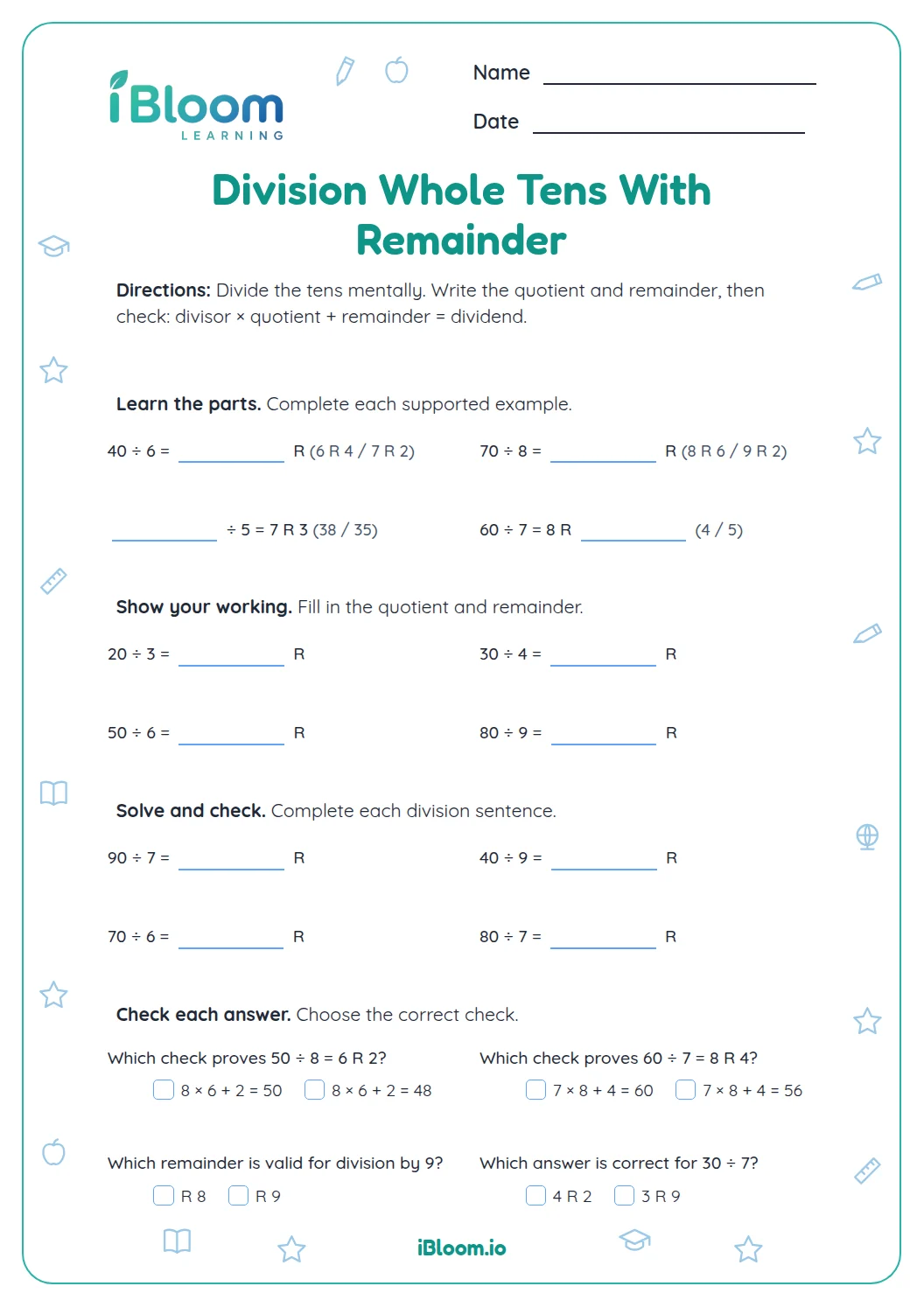
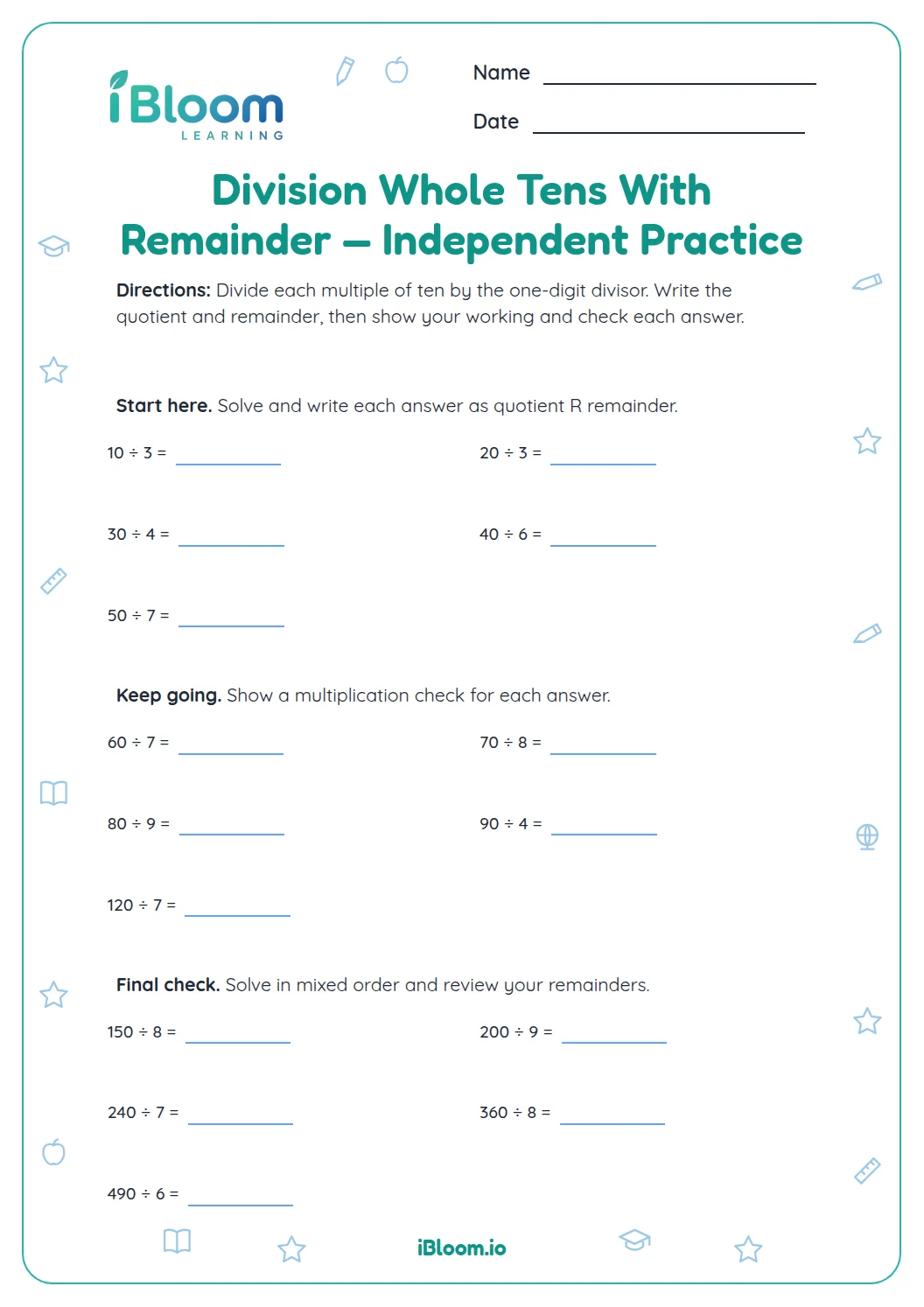
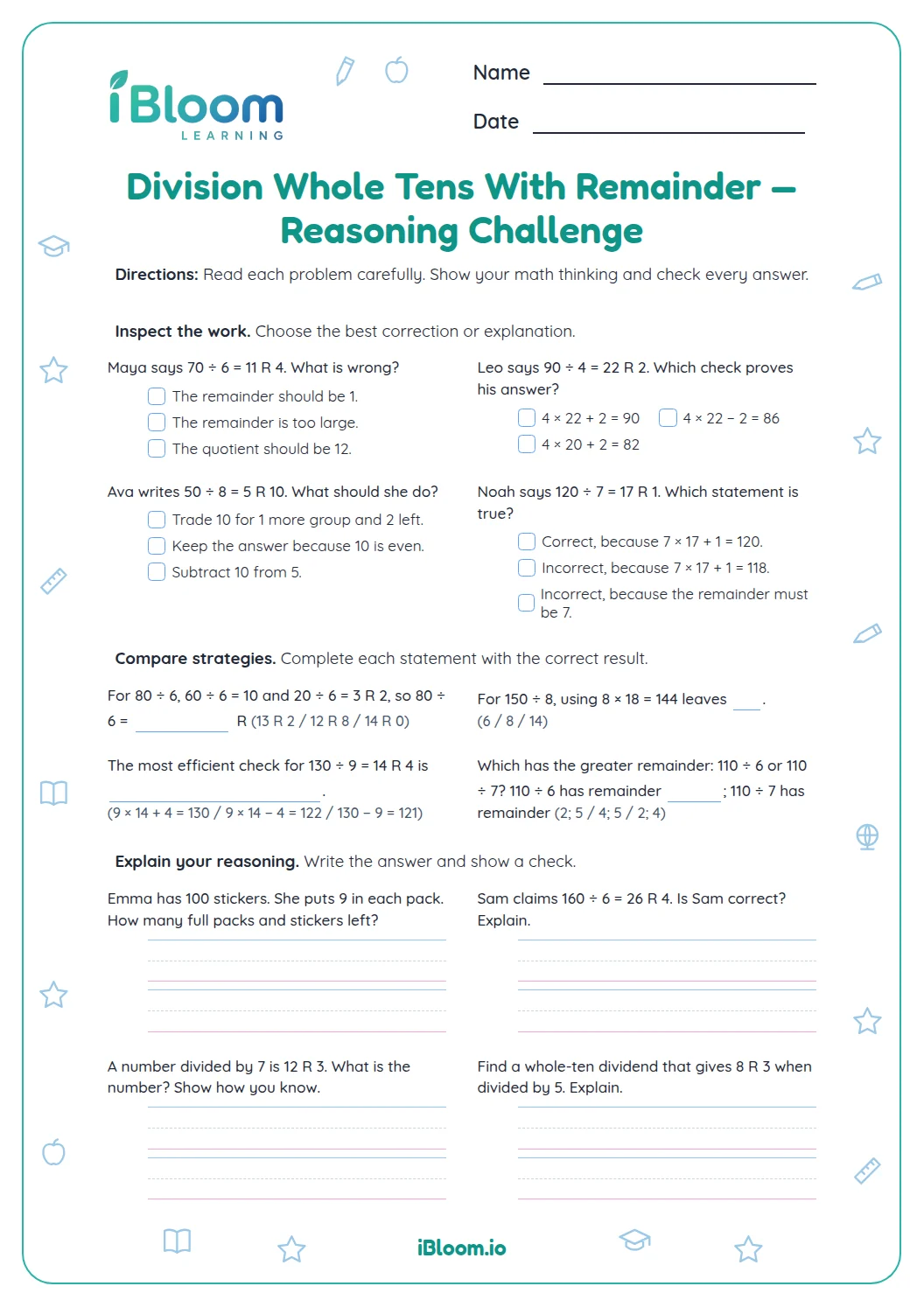
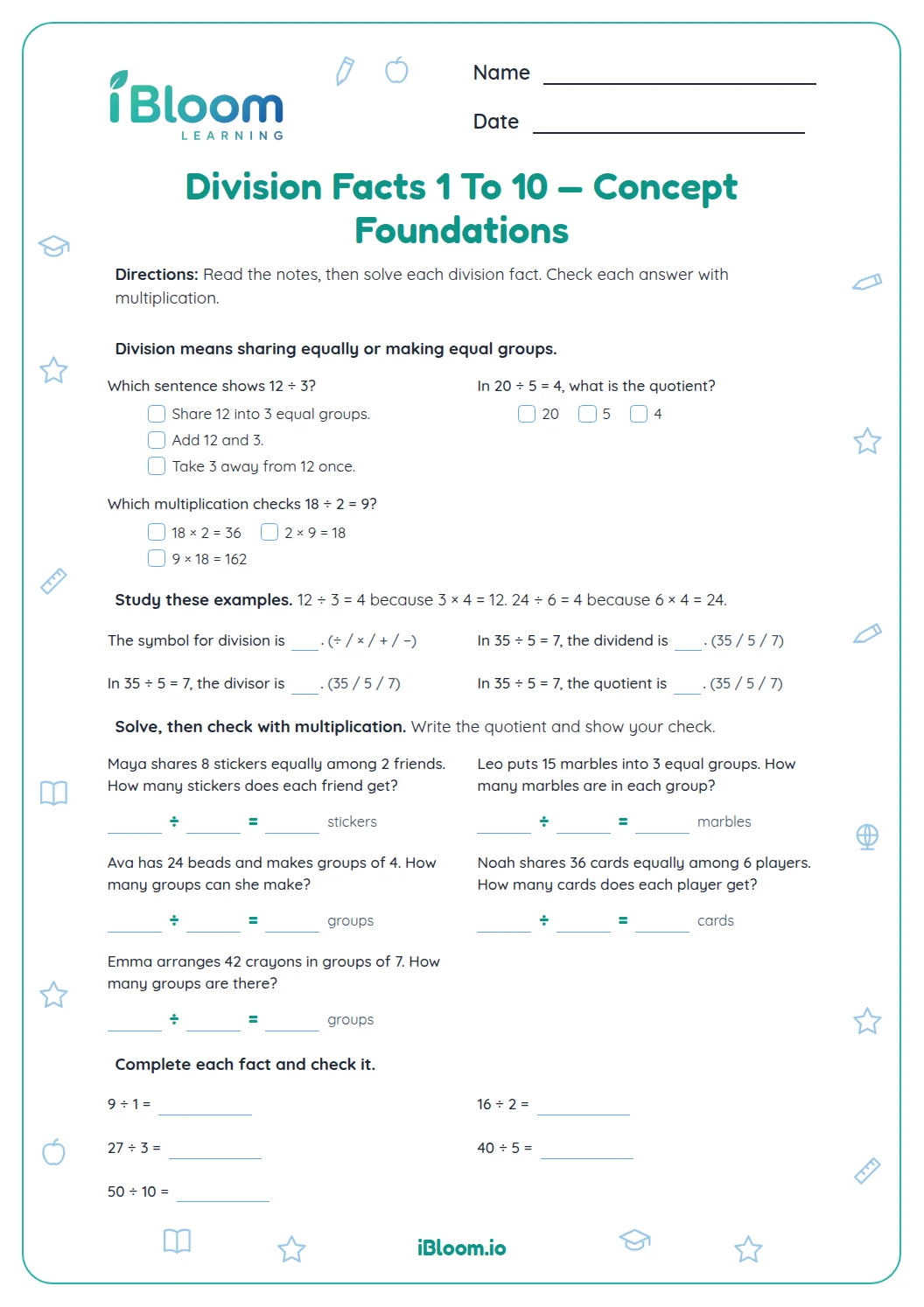
This free Grade 4 worksheet models division of whole tens by one-digit numbers. Children share 50, 70, 80, and 90 using base-ten rods, trading leftover tens for ones. Next, four number lines help children count complete divisor-sized intervals before a marked total. The last six questions check results using multiplication and the size of the remainder. These fourteen questions support Common Core 4.NBT.B.6 through place-value reasoning and the relationship between multiplication and division. A separate answer key gives each quotient and remainder and marks the correct checking statements.
Aligned to 4.NBT.B.6
How do tens rods show a remainder?
Each rod represents ten ones. In Part A, children imagine sharing the rods equally. A rod left after sharing is still worth ten, so it can be traded for ten ones and shared further. The final remainder counts ones.
Physical base-ten blocks or bundles of ten counters can help children rehearse the trade before writing the quotient and remainder.
- 150 ÷ 4: share 5 tens among 4 groups.
- 2Each group gets 1 ten; 1 ten remains.
- 3Trade that ten for 10 ones. Each group gets 2 ones; 2 remain.
- 4Answer: 12 R2. Check: 4 × 12 + 2 = 50.
How do the number lines show division?
In Part B, each tick-to-tick interval equals the divisor. Start at zero and count complete intervals ending before the dot. The dot marks the dividend. Subtract the last complete interval’s endpoint from that total to find the remainder.
For 50 ÷ 6, eight full jumps reach 48. The dot at 50 is two units farther, so the result is 8 R2. A ninth full jump would reach 54 and pass the total.
Why must the remainder be smaller than the divisor?
If the remainder is at least as large as the divisor, another complete group can be made. Question 10 gives 40 ÷ 6 = 5 R10. The ten leftover ones can make one more group of six, leaving four. The corrected result is 6 R4.
Use two checks: multiply the divisor by the quotient and add the remainder to recover the total; then confirm that the remainder is smaller than the divisor. Both checks matter.
Questions 13 and 14 add two more results to check. For 40 ÷ 3, 12 R4 uses the whole total but leaves enough for another group. Regroup to get 13 R1.
How to use this worksheet
- 1Review that each printed rod represents ten ones.
- 2Share the rods in Part A and trade leftover tens for ones.
- 3Write a whole-number quotient followed by R and the leftover ones.
- 4On each Part B line, count complete jumps from zero and find the remaining distance.
- 5Complete Part C by checking both the multiplication total and the remainder’s size.
Mistakes to check together
The mistake
Writing a leftover ten as a remainder of one.
The fix
Trade that rod for ten ones and finish sharing before naming the remainder.
The mistake
Counting the starting zero as a jump.
The fix
Count intervals between marks; the first jump ends at the first positive tick.
The mistake
Accepting 5 R10 for 40 ÷ 6 because the total checks.
The fix
Make another group of six from the ten leftover ones to get 6 R4.
Common Core alignment
Use place value and multiplication to find quotients and remainders.
On this sheet: Base-ten sharing, complete number-line jumps, and equation checks connect models to division results.
Show the official wordingHide the official wording
Find whole-number quotients and remainders with up to four-digit dividends and one-digit divisors, using strategies based on place value, the properties of operations, and/or the relationship between multiplication and division. Illustrate and explain the calculation by using equations, rectangular arrays, and/or area models.
What to practice next
Make more practice
Further reading
Questions parents and teachers ask
What does whole tens mean on this worksheet?
Whole tens means the starting totals are multiples of ten, such as 40, 50, 70, 80, and 90. Each total is divided by a one-digit number. The models help children see that a total ending in zero can still leave some ones after complete equal groups are made.
Do children need physical base-ten blocks?
No, the printed rods supply the starting model for Part A. Children can reason mentally about trading a ten for ten ones. If that trade is hard to imagine, physical rods and unit cubes or bundles of ten counters can make the sharing easier to follow before recording an answer.
Why does the dot sit between number-line marks?
The dot marks the total being divided, while each interval between tick marks equals the divisor. For 50 ÷ 6, the dot lies between 48 and 54. Eight full jumps reach 48, and two units remain to reach 50, so children write 8 R2 as the result.
What does the R in an answer mean?
R means remainder, the amount left after making all possible complete groups. In 12 R2 for 50 ÷ 4, the quotient is twelve and the remainder is two. Multiplying four by twelve and adding two returns fifty, and the remainder is smaller than the divisor, four.
Why is 5 R10 incorrect for 40 ÷ 6?
The remainder is too large because ten ones can form another group of six. Five groups of six use thirty of the forty ones. A sixth group uses six more, leaving four, so the correct result is 6 R4. The sheet asks children to choose that corrected result.