



About this worksheet
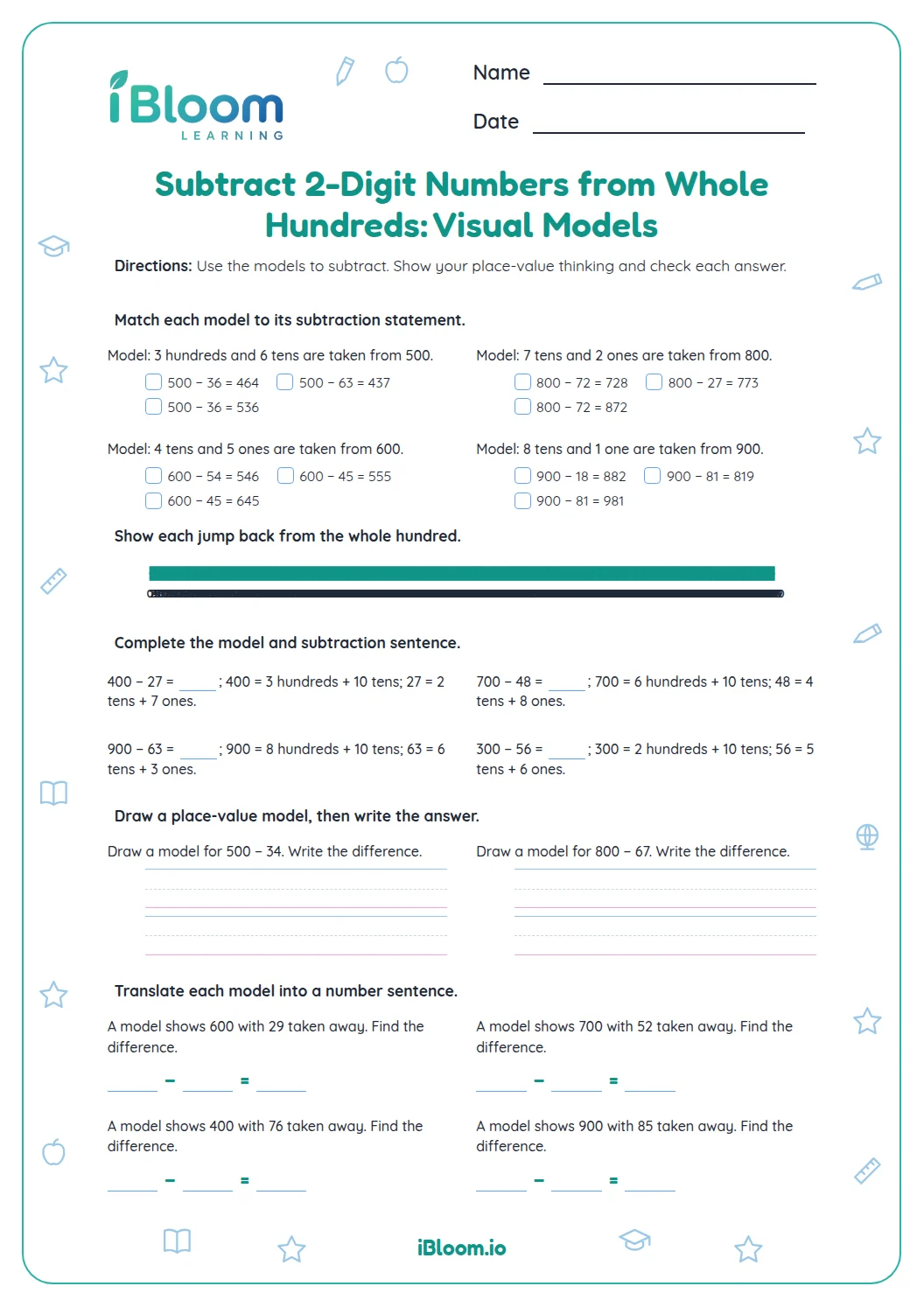
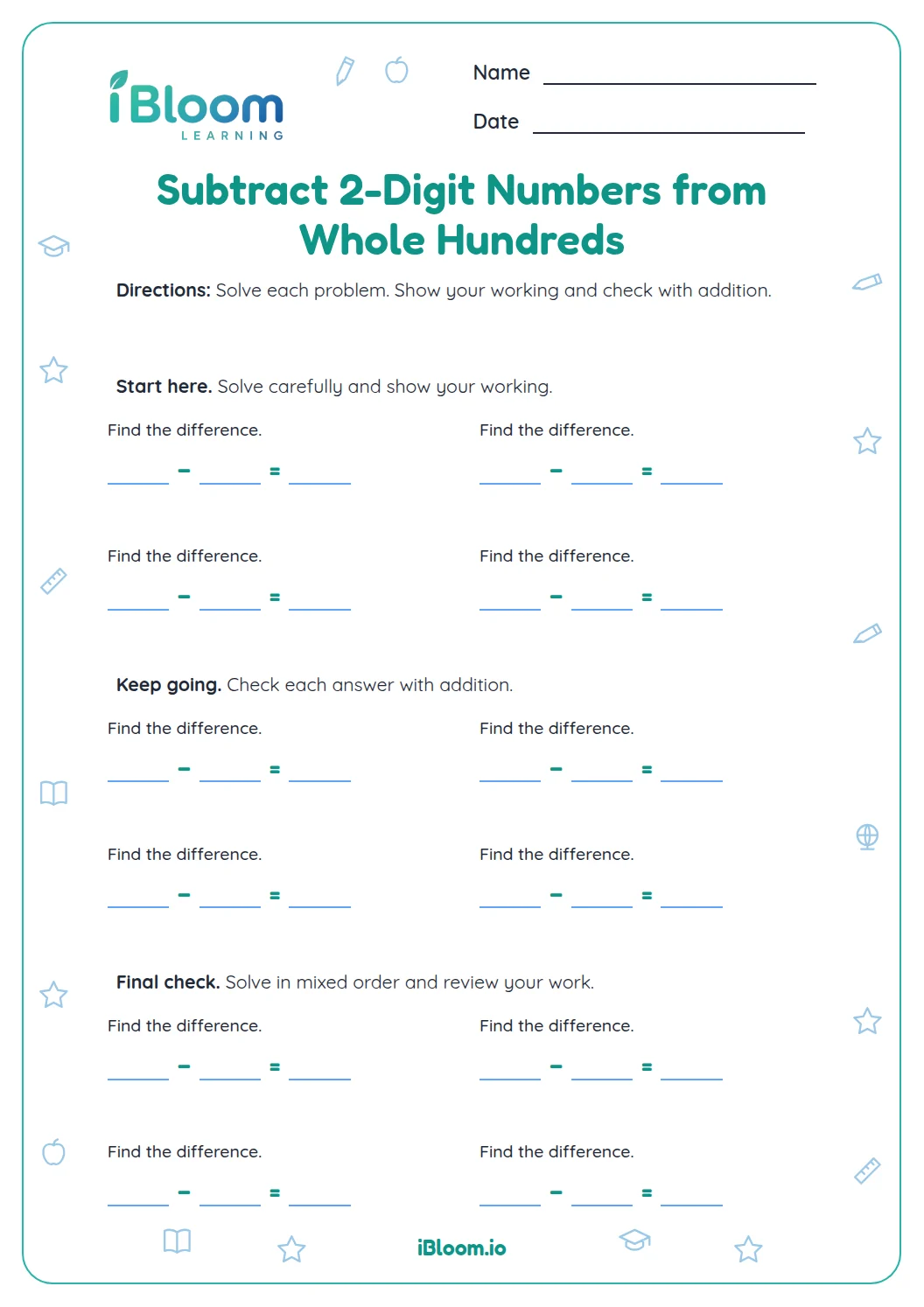
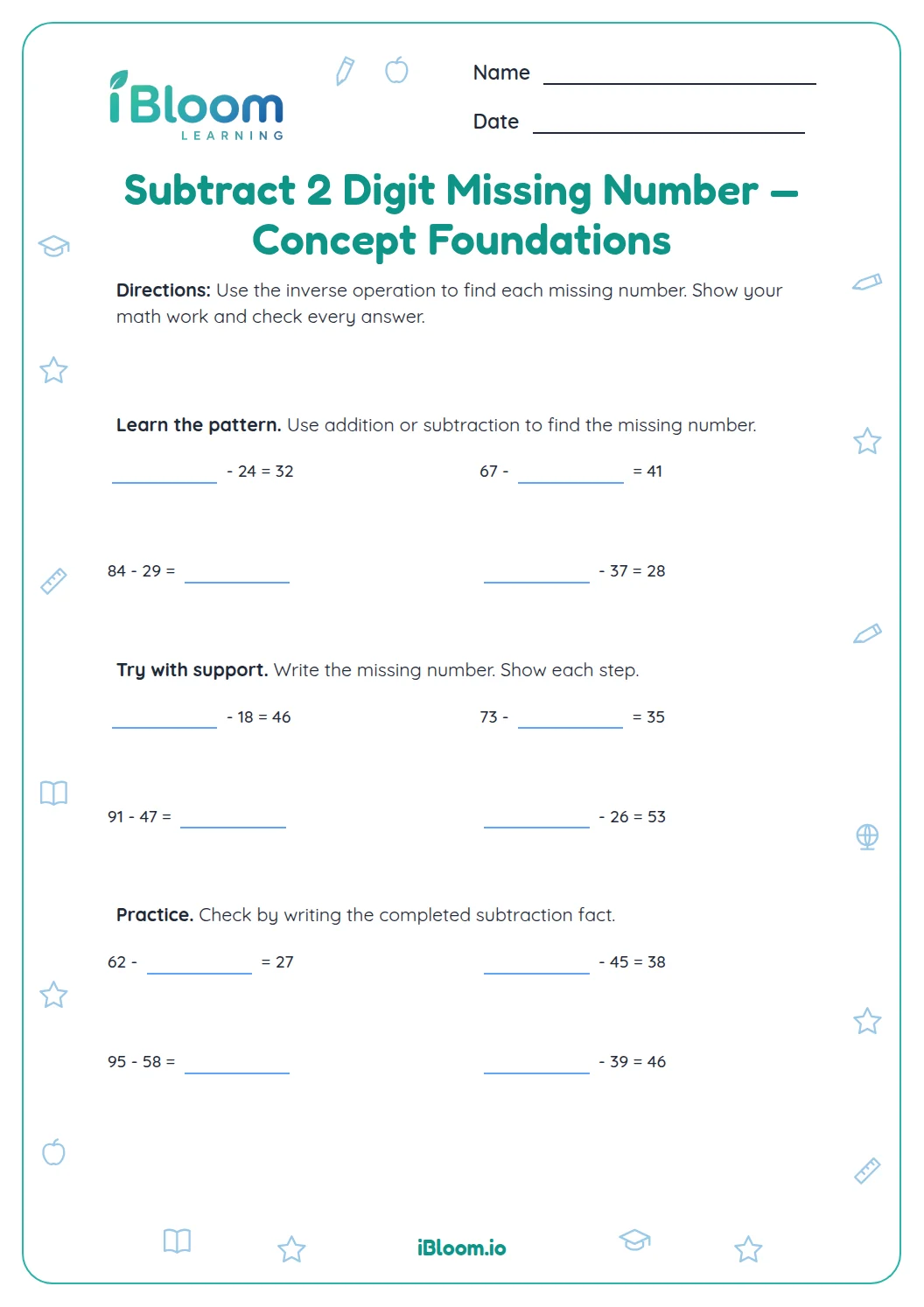
This Grade 4 printable practices subtracting a two-digit number from a whole hundred. Four short stories, six number sentences, and six error checks ask students to regroup across the hundreds place when needed. The 16 answers fit on two worksheet pages, with a separate answer key.
Aligned to 4.NBT.B.4
What happens when the ones digit is zero?
When subtracting from a whole hundred, rename one hundred as ten tens, then trade a ten for ten ones if needed. For question 1, 300 − 47 = 253 notebooks.
- 1300 − 47
- 2Regroup: 2 hundreds, 9 tens, 10 ones
- 3253 notebooks remain
How do the story problems show subtraction?
The number sentences practice the same regrouping without a story. Subtract the ones and tens after renaming the hundred, then add the difference back to check.
How can addition check a difference?
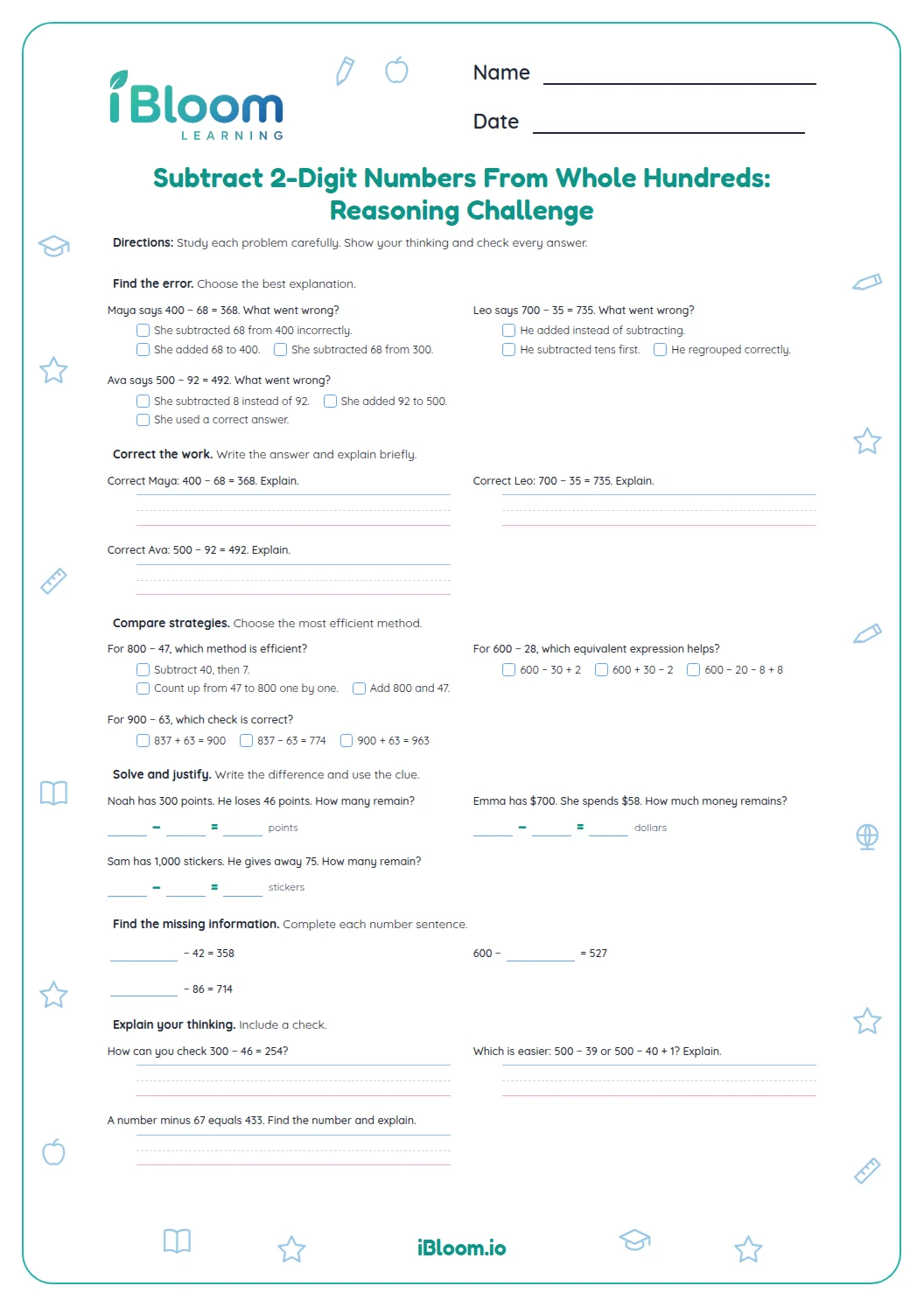
The final six items show a claimed equation with a blank for the correct result. Recompute each subtraction; several claims contain a borrowing error.
What should children check in an error analysis?
Compare each place value after regrouping. A difference that is ten too large may signal that the ones subtraction or regrouped tens were mishandled.
How to use this worksheet
- 1Read the starting amount and amount removed in each story.
- 2Write the subtraction equation before solving a word problem.
- 3Regroup a hundred into ten tens when the ones place needs it.
- 4Subtract ones, then tens, then hundreds.
- 5Add the amount removed to check the difference.
Common mistakes and quick fixes
The mistake
Subtracting 8 from the zero ones without regrouping.
The fix
Rename one hundred as 10 tens, then regroup one ten as 10 ones.
The mistake
Forgetting that regrouping changes the hundreds digit.
The fix
Cross out the original hundreds and write one fewer hundred.
The mistake
Accepting an answer that does not add back to the starting number.
The fix
Add the subtrahend to the difference to check.
Common Core alignment
This worksheet gives focused practice with the reading and math skills described below.
Use place value and the standard algorithm to subtract multi-digit whole numbers.
On this sheet: Use place value and the standard algorithm to subtract multi-digit whole numbers.
Show the official wordingHide the official wording
Fluently add and subtract multi-digit whole numbers using the standard algorithm.
What to practice next
Make more practice
Further reading
Questions parents and teachers ask
What is the regrouping method for these problems?
When a whole hundred has zero ones, rename one hundred as ten tens, then exchange one ten for ten ones. For example, 500 becomes 4 hundreds, 9 tens, and 10 ones before subtracting 86. Subtract by place and check by adding the difference back.
Which story problems are on the worksheet?
The four situations involve notebooks, bookmarks, apples, and tickets. Each gives a whole-hundred starting amount and a two-digit amount removed. Students find what remains, then use the same subtraction idea in number sentences and error checks. It puts subtraction in everyday situations.
How can a student check a difference?
Add the amount subtracted to the difference. For the notebook story, 253 + 47 = 300, which matches the starting amount. If the sum does not return to the whole hundred, revisit the regrouping and the place values. This confirms the operation.
What do the error questions ask students to notice?
Each error question gives a claimed result and asks for the correct difference. Students must calculate rather than trust a plausible-looking number. Adding the two-digit amount back to the corrected difference provides a quick way to verify it. The key lists each result.
Is this practice focused on whole hundreds?
Yes. Each calculation starts with a whole hundred, such as 400, 800, or 1,000, and subtracts a two-digit amount. Some problems require regrouping from the hundreds because the starting number has zero ones; others let students subtract directly by place.