

About this worksheet
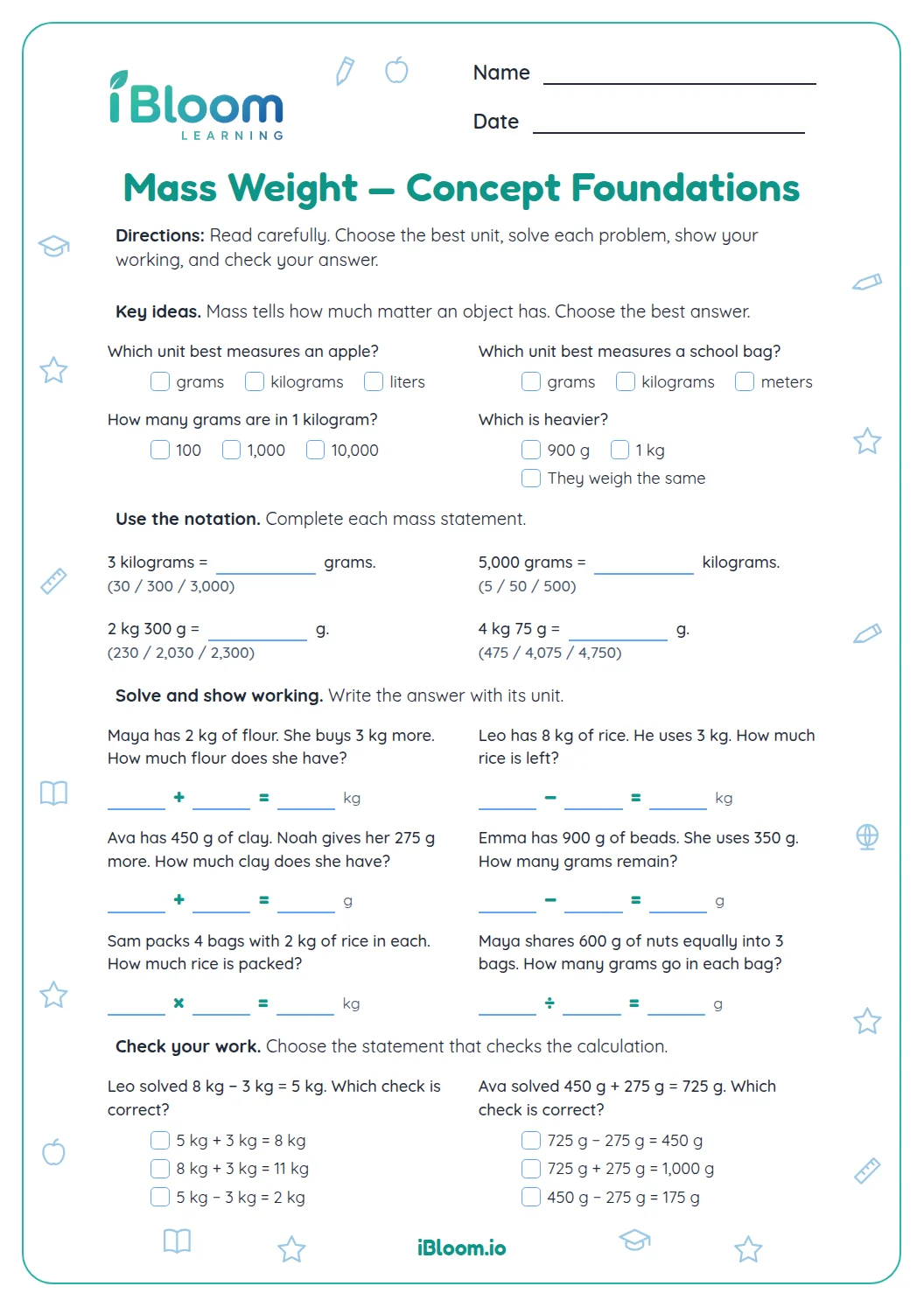
This Grade 4 printable gives students guided practice solving word problems about mass. The 14 questions begin with kilogram and gram conversions, then move through addition, subtraction, equal groups, and two-step situations. Students write each result with a unit and can show a calculation. It practices Common Core 4.MD.A.2, including mass problems and expressing measurements in smaller units. A separate answer key supports checking.
Aligned to 4.MD.A.2
How do kilograms and grams relate?
There are 1,000 grams in 1 kilogram. Convert to one unit before adding or comparing. For example, 2 kg 350 g is 2,350 g.
- Part A: change between kg and g
- Keep the unit with every result
How do you choose an operation?
Look for what the problem asks. “Combined” points to addition, “how much heavier” points to subtraction, and equal bags point to multiplication or division.
- Part B: solve a mass problem with an equation
- Part C: calculate totals and differences
- Part D: solve multi-step mass problems
How can you check a mass answer?
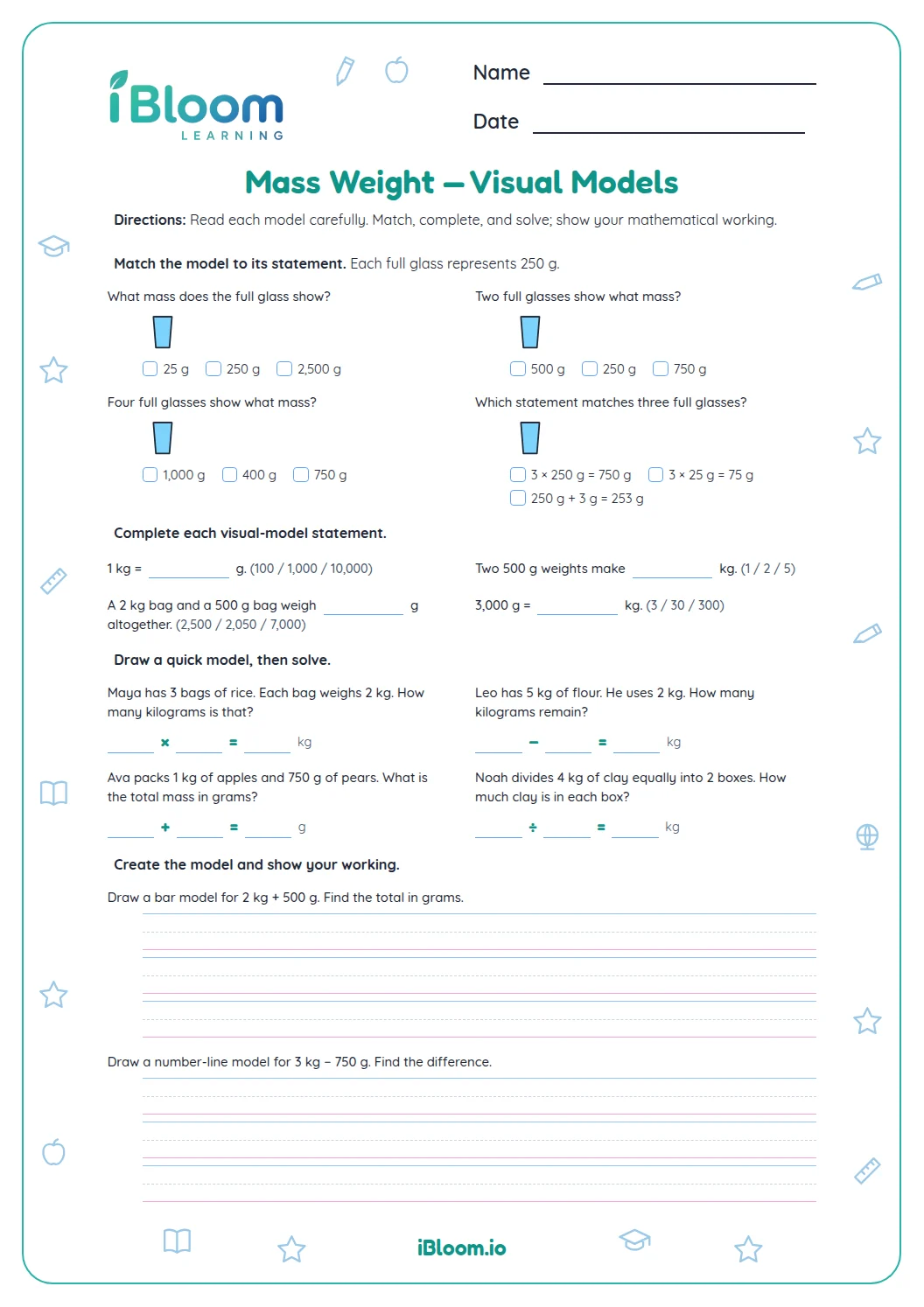
Ask whether the unit is consistent and whether the result is sensible. Four 250 g bags make 1,000 g, which is exactly 1 kg.
- Convert mixed units before calculating
- Estimate the size of the result
How to use this worksheet
- 1Read the last sentence first to identify what quantity is missing.
- 2Underline the given masses and units.
- 3Convert all masses to the same unit when needed.
- 4Write an equation, calculate, and label the answer.
- 5Use the key to find any unit or operation error.
Common mistakes and quick fixes
The mistake
Adding kilograms directly to grams in question 10.
The fix
Change both masses to grams before adding.
The mistake
Subtracting mixed units without converting in question 6.
The fix
Rewrite 3 kg 650 g as 3,650 g before subtracting.
The mistake
Dividing 6 kg by 8 without changing units in question 12.
The fix
Convert 6 kg to 6,000 g, then share 6,000 g equally.
Common Core alignment
These Grade 4 problems practice measurement calculations in mass contexts.
Solve mass word problems with operations and unit conversions.
On this sheet: Questions use addition, subtraction, multiplication, division, and kg-to-g conversions in mass contexts.
Show the official wordingHide the official wording
Use the four operations to solve word problems involving distances, intervals of time, liquid volumes, masses of objects, and money, including problems involving simple fractions or decimals, and problems that require expressing measurements given in a larger unit in terms of a smaller unit. Represent measurement quantities using diagrams such as number line diagrams that feature a measurement scale.
What to practice next
Make more practice
Further reading
Questions parents and teachers ask
How many problems are on the sheet?
There are 14 problems in four parts. They begin with kilogram and gram conversions, then practice mass calculations and multi-step situations. Students can write an equation or conversion in the work space. The separate key gives a result with the requested unit for every question.
Does the worksheet use both grams and kilograms?
Yes. The first questions convert between kilograms and grams, and later problems use both units. When units differ, convert before adding or subtracting. Keeping the unit beside each number helps children see whether a result should be in grams or kilograms.
What does 1 kilogram equal?
One kilogram equals 1,000 grams. To change kilograms to grams, multiply by 1,000. For example, 2 kg is 2,000 g, so 2 kg 350 g is 2,350 g. Several questions use this relationship before students calculate a total or difference.
Should students show their work?
Yes. The word problems provide space for a calculation. Writing the conversion and operation makes it easier to catch a unit mismatch, especially when a problem combines kilograms and grams. The answer key can then be used to check both the result and its unit.
What can my child practice next?
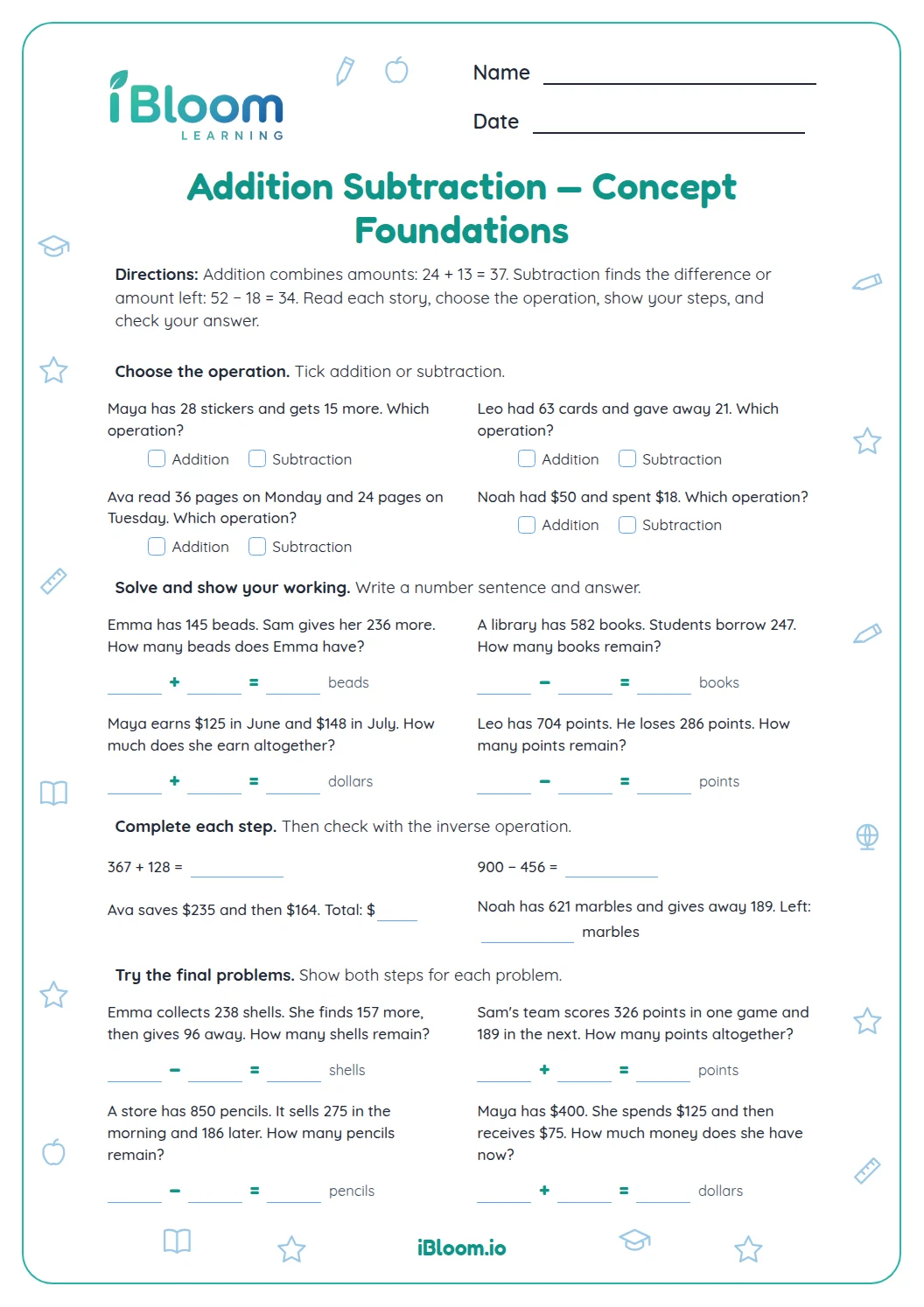
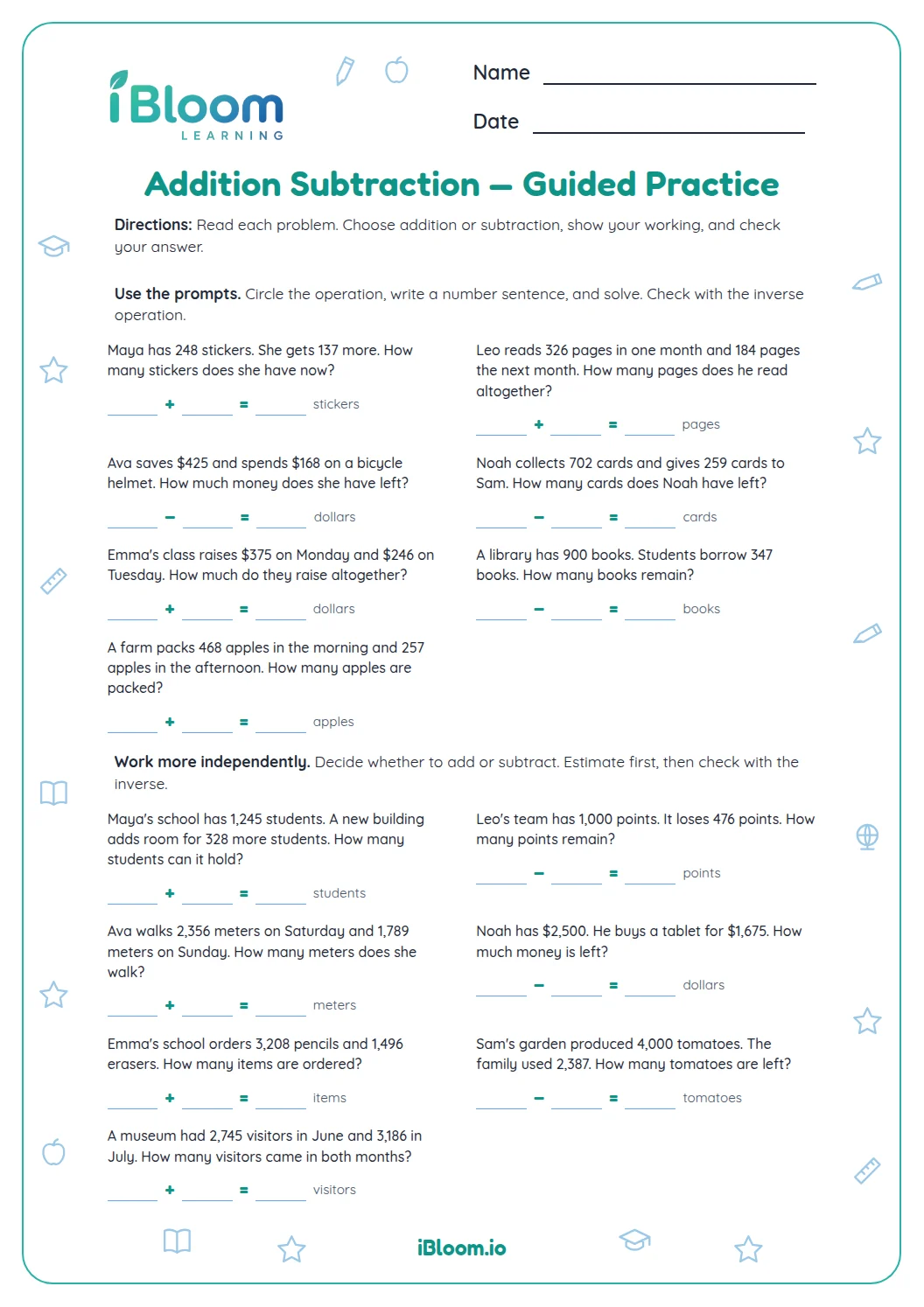
After this sheet, try another Grade 4 word problem page on addition and subtraction or on all four operations. Those pages keep the focus on deciding what a situation asks, while changing the quantities and context from mass to other kinds of problems.