



About this worksheet
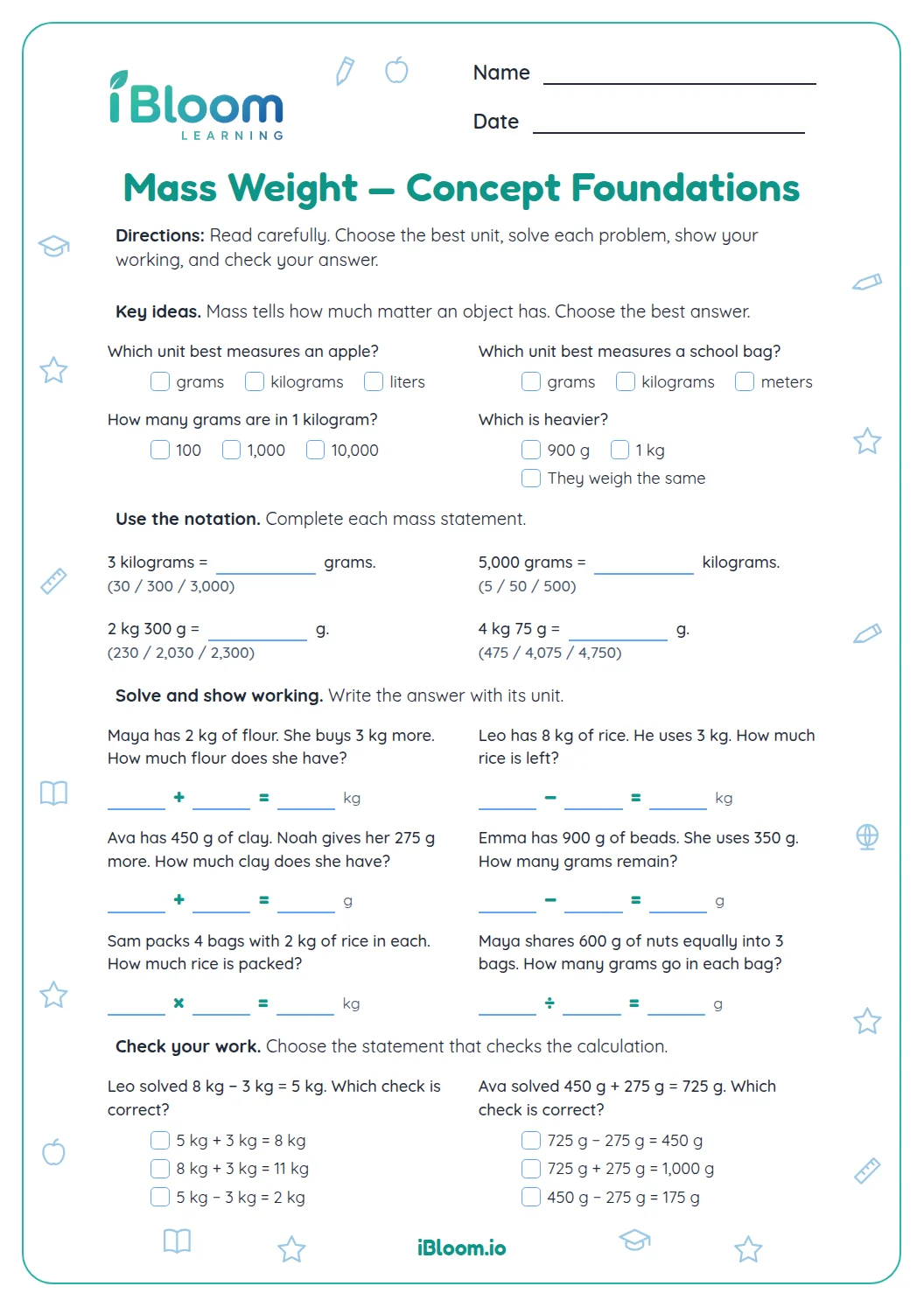
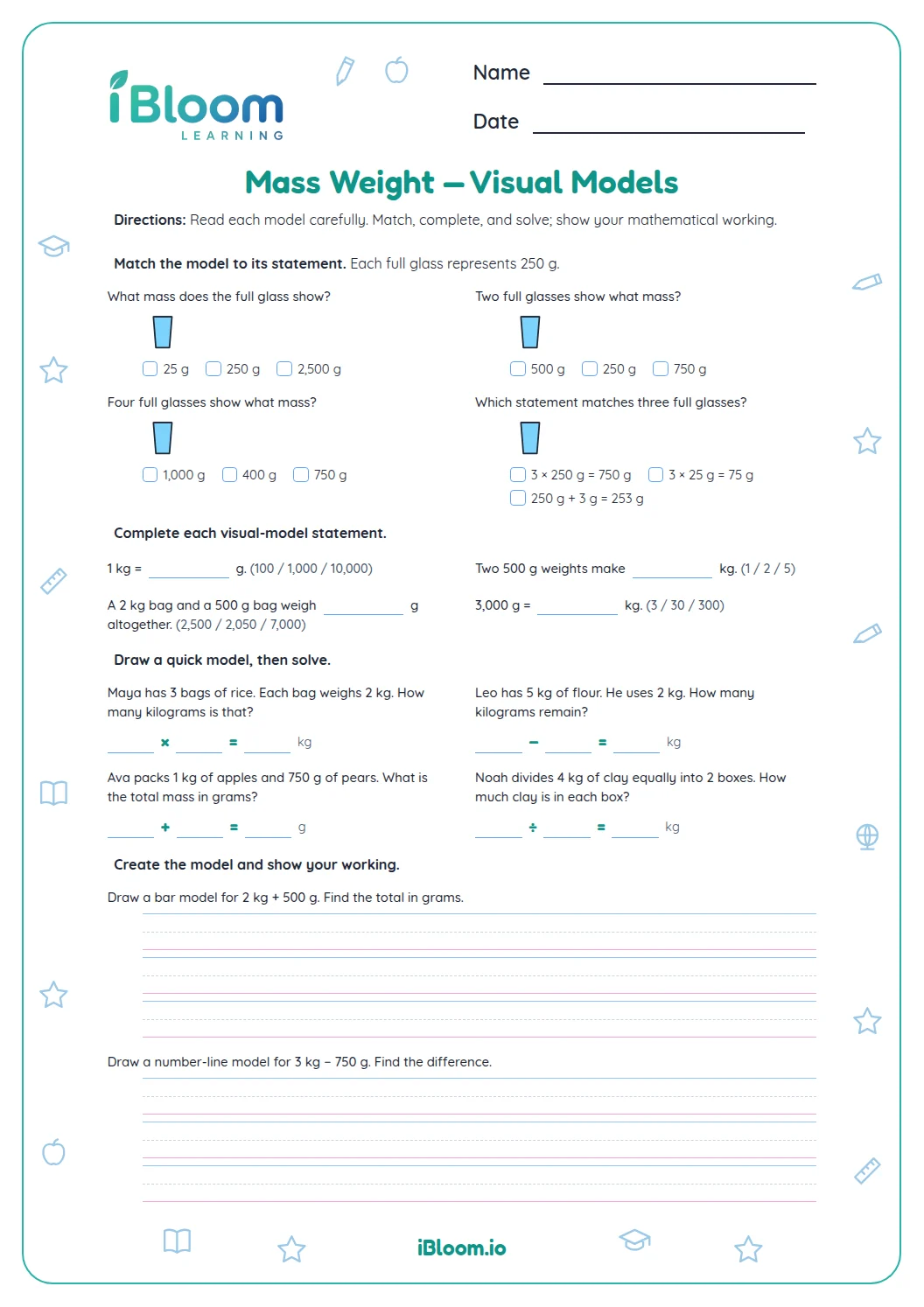
This Grade 4 worksheet gives children 14 mass and weight word problems using kilograms and grams. They convert mixed masses to grams, add and subtract, solve equal-share situations, compare quantities, and correct a unit-conversion error. Most prompts ask for a short answer with units; one asks children to write an equation. A separate answer key is included. It aligns with Common Core 4.MD.A.2, which includes word problems involving masses and larger-to-smaller unit conversions.
Aligned to 4.MD.A.2
How should children handle kilograms and grams?
Change each kilogram to 1,000 grams before combining masses. Then keep the unit consistent through the calculation.
For question 1, 2 kg 350 g is 2,350 g and 1 kg 875 g is 1,875 g. Add 2,350 + 1,875 = 4,225 g.
- 12 kg 350 g = 2,350 g
- 21 kg 875 g = 1,875 g
- 32,350 + 1,875 = 4,225 g
How do the later problems add reasoning?
Part B begins with a conversion error, then asks children to compare masses, divide quantities equally, and solve a two-step story.
What is included?
Parts A and B move from direct mass calculations to comparisons and a two-step problem. The separate answer key gives all 14 answers.
How to use this worksheet
- 1Underline each mass and circle the unit.
- 2Rewrite kilograms as groups of 1,000 grams.
- 3Choose addition, subtraction, multiplication, or division from the story.
- 4Write an equation before calculating.
- 5Check that the result makes sense and include grams.
Common mistakes and quick fixes
The mistake
Reading 2 kg 80 g as 280 g
The fix
Write 2,000 g + 80 g. The zero keeps the 80 g in the tens and ones places.
The mistake
Adding kilograms directly to grams
The fix
Convert every kilogram to 1,000 grams first, then combine amounts in grams.
The mistake
Leaving off the requested unit
The fix
Write “g” after each result and check that the question asked for grams.
Common Core alignment
The questions practice 4.MD.A.2 with mass conversion and operation word problems.
Solve mass word problems, including converting kilograms to grams.
On this sheet: Every problem uses mass quantities and operations; several convert kilograms to grams.
Show the official wordingHide the official wording
Use the four operations to solve word problems involving distances, intervals of time, liquid volumes, masses of objects, and money, including problems involving simple fractions or decimals, and problems that require expressing measurements given in a larger unit in terms of a smaller unit.
What to practice next
Make more practice
Further reading
Questions parents and teachers ask
What does this mass worksheet practice?
It practices adding, subtracting, multiplying, and dividing masses written in kilograms and grams. Children convert mixed masses to grams, compare quantities, and solve equal-share problems. A final two-step story combines addition and subtraction, with every answer labeled in grams. Children can show each conversion in the work space.
How many questions are on the printable?
There are 14 questions in two parts. Part A has seven mass calculations; Part B asks children to correct a conversion error, compare masses, share quantities equally, and solve two more situations. The worksheet and its answer key each print across two pages.
Why convert kilograms to grams?
Using one unit makes masses easier to add and compare. Since 1 kilogram is 1,000 grams, 2 kg 80 g becomes 2,080 g. This also shows why Nia’s claim of 280 g is missing the two thousand grams from the kilograms.
What is the answer to the two-step clay problem?
The clay starts at 2,500 g. Adding 750 g gives 3,250 g, and removing 1,000 g leaves 2,250 g. Children can write the two operations in order and keep the unit in grams throughout the calculation. The answer box needs the final amount, and children can note both steps in the margin.
Does the key come with the worksheet?
Yes. The answer key is included on separate pages. It lists the results in grams and gives the comparison and equation answers, so an adult can check both the number and the unit after the child finishes the worksheet. It is ready to use after the child completes the problems.