


About this worksheet
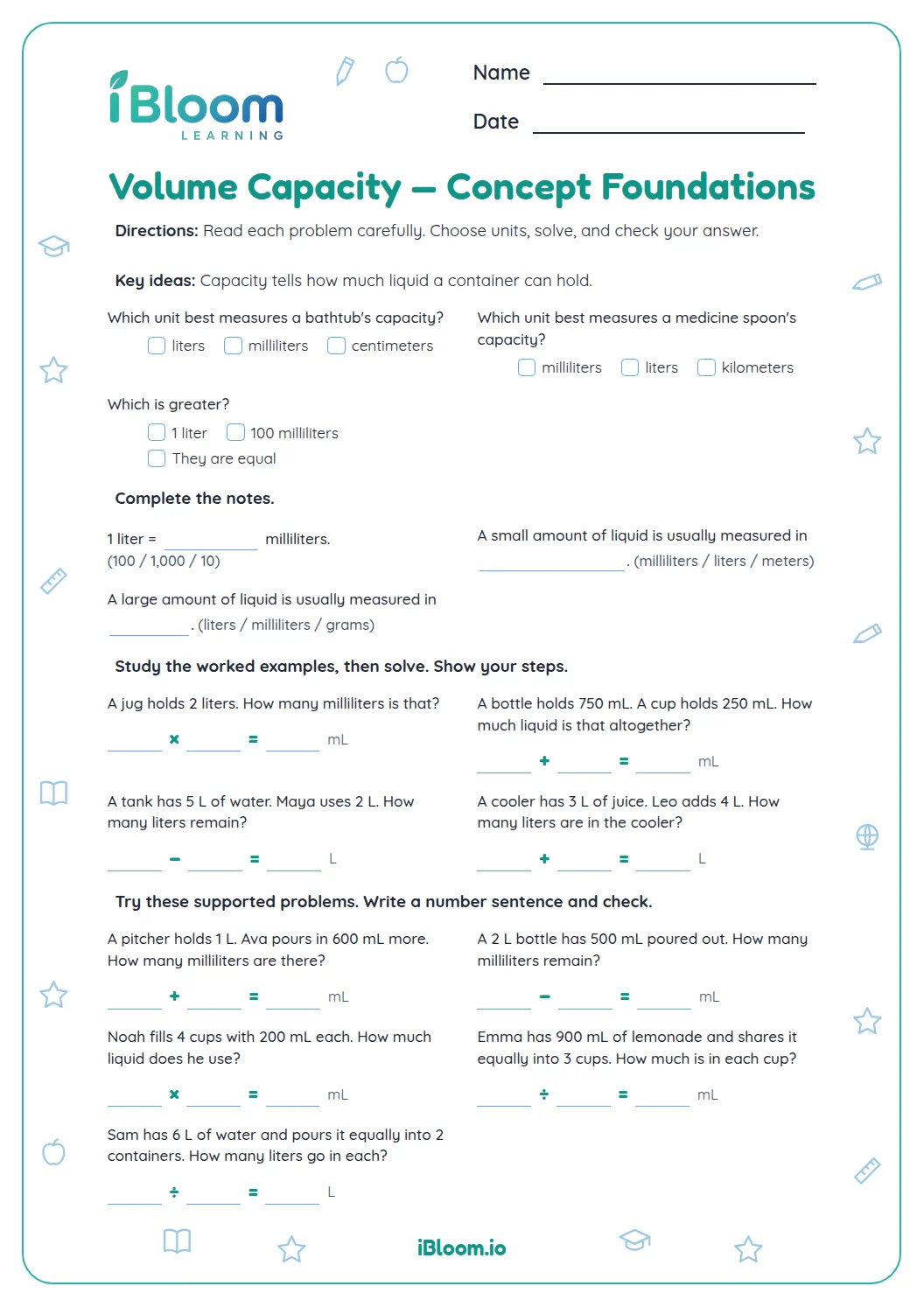
This Grade 4 printable builds volume and capacity problem-solving with liters, milliliters, and everyday containers. The 16 problems move from unit conversions to multi-step situations, with space to calculate and label units. It practices Common Core 4.MD.A.2, which includes measurement conversions and liquid-volume problems. A separate answer key supports checking each calculation.
Aligned to 4.MD.A.2
How do liters and milliliters relate?
One liter equals 1,000 milliliters. Convert to the unit asked for before combining amounts.
- 12 L 350 mL = 2,000 mL + 350 mL = 2,350 mL
How can an operation model capacity?
Multiplication combines equal container amounts. Subtraction finds what remains or what is still needed.
- 16 × 750 mL = 4,500 mL
How do you combine amounts?
Write both amounts in the same unit before adding or subtracting. For a fraction of a full container, find that part of its capacity.
- 13/4 of 12 L = 9 L
How can you check a capacity answer?
Estimate the size before calculating. For full containers, divide and check that the leftover amount is smaller than one container.
- 17,000 mL ÷ 600 mL = 11 full bottles, with 400 mL left.
How to use this worksheet
- 1Read the direction at the start of each part.
- 2Work one item at a time and use the clue named in the prompt.
- 3Label units on measurement answers.
- 4Check the completed page with the answer key.
- 5Review any item that needs another try.
Common mistakes and quick fixes
The mistake
Adding liters and milliliters without converting.
The fix
Rewrite both amounts in the same unit first.
The mistake
Using the wrong operation for what remains.
The fix
Find the total amount used, then subtract it from the start.
The mistake
Leaving off a unit.
The fix
Write mL, L, or cups as the question requests.
Common Core alignment
This worksheet practices measurement conversions and liquid-volume problems.
Use conversions and the four operations to solve liquid-volume word problems.
On this sheet: Problems convert liters and milliliters and solve one- and two-step capacity situations.
Show the official wordingHide the official wording
Use the four operations to solve word problems involving distances, intervals of time, liquid volumes, masses of objects, and money, including problems involving simple fractions or decimals, and problems that require expressing measurements given in a larger unit in terms of a smaller unit. Represent measurement quantities using diagrams such as number line diagrams that feature a measurement scale.
What to practice next
Make more practice
Further reading
Questions parents and teachers ask
What does this worksheet practice?
It includes 16 Grade 4 problems on liters, milliliters, and real-world capacity, followed by a separate answer key. Learners convert units, combine amounts, and solve one- and two-step container situations. Ask the learner to name the clue that helped before moving on.
How many items are on the page?
There are 16 capacity questions in four parts. The first part reviews liters and milliliters; later problems ask learners to combine amounts, find what remains, or determine how many containers can be filled. Ask the learner to name the clue that helped before moving on.
How should we use the answer key?
Have the learner complete the problems before checking the key. Compare both the number and unit, then return to any missed item and identify whether the conversion, operation, or calculation needs another look. Ask the learner to name the clue that helped before moving on.
Can an adult use this in a small group?
Yes. Model one conversion aloud, then invite learners to explain which operation fits a container story. They can solve the remaining items independently or with a partner, and use the key to discuss different strategies. Ask the learner to name the clue that helped before moving on.
What if an answer differs from the key?
Check that all amounts were converted to the same unit and that the answer includes the unit requested. For a fixed-answer problem, redo the calculation; for a multi-step item, check each step separately before comparing again. Ask the learner to name the clue that helped before moving on.