


About this worksheet
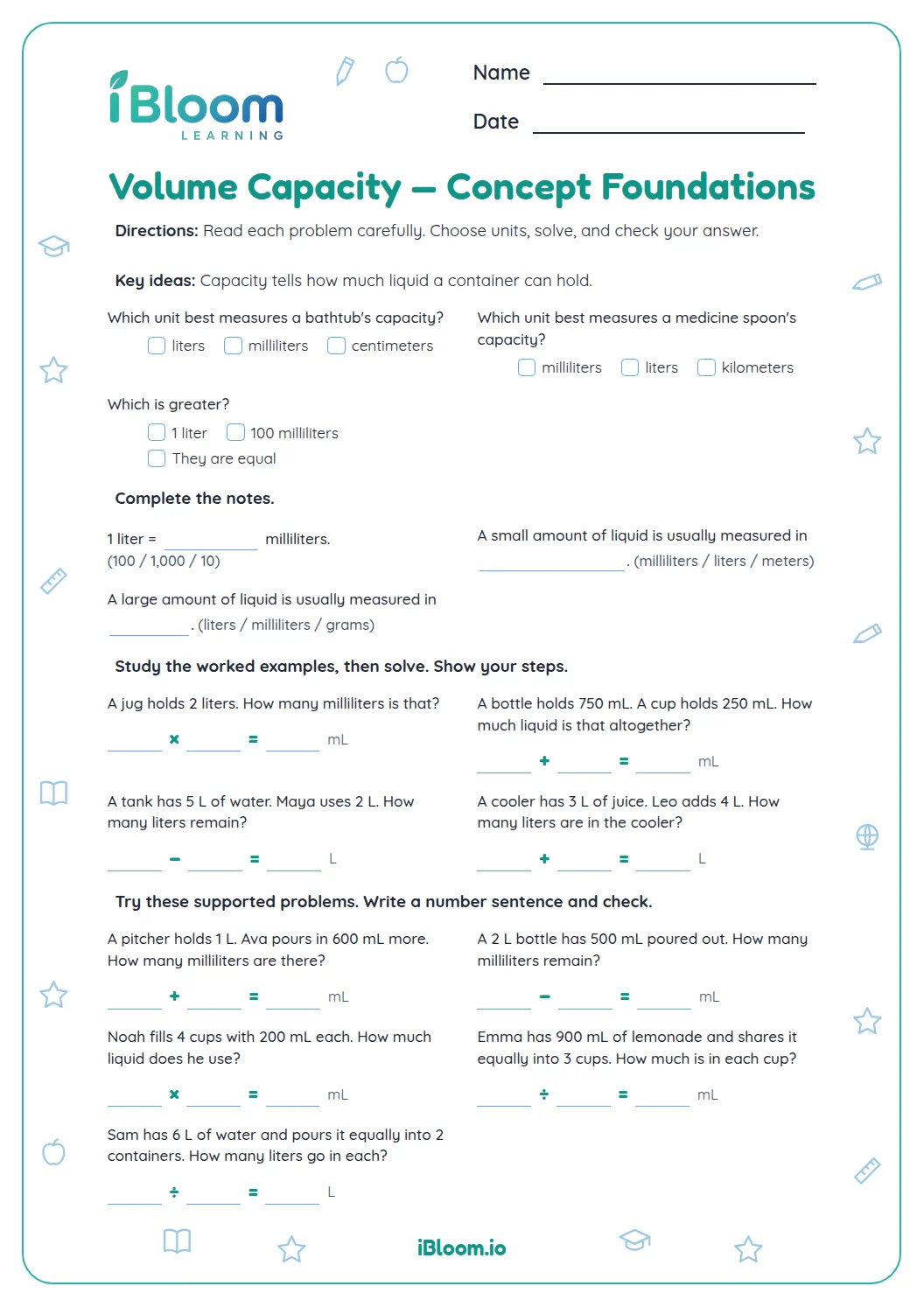
This Grade 4 worksheet gives students 15 word problems about liquid volume and capacity in liters and milliliters. Problems include combining amounts, finding what remains or is needed, equal sharing, and comparing capacities. Students write equations and label units; a separate answer key shows the results. The practice supports 4.MD.A.2, solving word problems involving measurement and conversion of measurement units.
Aligned to 4.MD.A.2
Which capacity units appear on the sheet?
The problems use liters and milliliters, with 1 L equal to 1,000 mL. Students may convert to a common unit before adding, subtracting, multiplying, or dividing.
How do you subtract milliliters from liters?
Convert 2 L to 2,000 mL, then subtract the amount poured out.
- 12 L = 2,000 mL
- 22,000 − 650 = 1,350 mL
What kinds of problems are included?
Part A combines amounts and finds leftovers, Part B uses equal groups and sharing, and Part C compares capacities or finds a missing amount. Each prompt calls for an equation and a unit.
How can students check a capacity answer?
Check the operation and unit. For subtraction, add the amount used back to the amount remaining; for equal sharing, multiply one share by the number of containers.
How to solve a capacity story problem
- 1Identify the amount and unit asked for.
- 2Convert liters to milliliters when that makes the calculation easier.
- 3Choose an operation that matches the story.
- 4Write an equation and calculate.
- 5Label the result and check that its size makes sense.
Capacity mistakes to avoid
The mistake
Adding liters directly to milliliters.
The fix
Convert both amounts to the same unit first.
The mistake
Reporting the total when the problem asks for the amount left.
The fix
Check whether the story describes adding, using, or filling.
The mistake
Leaving the unit off the answer.
The fix
Write L, mL, or the requested container unit after the number.
Common Core alignment
This worksheet practices the following Common Core skill.
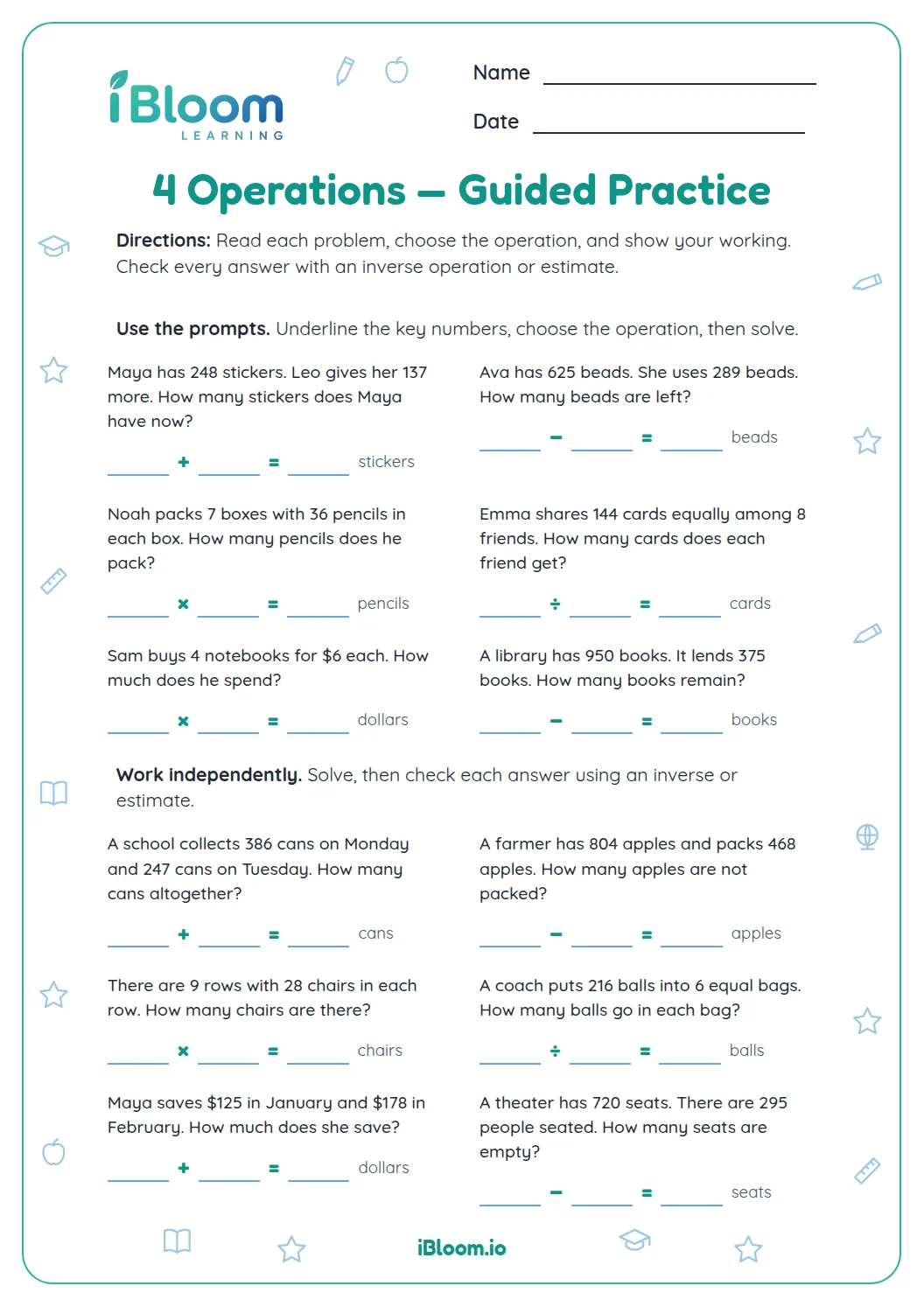
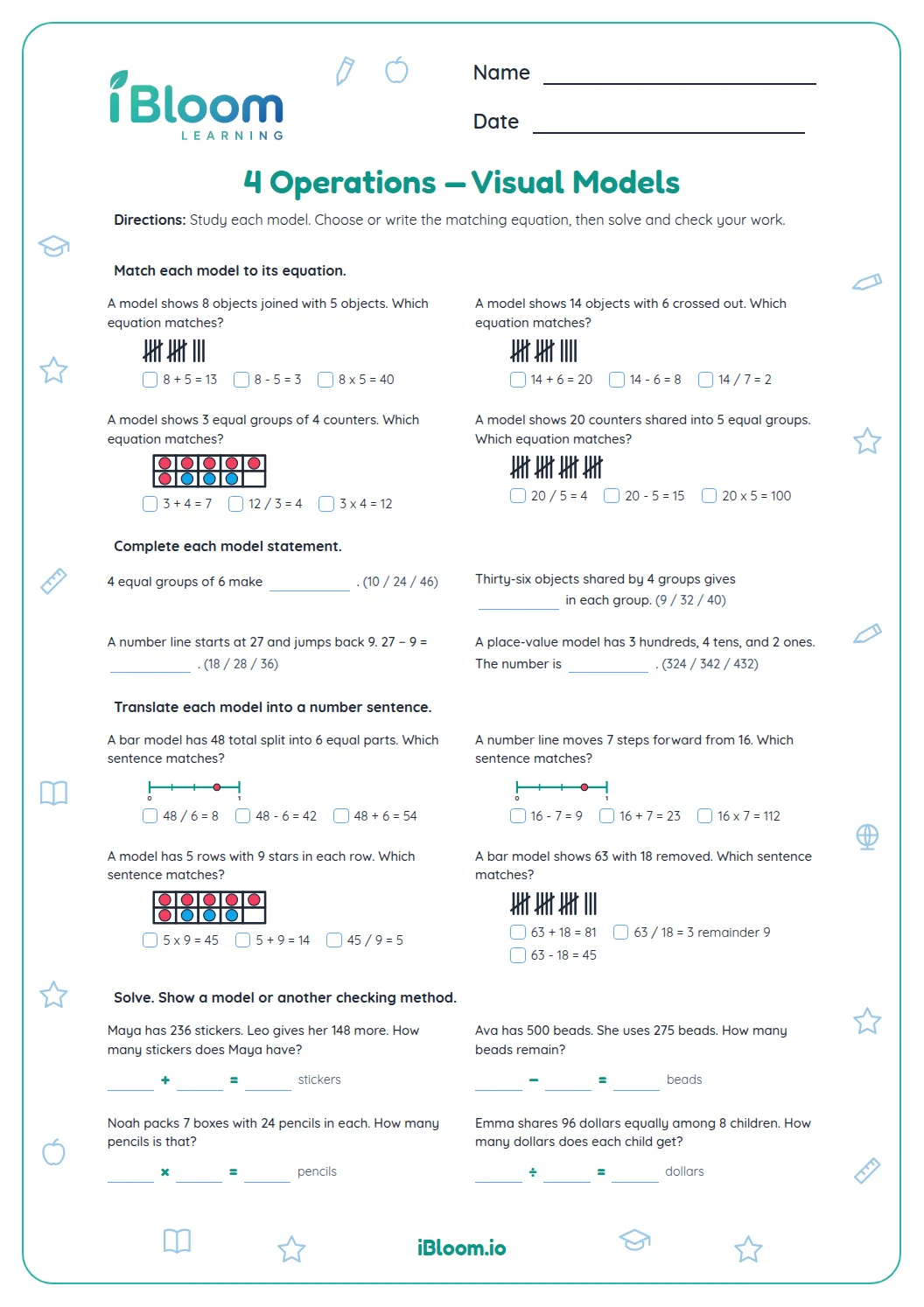
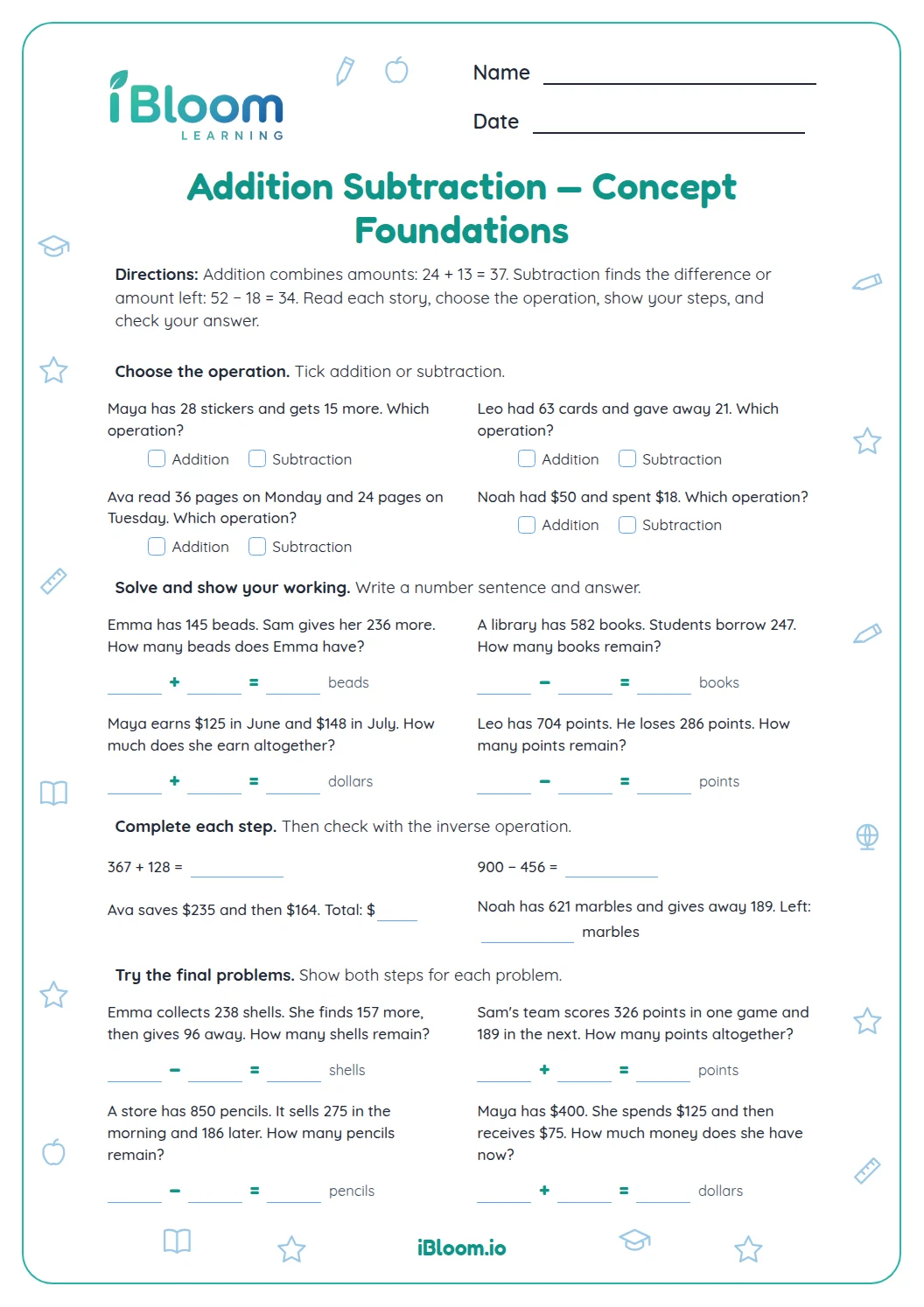
Solve measurement word problems using the four operations.
On this sheet: The story problems combine liquid volume measurements and the four operations.
Show the official wordingHide the official wording
Use the four operations to solve word problems involving distances, intervals of time, liquid volumes, masses of objects, and money, including problems involving simple fractions or decimals, and problems that require expressing measurements given in a larger unit in terms of a smaller unit. Represent measurement quantities using diagrams such as number line diagrams that feature a measurement scale.
What to practice next
Make more practice
Further reading
Questions parents and teachers ask
How many questions are on this worksheet?
There are 15 questions across 3 parts. The questions use the skill named on this page, moving from direct practice to a check or application. A separate answer key is included. Students can complete one part at a time, then check each response against the key and return to any item that needs another look.
Is an answer key included?
Yes. A separate answer key gives answers for every question. Written responses include sample answers; another clear response is acceptable when it matches the information in the passage or problem. Check the work against the key after completing the page.
How should students use the work space?
Students can record calculations or text evidence that supports an answer. Writing a short check makes it easier to see whether the chosen operation or story detail matches what the question asks. Use the space to show enough thinking to review the result.
Can students complete the worksheet independently?
The page is designed for independent practice after students have met the skill. An adult can read the directions with the student first, then use the key to review any answer that needs another look. Students can also explain how they checked a result.
How long will the worksheet take?
Plan for about 20 minutes, with extra time for careful working and checking. The pace depends on how much reasoning a student writes and whether they revisit questions using the answer key. A student can pause between parts and finish later.