
About this worksheet
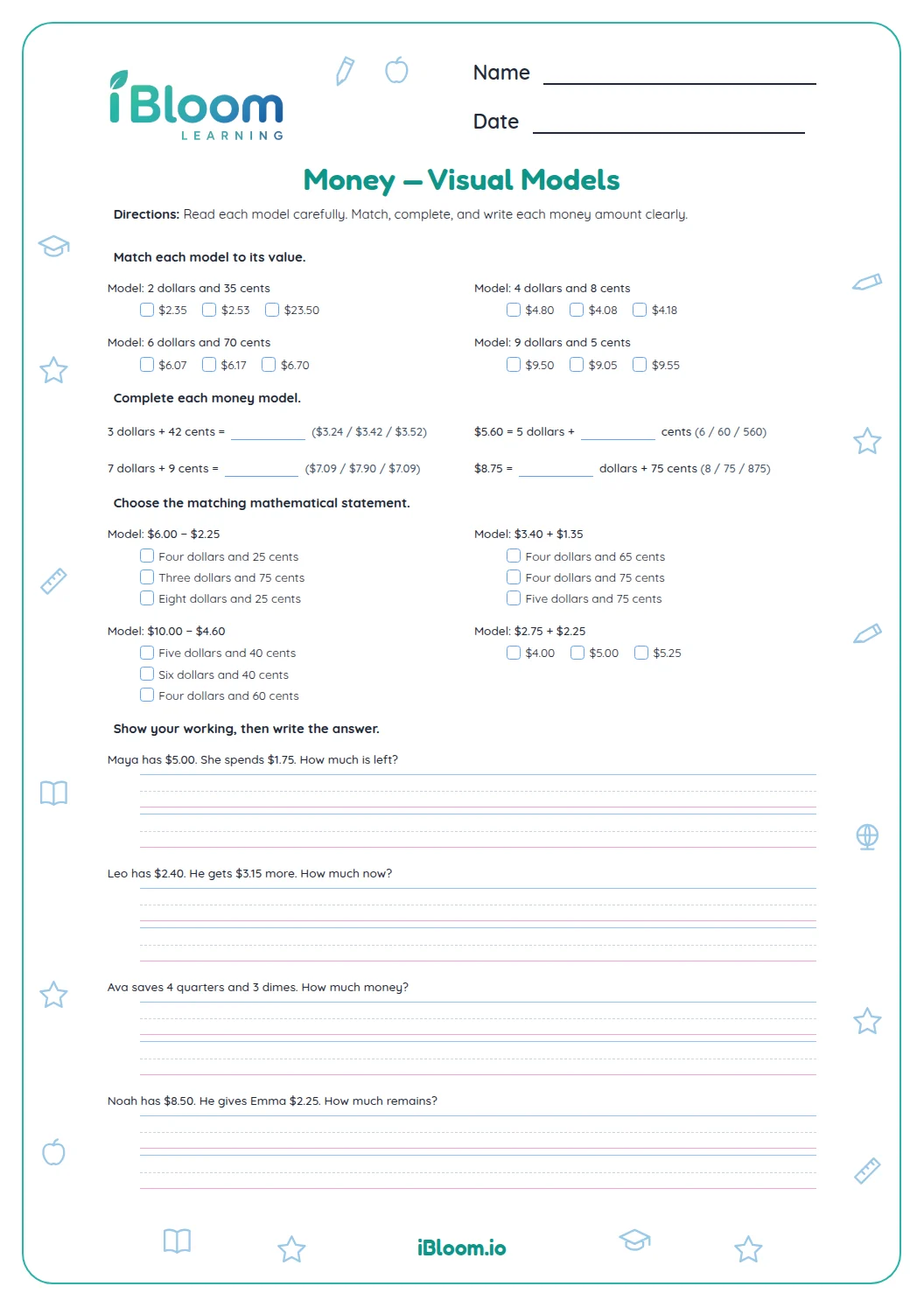
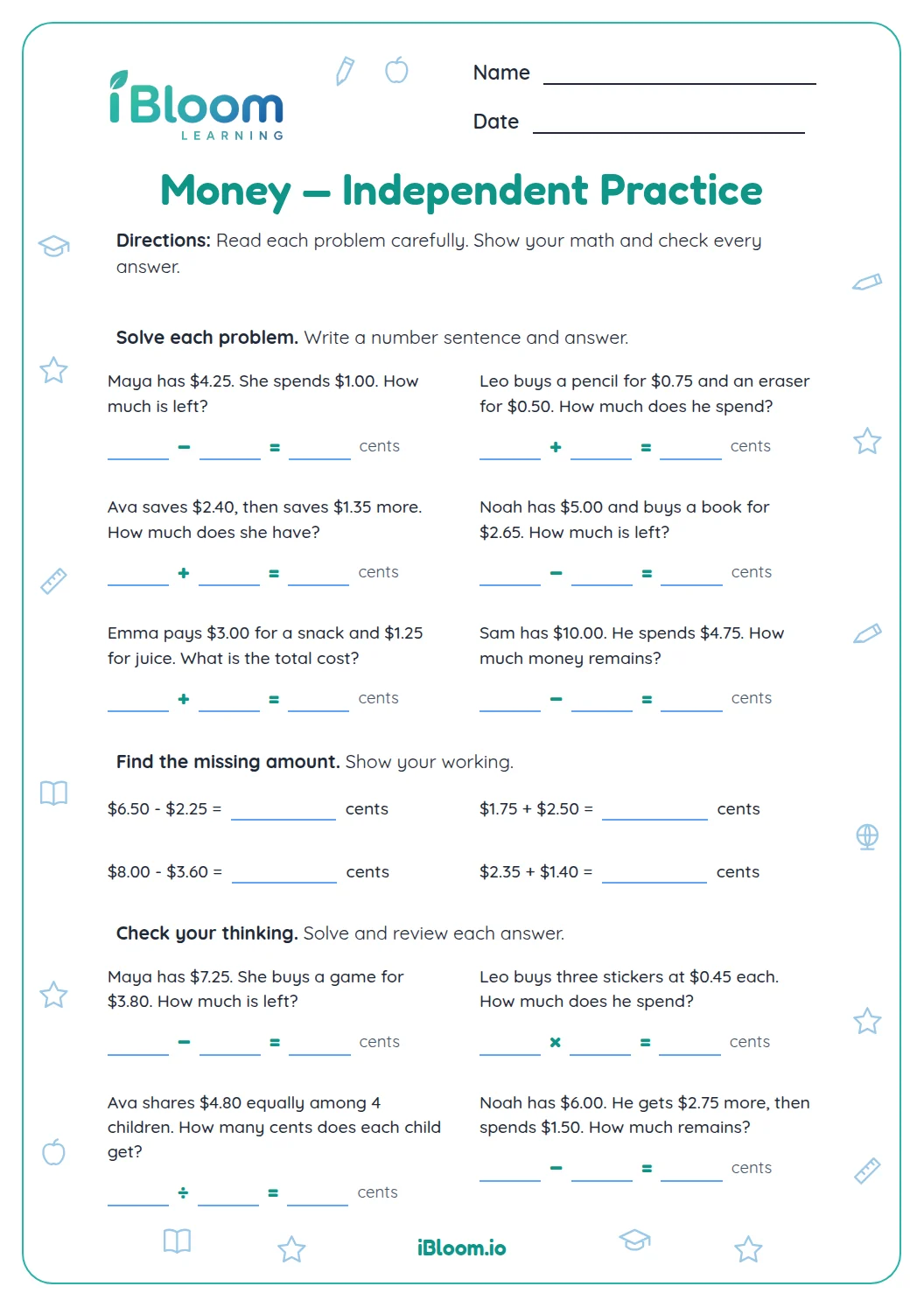
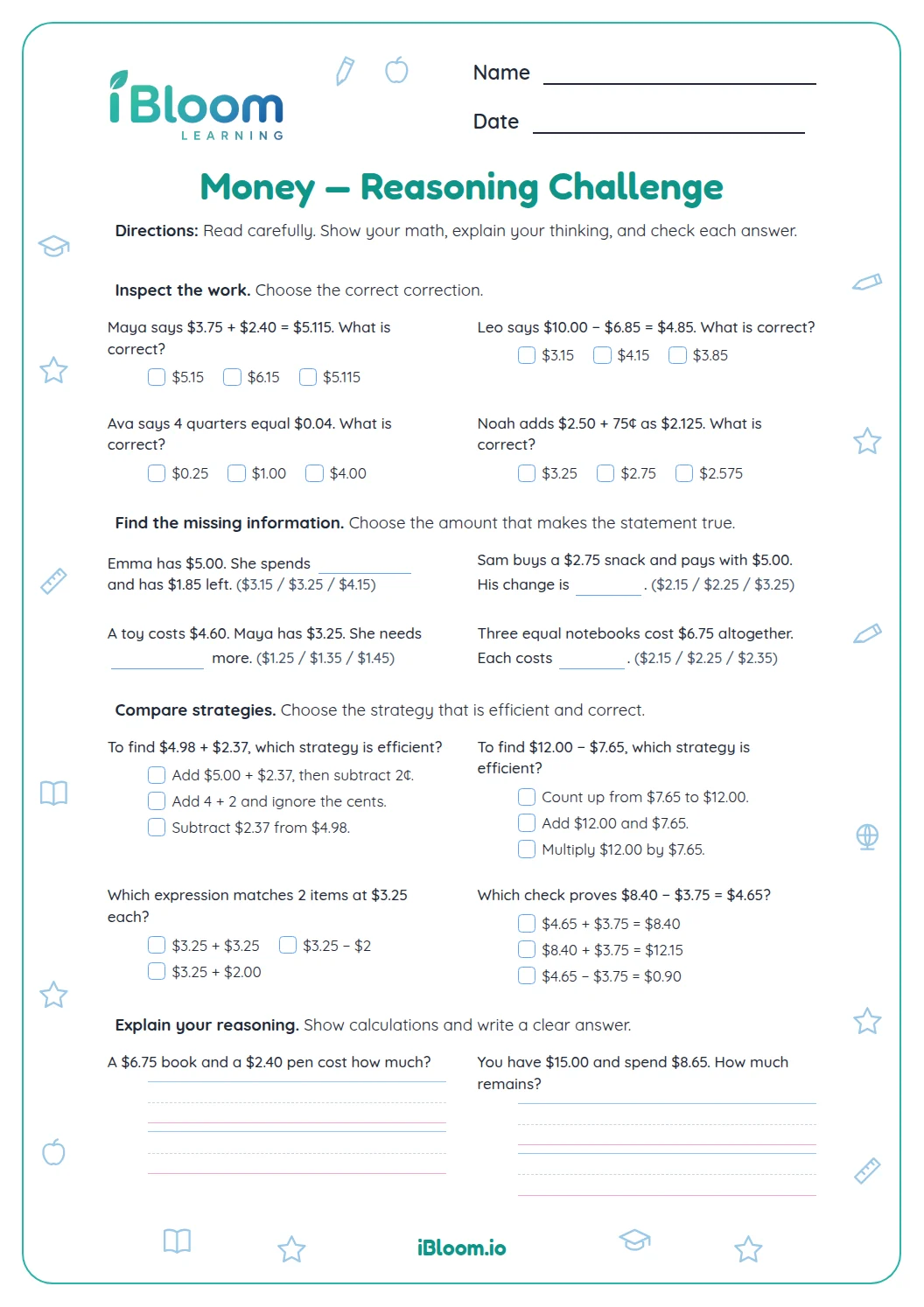
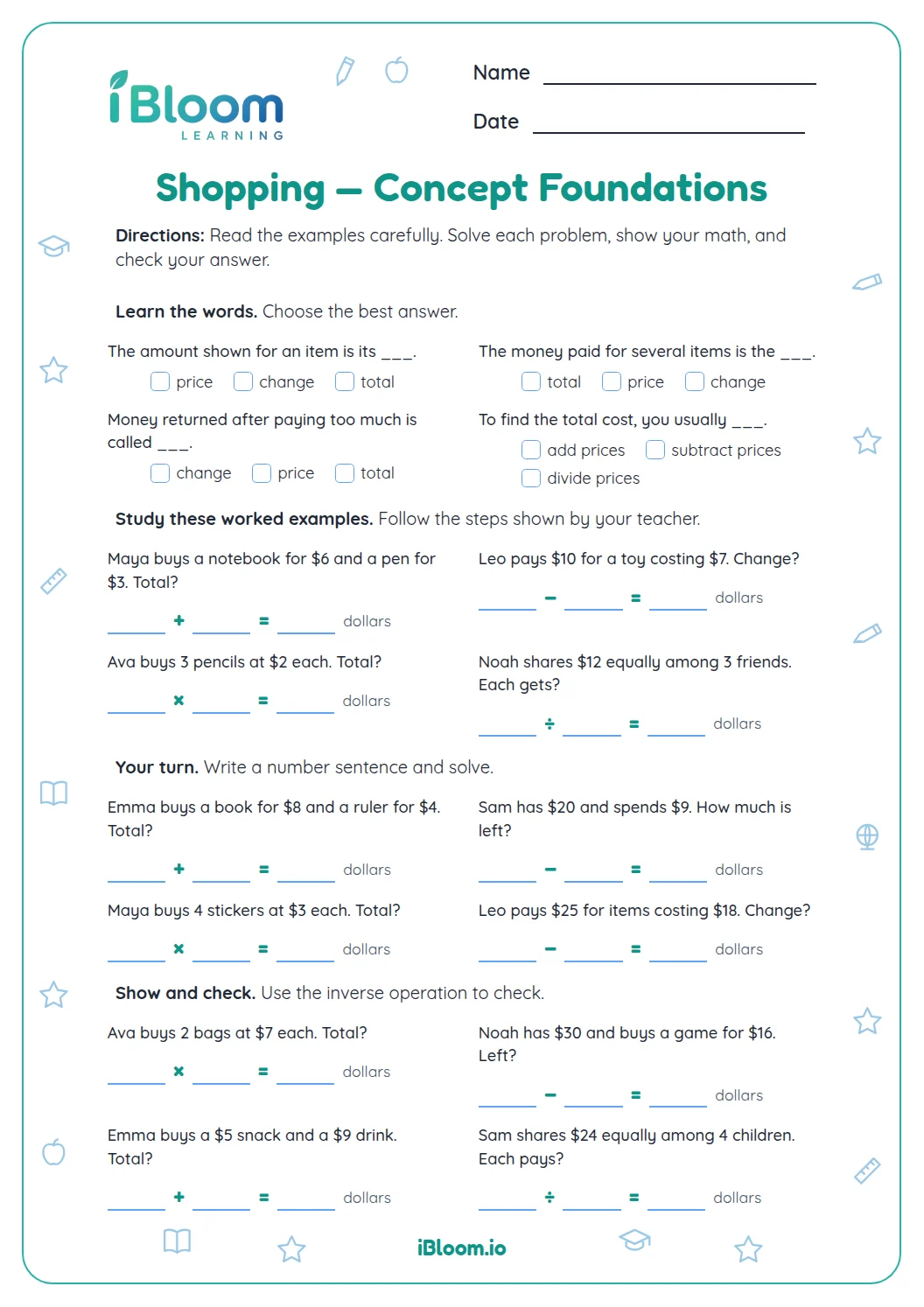
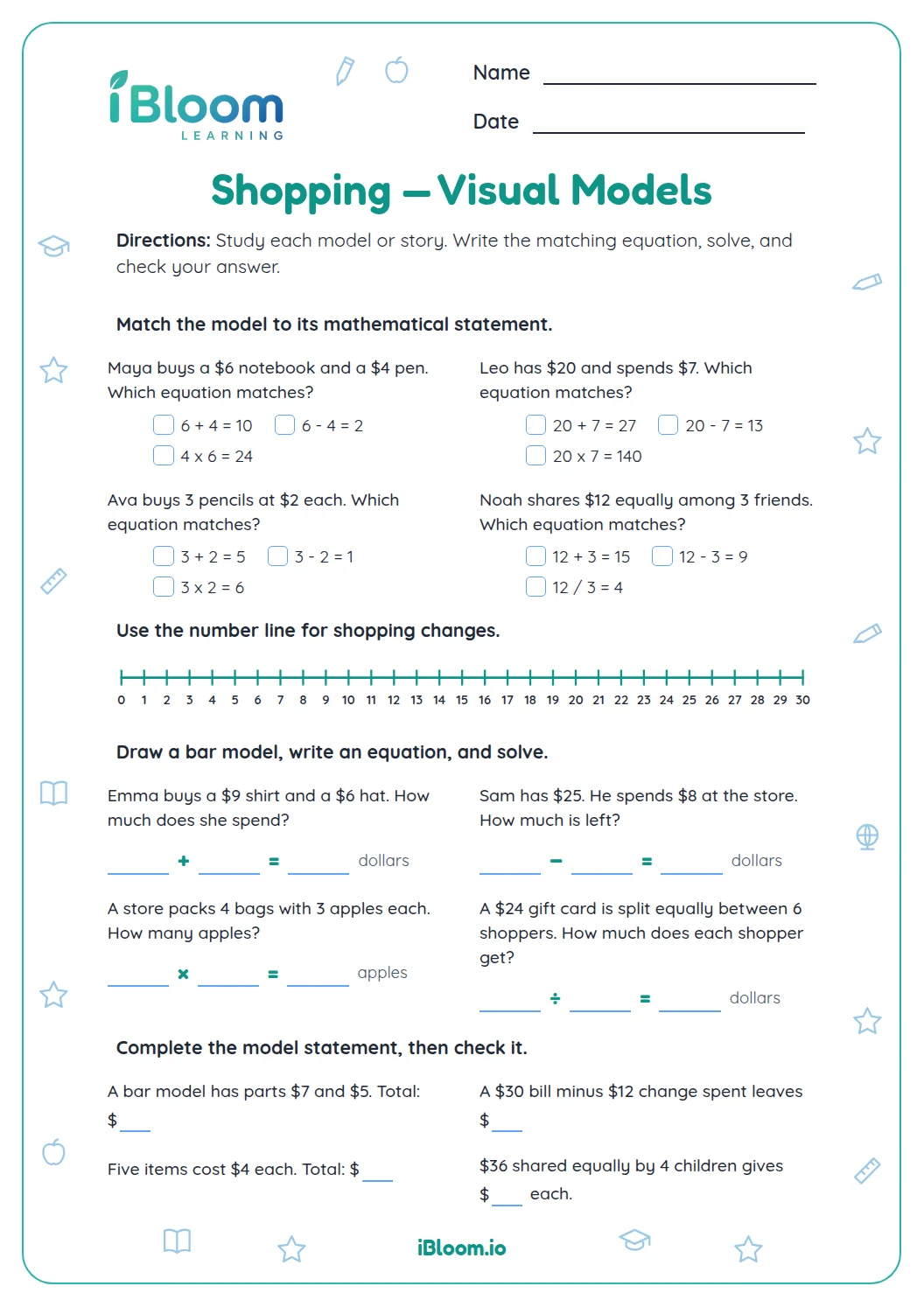
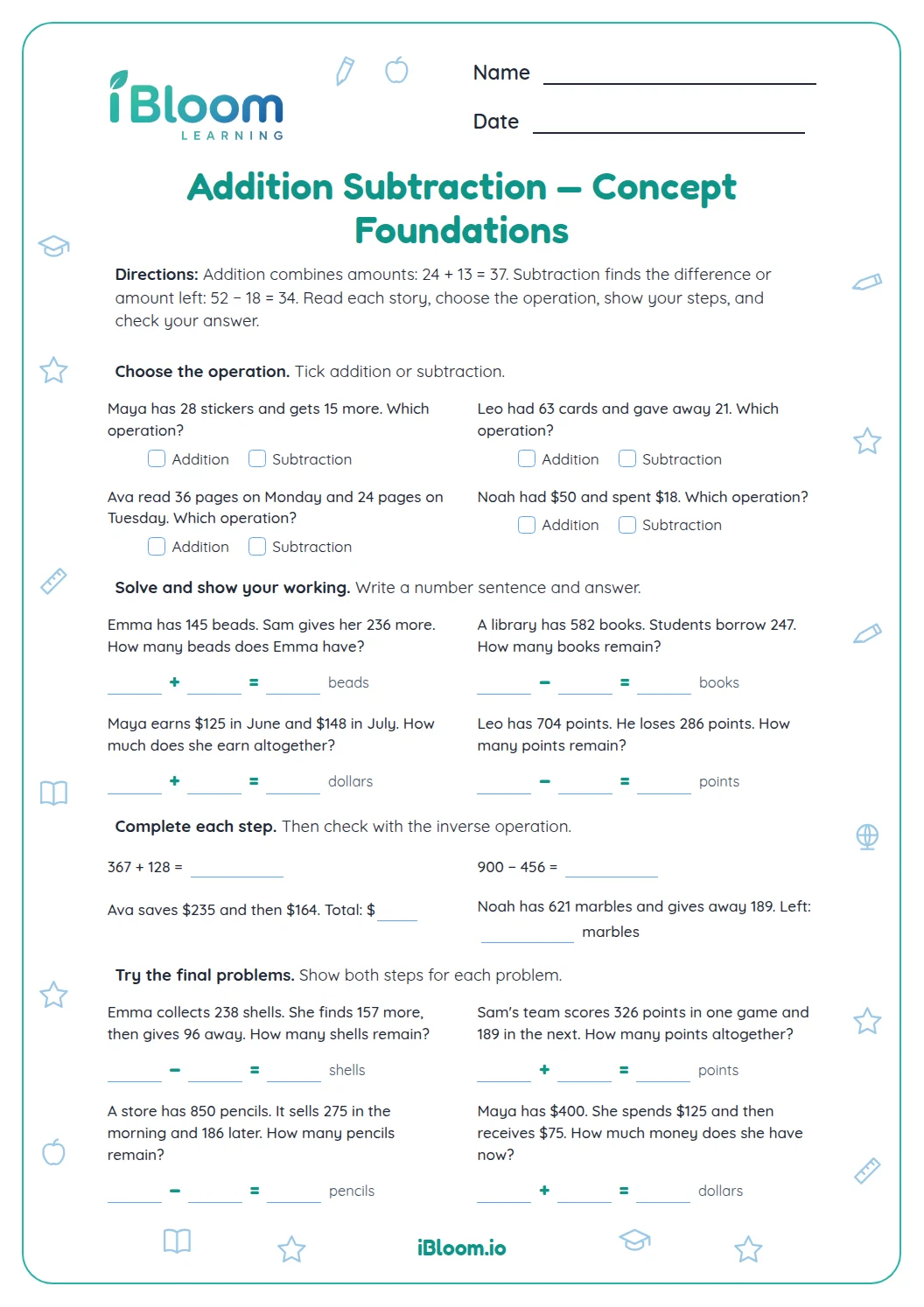
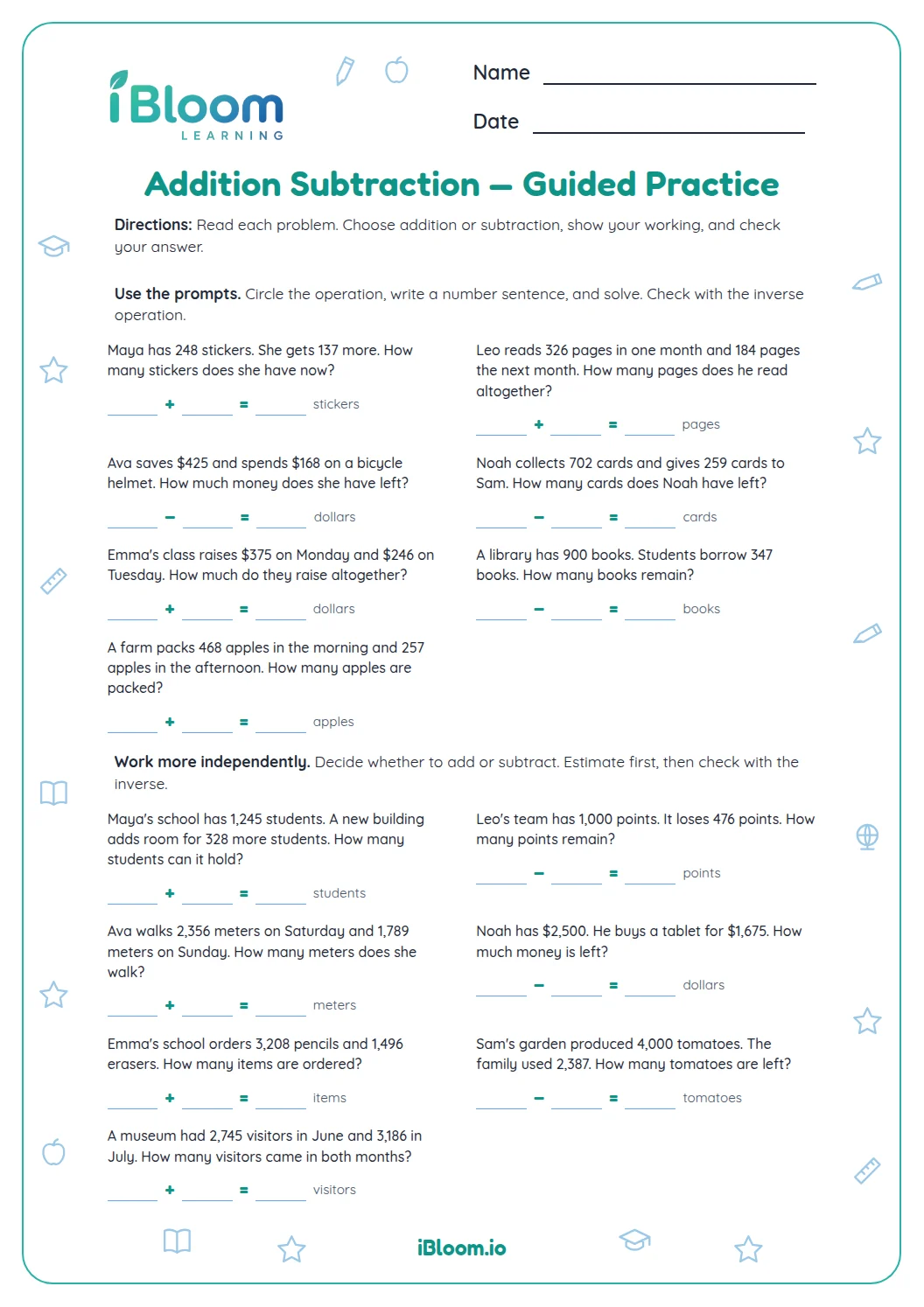
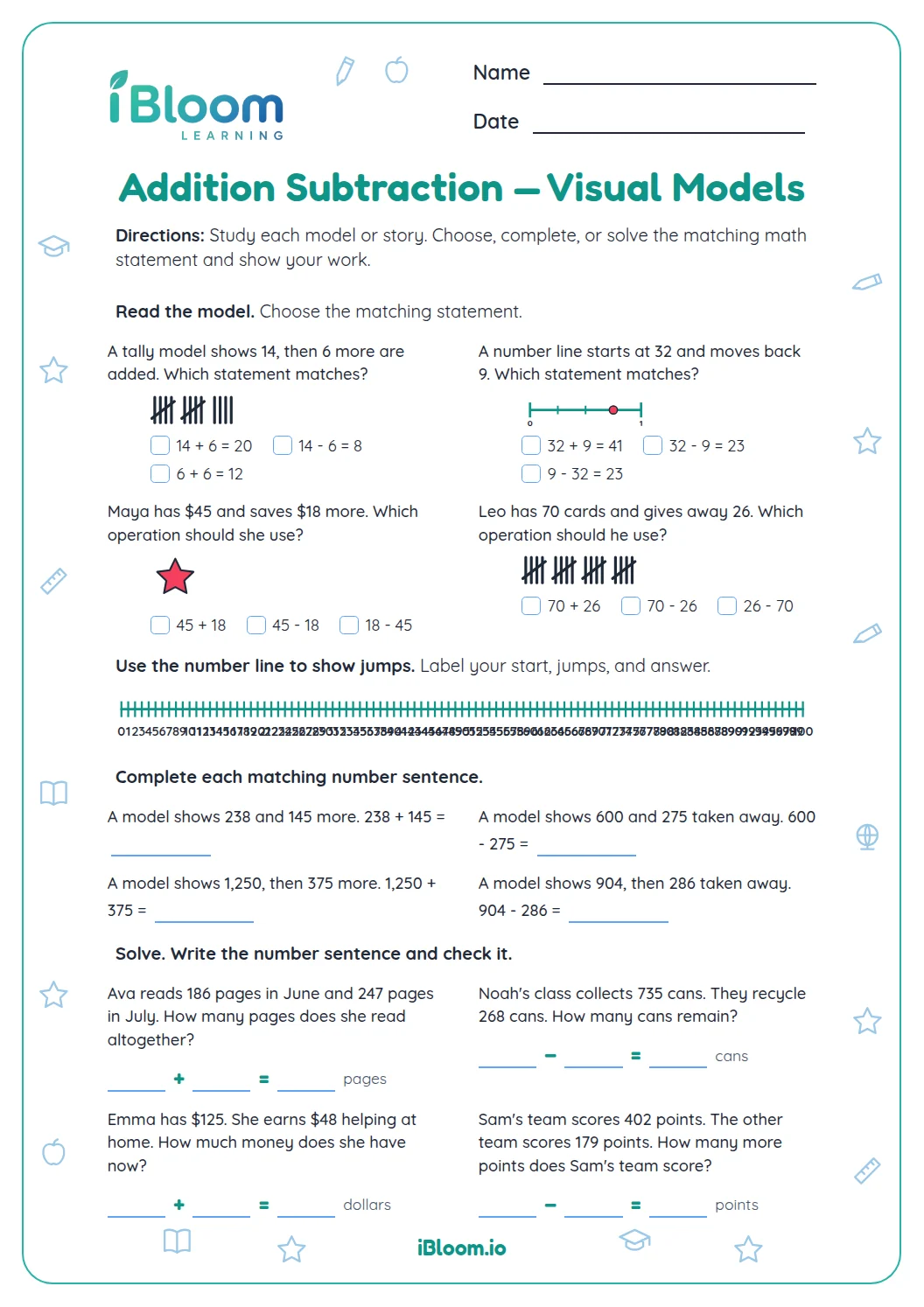
This four-page printable gives Grade 4 students 16 money word problems using dollar amounts and decimal prices. Students add purchases, find change, compare prices, and solve equal-group cost problems. Each item provides room to write an equation and solve. A separate answer key lists the dollar amount for every problem.
Aligned to 4.MD.A.2
How can students choose an operation for a money problem?
Identify what the question asks for, then connect the story to an operation. Combine prices for a total, subtract a purchase from the amount paid for change, and multiply or divide when equal groups are involved. Write the equation before calculating.
- 1$3.45 + $2.30 = $5.75
- 2Maya spends $5.75.
How do you keep dollar amounts lined up?
Write dollars under dollars and cents under cents. Use a zero as a placeholder when needed, such as $10.00, then check that the answer makes sense in the story.
What kinds of situations appear?
The four parts move from adding prices and finding a unit cost to mixed totals and change. Contexts include school supplies, tickets, snacks, and a school store. Students show an equation and a dollar answer for each situation.
How to solve the money problems
- 1Read the final question to identify the amount being sought.
- 2Mark the prices or amounts needed from the story.
- 3Choose addition, subtraction, multiplication, or division.
- 4Write an equation with dollar amounts aligned by place value.
- 5Solve and check that the answer fits the situation.
Common money mistakes and quick fixes
The mistake
Adding dollars and cents in the wrong place.
The fix
Line up the decimal points before adding or subtracting.
The mistake
Reporting the amount paid instead of the change.
The fix
Subtract the cost from the amount paid and check that the change is less.
The mistake
Multiplying when the question asks for the cost of one item.
The fix
Divide the total cost by the number of equal items.
Common Core alignment
This worksheet practices the Common Core skill named below.
Solve word problems involving money with the four operations.
On this sheet: Students solve contextual money problems with decimal addition, subtraction, multiplication and division.
Show the official wordingHide the official wording
Use the four operations to solve word problems involving distances, intervals of time, liquid volumes, masses of objects, and money, including problems involving simple fractions or decimals, and problems that require expressing measurements given in a larger unit in terms of a smaller unit.
What to practice next
Make more practice
Further reading
Questions parents and teachers ask
What operations do the money problems use?
The 16 problems use addition, subtraction, multiplication, and division with dollar amounts. Students find totals, money remaining, change, and cost per item. Each question gives room for an equation and a solved amount to check their work. The varied contexts help students connect each calculation to what the question asks.
How do I help a child line up dollars and cents?
Have the child write the decimal points in a vertical line, with dollars and cents in matching columns. Include trailing zeros when helpful, such as $10.00. Then check that the result is a reasonable amount for the story.
How can students find change?
Subtract the total cost from the amount paid. For an $8.65 item paid with $10.00, compute $10.00 − $8.65 = $1.35. The change should be less than the amount paid, which is a useful check for this type of problem.
How do you find the cost of one item in an equal group?
Divide the total cost by the number of identical items. If three markers cost $4.50, then $4.50 ÷ 3 = $1.50 per marker. The worksheet includes equal-group cost questions as well as totals, comparisons, and change in familiar settings.
How many pages and questions are included?
The worksheet has four practice pages with 16 questions, followed by a separate answer key. Students can work through one page at a time and check their equations and dollar amounts after finishing each page at home or school.