



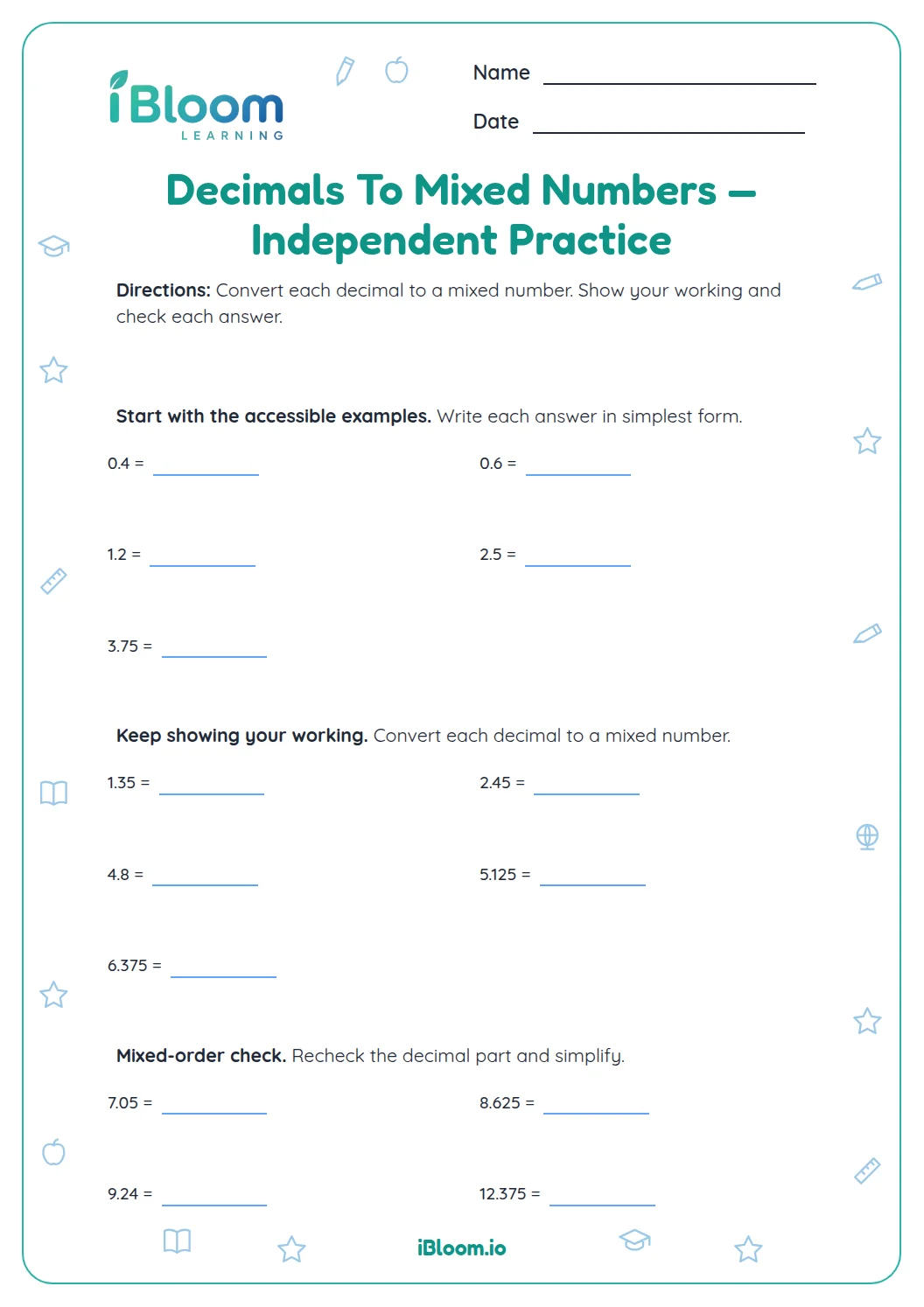
About this worksheet
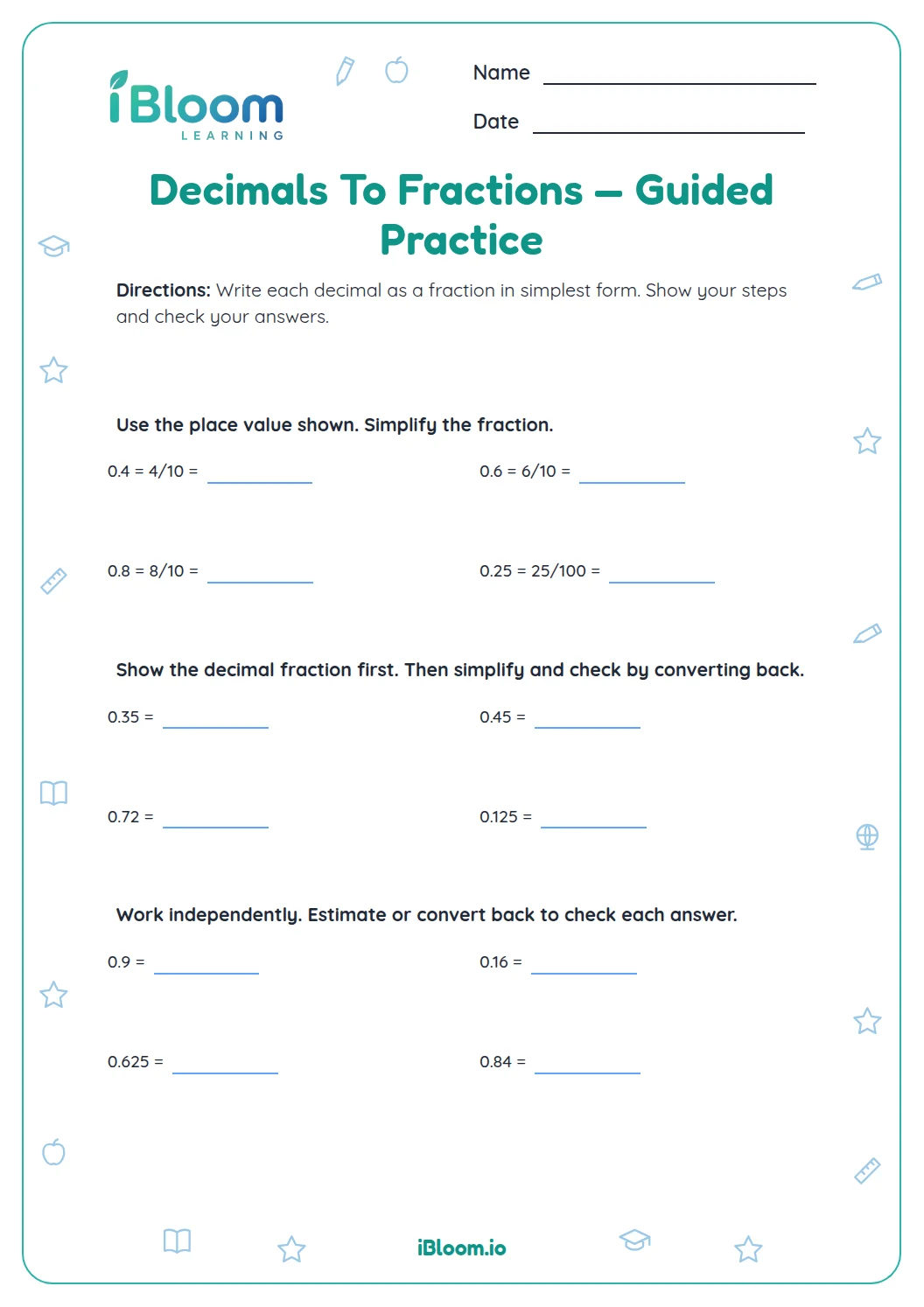
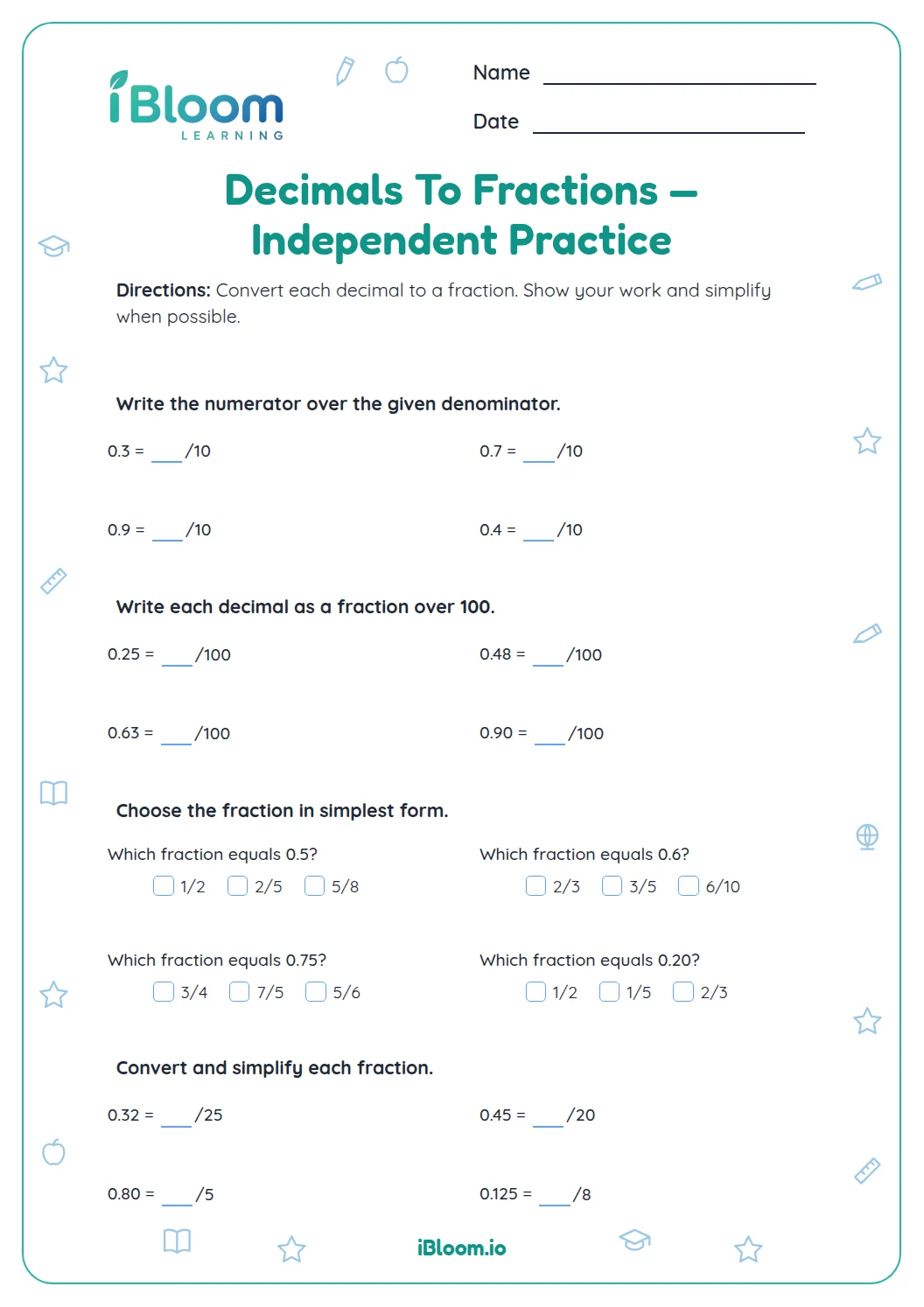
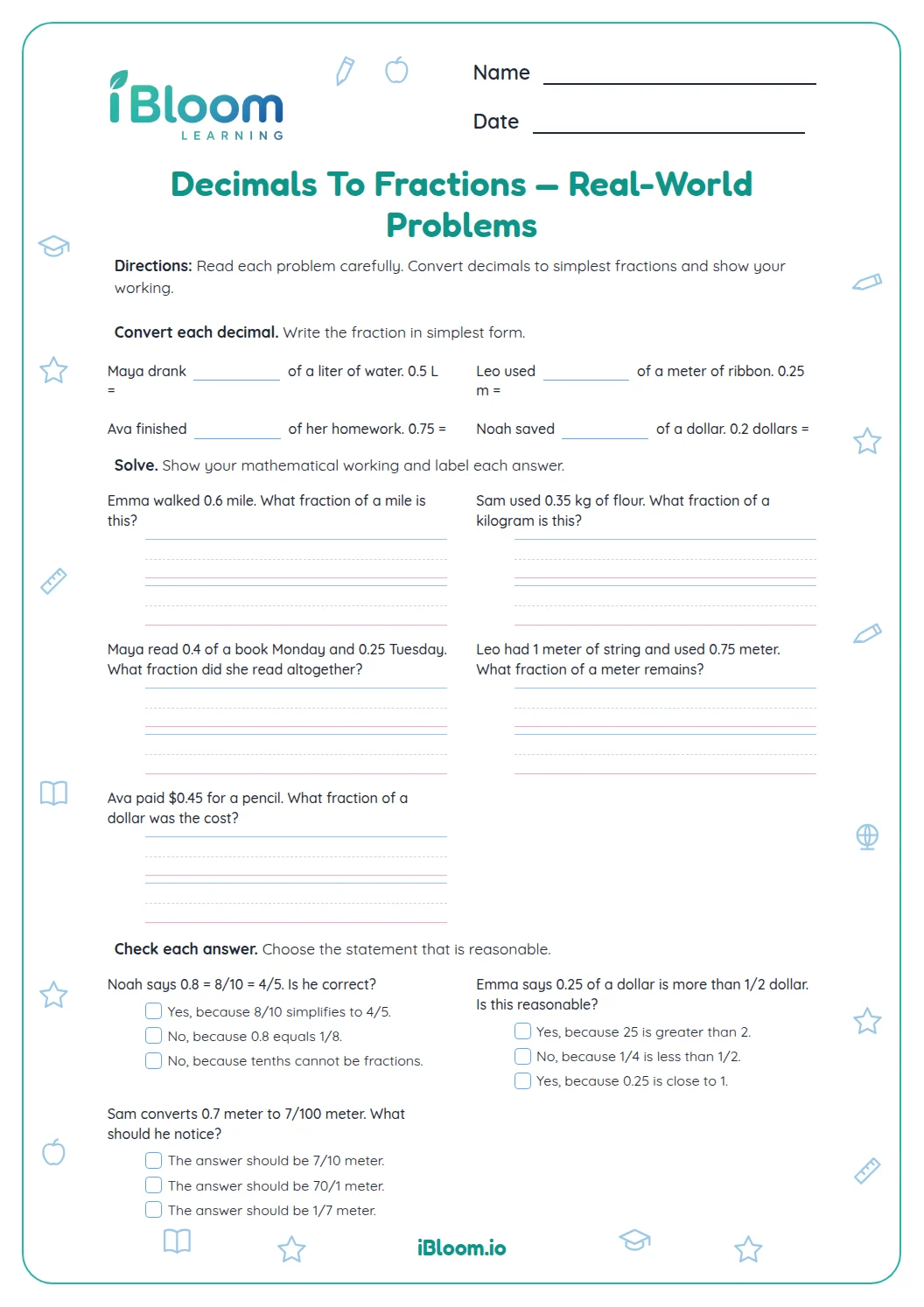
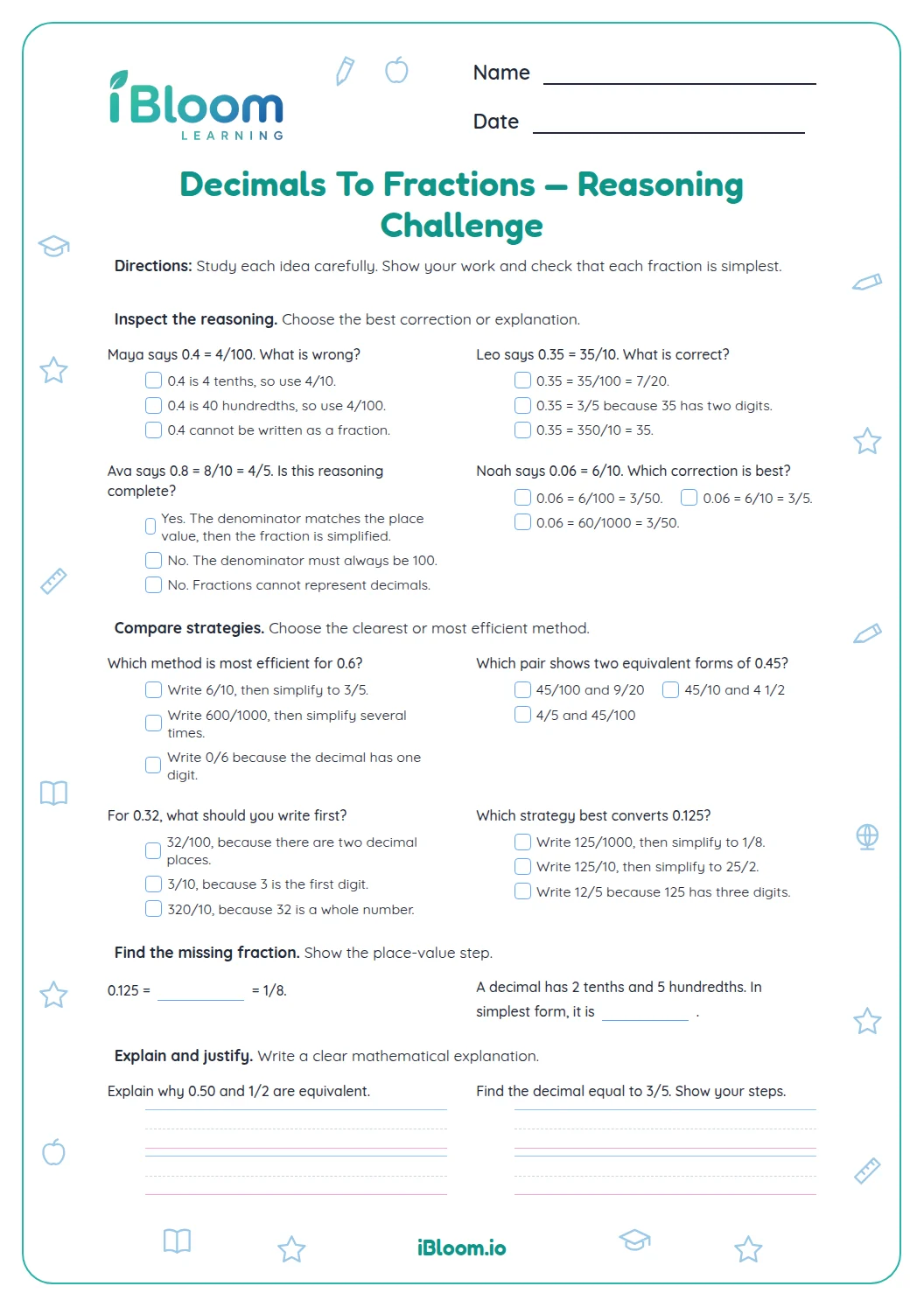
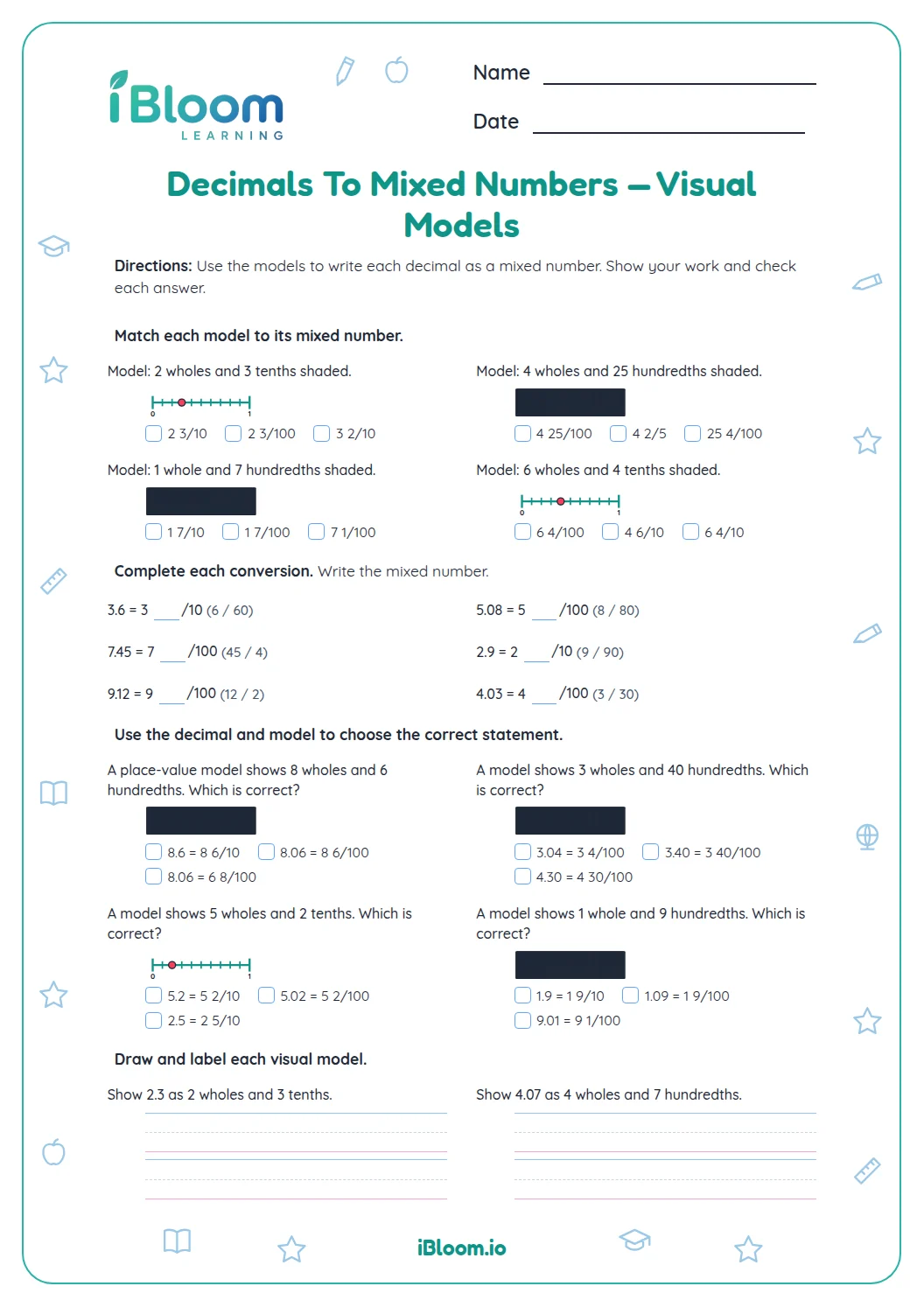
This Grade 5 printable connects decimal place value to fractions with denominators of 10 and 100. Students read tenths strips and hundredths grids, complete decimal-to-fraction statements, and choose equivalent fractions. The 14 questions use the visual models and direct conversions shown on the sheet, with a separate answer key for checking.
Aligned to 4.NF.C.6
How do decimal places become fractions?
One digit to the right of the decimal point names tenths; two digits name hundredths. Write the digits over 10 or 100 to show that place value.
Question 2 pairs 0.25 with a grid showing 25 shaded hundredths, so its fraction is 25/100.
- 1Two decimal places: hundredths
- 225 hundredths = 25/100
What does the zero mean in 0.08?
The zero holds the tenths place, so 8 is in the hundredths place. That makes 0.08 equal to 8/100. Read both decimal places before choosing the denominator.
What will students practice?
The sheet contains 14 questions across two worksheet pages, with a matching two-page key. Students read three models, complete nine conversions, and answer two multiple-choice equivalence questions.
- Part A: read 3 tenths and hundredths models
- Part B: complete 9 conversions
- Part C: choose between 2 equivalent fractions
How to use this worksheet
- 1Read the digits after the decimal point from left to right.
- 2Name the last place: tenths or hundredths.
- 3Write the digit amount over 10 or 100.
- 4For a mixed decimal such as 1.2, keep the whole number and write the decimal part as tenths.
- 5Check that the model and fraction name the same shaded amount.
Common mistakes and quick fixes
The mistake
Using denominator 10 for every decimal.
The fix
Count decimal places: one place means tenths, two places means hundredths.
The mistake
Reading 0.08 as eight tenths.
The fix
The zero is in the tenths place; 8 is in the hundredths place, so write 8/100.
The mistake
Leaving the whole number out of 1.6.
The fix
Write the whole part and decimal part: 1.6 = 1 6/10.
Common Core alignment
Decimal place value can be expressed with fractions over powers of ten.
Use decimal notation for fractions with denominators 10 or 100.
On this sheet: Students connect tenths and hundredths fractions to decimal notation and decimal place value.
Show the official wordingHide the official wording
Use decimal notation for fractions with denominators 10 or 100.
What to practice next
Make more practice
Further reading
Questions parents and teachers ask
Why is 0.4 equal to 4/10?
The 4 in 0.4 is in the tenths place, so it names four tenths. Four tenths is written 4/10. Question 1 shows a strip with four tenths shaded, connecting the decimal to its fraction form. The denominator records the place value of the 4.
What fraction does 0.25 name?
It names 25 hundredths, or 25/100. Two digits follow the decimal point, so the denominator is 100. Question 2 includes a grid with 25 shaded squares to show that value. The numerator counts the shaded hundredths, connecting the model to the fraction notation.
How do you write 0.08 as a fraction?
The 8 is in the hundredths place because the zero holds the tenths place. Therefore, 0.08 is 8/100. Read both decimal places before writing the denominator; leaving out the zero changes the value to eight tenths. The zero is an important place holder here.
Does 1.2 include a whole number?
Yes. The 1 names one whole and the 2 names two tenths, so 1.2 is 1 2/10. Question 6 asks students to fill in the tenths numerator after the whole number. The whole number remains in front of the fractional part.
Do students simplify the fractions?
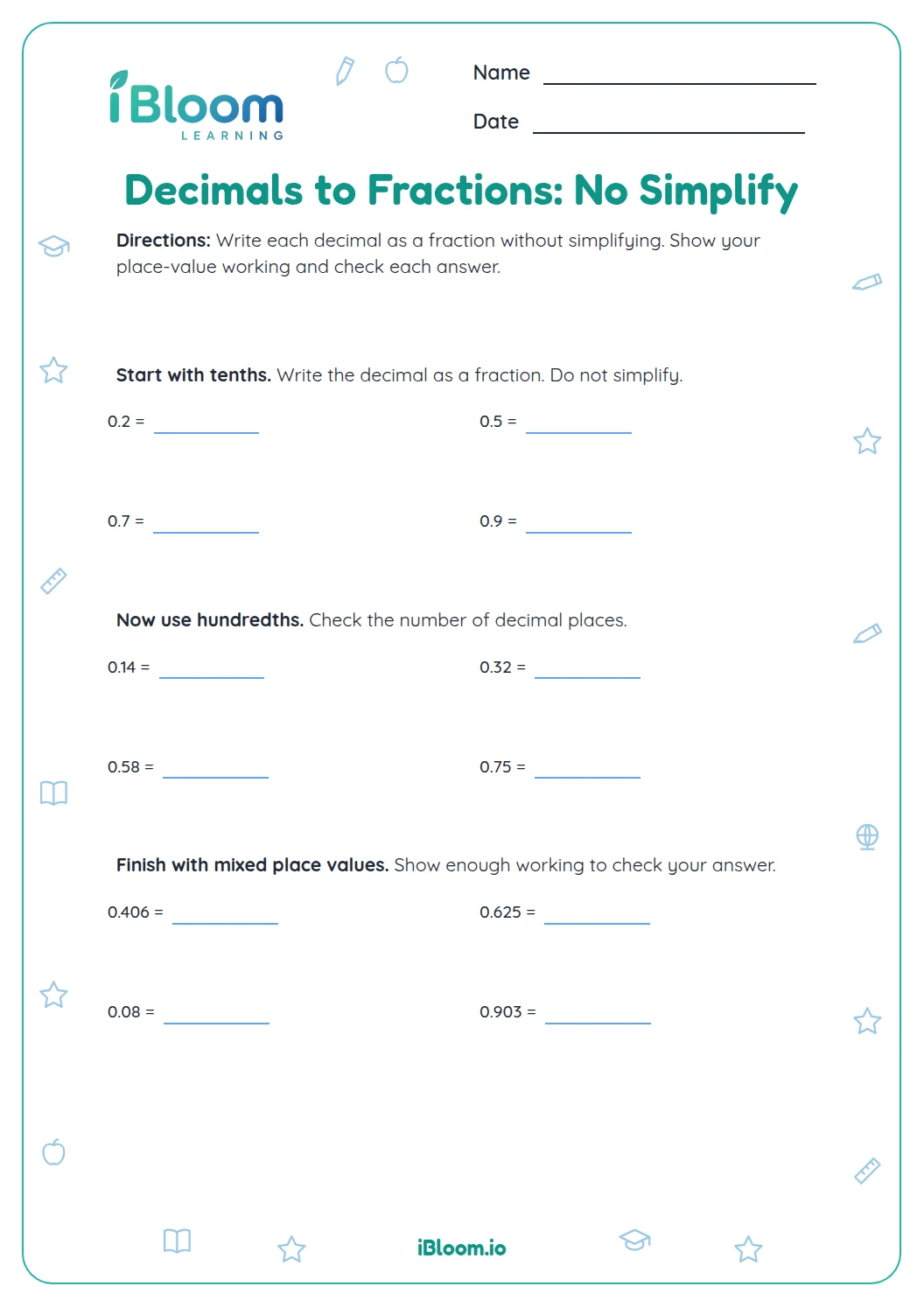
The sheet practices decimal place value with denominators of 10 and 100. For example, it writes 0.4 as 4/10 and 0.25 as 25/100. Keeping these place-value forms makes the connection between each decimal digit and its fraction visible.
Is an answer key included?
Yes. The two-page answer key gives the fractions for the model questions, the numerators for the fill-in conversions, and the correct choices for both equivalence questions. It can be printed separately so students can complete the worksheet before checking.