




About this worksheet
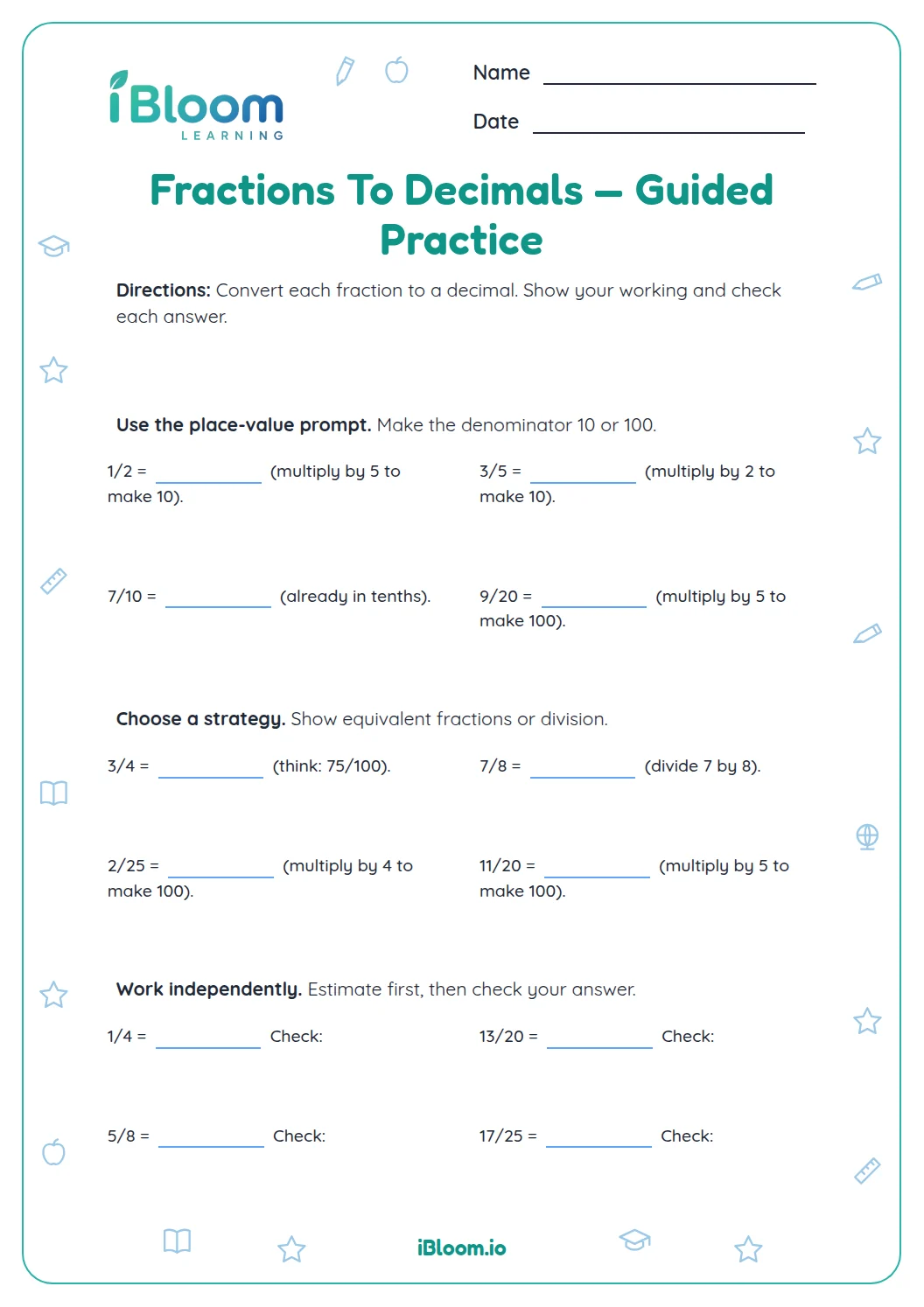
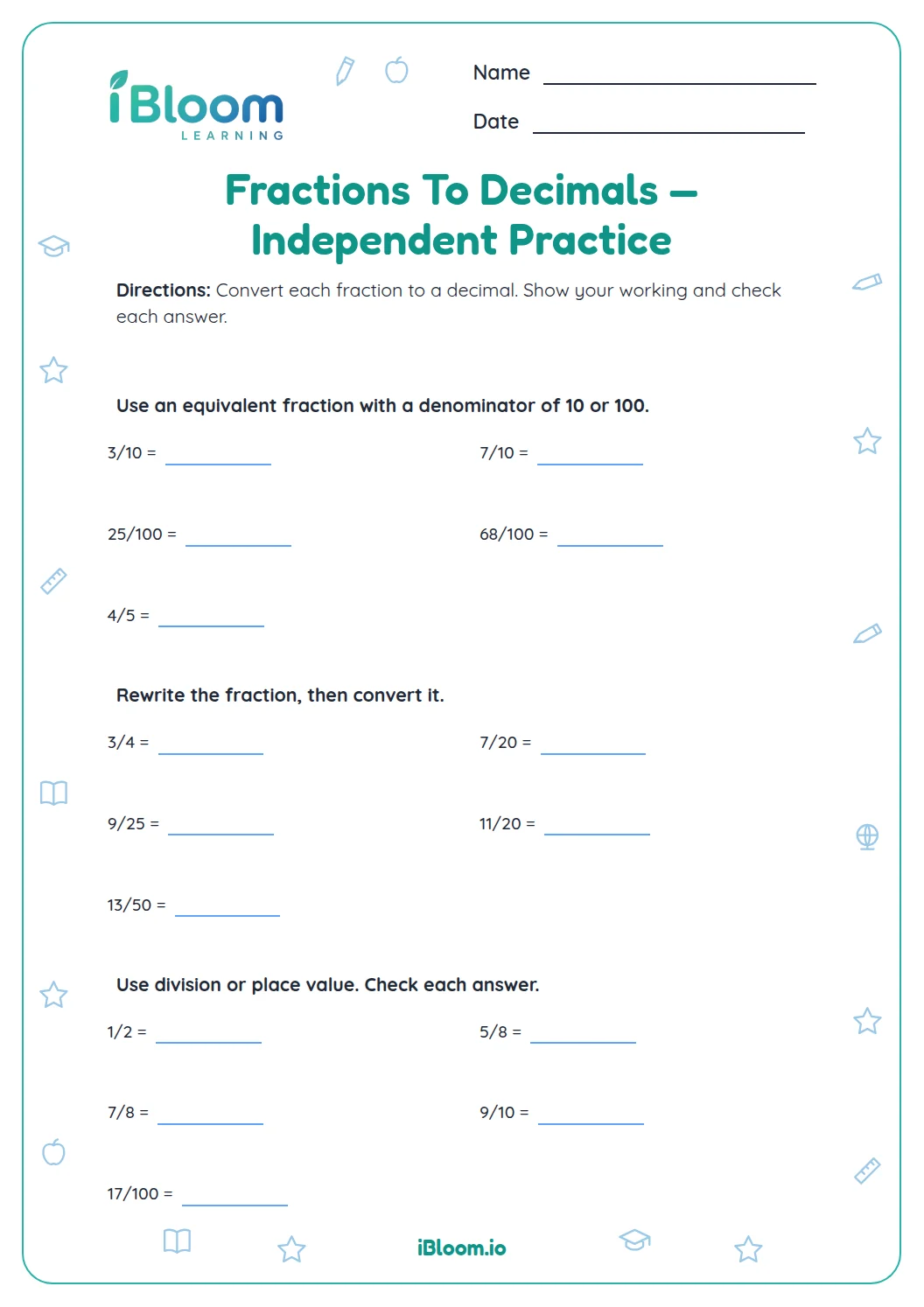
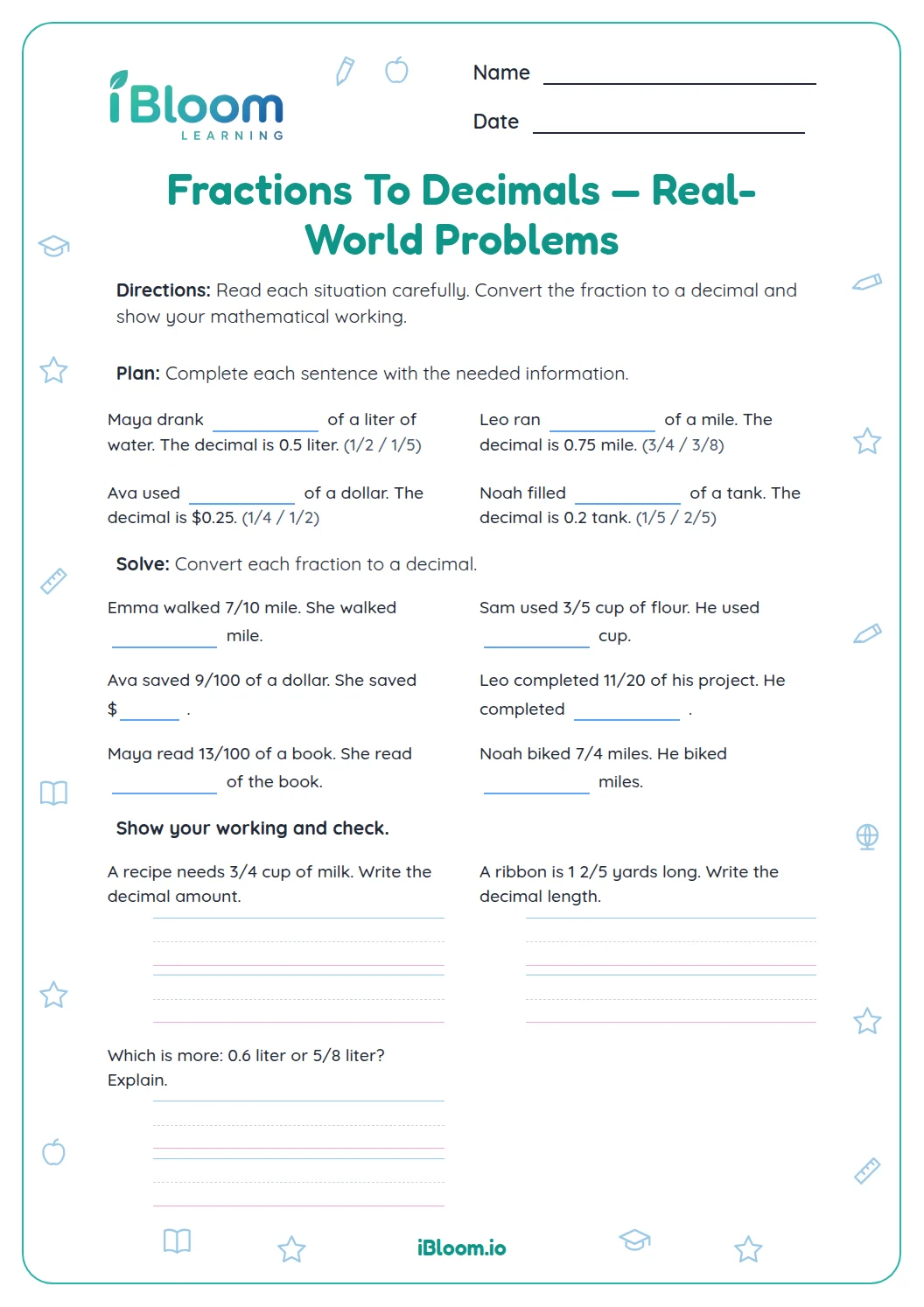
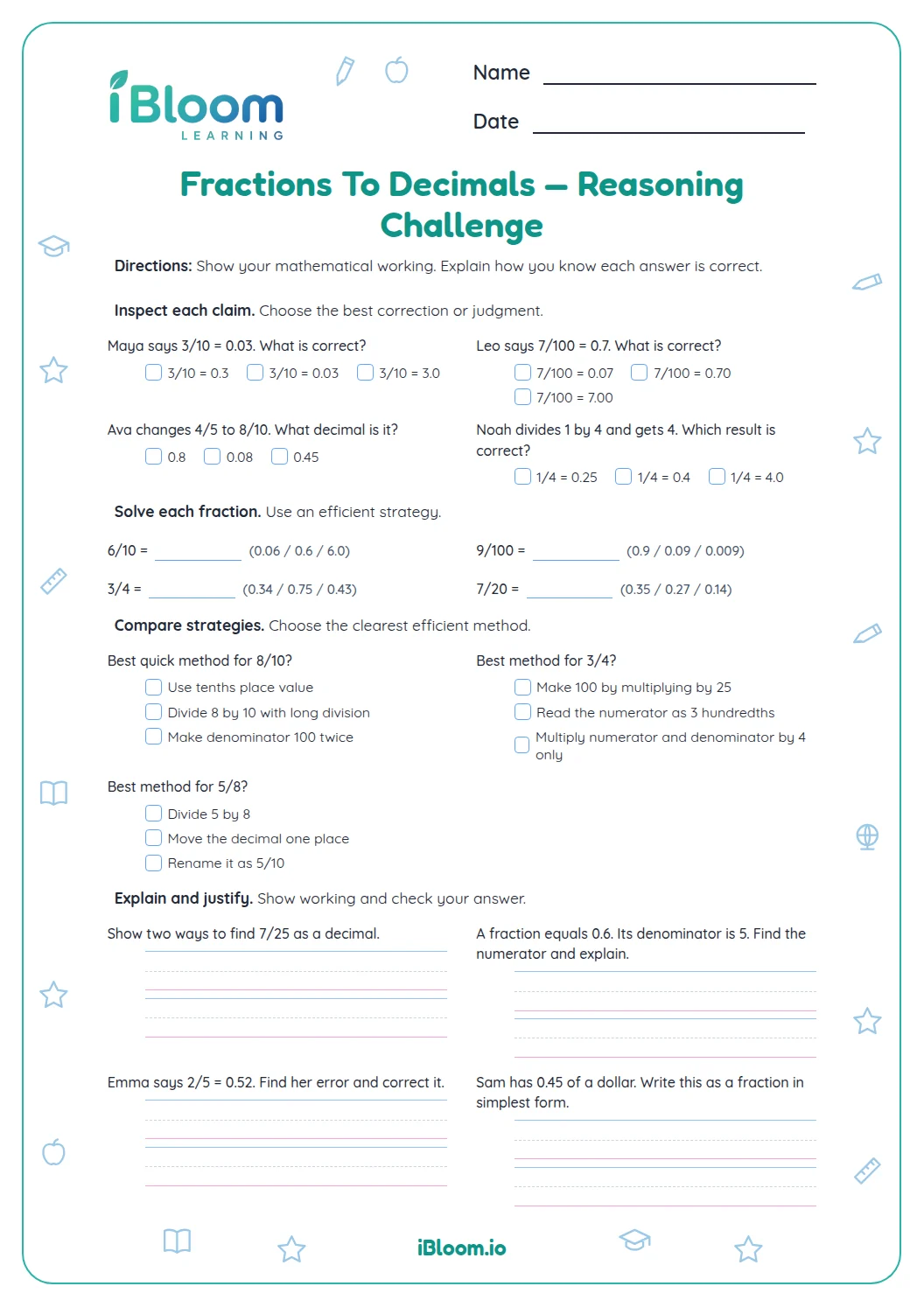
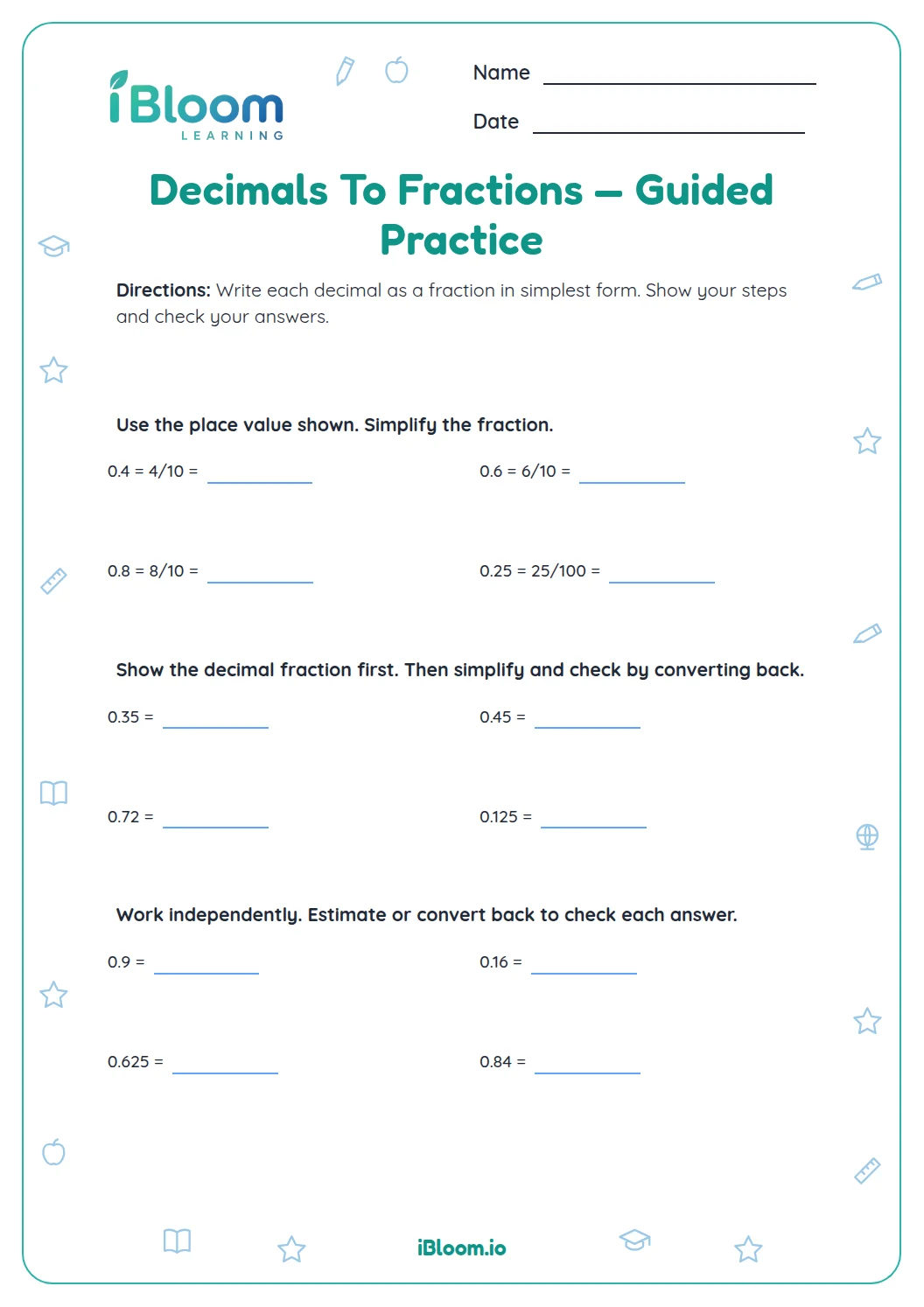
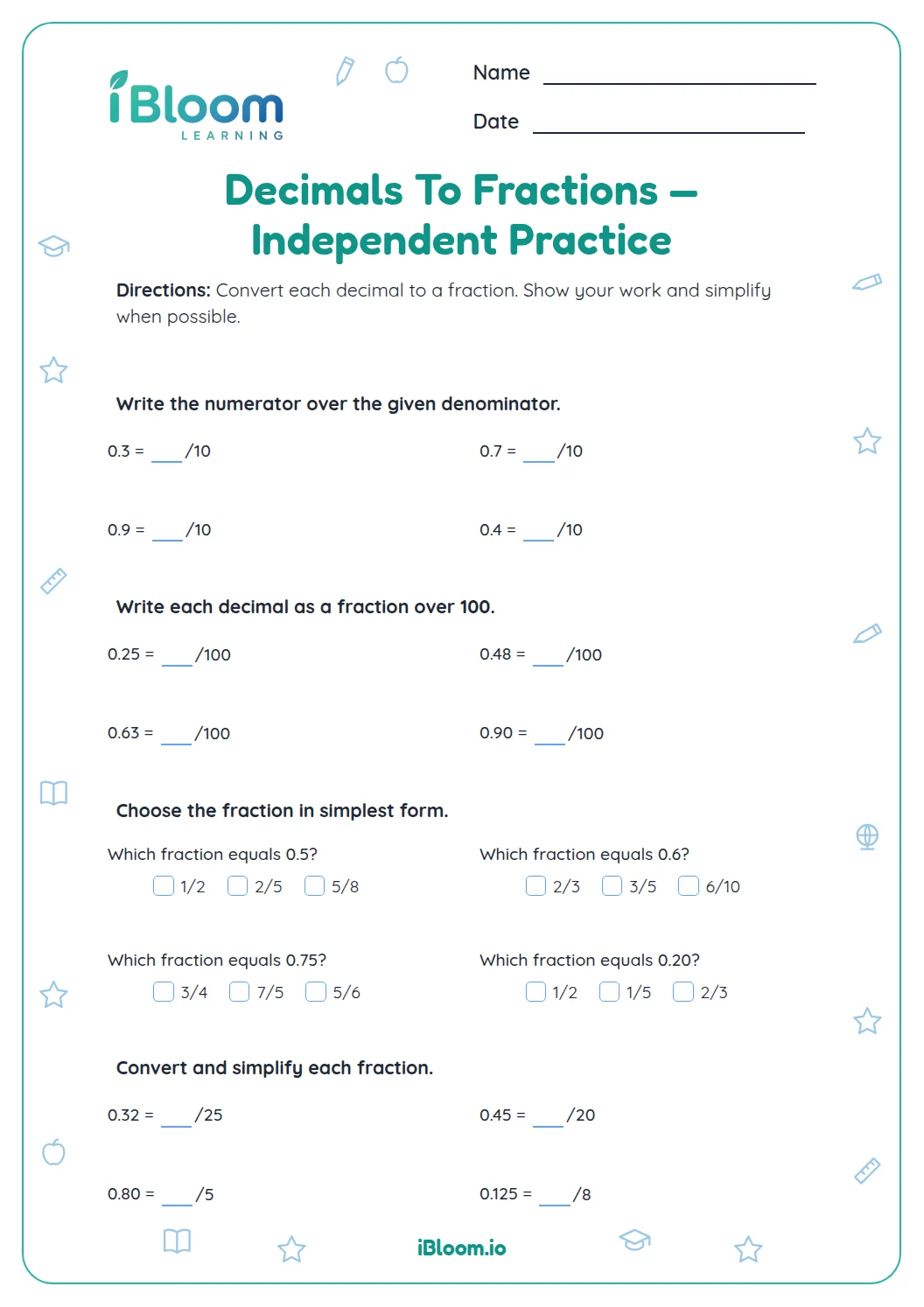
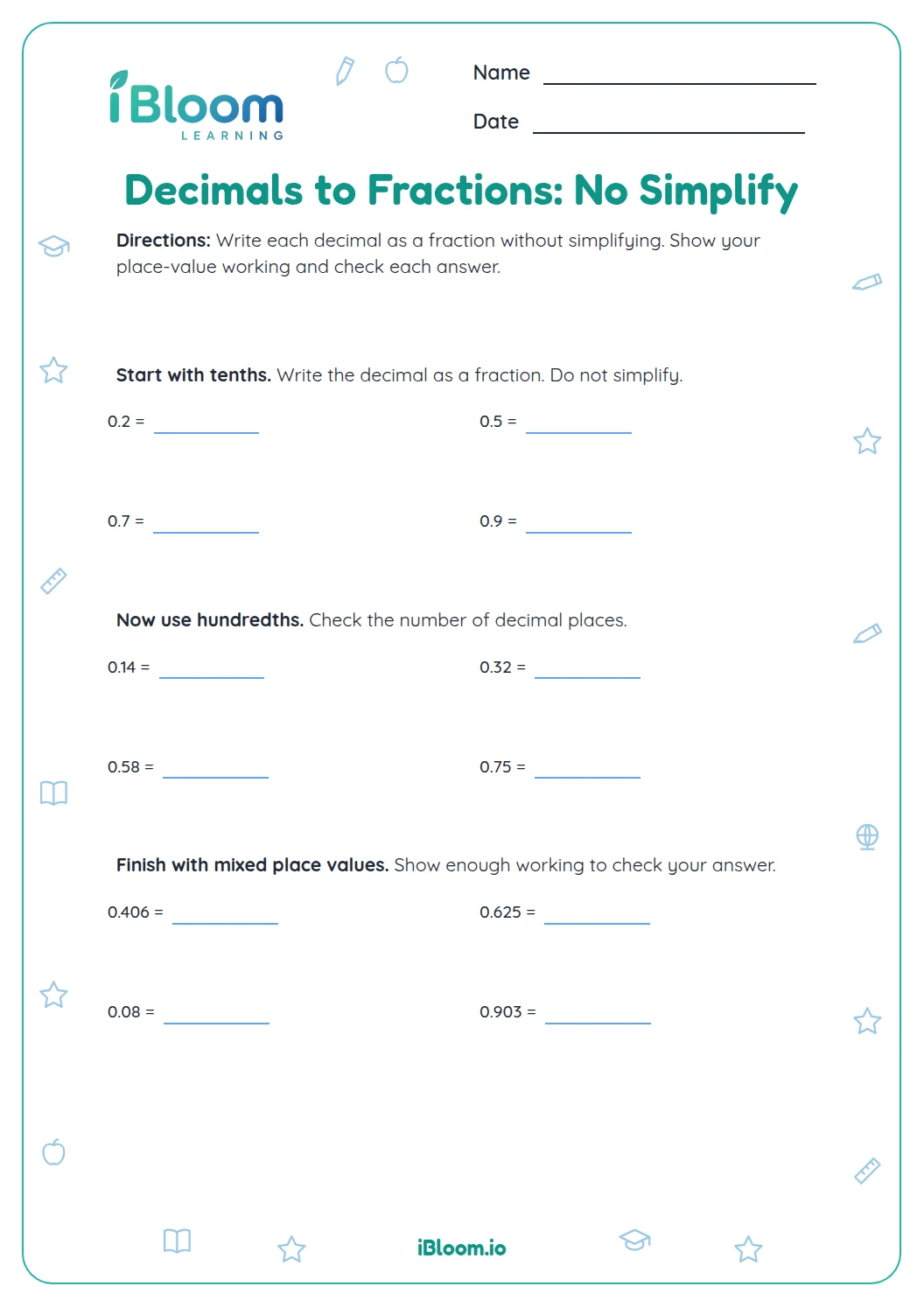
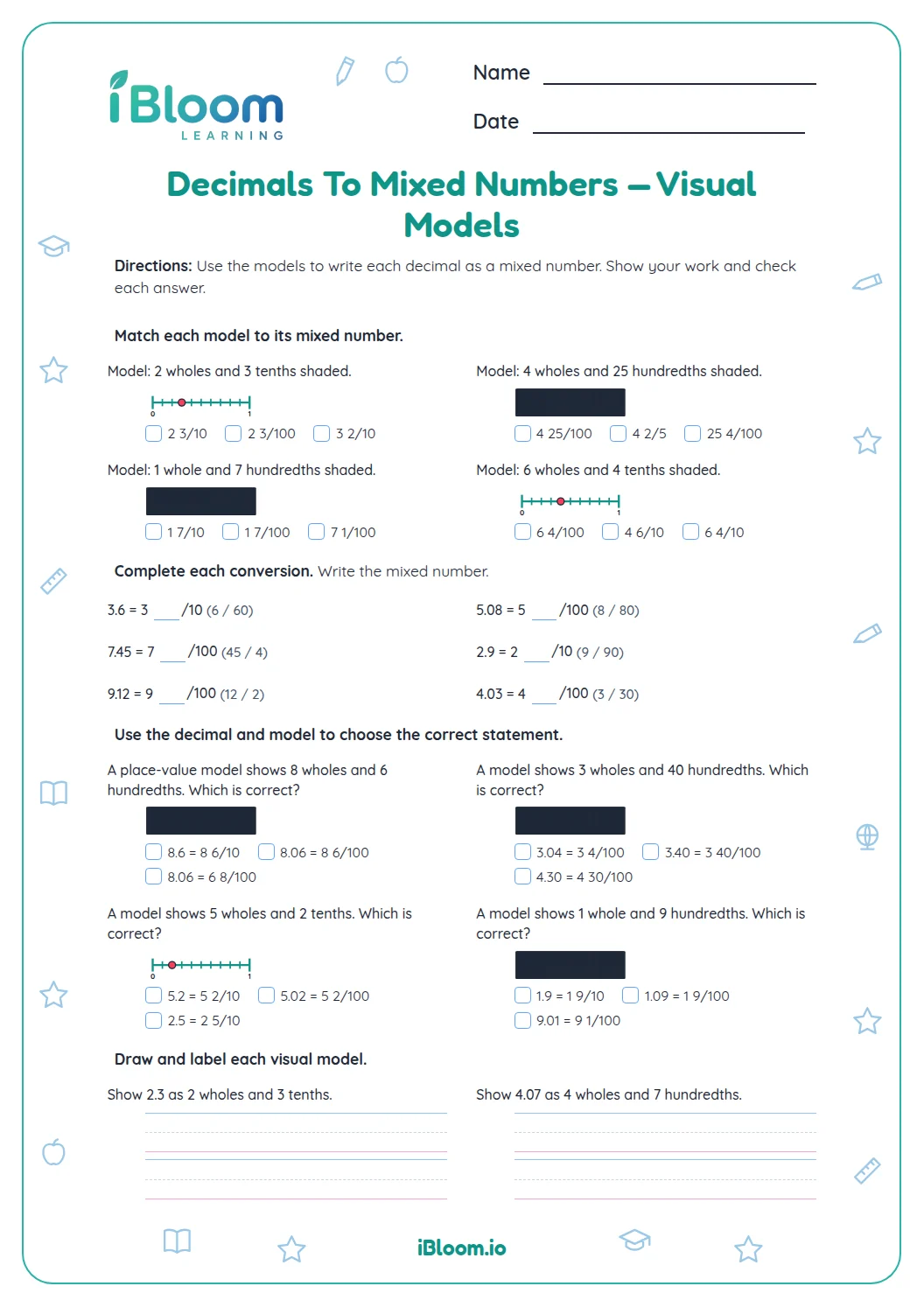
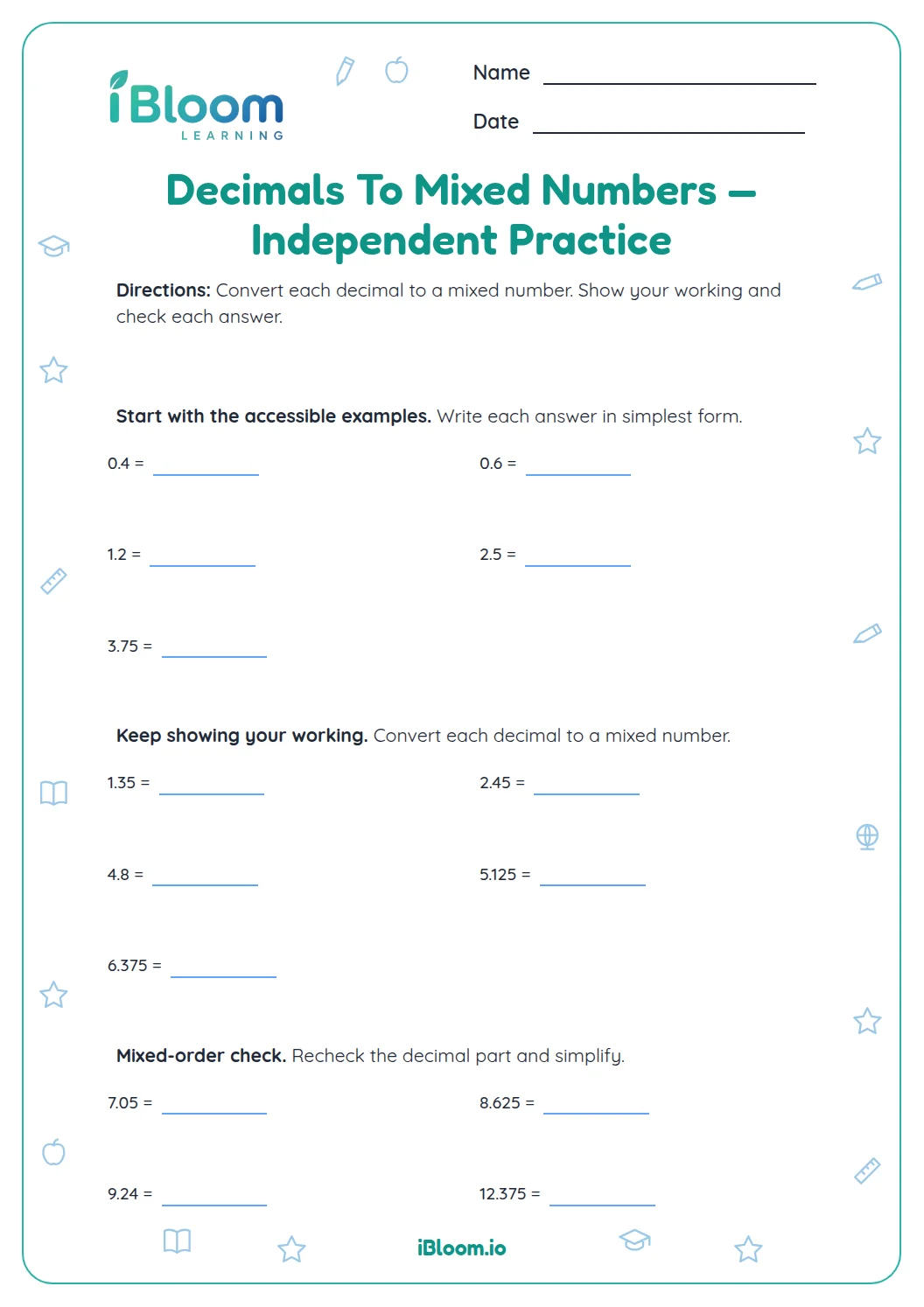
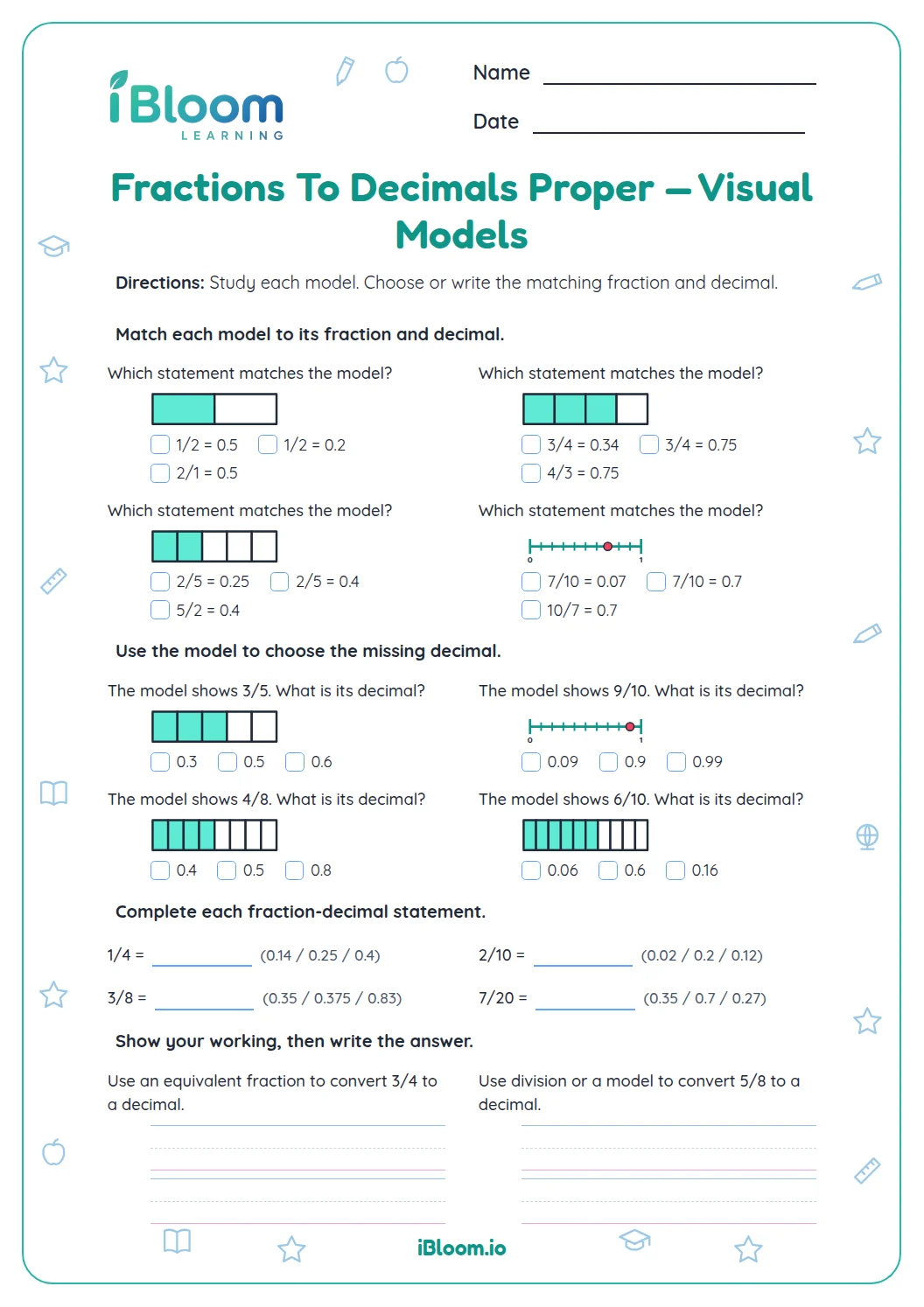
This Grade 5 worksheet builds a connection between fractions with denominators 10 or 100 and decimal notation. Sixteen questions begin with shaded tenths and hundredths, then ask students to convert, complete equivalent forms, and explain why 7/10 and 70/100 match. A meter context and a marked number line add applied practice. The separate answer key includes concise answers and an explanation model.
Aligned to 4.NF.C.6
How does the denominator determine decimal places?
Tenths have one digit after the decimal point, and hundredths have two. For example, 6/10 is 0.6, while 6/100 is 0.06. The zero keeps the 6 in the hundredths place.
- 13/10 = 30/100
- 2Thirty hundredths is 0.30.
- 3So 3/10 = 30/100 = 0.3.
How do shaded models support conversion?
A tenths strip shows how many of ten equal parts are shaded. A hundredths grid counts out of 100. These models help students see the value before writing the matching decimal.
What does this foundations worksheet include?
Sixteen questions move from two visual models to conversion, equivalent forms, decimal place value, and a number-line reading. The final written response asks students to explain why seven tenths and seventy hundredths name the same amount.
How can I use this worksheet?
- 1Look at the model and name the whole as one.
- 2Count shaded tenths or hundredths.
- 3Write tenths with one decimal place and hundredths with two.
- 4Use equivalent fractions to connect tenths to hundredths.
- 5Check the decimal with the grid or number line.
Common slips and quick fixes
The mistake
Writing 0.08 for 8/10.
The fix
Check the denominator: tenths place the 8 one place after the decimal, so 8/10 is 0.8.
The mistake
Dropping a needed zero in 6/100.
The fix
Use two decimal places: 6/100 is 0.06.
The mistake
Reading 0.30 as thirty tenths.
The fix
The 3 is in the tenths place and the 0 in hundredths; 0.30 equals 30/100 and also 3/10.
Common Core alignment
This page practices the standards below through the questions and examples on its worksheet.
Write fractions with denominators 10 or 100 in decimal notation.
On this sheet: The models and conversion questions connect tenths and hundredths to decimal notation.
Show the official wordingHide the official wording
Use decimal notation for fractions with denominators 10 or 100. For example, rewrite 0.62 as 62/100; describe a length as 0.62 meters; locate 0.62 on a number line diagram.
What to practice next
Make more practice
Further reading
Questions parents and teachers ask
Why is 3/10 equal to 30/100?
Each tenth is the same size as ten hundredths. So three tenths contain thirty hundredths. This equivalence lets students write 3/10 as 0.3 or as 0.30 without changing the amount. Use the passage or picture clue to check the answer, and accept different wording when the main idea and important details remain accurate.
How do tenths and hundredths appear in decimal notation?
Tenths are one place to the right of the decimal point, as in 0.6. Hundredths are two places to the right, as in 0.06. A zero can hold the tenths place when the fraction has only hundredths. Use the passage or picture clue to check the answer, and accept different wording when the main idea and important details remain accurate.
Does the worksheet use visual models?
Yes. The opening questions show a tenths strip and a hundredths grid, and another question uses a number line with point A. Students count shaded parts or read the marked position before writing the matching decimal. The teacher can ask how the model supports each answer.
How many questions does the worksheet include?
There are 16 questions in four parts: matching decimal models, converting and connecting forms, reading a marked number line, and explaining an equivalence. One conversion uses a meter context. The separate answer key gives the decimals and a sample explanation.
Which standard does this sheet practice?
The worksheet practices CCSS 4.NF.C.6 by connecting fractions with denominators 10 or 100 to decimal notation. Students use shaded models, equivalent fractions, a meter context, and a number line to write and interpret these decimal values. The standard statement and official link appear below.