




About this worksheet
This Grade 5 worksheet connects fractions with denominators 10 and 100 to decimal notation. Students read four shaded models, convert six fractions, and choose decimal forms in six multiple-choice items. The answer key shows the decimal values, including a zero in the tenths place when needed. This work practices CCSS 4.NF.C.6.
Aligned to 4.NF.C.6
What will students practice on this fractions-to-decimals sheet?
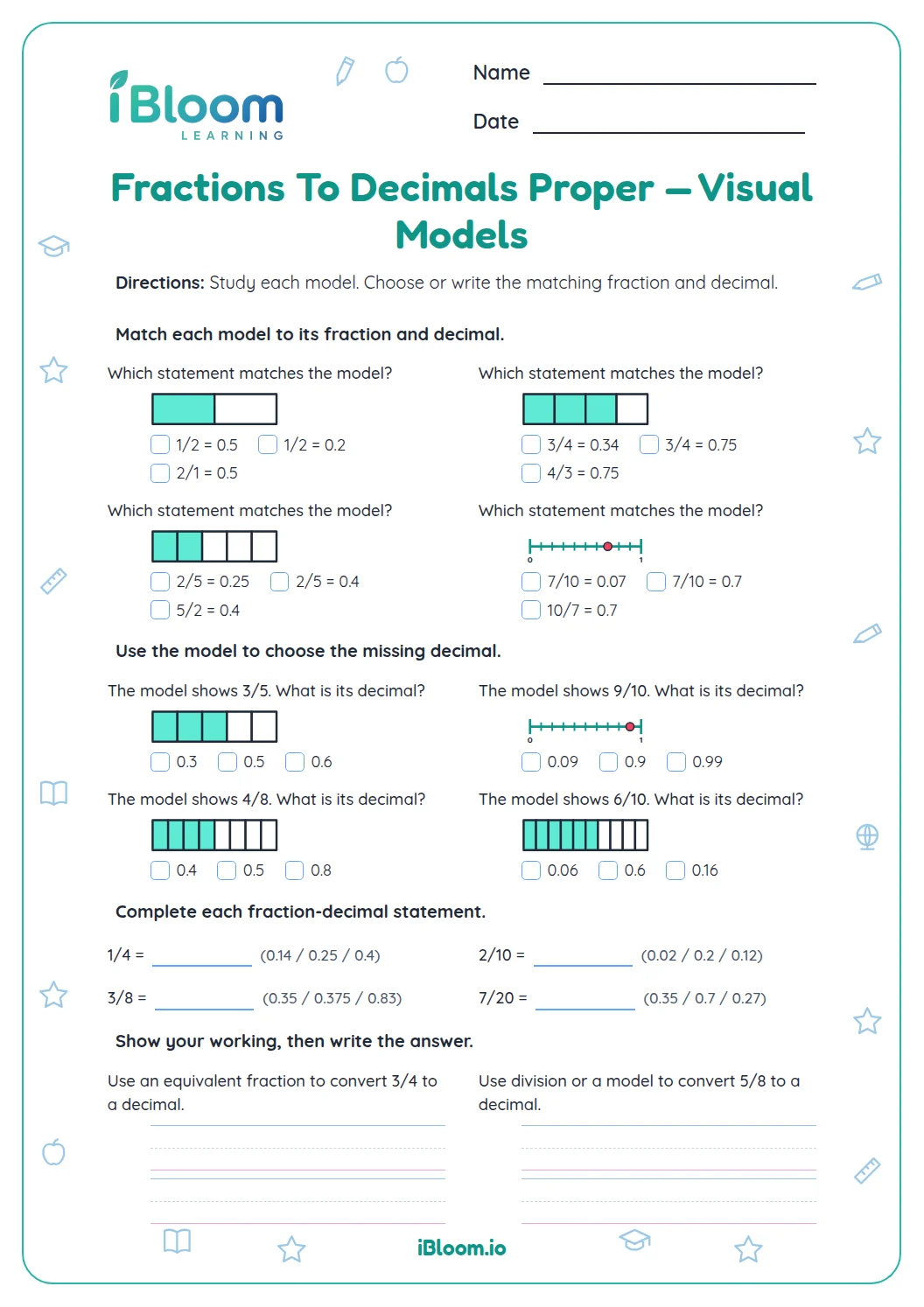
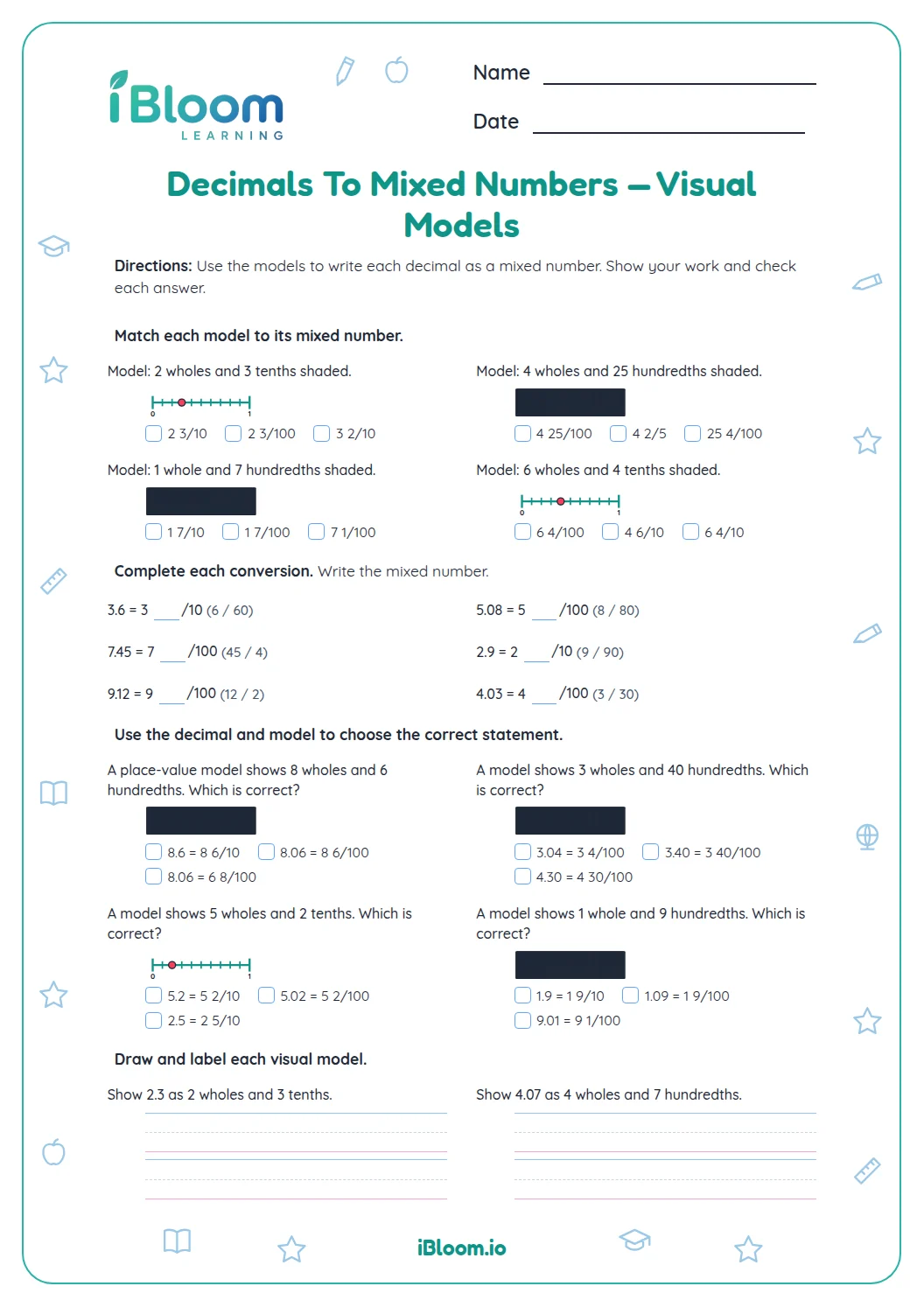
The first four questions ask students to read shaded tenths strips and hundredths grids. Six fill-in items then convert fractions such as 3/10 and 27/100, followed by six choices that check place value.
The sequence moves from a visual amount to the written fraction and then to its decimal. A zero in the tenths place matters in a value such as 0.06.
- 127/100 = 0.27: 27 hundredths occupy the hundredths places.
How do tenths and hundredths appear in decimal notation?
A denominator of 10 names tenths, so 3/10 is 0.3. A denominator of 100 names hundredths, so 6/100 is 0.06. In 0.06, the zero marks an empty tenths place and the 6 stays in the hundredths place.
How can students use the shaded models to check?
Count the shaded pieces and identify whether the model is divided into tenths or hundredths. Three shaded tenths are 0.3; 42 shaded hundredths are 0.42. Then compare the model’s place value with the decimal digits before checking the answer key.
How to use this worksheet at home or in class
- 1Check whether the denominator names tenths or hundredths.
- 2Use that place to position the digits after the decimal point.
- 3Write a zero in an empty place when needed.
- 4Compare your decimal with the shaded model or fraction.
Common mistakes and quick fixes
The mistake
Writing 0.9 for 9/100
The fix
Hundredths need two places after the decimal.
The mistake
Dropping a leading zero
The fix
Write 0.06 so the hundredths digit stays in the correct place.
The mistake
Reading the numerator as a whole number
The fix
Keep the denominator’s place value in the decimal.
Common Core alignment
This worksheet practices 4.NF.C.6 through its printed questions.
Write fractions with denominators 10 and 100 in decimal notation.
On this sheet: The worksheet questions ask students to practice this skill directly.
Show the official wordingHide the official wording
Use decimal notation for fractions with denominators 10 or 100. For example, rewrite 0.62 as 62/100; describe a length as 0.62 meters; locate 0.62 on a number line diagram.
What to practice next
Make more practice
Further reading
Questions parents and teachers ask
How do tenths become decimals?
A denominator of 10 means the numerator counts tenths, so 7/10 is 0.7. A denominator of 100 means hundredths, so 7/100 is 0.07. The worksheet connects those place names to the digits after the decimal point and uses both denominators in its practice.
Why does 6/100 have a zero after the decimal?
The zero in 0.06 holds the tenths place so the 6 remains in the hundredths place. Writing 0.6 would mean six tenths, which is ten times as much as six hundredths. The hundredths model and the fraction denominator help students check the position.
Can 0.50 also represent 5/10?
Yes. Five tenths is 0.5, and 0.50 names the same amount because the added zero is in the hundredths place. This worksheet uses the place values named by the denominator, so 5/10 is written as 0.5. Students can reread the decimal as tenths or hundredths to verify that it names the original fraction.
What do the shaded grids help students see?
The tenths strips and hundredths grids show equal parts of one whole. Counting shaded parts links the numerator to the decimal digits, helping students see why 42 out of 100 is 0.42 rather than 4.2. The key labels each value by place, making it easier to distinguish a tenths digit from a hundredths digit.
How can I check a conversion?
Read the decimal aloud using place-value language, then compare it with the fraction. For instance, 0.27 means 27 hundredths, which matches 27/100. You can also check that the decimal is less than one for a proper fraction. Invite the learner to point to the numerator and denominator and say what each contributes to the decimal.