



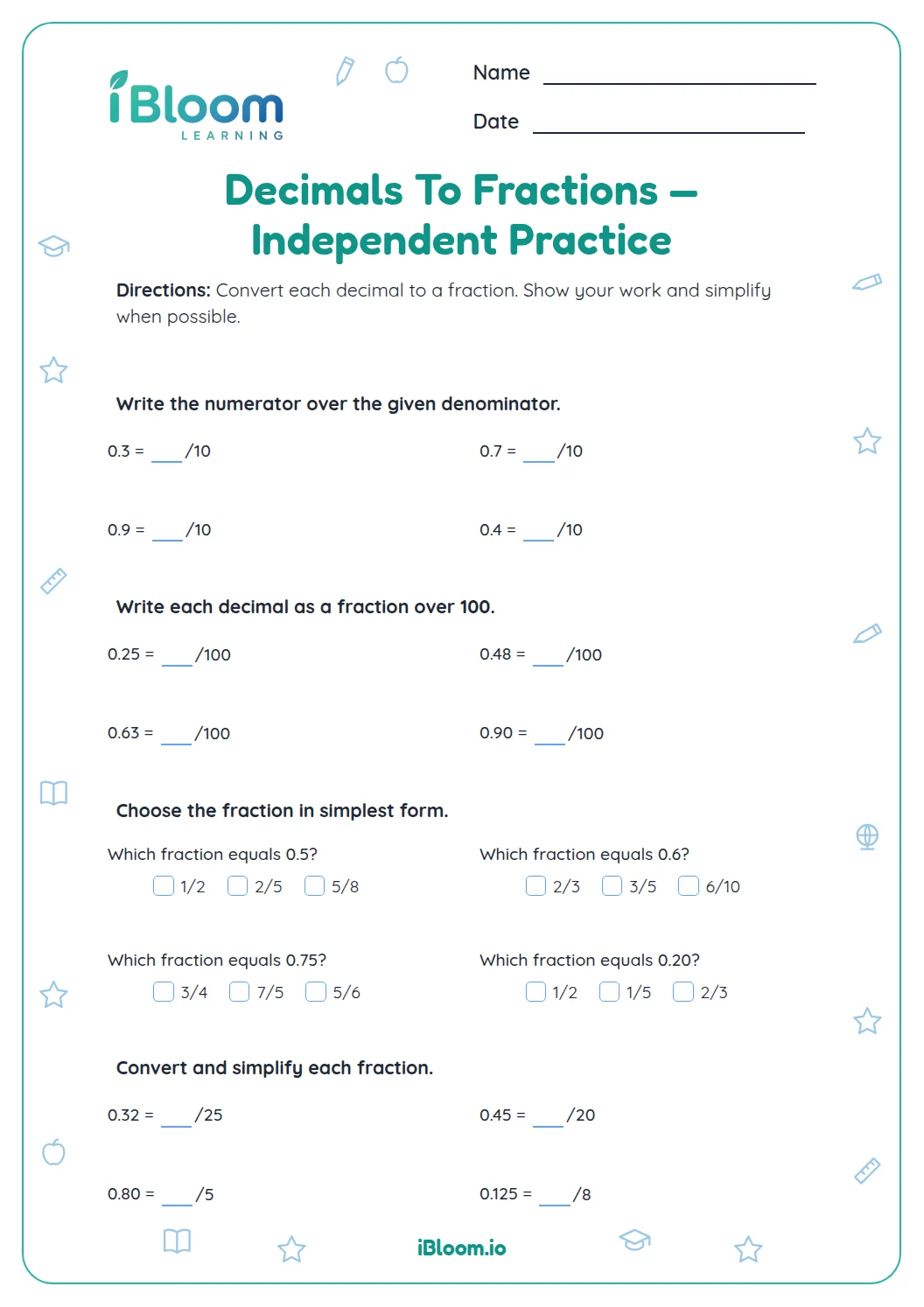
About this worksheet
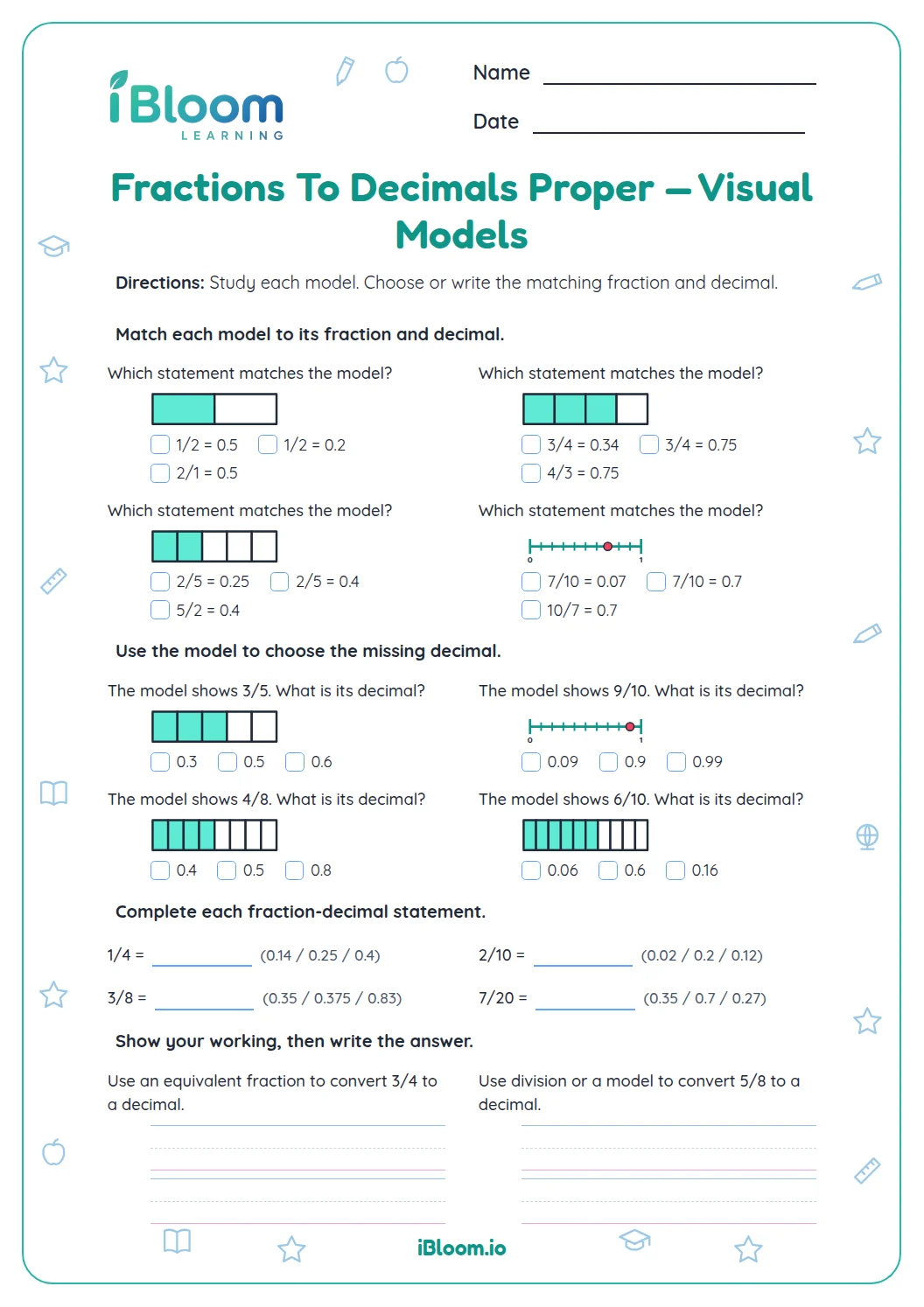
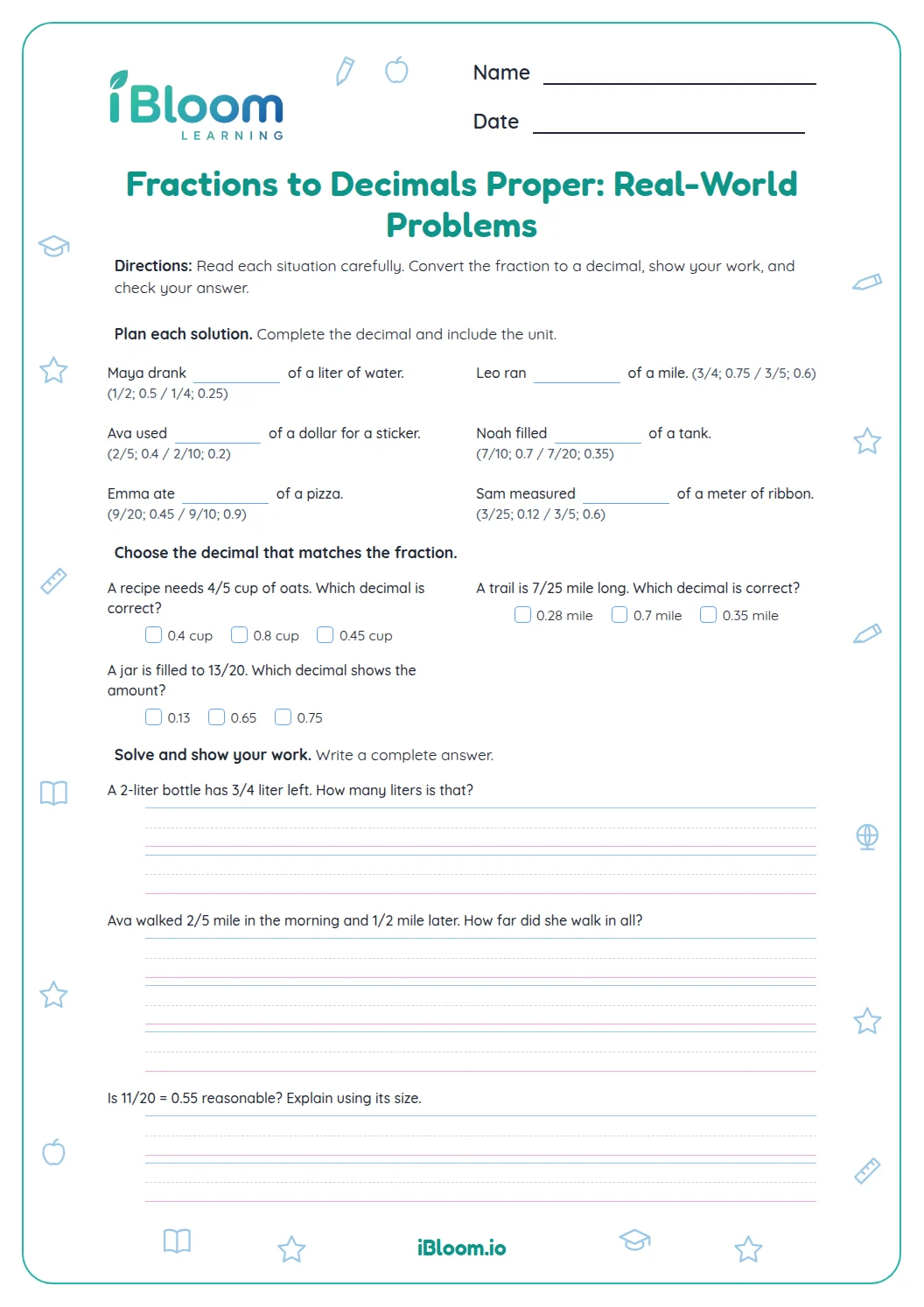
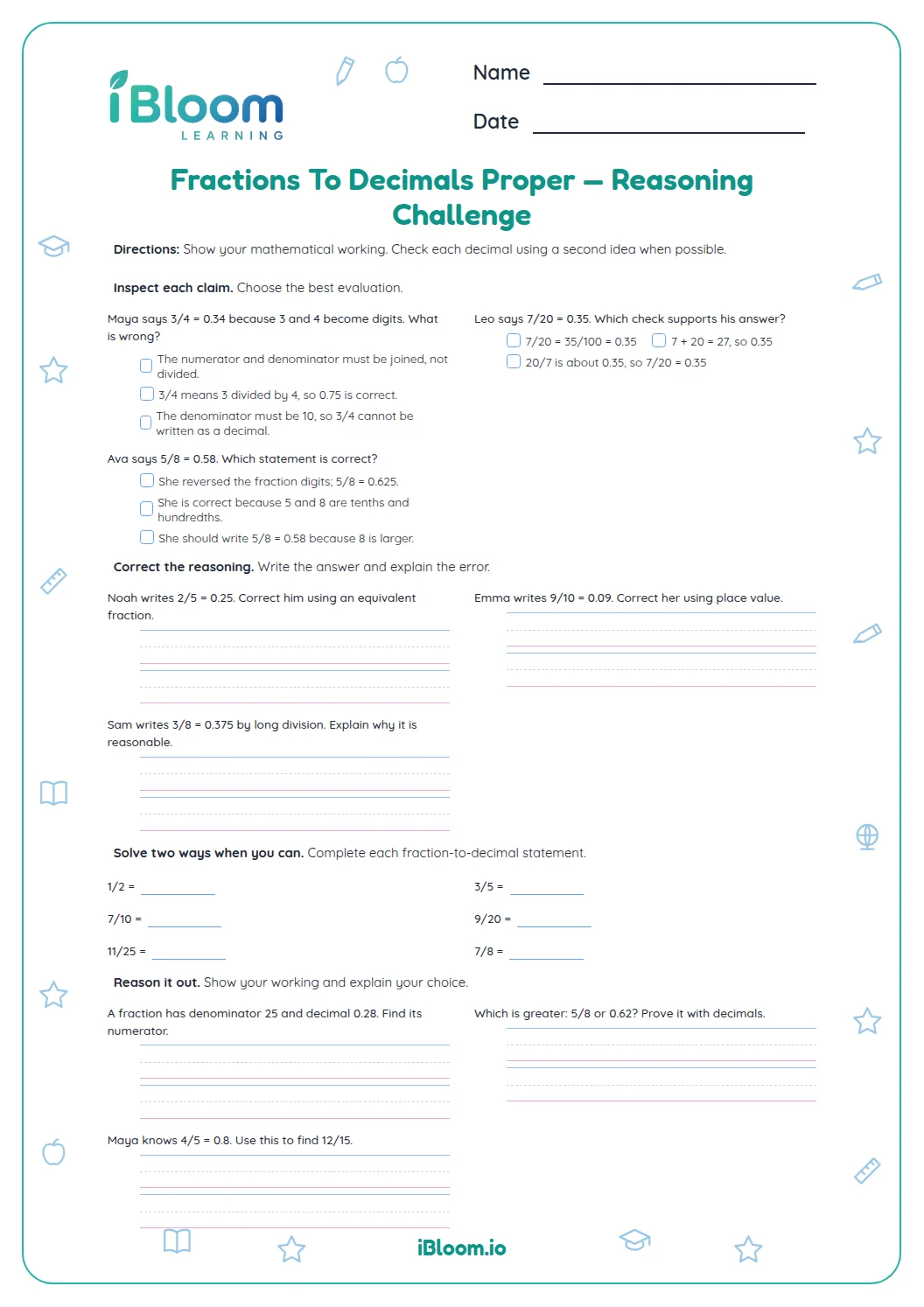
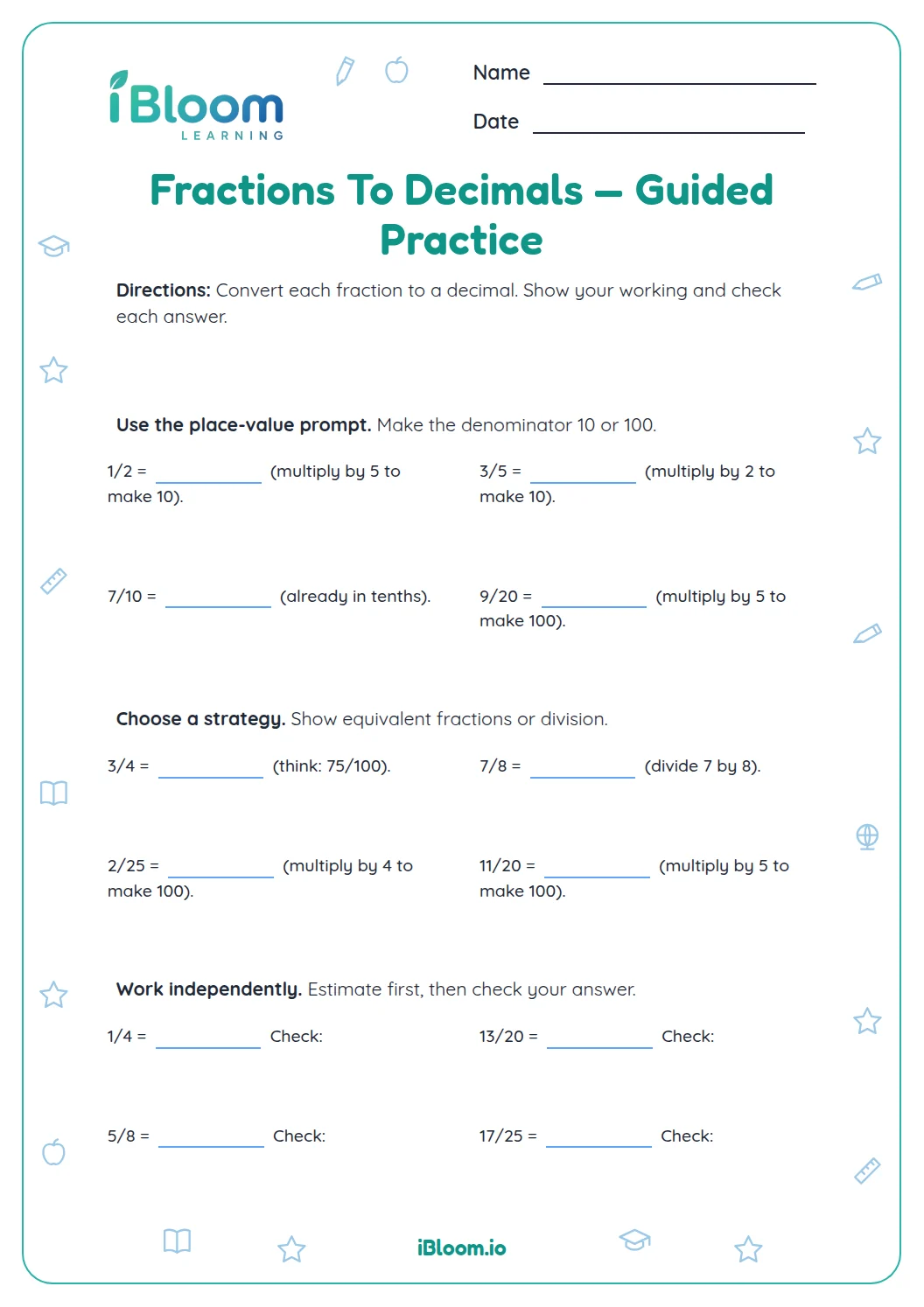
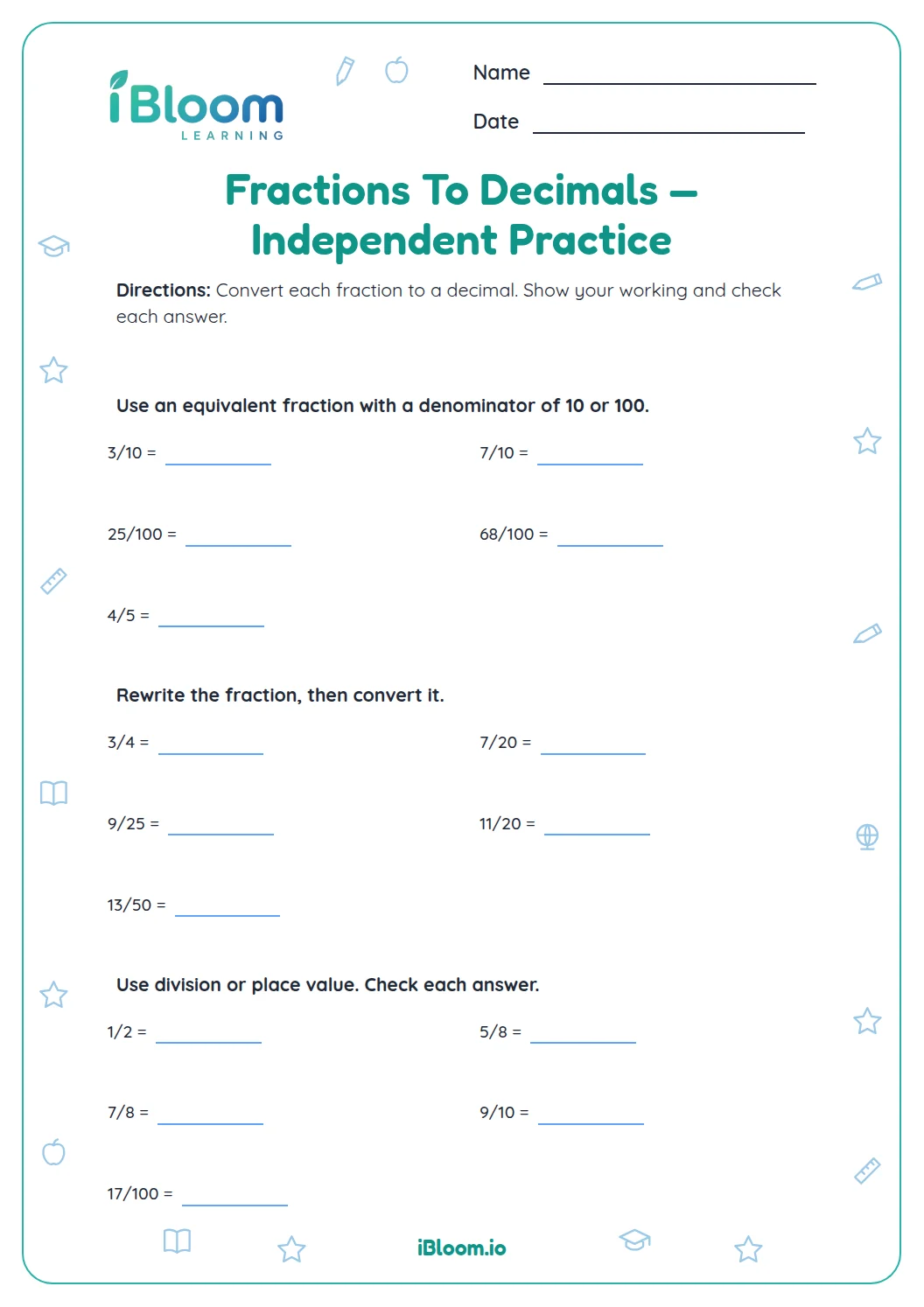
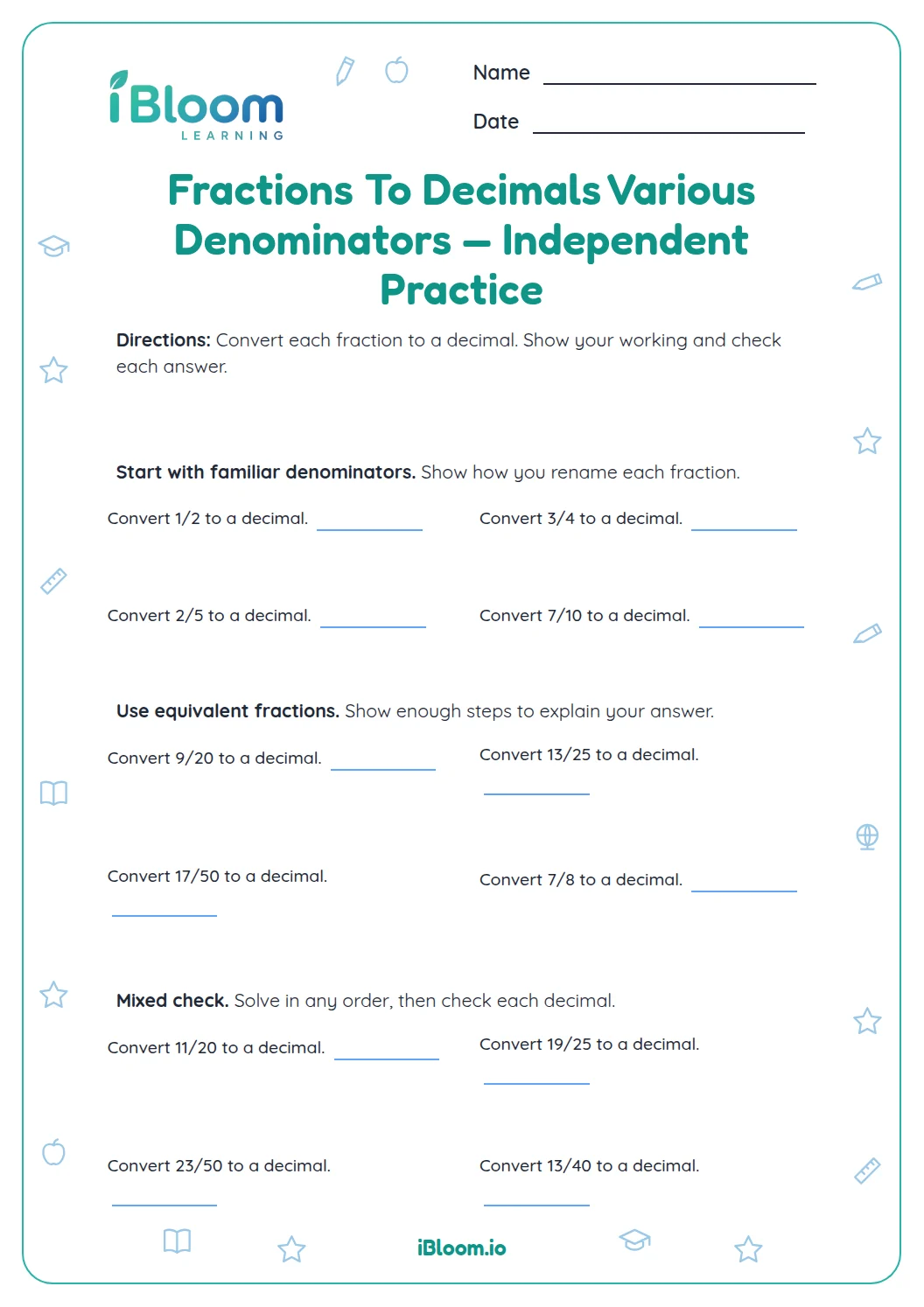
This two-page Grade 5 worksheet helps students write proper fractions as decimals. The first part starts with familiar halves and fourths; the next set includes fifths, tenths, and twentieths, including hundredths such as 7/20 = 0.35. Four context questions ask students to interpret a fraction of a bottle, lap, garden bed, or page as a decimal. A separate two-page answer key lists the conversions. The work connects to interpreting a fraction as numerator divided by denominator in Common Core 5.NF.B.3.
Aligned to 5.NF.B.3
How do halves and fifths become decimals?
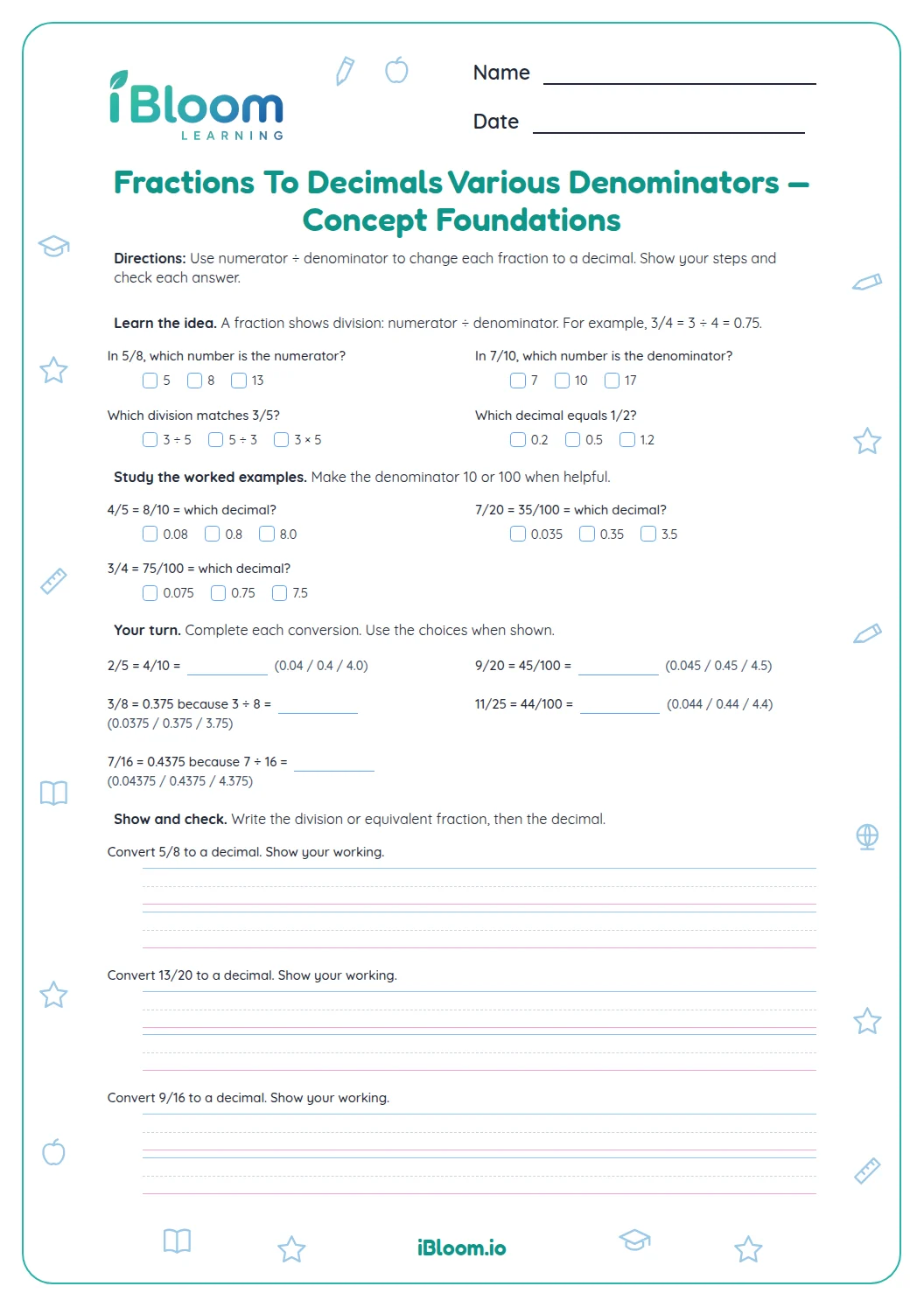
Part A reviews familiar fractions such as 1/2, 1/4, 3/4, and fifths. Divide the numerator by the denominator or use an equivalent fraction with a denominator of 10 or 100.
- 13/4
- 23 ÷ 4 = 0.75
- 3So, 3/4 = 0.75
How can twentieths become hundredths?
For a fraction with denominator 20, multiply the numerator and denominator by 5 to make hundredths. For example, 7/20 = 35/100 = 0.35.
Where do fractions appear in a situation?
The final four questions describe a part of a whole. Convert the fraction to a decimal and keep the unit or object in view: a part of a lap, bottle, bed, or page.
A reliable conversion routine
- 1Read the numerator and denominator carefully.
- 2Ask whether the denominator can become 10 or 100.
- 3Multiply the numerator by the same amount as the denominator.
- 4Write the equivalent fraction as a decimal.
- 5Check by dividing the numerator by the original denominator.
Fraction conversion checks
The mistake
Changing the denominator but not the numerator
The fix
Multiply both parts of the fraction by the same number.
The mistake
Writing 7/20 as 0.7
The fix
Convert twentieths to hundredths: 7/20 = 35/100 = 0.35.
The mistake
Putting the decimal in the wrong place
The fix
Check the value by division; a proper fraction must be between 0 and 1.
Common Core alignment
This sheet practices the following Common Core standard.
Interpret each fraction as numerator divided by denominator to write its decimal value.
On this sheet: Convert each proper fraction by dividing its numerator by its denominator.
Show the official wordingHide the official wording
Interpret a fraction as division of the numerator by the denominator (a/b = a ÷ b). Solve word problems involving division of whole numbers leading to answers in the form of fractions or mixed numbers, e.g., by using visual fraction models or equations to represent the problem.
What to practice next
Further reading
Questions parents and teachers ask
What decimal is equal to 3/4?
Three fourths is 0.75. One way to see it is to change 3/4 to 75/100 by multiplying both numerator and denominator by 25. Part A includes this familiar conversion before students work with other denominators. The quotient gives the decimal value of the fraction, including hundredths when needed.
How do you convert a fraction with denominator 20?
Make an equivalent fraction with denominator 100 by multiplying the numerator and denominator by 5. For example, 7/20 becomes 35/100, which is 0.35. The worksheet includes 1/20, 7/20, and 9/20. This method works because multiplying top and bottom by five preserves the fraction’s value.
Does the worksheet include real-life examples?
Yes. Four questions use fractions of a bottle, a lap, a garden bed, and a page. Students write each fractional amount as a decimal, then keep the context in mind when stating what the number describes. For example, 3/4 of a lap is 0.75 lap, and the unit remains part of the story.
How many conversions are on the pages?
There are 16 questions in three parts: 12 direct fraction-to-decimal conversions and four context questions. The worksheet spans two pages, followed by a separate two-page answer key. The first two parts focus on number conversions before applying them to context.
How can a student check a conversion?
Divide the numerator by the denominator and compare the quotient with the decimal. For 9/20, the quotient is 0.45; the equivalent-fraction check is 45/100, which is also 0.45. Both methods should give the same decimal, which offers a quick way to catch errors.
What does 5.NF.B.3 mean for this practice?
The standard asks students to interpret a fraction as division of its numerator by its denominator. Each conversion uses that relationship: the fraction bar means divide, and the quotient is written as a decimal. The conversion prompts use fractions as division, so students connect the two notations.