



About this worksheet
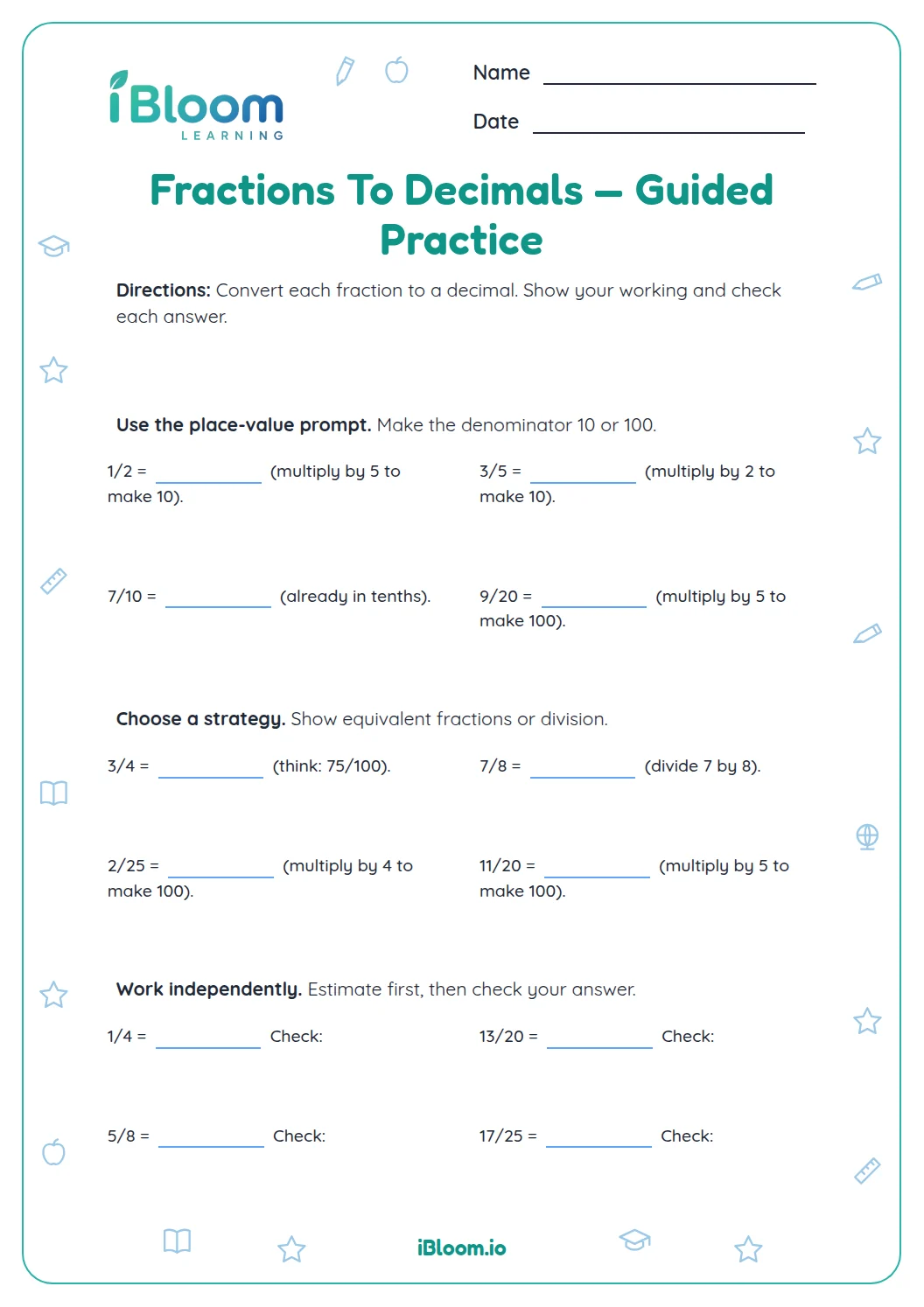
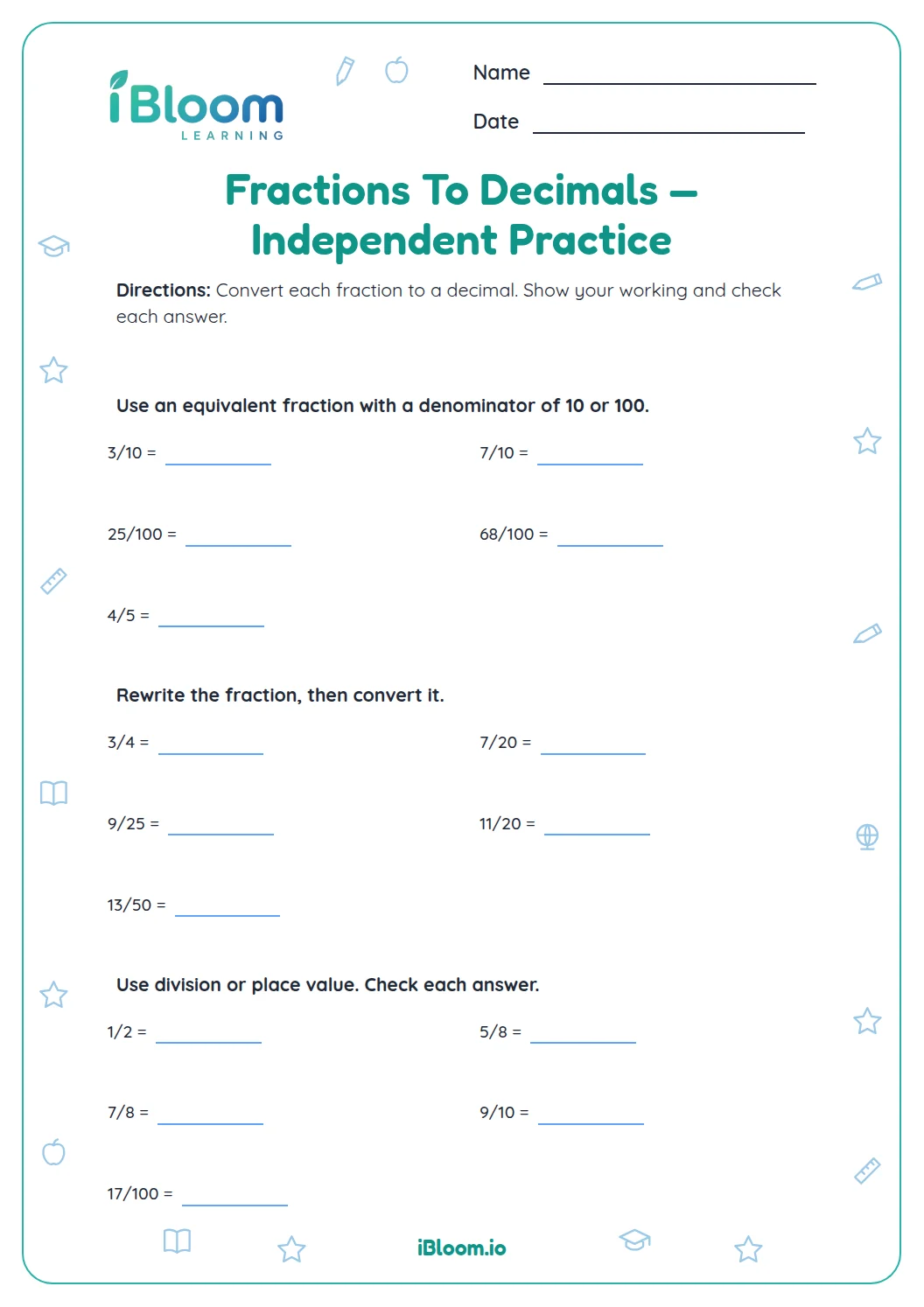
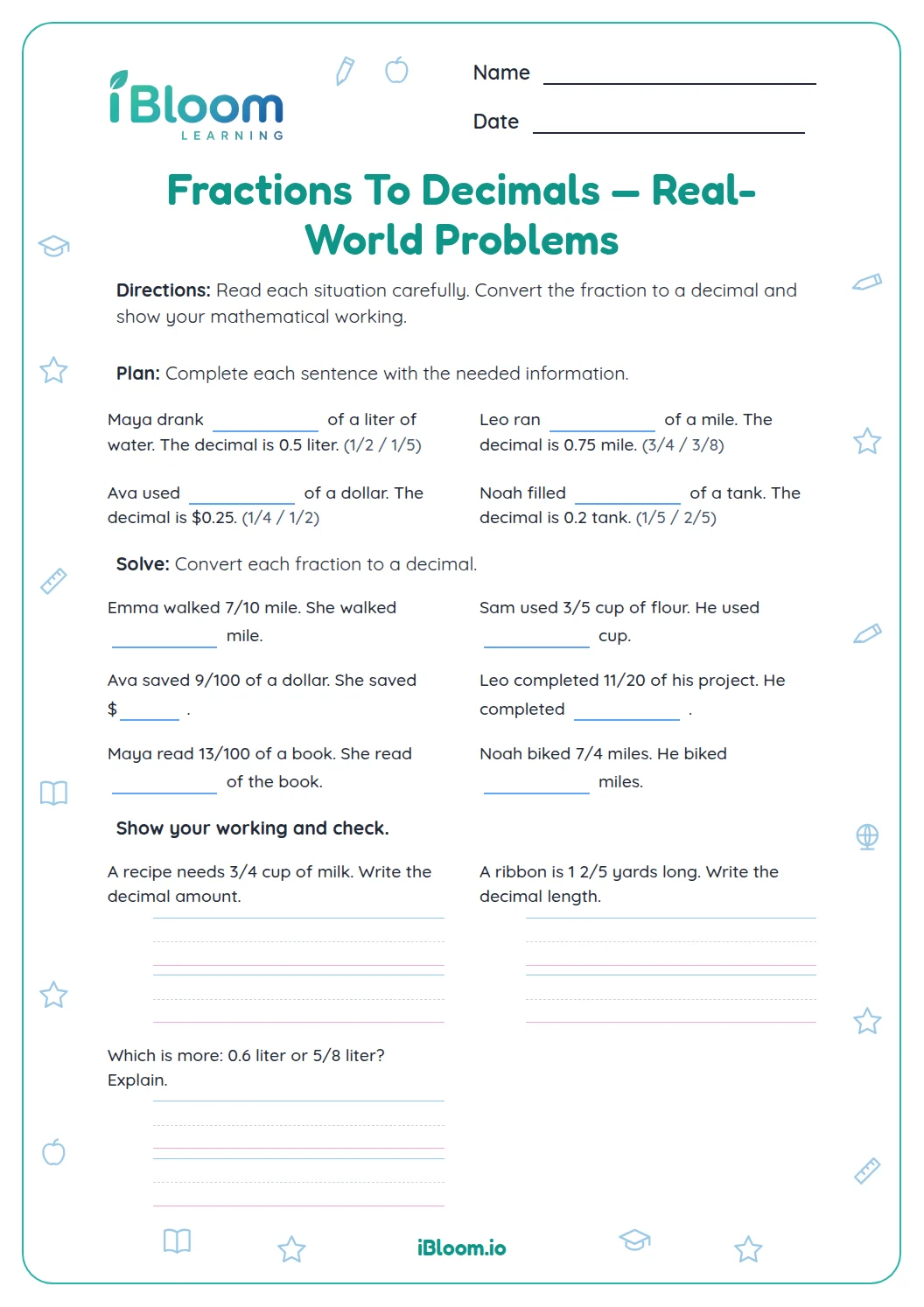
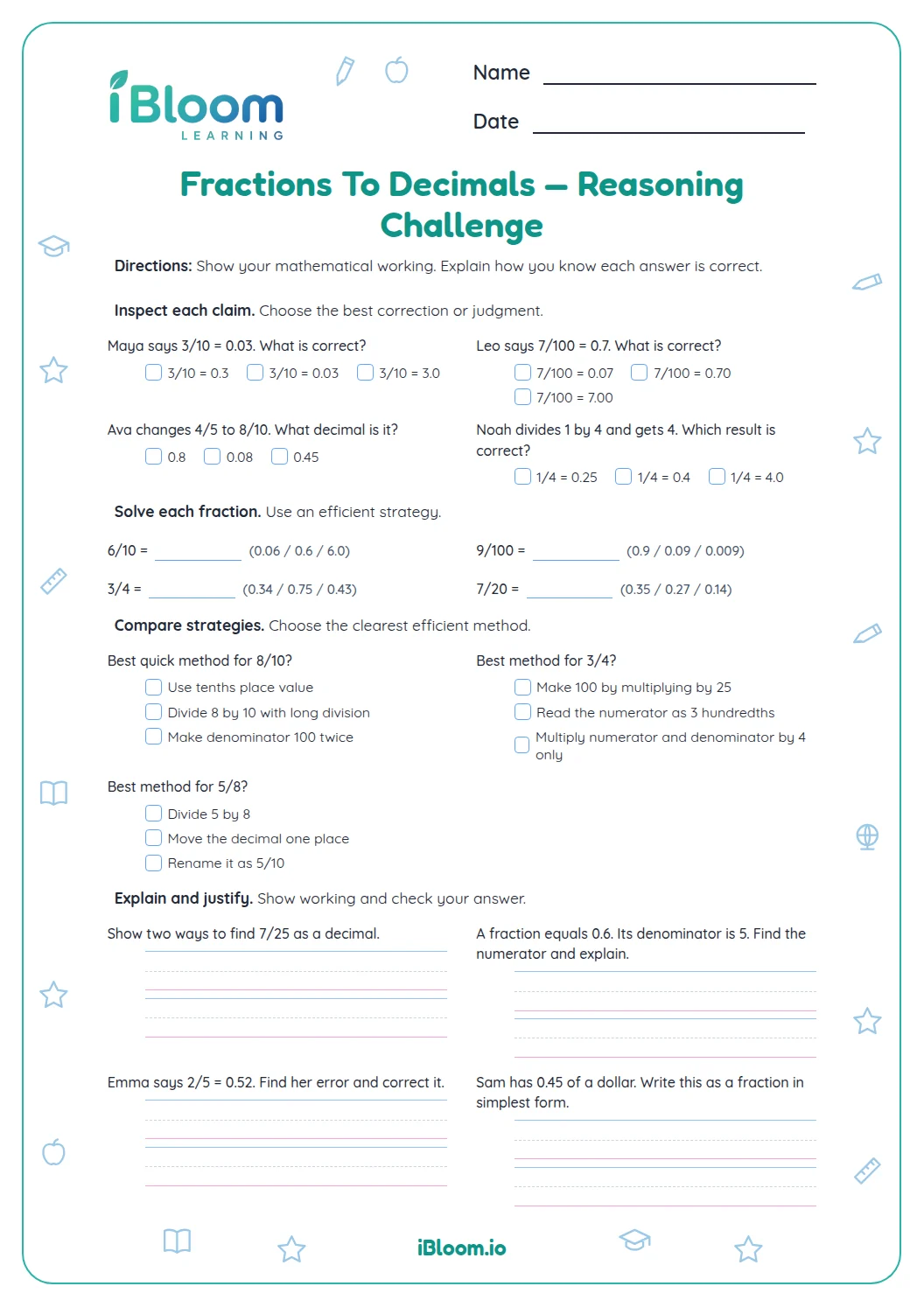
This Grade 5 printable connects fraction notation to decimal notation through shaded tenths strips and hundredths grids. Children read models, convert fractions with denominators 10 or 100, and match equal amounts such as 32/100 and 0.32. The 14 questions include model readings, conversions, and two short applications, followed by a separate answer key.
Aligned to 4.NF.C.6
How do tenths and hundredths models show decimals?
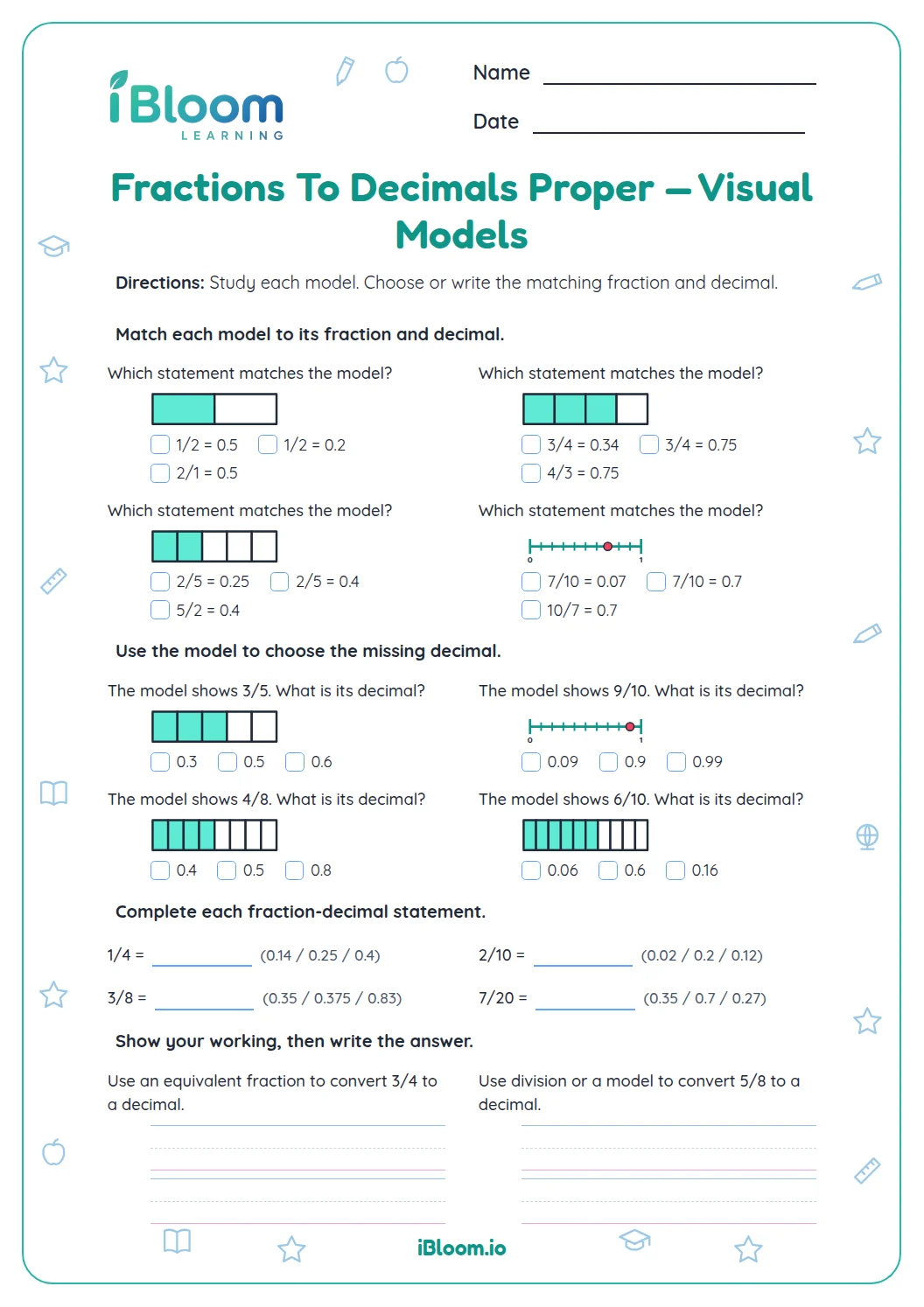
A tenths strip divides one whole into ten equal parts. Six shaded parts show 6/10, or 0.6. A hundredths grid divides the whole into 100 small squares, so 34 shaded squares show 34/100, or 0.34.
Question 2 uses a 10-by-10 grid with 34 shaded squares. Each small square is one hundredth, so the decimal has 3 tenths and 4 hundredths.
- 134 shaded squares means 34/100.
- 234/100 = 0.34.
How do you place the digits in a decimal?
The denominator tells the place: tenths go in the first place to the right of the decimal point; hundredths go in the second. Keep a zero in the tenths place for a value such as 6/100, which is 0.06.
What kinds of questions are included?
The sheet uses shaded tenths strips and hundredths grids for most questions, then asks children to name equal amounts in fraction and decimal form. The final two questions apply the same reading skill to a meter strip and a square grid.
How to use this worksheet
- 1Count tenths or hundredths before writing digits.
- 2For a hundredths grid, name the number of shaded small squares.
- 3Place the decimal point before the tenths and hundredths digits.
- 4Use a zero placeholder when there are no tenths.
- 5Check the written decimal against the shaded amount.
Common mix-ups and fixes
The mistake
Putting 6/100 in the tenths place.
The fix
Hundredths are two places right of the decimal: 6/100 = 0.06.
The mistake
Writing 34 shaded squares as 0.034.
The fix
The grid has 34 hundredths, so use two decimal places: 0.34.
The mistake
Dropping the zero in 0.8.
The fix
The zero shows there are zero whole units; write 0.8.
Curriculum alignment
This worksheet practices the reading and language skills named below.
Write fractions with denominators 10 or 100 in decimal notation.
On this sheet: Write fractions with denominators 10 or 100 in decimal notation.
Show the official wordingHide the official wording
Use decimal notation for fractions with denominators 10 or 100. For example, rewrite 0.62 as 62/100; describe a length as 0.62 meters; locate 0.62 on a number line diagram.
What to practice next
Make more practice
Further reading
Questions parents and teachers ask
What does a tenths strip show?
A tenths strip is divided into ten equal parts, so six shaded parts represent six tenths. Write the six in the tenths place and keep a zero before the decimal point. Saying “six tenths” aloud can help check that the model and decimal agree.
How does a hundredths grid show 0.34?
A hundredths grid has 100 equal small squares. Shading 34 squares means 34/100, or 0.34. The 3 is in the tenths place and the 4 is in the hundredths place. Each small square is one hundredth. Count all shaded squares, then write that count over 100 before changing it to decimal form.
Why does 6/100 become 0.06?
The denominator 100 means hundredths, which are two places to the right of the decimal point. Since there are no tenths, place a zero in that spot: 6/100 = 0.06. The zero keeps the hundredths digit in the correct place. Saying “zero tenths and six hundredths” can help check the notation.
Is 32/100 the same as 0.32?
Yes. The fraction names 32 hundredths, and the decimal 0.32 also names 32 hundredths. The matching question checks that children connect the fraction and decimal notations. Both notations describe the same amount. The 32 is the number of hundredths, and the decimal point separates whole units from parts of one.
How many questions are on this page?
There are 14 questions: shaded tenths and hundredths models, fraction-to-decimal conversions, equivalent forms, and two short applications. The answer key is provided separately for checking. The key shows the correct decimal or fraction for each item so an adult can review the place-value thinking with the child.