





About this worksheet
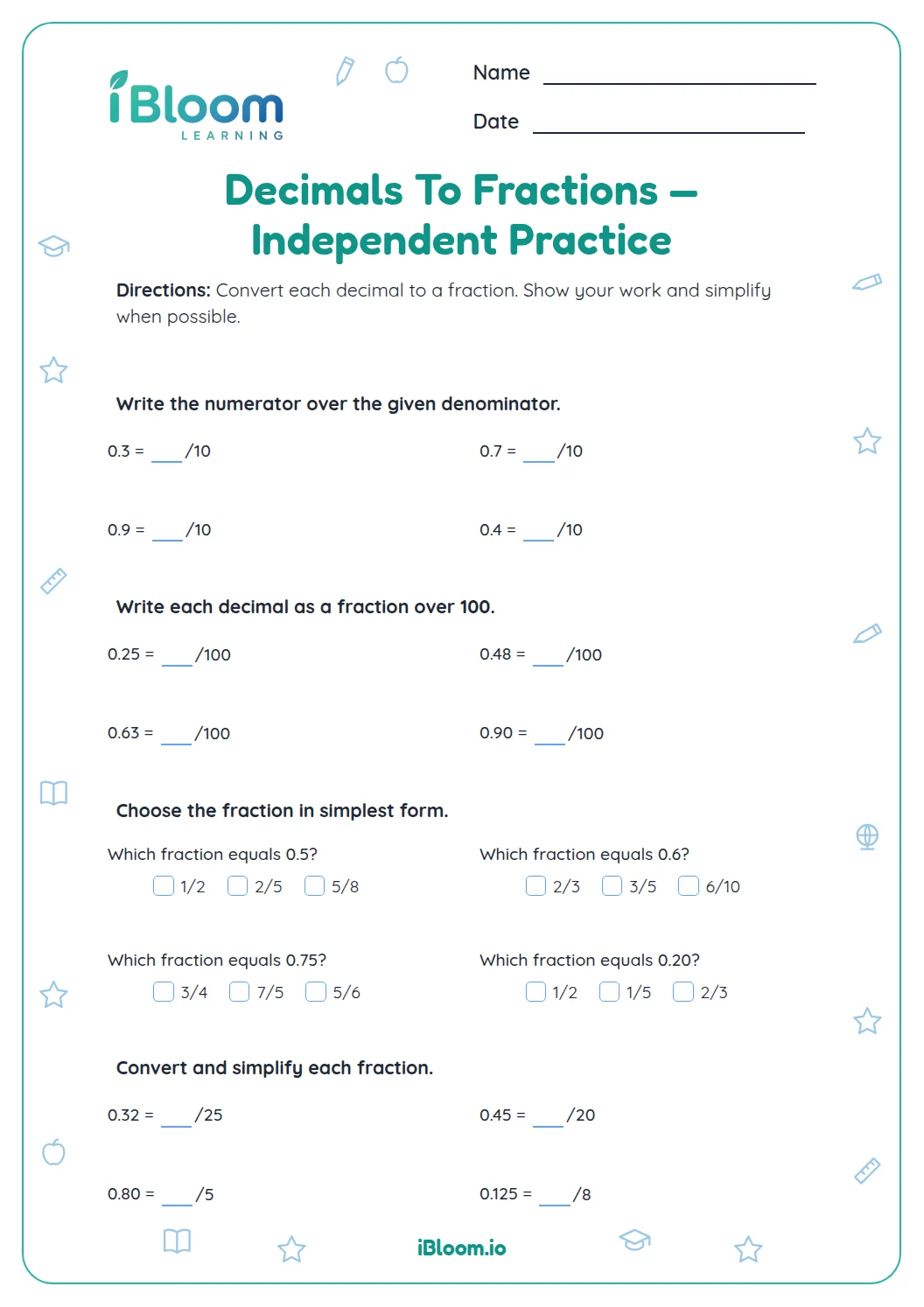
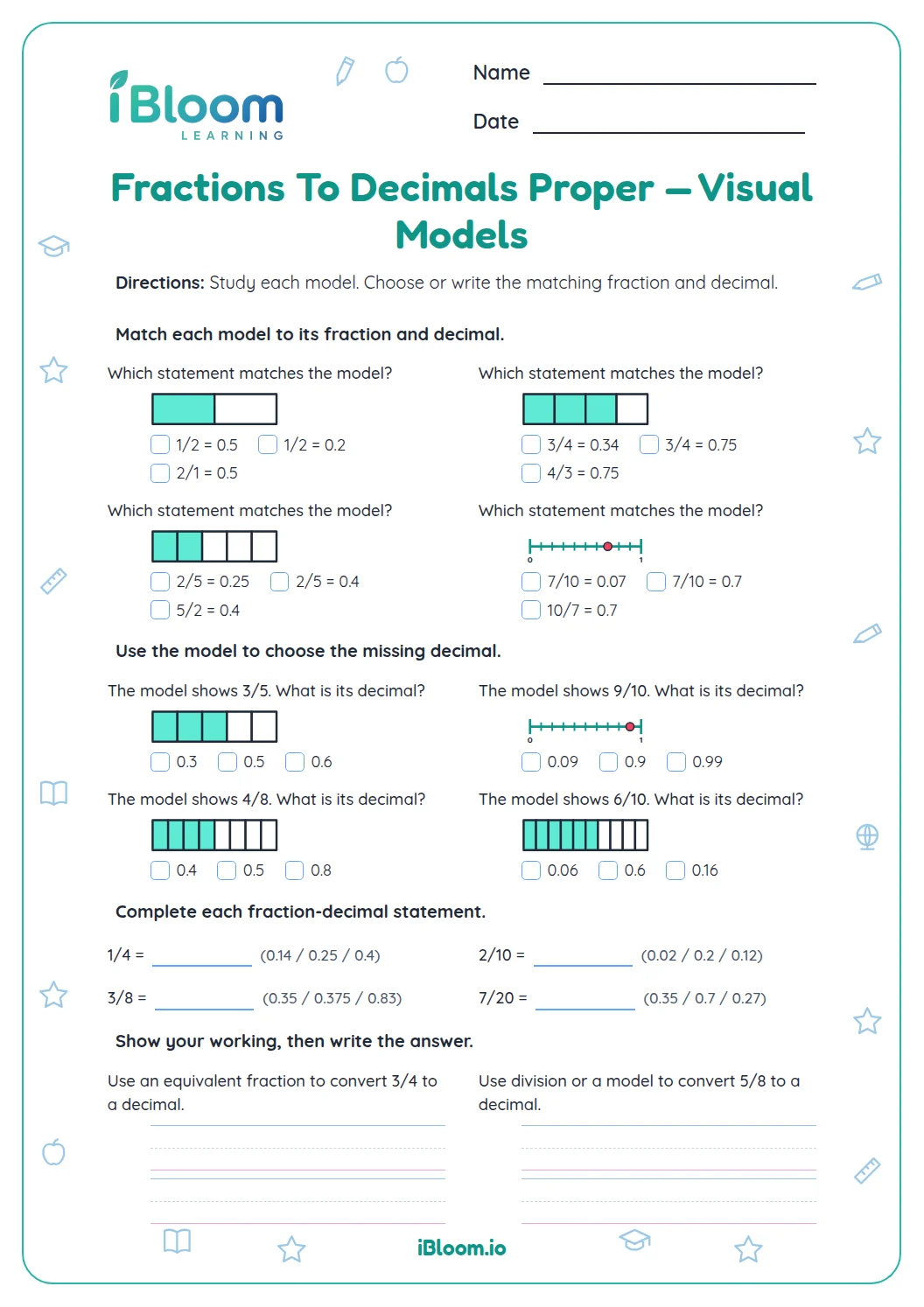
This Grade 5 worksheet connects shaded fraction models with decimal notation. Students read three models, convert fractions with denominators including 4, 5, 8, 10, 20, 25 and 50, and select equivalent decimals. The answer key is included.
Aligned to 5.NBT.A.3.a
What does this worksheet practice?
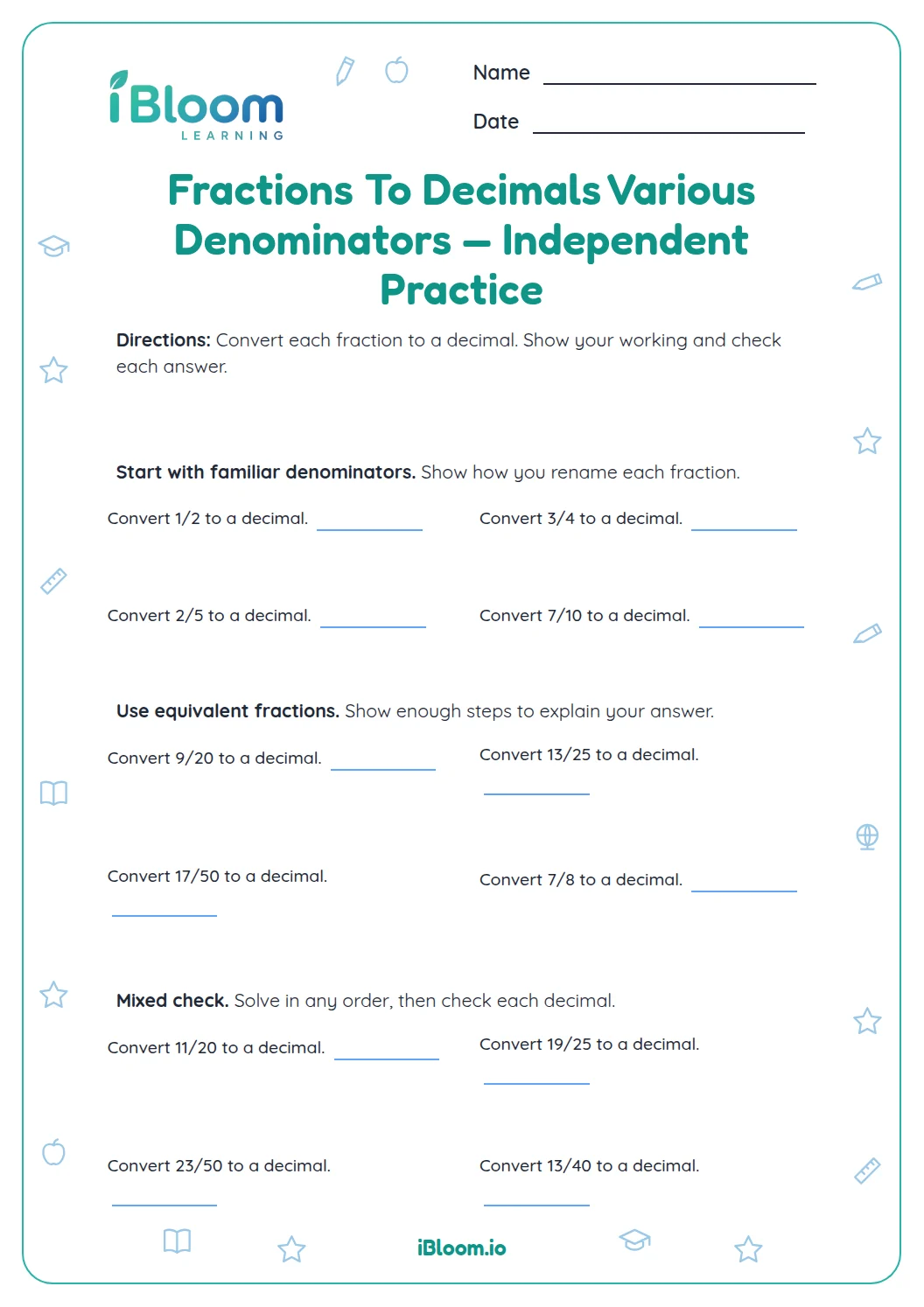
Three shaded models begin the page, followed by eight fraction conversions and four multiple-choice checks. Students use equivalent fractions and decimal place value; the key gives the correct decimal for every item.
- Complete each part in order.
- Use the key to check answers.
How do you change a fraction to a decimal?
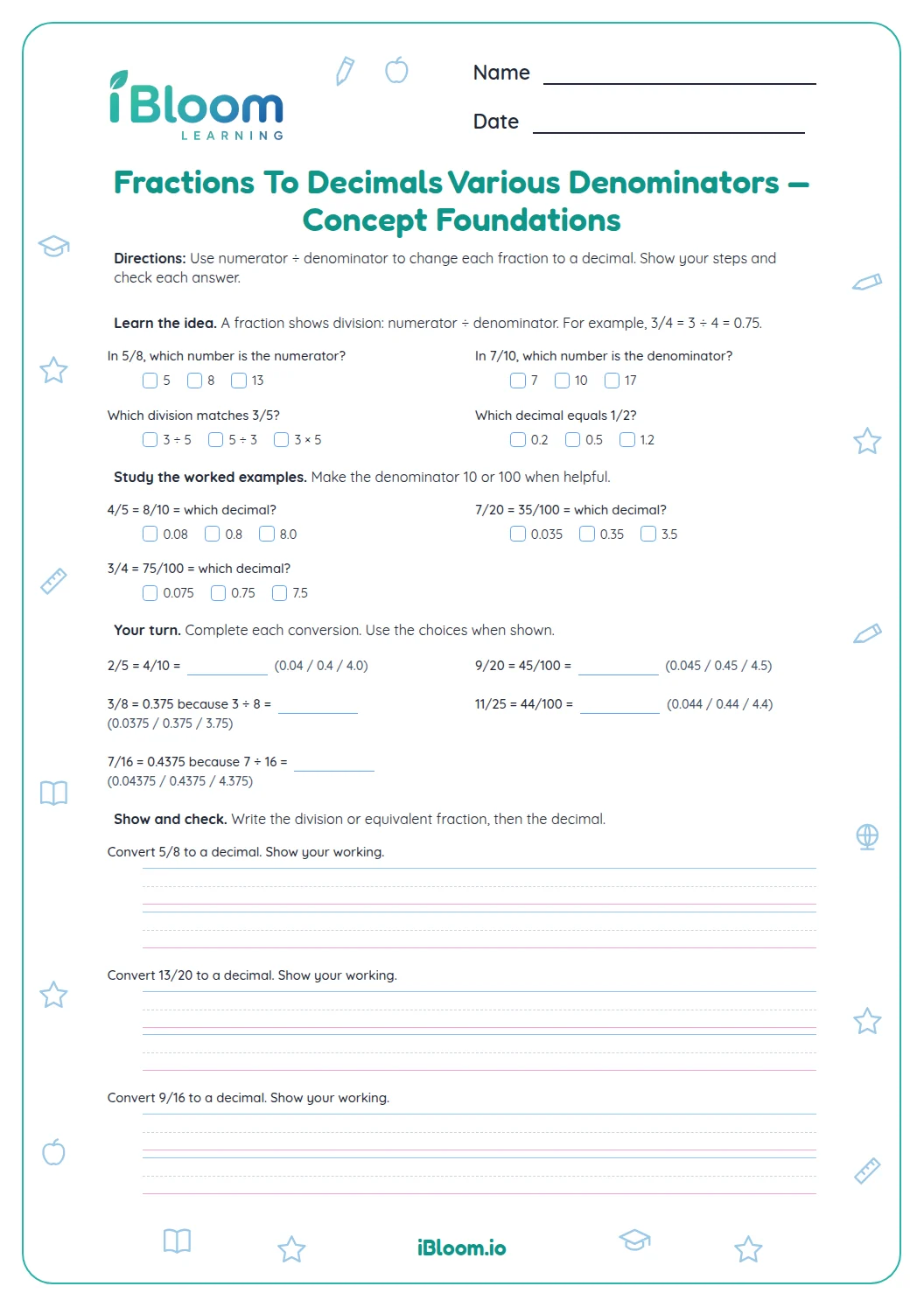
For 3/8, multiply numerator and denominator by 125 to make 375/1,000. That is 0.375, so the thousandths place matters; 0.38 is close but not equal.
- 1Write the shaded amount as a decimal. ___ → 0.5
How can a student check the work?
Check that the decimal has the same value as the fraction. The fraction 9/20 becomes 45/100, so its decimal is 0.45.
How to use this worksheet
- 1Read each model as a fraction.
- 2Rename the fraction with denominator 10 or 100 when possible.
- 3Write the equivalent decimal.
- 4For other denominators, divide numerator by denominator.
- 5Use the answer key to check each conversion.
Common mistakes and quick fixes
The mistake
Writing 9/20 as 0.920.
The fix
Since 9/20 = 45/100, write 0.45.
The mistake
Treating 3/8 as 0.38.
The fix
Divide 3 by 8; the value is 0.375.
The mistake
Forgetting a whole number in 9/4.
The fix
Rename it 2 1/4, or 2.25.
Common Core alignment
This sheet connects fraction values to decimal place value.
Write each fraction as an equivalent decimal, using tenths and hundredths.
On this sheet: Write each fraction as an equivalent decimal, using tenths and hundredths.
Show the official wordingHide the official wording
Read and write decimals to thousandths using base-ten numerals, number names, and expanded form.
What to practice next
Make more practice
Further reading
Questions parents and teachers ask
Which fractions appear in the model section?
The first three questions show one-half, three-fourths, and eight-tenths. Students write each shaded amount as a decimal, then continue with fraction conversions and decimal choices. The three parts move from reading a model to converting and checking decimal values. The three parts move from reading a model to converting and checking decimal values.
How do I convert 9/20 to a decimal?
Make an equivalent fraction with denominator 100: multiply 9 and 20 by 5 to get 45/100. Then write 45 hundredths as 0.45. The worksheet also includes 3/8, which uses thousandths. Keeping numerator and denominator in the same ratio preserves the fraction’s value.
Why is 3/8 written as 0.375?
A decimal to the hundredths place is not exact for 3/8. Since 3/8 equals 375/1,000, its decimal is 0.375. The multiple-choice item distinguishes that exact value from 0.38. This question compares an exact decimal with choices that shift the digits.
What does the answer key include?
The separate key gives decimal answers for all 15 items. For a model question, compare the shaded portion with the decimal; for a conversion, an equivalent fraction can help explain why the decimal is correct. Students can show an equivalent fraction to explain a conversion if they wish.
How many pages should I print?
Print the two worksheet pages for practice and the two answer-key pages for checking. The model reads, conversions, and multiple-choice questions are all included in the 15-item count. The key is separate so students can attempt the problems before checking their work.