



About this worksheet
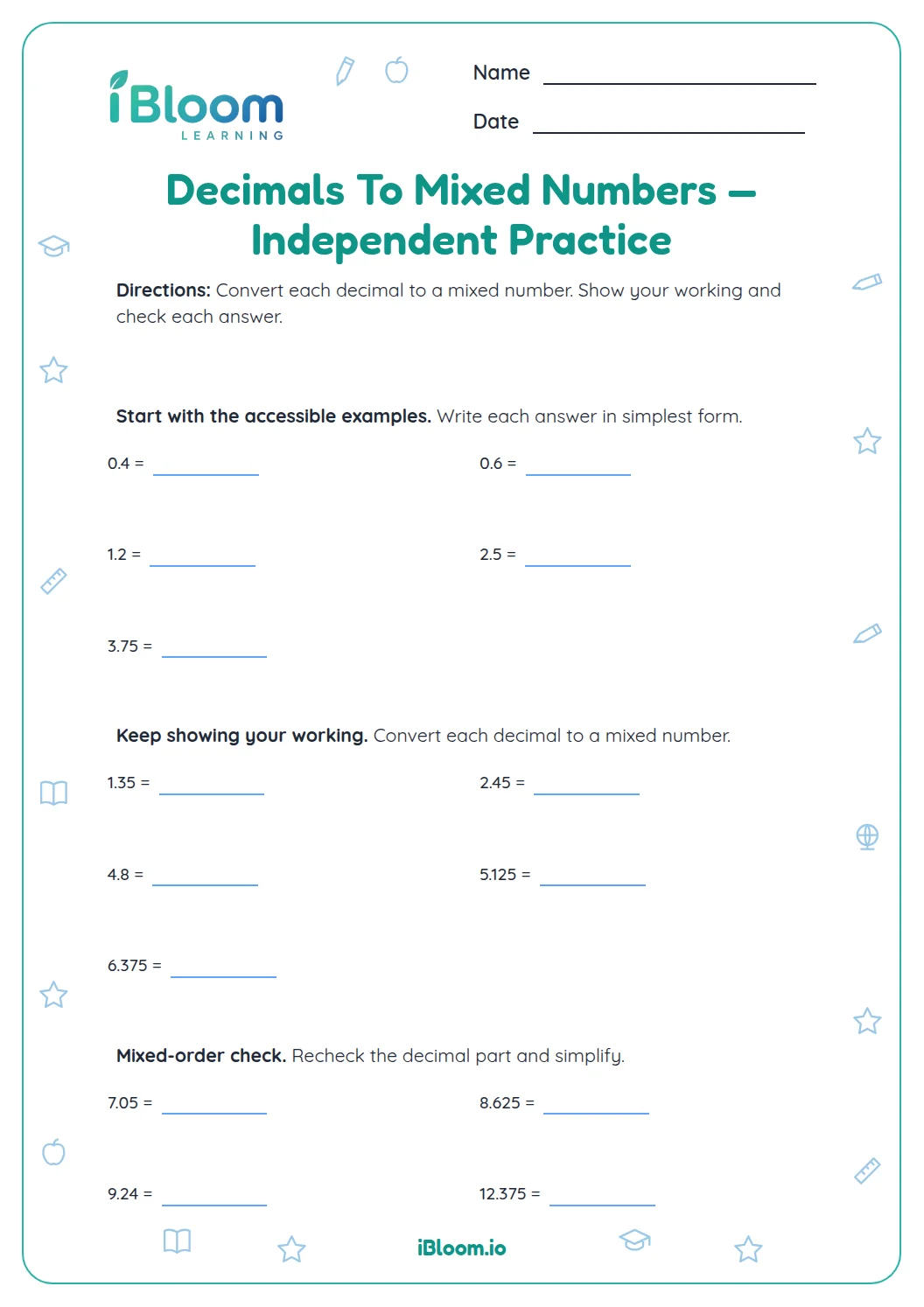
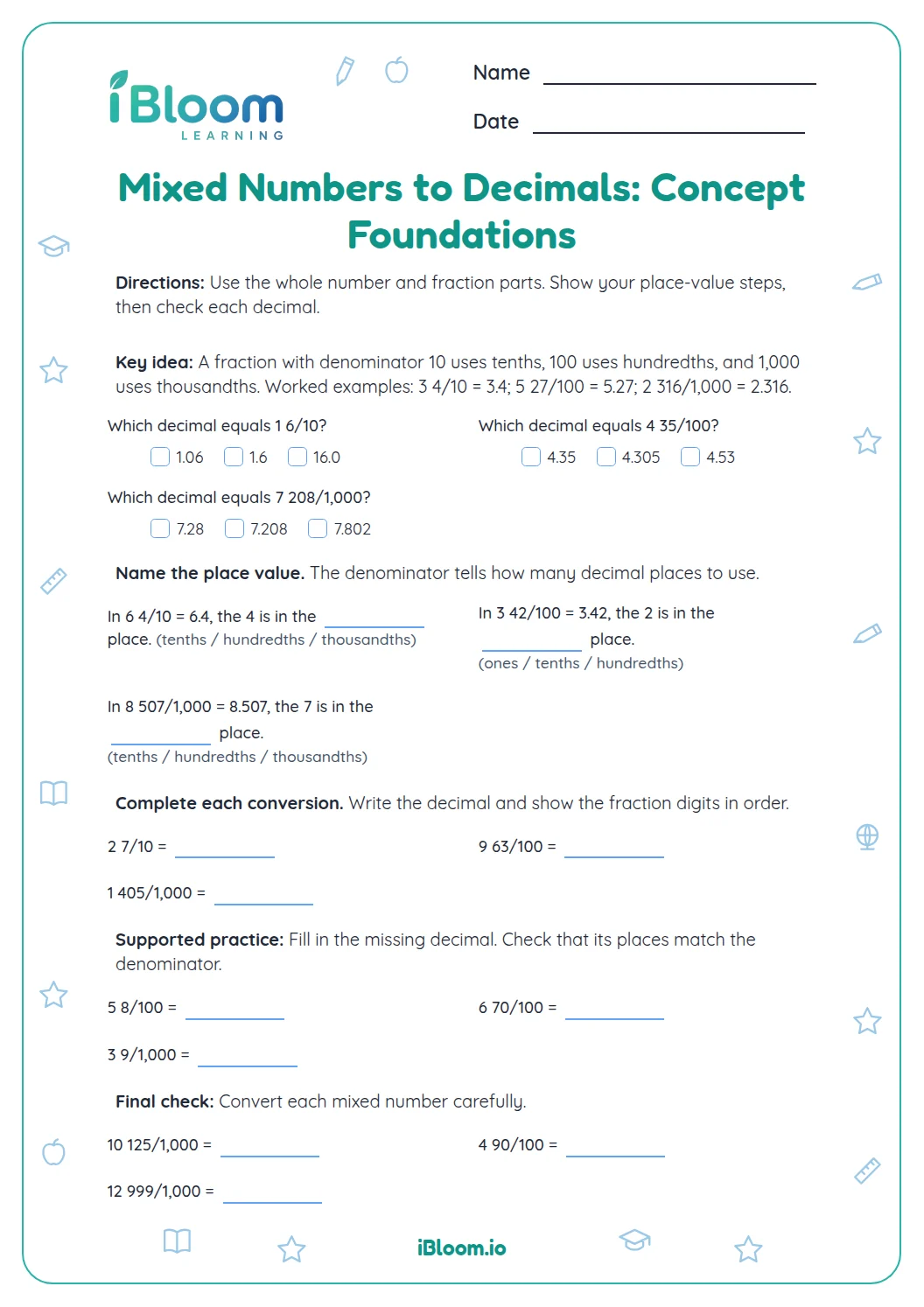
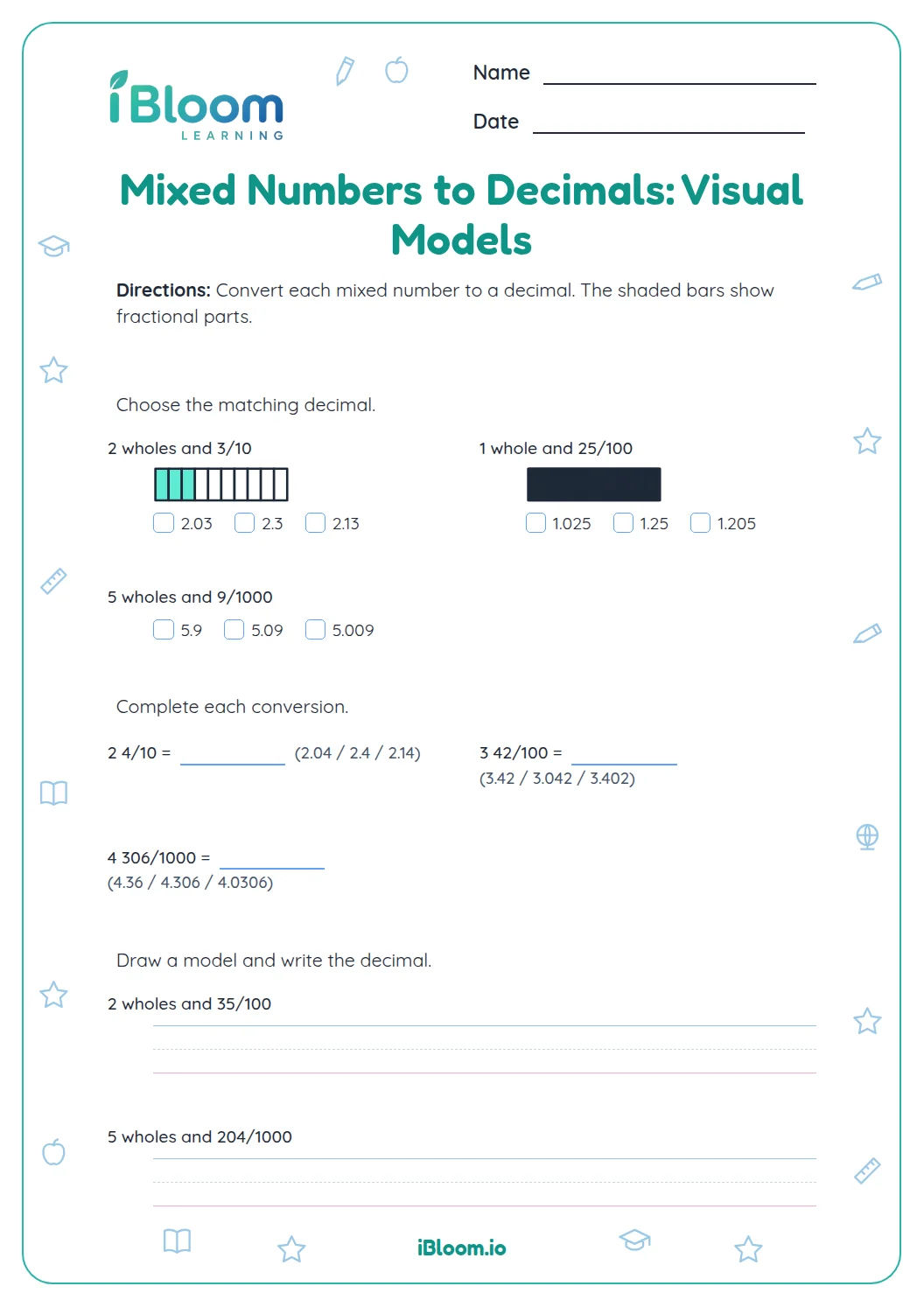
This Grade 5 independent practice sheet has 16 authored mixed-number conversions using tenths, hundredths, and thousandths. Learners keep the whole-number part and place each fractional value in the matching decimal places, adding zeroes when needed. The conversion practice aligns with CCSS 5.NBT.A.3.a. The rendered worksheet also includes three equivalent-fraction bonus checks; the separate two-page answer key covers both sets.
Aligned to 5.NBT.A.3.a
How does the denominator show decimal place value?
A denominator of 10 names tenths, 100 names hundredths, and 1,000 names thousandths. Keep zeroes that hold a place, so 4 7/100 becomes 4.07 rather than 4.7.
- 14 7/100
- 2The fraction is seven hundredths.
- 3Write the whole part and hundredths: 4.07.
When should you write a zero?
A zero can hold an empty decimal place. In 9 3/1,000, the 3 belongs in the thousandths place, so write 9.003. Compare the decimal places before checking the answer.
How do equivalent fractions check the place value?
The rendered page adds three equivalent-fraction checks after the 16 conversions. For 3/10 = ___/100, multiply both numerator and denominator by 10, so the missing numerator is 30.
How to use this worksheet
- 1Read the denominator to identify tenths, hundredths, or thousandths.
- 2Keep the whole-number part unchanged.
- 3Place the numerator digits in the matching decimal places.
- 4Add zeroes when needed to hold empty places.
- 5Check the decimal by reading it aloud in place-value words.
Common mistakes and quick fixes
The mistake
Writing 4 7/100 as 4.7.
The fix
The denominator is 100, so 7 belongs in the hundredths place: 4.07.
The mistake
Dropping a needed zero in 9 3/1,000.
The fix
Hold the tenths and hundredths places with zeroes: 9.003.
The mistake
Changing the whole-number part while converting the fraction.
The fix
Copy the whole number first, then write only the fractional part as a decimal.
Common Core alignment
This worksheet practices the following Common Core skill.
Write decimals to thousandths with base-ten numerals.
On this sheet: The problems express mixed numbers with tenths, hundredths, and thousandths as decimal numerals.
Show the official wordingHide the official wording
Read and write decimals to thousandths using base-ten numerals, number names, and expanded form, e.g., 347.392 = 3 × 100 + 4 × 10 + 7 × 1 + 3 × (1/10) + 9 × (1/100) + 2 × (1/1000).
What to practice next
Make more practice
Further reading
Questions parents and teachers ask
How do I convert a mixed number to a decimal?
Keep the whole-number part and write the fractional part in the place named by its denominator. For example, 4 7/100 is 4.07: the 7 belongs in the hundredths place. Add zeroes when needed to hold empty places, as in 9 3/1,000 = 9.003.
Why does 4 7/100 become 4.07 instead of 4.7?
The denominator 100 means the fraction is measured in hundredths. The 7 must sit two places to the right of the decimal point, so a zero holds the tenths place: 4.07. Writing 4.7 would mean seven tenths, which is a different value.
What does the worksheet add after the conversions?
After the 16 mixed-number conversions, the rendered sheet includes three equivalent-fraction bonus checks. For instance, to change 3/10 into hundredths, multiply numerator and denominator by 10 and get 30/100. Learners can use this step to connect equivalent fractions with decimal place value.
Does the answer key include all 19 visible items?
Yes. The two-page answer key covers the 16 authored conversion questions and the three rendered equivalent-fraction checks. Learners can finish the worksheet first, then use the key to check every decimal and missing numerator. It also gives an adult a quick way to review the place-value work.
How can I check a decimal with thousandths?
Read the denominator and count decimal places. Thousandths use three places after the decimal point, so 3/1,000 becomes 0.003 and 9 3/1,000 becomes 9.003. A zero holds the tenths and hundredths places so the 3 stays in the thousandths place.