


About this worksheet
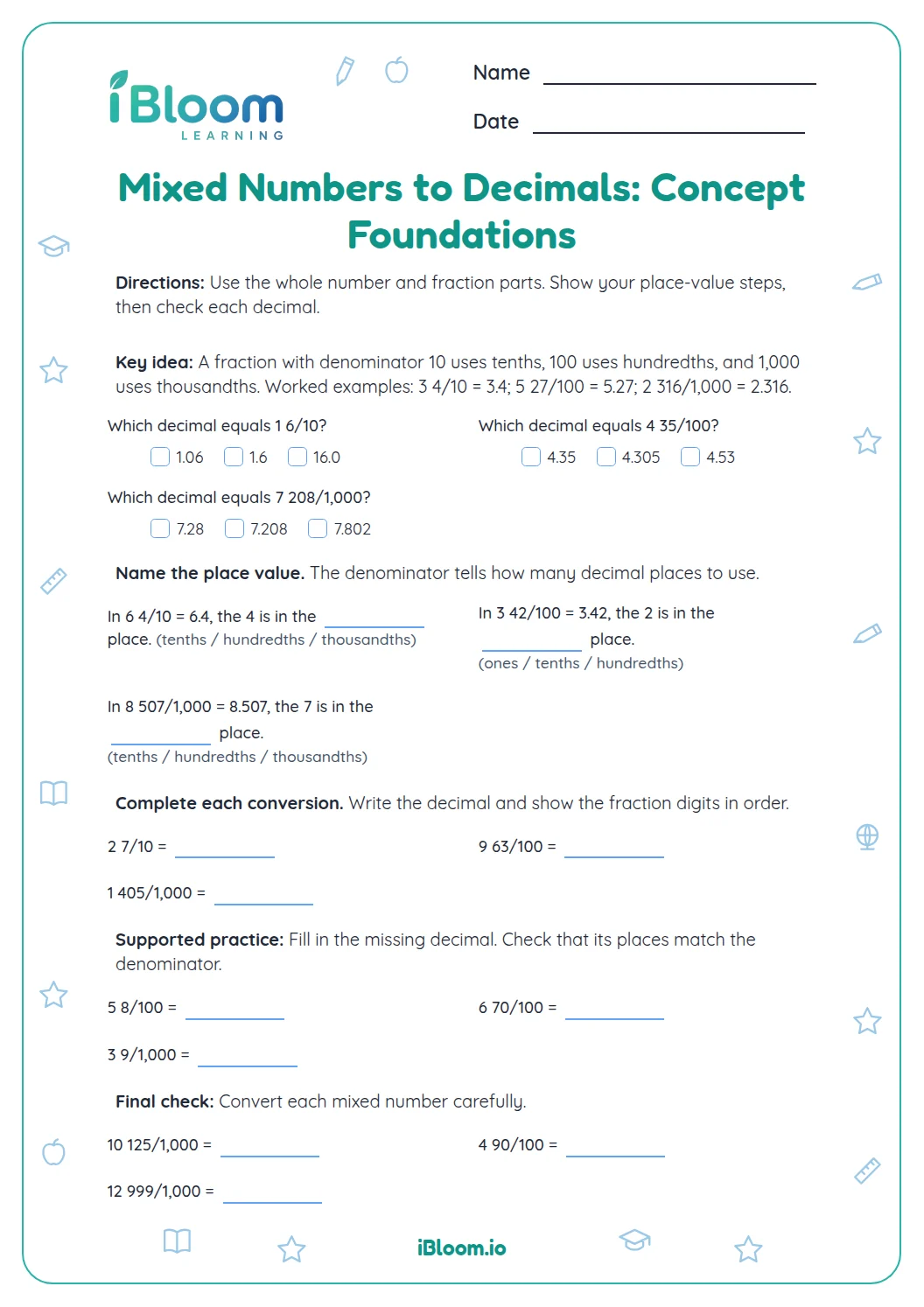
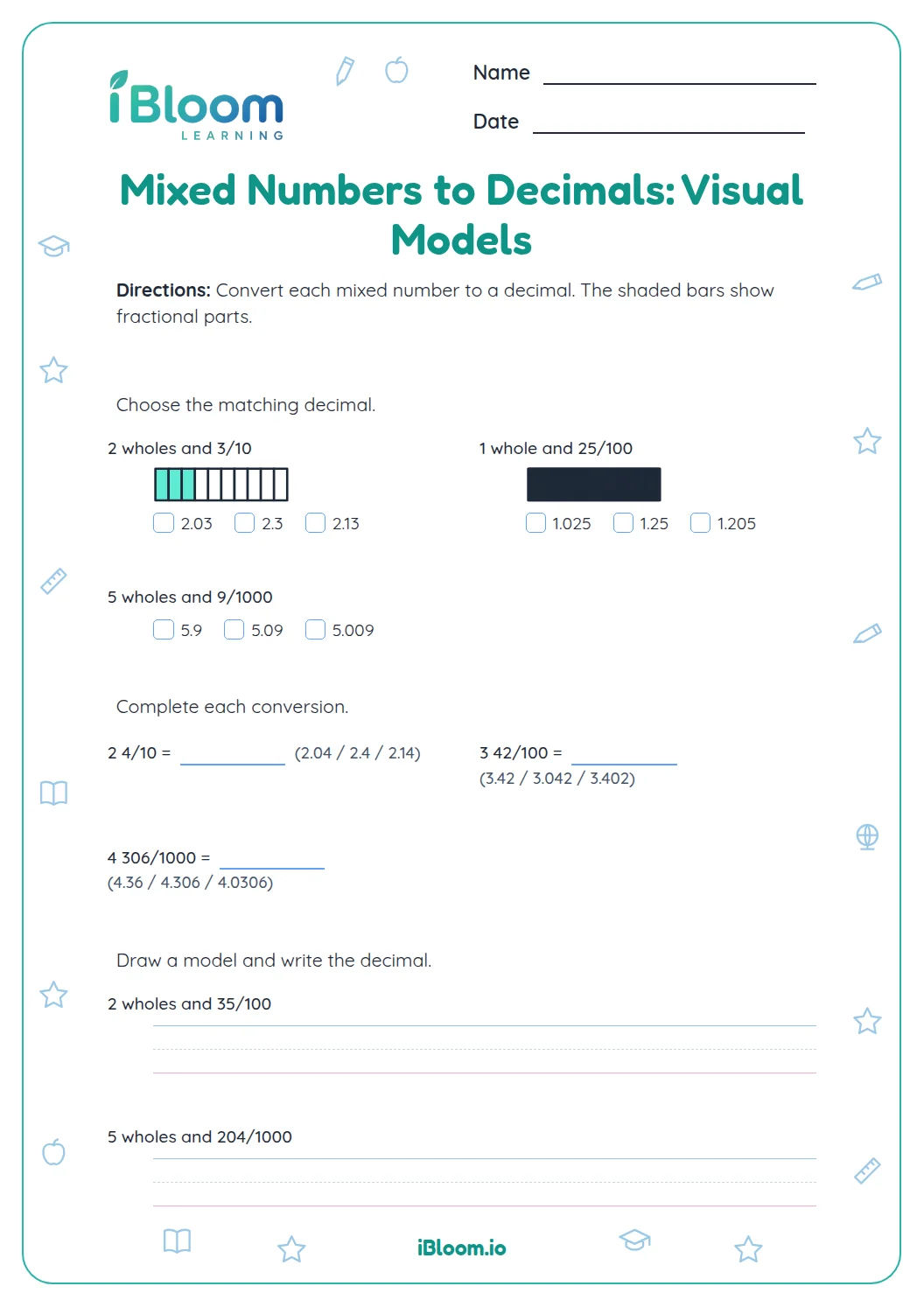
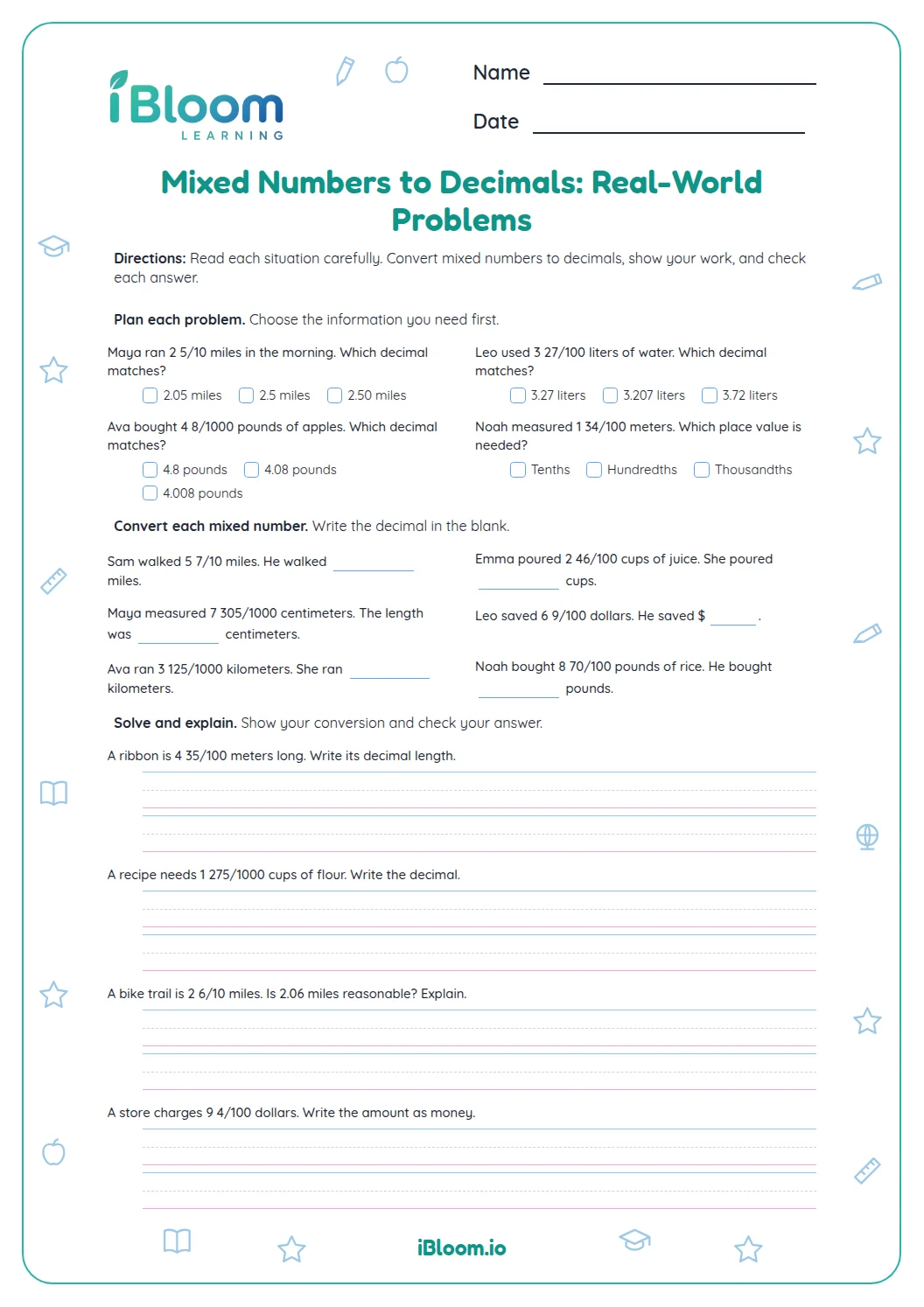
This free Grade 5 worksheet gives students focused practice writing mixed numbers as decimals through the thousandths place. Part A works with tenths and hundredths, Part B moves to thousandths, and Part C applies the same conversion in short measurement situations. The answer key shows the decimal and unit for each item. The practice aligns with CCSS 5.NBT.A.3.a, which asks students to read and write decimals to thousandths in base-ten numerals.
Aligned to 5.NBT.A.3.a
How do tenths and hundredths become decimal digits?
A denominator of 10 names one digit after the decimal point. A denominator of 100 names two digits, including a zero when the tenths place is empty. The whole-number part stays to the left of the decimal point.
Question 4, 8 6/100 = ___, needs a zero in the tenths place, so the decimal is 8.06. Writing 8.6 would give six tenths, a different value.
- 1Question 4: 8 6/100 = 8.06
- 2The hundredths digit is 6; the tenths digit is 0.
What does the denominator 1,000 tell you?
A denominator of 1,000 names three digits after the decimal point. Keep all three places, even when the numerator starts with zero or ends with zero.
For question 8, 4 58/1000 becomes 4.058. The 5 is in the hundredths place because the tenths place is empty; the 8 is in the thousandths place.
- 1Question 8: 4 58/1000 = 4.058
- 2Read the fraction as 058 thousandths, not 58 hundredths.
How can the same conversion help with measurements?
The last four questions place the mixed numbers in familiar measurement sentences. Students convert the number first and then keep the unit that describes what was measured.
Question 15 asks for 1 275/1000 kilometers as a decimal. The whole number remains 1, and 275 thousandths gives 0.275, so the distance is 1.275 km.
How to use this worksheet
- 1Read the denominator before writing any decimal digits.
- 2Keep the whole-number part to the left of the decimal point.
- 3Use one, two or three decimal places for denominators 10, 100 or 1,000.
- 4Write zeros in empty places, as in question 4.
- 5For Part C, add the unit after converting and check that the decimal has the right number of places.
Common mistakes and quick fixes
The mistake
Writing 8.6 for 8 6/100.
The fix
The denominator is 100, so the fraction needs two decimal places: 8.06.
The mistake
Dropping a zero in 4 58/1000 and writing 4.58.
The fix
Thousands need three decimal places. Use 4.058 so 58 thousandths keeps its place.
The mistake
Changing the whole-number part while converting.
The fix
Copy the whole number first, then place the fractional digits after the decimal point.
Common Core alignment
This page practices writing decimal numerals to the thousandths place.
Write mixed numbers with tenths, hundredths or thousandths as decimal numerals.
On this sheet: The conversion questions write each mixed number as a decimal numeral through the thousandths place.
Show the official wordingHide the official wording
Read and write decimals to thousandths using base-ten numerals, number names, and expanded form, e.g., 347.392 = 3 × 100 + 4 × 10 + 7 × 1 + 3 × (1/10) + 9 × (1/100) + 2 × (1/1000).
What to practice next
Make more practice
Further reading
Questions parents and teachers ask
Why does 8 6/100 become 8.06?
The denominator 100 means the fraction belongs in the hundredths place. Since there are no tenths, write a zero in that place: 8 6/100 = 8.06. Writing 8.6 would mean 8 and 6 tenths, which is ten times as large as 8 and 6 hundredths.
How many decimal places should my child write?
Use the denominator to decide: 10 calls for one decimal place, 100 for two, and 1,000 for three. Keep zeros that hold an empty place, such as 4 58/1000 = 4.058. The questions and answer key show examples from each place value.
Does 3.700 have the same value as 3.7?
Yes. The trailing zeros do not change the value, so 3.700 and 3.7 are equal. On this worksheet, 3 700/1000 is written as 3.700 to show all three thousandths places requested by the fraction. The key preserves those places, while either decimal has the same value.
What should students do with the unit in Part C?
First convert the mixed number to a decimal. Then copy the measurement unit from the question, such as meters, centimeters, kilometers or kilograms. For example, 1 275/1000 kilometers becomes 1.275 km. The unit describes the quantity; it does not change the conversion.
What is a quick way to check a conversion?
Check that the decimal has as many places as the denominator names, then compare the fractional part. For 4 58/1000, 58 thousandths is less than one tenth, so the decimal part should be 0.058. The answer key provides a quick check for all sixteen questions.