



About this worksheet
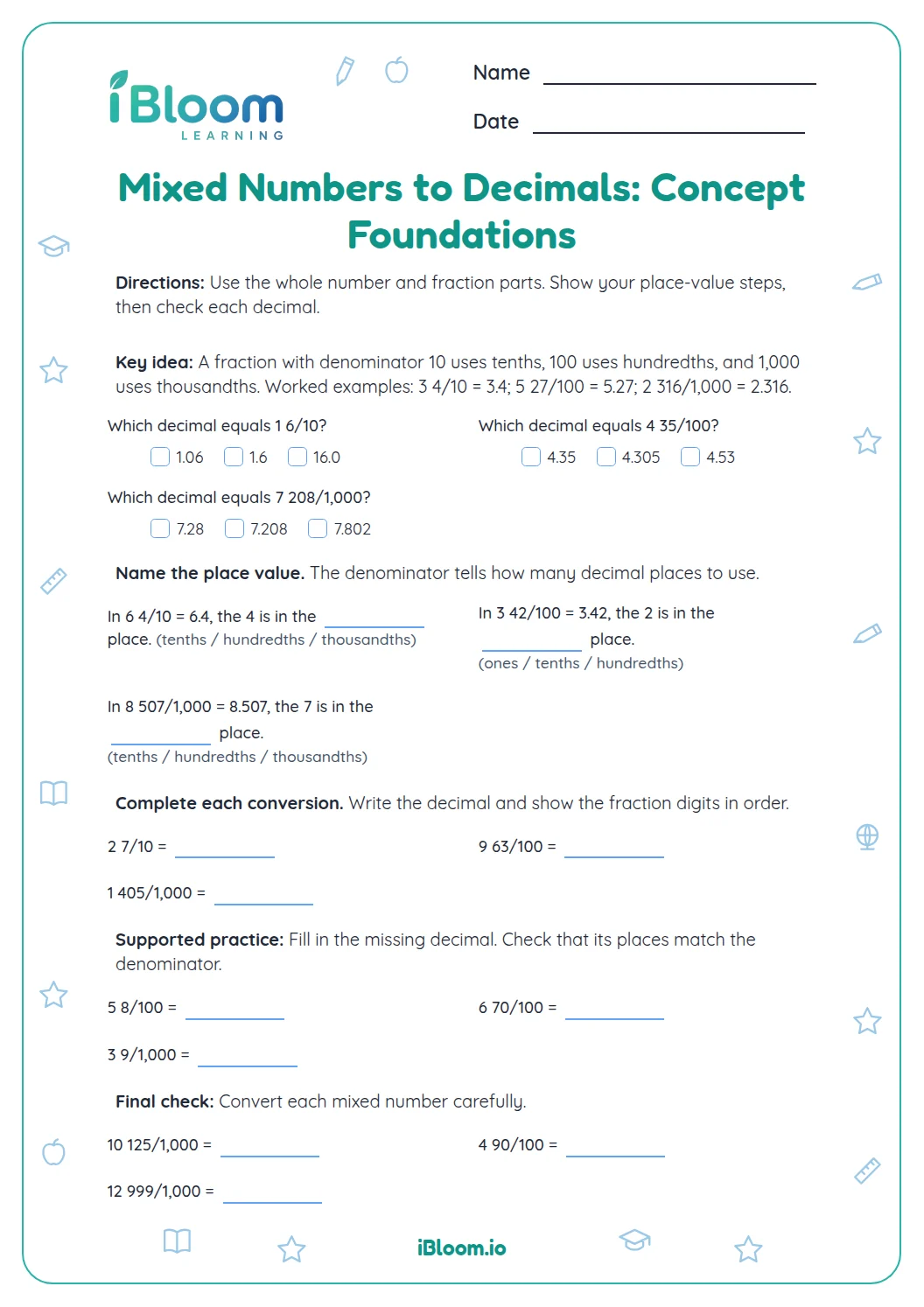
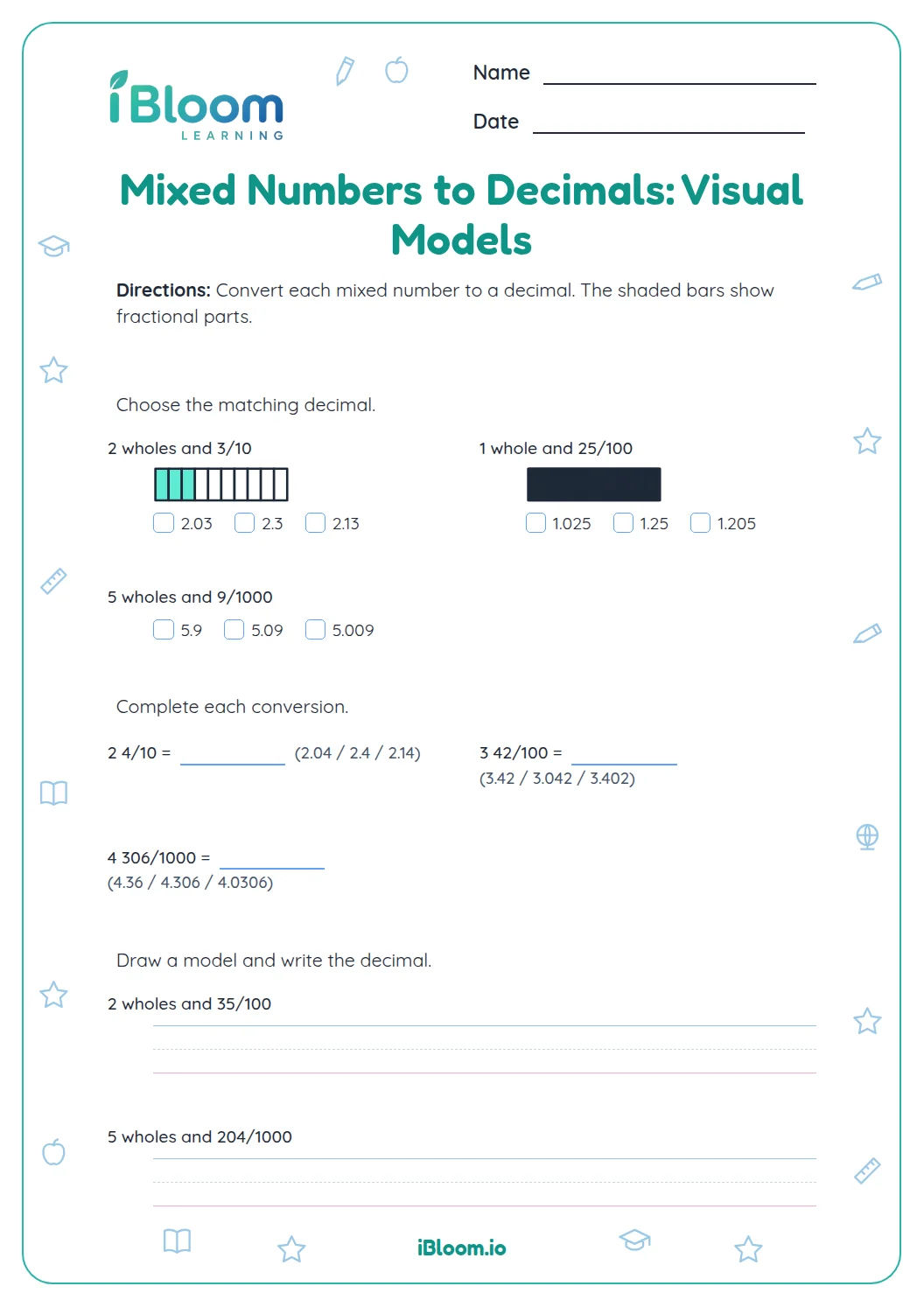
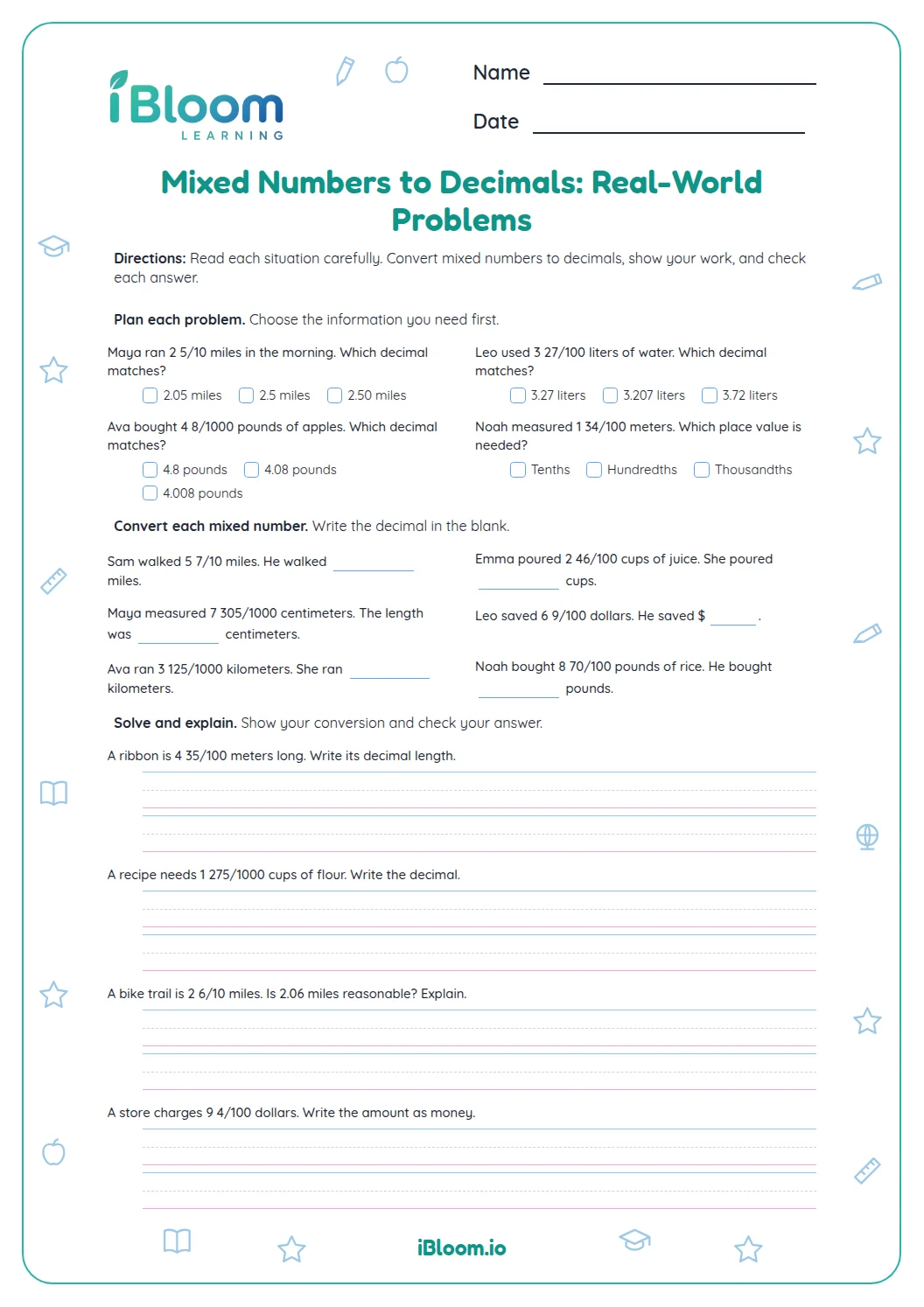
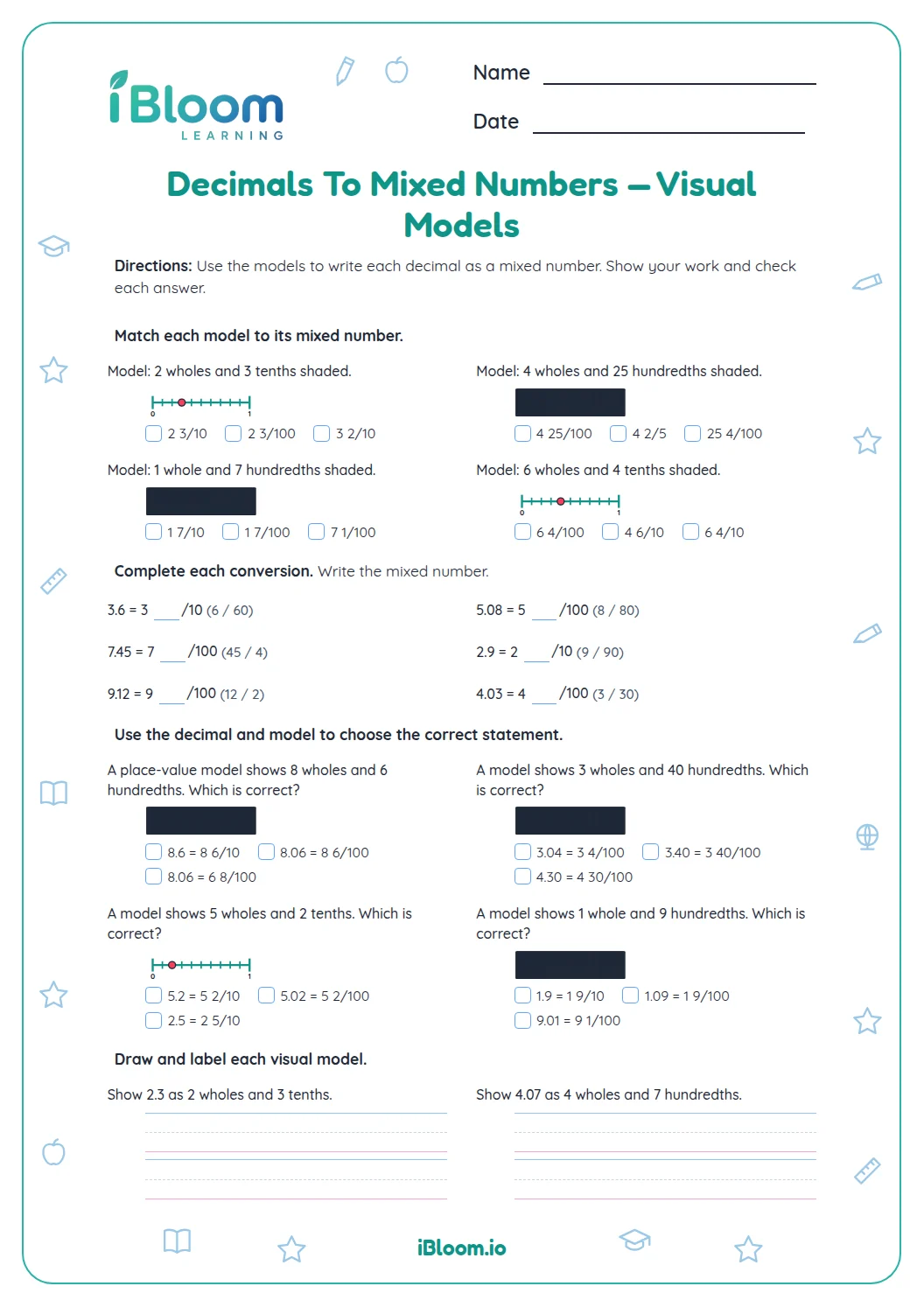
This Grade 5 printable provides 14 conversions from mixed numbers to decimal notation. Children place the numerator digits in the tenths, hundredths, or thousandths places, including zeros needed to hold a place, as in 3 7/1000 = 3.007. The final two questions use recipe and bottle contexts. A separate answer key shows each decimal form. The practice supports Common Core 5.NBT.A.3a: reading and writing decimals to thousandths using decimal notation.
Aligned to 5.NBT.A.3a
Where do the fraction digits go?
The denominator names the decimal place: tenths use one digit, hundredths two, and thousandths three. Keep all places, including zeros, before combining the fraction part with the whole number.
How do I write a thousandth as a decimal?
Write the numerator in the thousandths places, filling any empty places with zero. Then place the decimal point after the whole-number part.
- 1q5: Write 3 7/1000 as a decimal.
- 27 thousandths is 0.007.
- 3Answer: 3.007
How can I check a conversion?
Count the decimal places from the denominator, then compare the whole and fractional parts with the original mixed number. In q11, 70 hundredths takes two places, so the written decimal is 12.70.
Convert a mixed number
- 1Read the denominator to identify tenths, hundredths, or thousandths.
- 2Write the numerator in those decimal places.
- 3Add zeros to keep the required number of places.
- 4Place the decimal point after the whole-number part.
- 5Read the decimal aloud and check that its value matches the mixed number.
Place-value errors to watch for
The mistake
Writing 7/1000 as 0.7.
The fix
Thousandths need three places, so write 0.007.
The mistake
Dropping a zero in 8/1000.
The fix
Use 0.008 so the 8 stays in the thousandths place.
The mistake
Changing 70/100 to 0.7 when the task asks for place-value notation.
The fix
Keep both hundredths places: 70/100 is 0.70.
Curriculum alignment
Write mixed numbers with tenths, hundredths, or thousandths as decimals.
On this sheet: Each item renames a fractional part with denominator 10, 100, or 1,000 in decimal notation.
Show the official wordingHide the official wording
Read and write decimals to thousandths using base-ten numerals, number names, and expanded form, e.g., 347.392 = 3 × 100 + 4 × 10 + 7 × 1 + 3 × (1/10) + 9 × (1/100) + 2 × (1/1000).
What to practice next
Make more practice
Further reading
Questions parents and teachers ask
What kinds of mixed numbers are included?
The sheet includes mixed numbers whose fractional parts are tenths, hundredths, or thousandths. Numerators such as 7 and 5 need zeros to hold the correct decimal places. For example, 7 thousandths is 0.007, with the whole number kept to the left of the decimal point.
What grade is this worksheet for?
This worksheet is for Grade 5 and practices writing decimals through thousandths. Reading the denominator first helps students place each numerator digit correctly and preserve the whole number part. For example, 47/100 is 0.47, so 5 47/100 is 5.47. The denominator determines the number of decimal places in the fractional part.
How many problems are on the sheet?
There are 14 items total. Twelve are direct conversions, and two use everyday contexts: measuring oats in a recipe and liquid in a bottle. Each answer is written as a decimal. The recipe and bottle questions use the same conversion skill as the direct questions. Write the fractional part as a decimal, then include the whole number.
Does the answer key show the conversions?
Yes. The key shows each decimal answer, including zeros that hold a place. Students can compare those places with the original denominator when checking their work. A zero is a digit that can hold a decimal place. Without it, a thousandths digit could appear in the tenths place and change the value.
Why keep a zero in 12.70?
Because 70/100 names seventy hundredths, the hundredths place remains visible in 12.70. The ending zero preserves the given form and shows both decimal places clearly. The ending zero does not change the value, but it shows the two places named by hundredths. It also matches the form of the fraction given in the problem.