



About this worksheet
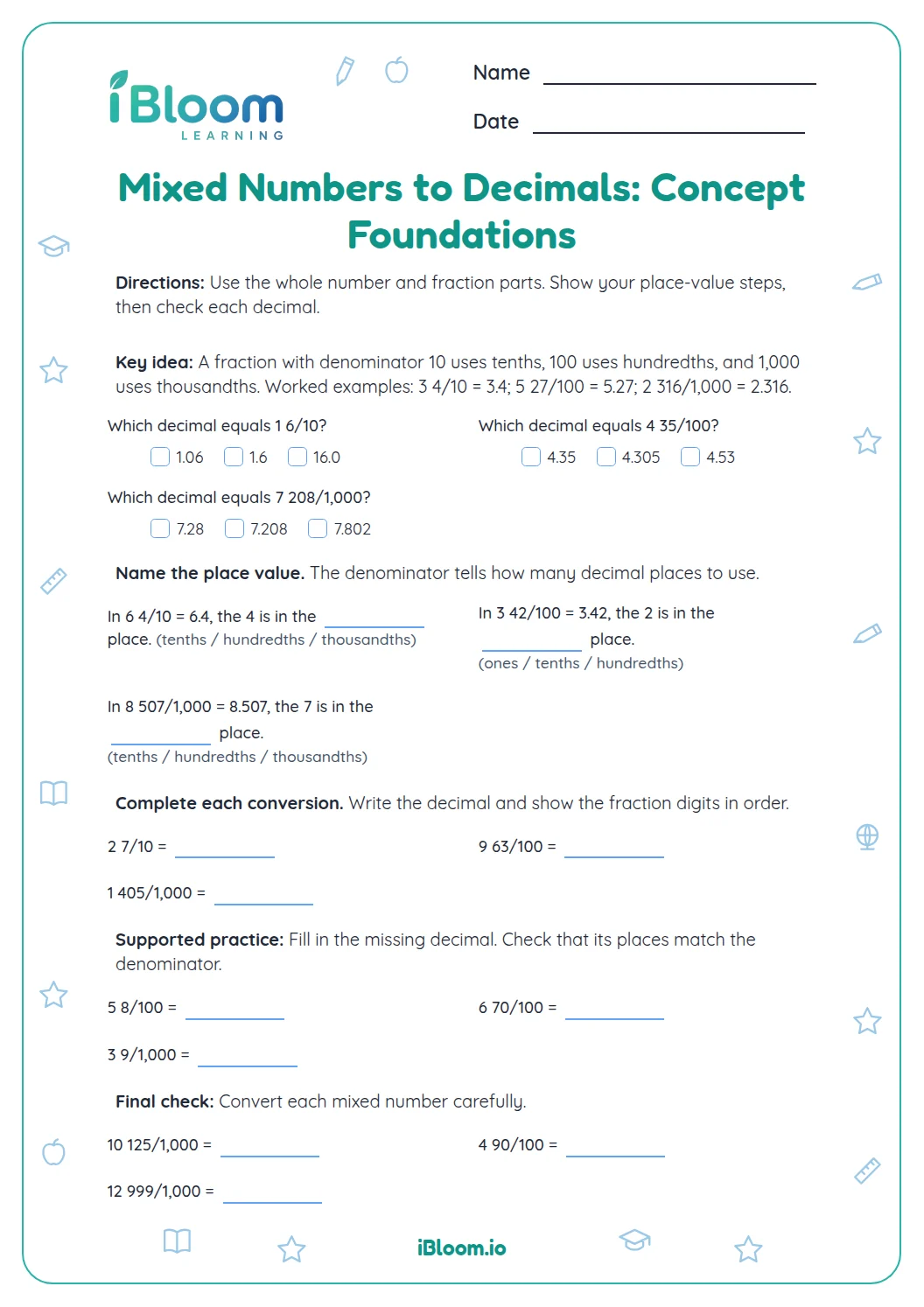
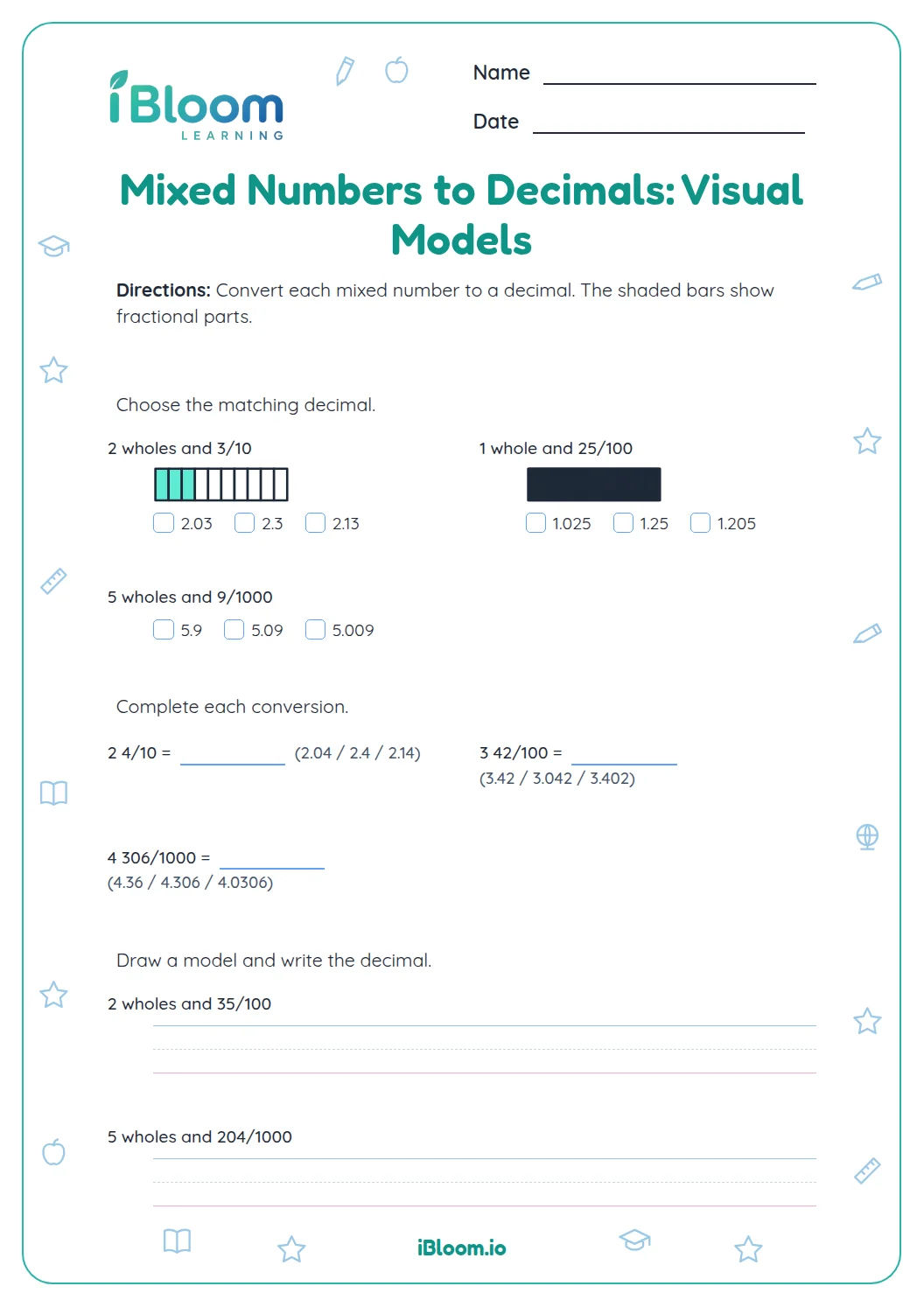
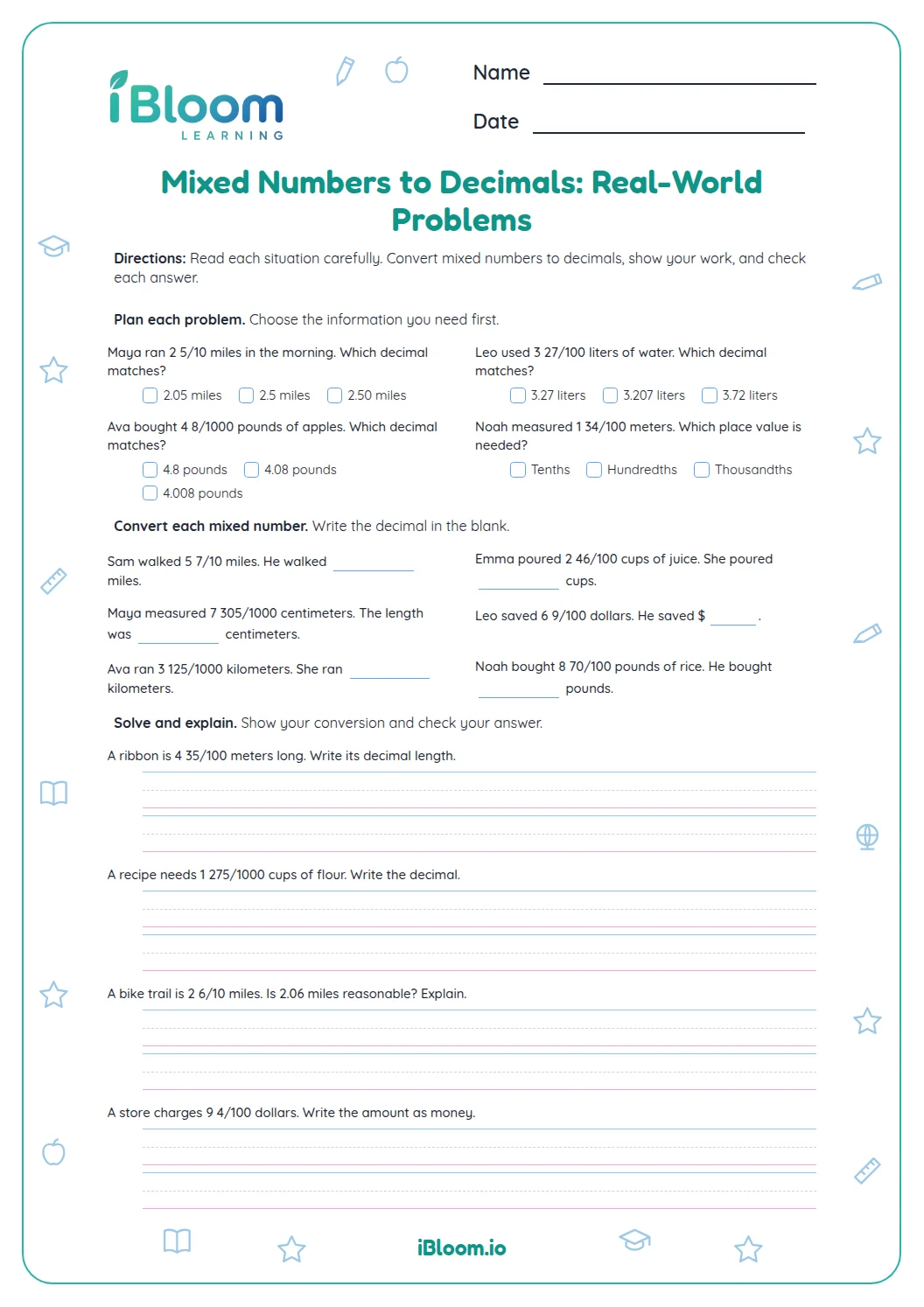
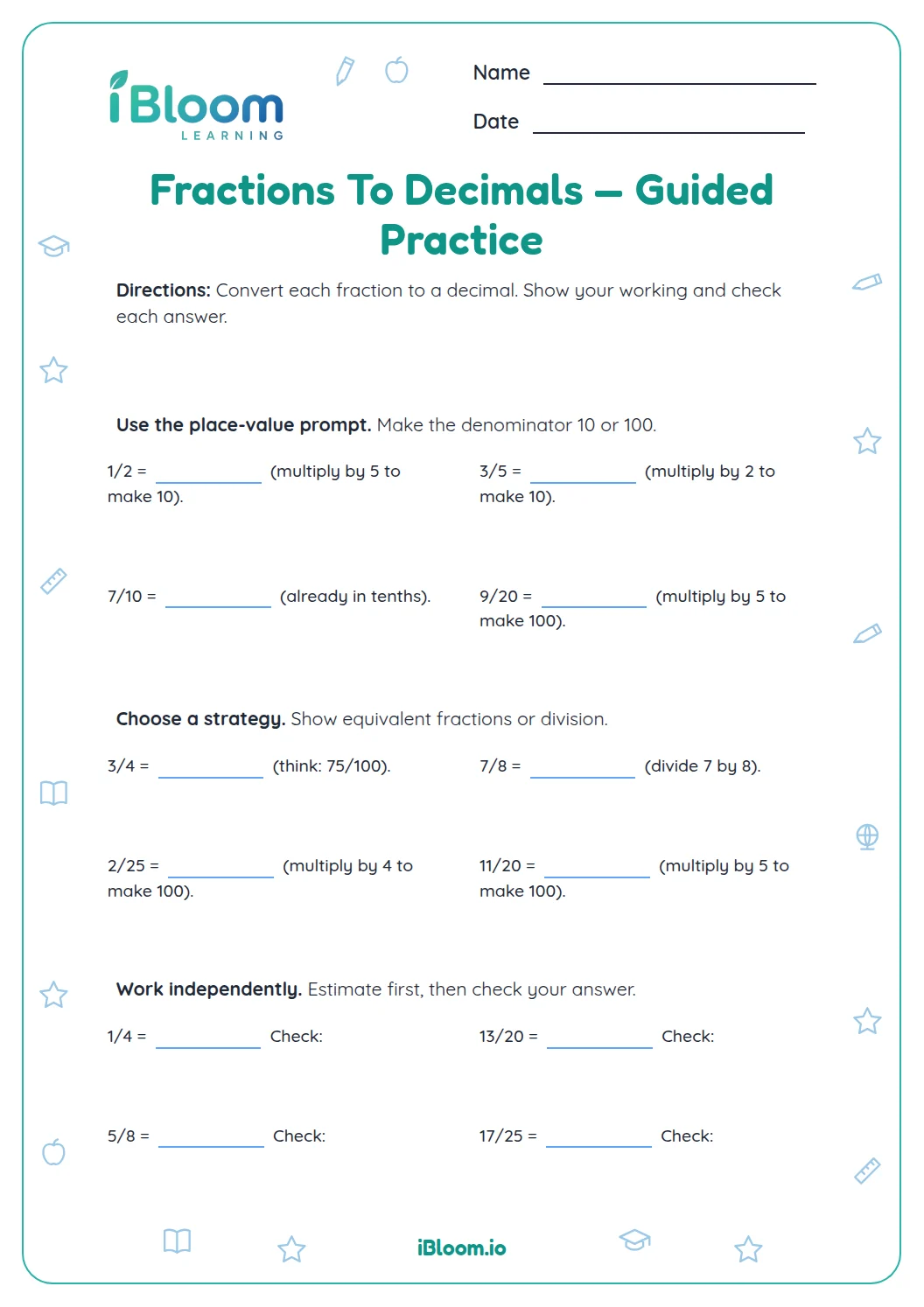
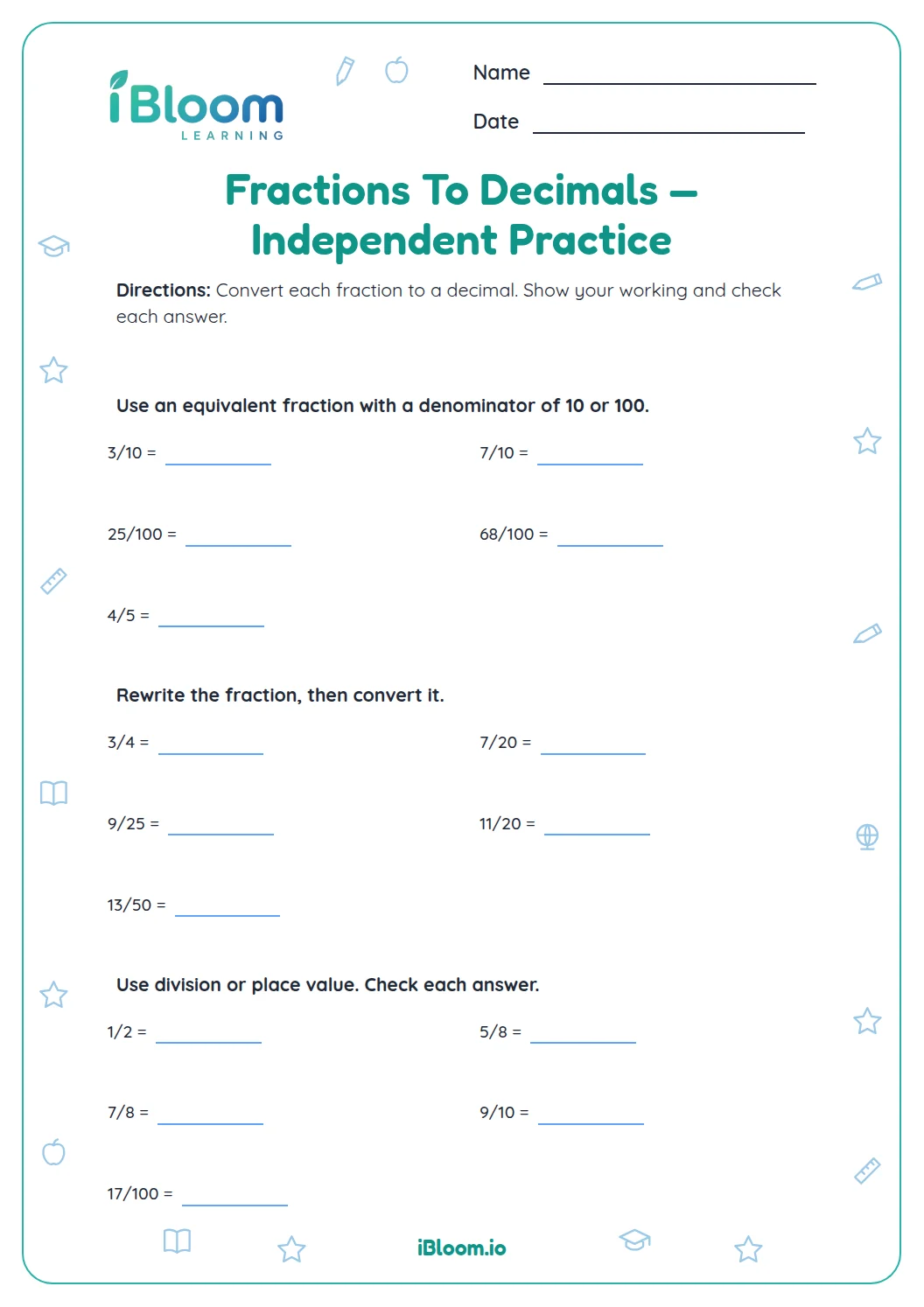
Convert mixed numbers with fractional parts in tenths, hundredths, or thousandths. The practice then checks place value with comparisons, zero placeholders, a real-world amount, and short reasoning. The worksheet has 16 questions, and the answer key is included.
What skill does this worksheet build?
Convert mixed numbers with fractional parts in tenths, hundredths, or thousandths. The practice then checks place value with comparisons, zero placeholders, a real-world amount, and short reasoning. The answer key gives a check for each item.
How can a learner solve one?
Three tenths is 0.3, so keep the whole number 2.
- 12 3/10 = ___
- 2Three tenths is 0.3, so keep the whole number 2.
- 3Answer: 2.3
What is included on the pages?
The worksheet has 16 questions across 5 activity parts. The answer key gives a check for every response.
How to use this worksheet
- 1Name the denominator: tenths, hundredths, or thousandths.
- 2Keep the whole-number part.
- 3Place the fractional digits in the matching decimal places.
- 4Add zeros where empty places must hold their position.
- 5Compare decimals by lining up place values.
Common mistakes and quick fixes
The mistake
Writing 8 thousandths as 0.8.
The fix
Use three decimal places: 8 thousandths is 0.008.
The mistake
Dropping a needed zero.
The fix
Keep the fractional digits in their correct tenths, hundredths, or thousandths places.
The mistake
Comparing only the number of digits.
The fix
Write equal place-value lengths, such as 3.800 and 3.750, then compare.
What to practice next
Make more practice
Further reading
Questions parents and teachers ask
How do you convert 4 27/100?
Keep the whole number 4 and write 27 hundredths in the hundredths places. The decimal is 4.27. The digits 2 and 7 represent two tenths and seven hundredths, together making twenty-seven hundredths. Ask the learner to point to the clue in the question and explain how it supports the answer.
Why does 1 8/1000 become 1.008?
The 8 is in the thousandths place. Two zeros hold the tenths and hundredths places, so the decimal part is 0.008. Adding the whole number gives 1.008, or one and eight thousandths. Ask the learner to point to the clue in the question and explain how it supports the answer.
What is a placeholder zero?
It marks a place with no tenths or hundredths so later digits keep their value. In 8 9/1000, the decimal digits are 009, giving 8.009. The two zeros keep 9 in the thousandths place. Ask the learner to point to the clue in the question and explain how it supports the answer.
How can a learner check a conversion?
Read the decimal part by place value and compare it with the fraction. For example, 0.05 is five hundredths, so 6 5/100 equals 6.05. This check catches misplaced digits and missing zeros. Ask the learner to point to the clue in the question and explain how it supports the answer.
Does the answer key include the written explanation?
Yes. Question 14 includes a sample explanation that names five hundredths and shows 6 + 0.05 = 6.05. Other correct explanations may use different wording if they correctly connect the fraction to the decimal. Ask the learner to point to the clue in the question and explain how it supports the answer.