



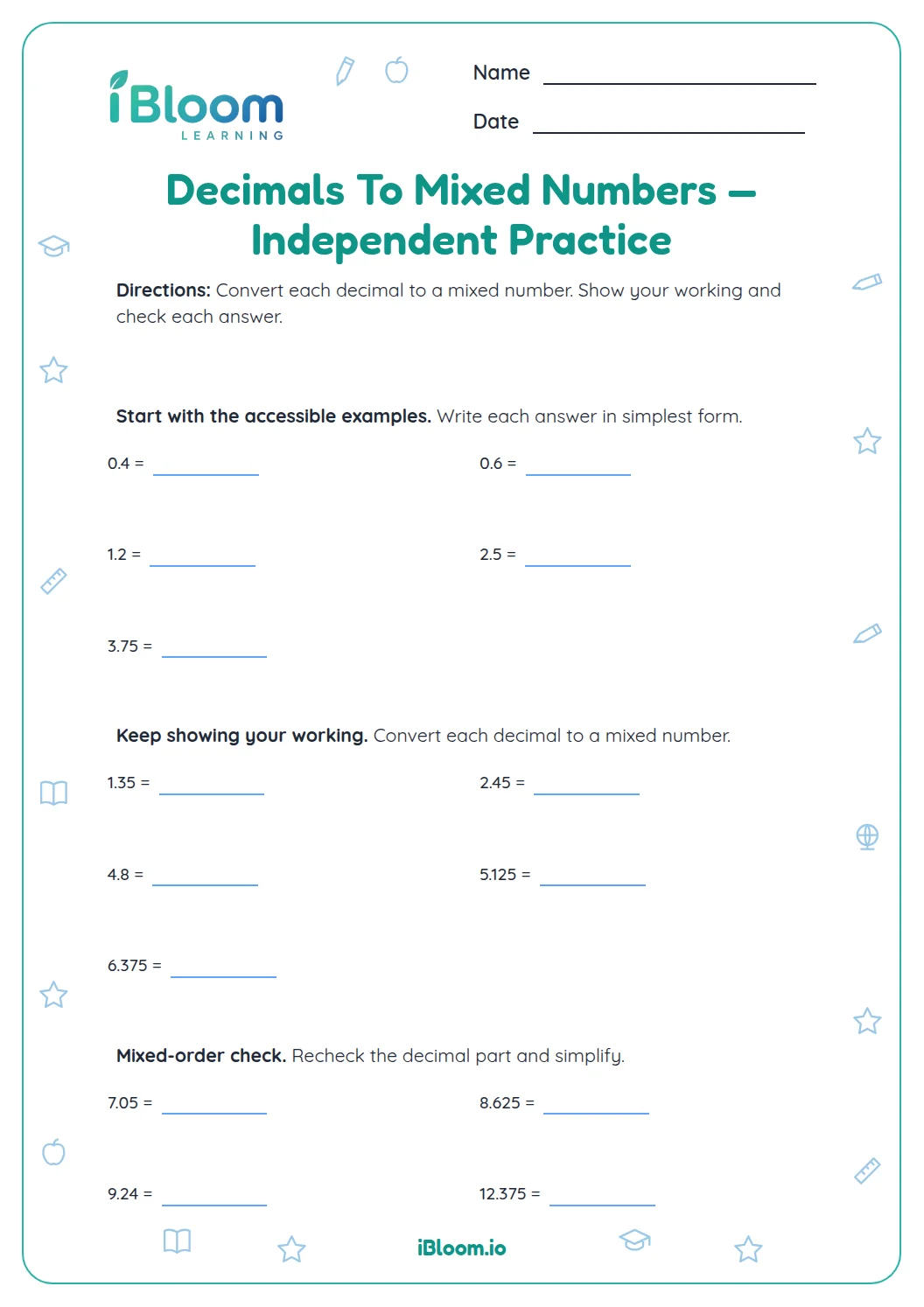
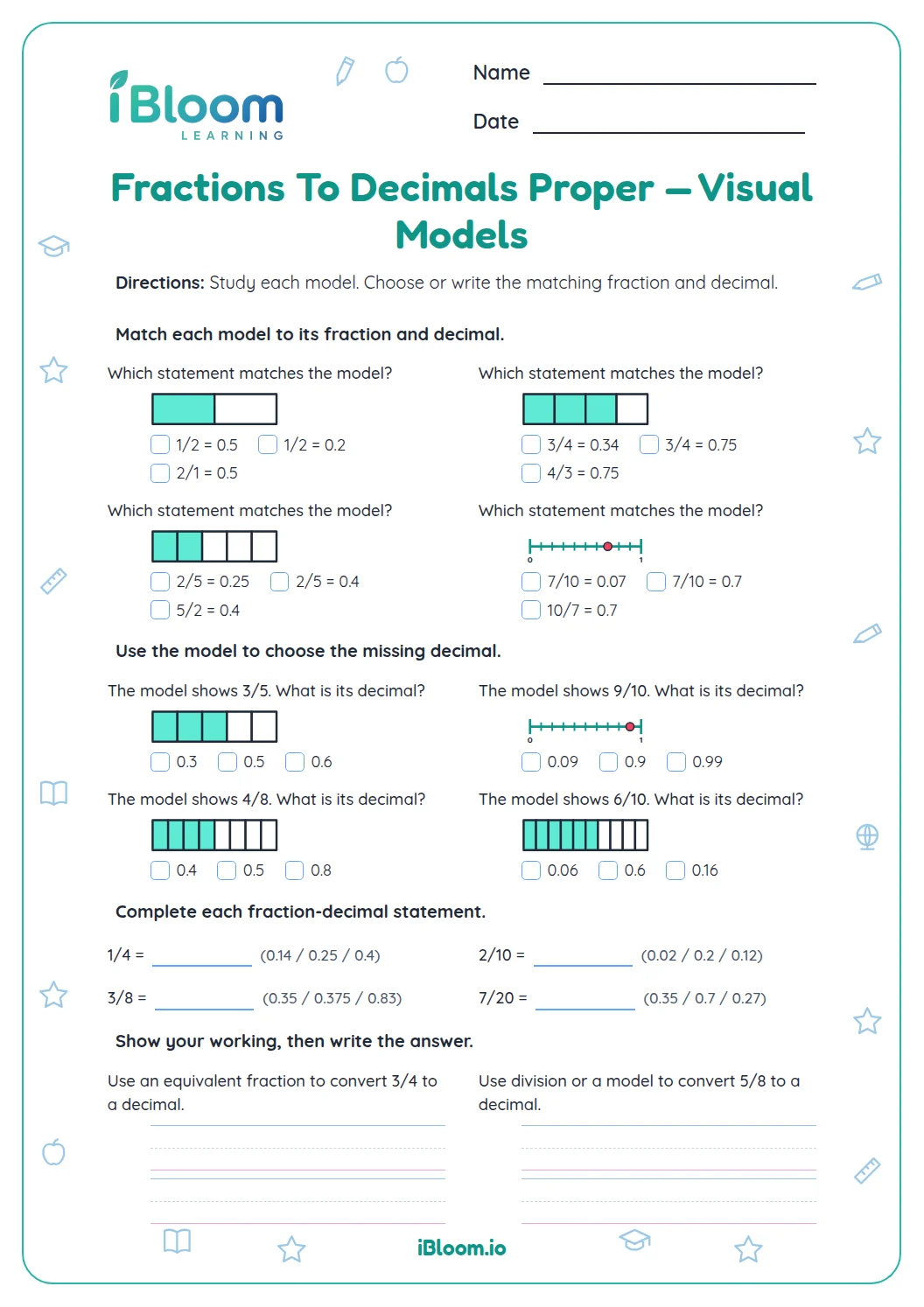


About this worksheet
This free printable worksheet helps Grade 5 students see why every decimal can be written as a fraction. Children count the digits after the decimal point to choose the denominator, 10 for tenths, 100 for hundredths or 1000 for thousandths, and write the digits over it, so 0.47 becomes 47/100. Part A chooses the denominator, Part B fills in a missing numerator or denominator, and Part C asks for the whole fraction, including 0.80 and a slip made by a student named Leo. No answer is simplified: each denominator matches the number of decimal places. It practices Common Core 5.NBT.A.3.a and 4.NF.C.6. A separate answer key is included.
Aligned to 5.NBT.A.3.a and 4.NF.C.6
What is on this decimals to fractions worksheet?
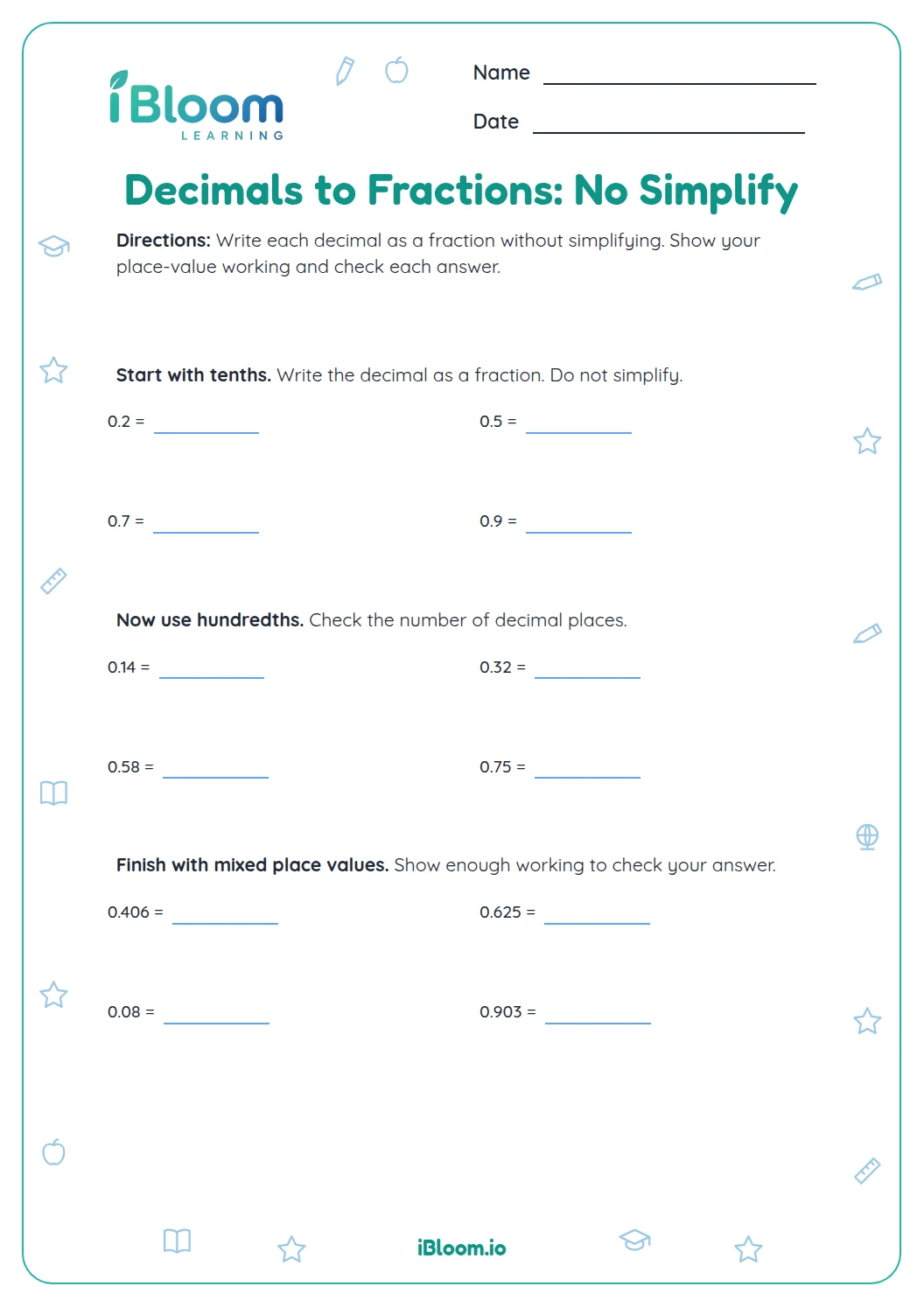
Part A has four multiple-choice questions. Three ask which denominator goes with 0.9, 0.05 and 0.123, and one asks which fraction shows 0.08 without simplifying. Part B gives six decimals with half of a fraction already written, such as 0.3 = ___/10 and 0.014 = 14/___, and children supply the missing numerator or denominator.
Part C asks children to write the whole fraction with working space: 0.24, 0.007 and 0.80, and then a correction. Leo wrote 0.05 as 5/10, and children fix his answer.
- Part A: 4 multiple choice on denominators
- Part B: 6 fill-in fractions (3 missing numerators, 3 missing denominators)
- Part C: 4 whole fractions with working space
- Denominators used: 10, 100 and 1000
How do you choose the denominator?
Count the digits to the right of the decimal point. That count tells you how many zeros the denominator has: one digit gives 10, two digits give 100 and three digits give 1000. The digits themselves, read as a whole number, become the numerator.
This is place value in fraction form. The last digit of 0.205 sits in the thousandths place, so the whole decimal is read as 205 thousandths, which is 205/1000.
- 10.205 = ___/1000
- 20.205 has 3 digits after the decimal point.
- 3Three places means thousandths, so the denominator is 1000.
- 4The digits 205 are the numerator.
- 5Answer: 0.205 = 205/1000
What about decimals with a zero, like 0.05 or 0.007?
A zero after the decimal point still counts as a place. In 0.05 the zero holds the tenths place and the 5 is in the hundredths place, so the decimal is 5 hundredths, 5/100. Leo’s answer, 5/10, would be 0.5, which is ten times bigger.
The same rule works for 0.007, which has three places and is 7/1000. A reliable check is to read the decimal aloud, “seven thousandths,” and then read the fraction, 7/1000, and make sure the words match.
Why does 0.80 stay 80/100?
On this worksheet the goal is to show the decimal exactly as it is written, so 0.80 has two decimal places and becomes 80/100. Question 13 reminds children to keep both decimal digits. Writing 80/100 makes the link between the decimal and the hundredths place clear.
A fraction like 8/10 has the same value, and it is a fair answer to discuss, but the answer key here shows 80/100 so that the denominator always matches the number of decimal places.
How to use this worksheet at home or in class
- 1Review place value by asking your child to name the tenths, hundredths and thousandths places in 0.374.
- 2Work question 1 together. Ask how many digits come after the point in 0.9, then match that to the denominator.
- 3Let your child complete Part A, then check that every denominator matches the count of decimal places.
- 4In Part B, have your child read each decimal aloud before filling the blank, for example “forty-seven hundredths.”
- 5In Part C, ask for a quick sketch or sentence in the working space. Then compare the spoken decimal with the fraction.
- 6Check with the answer key and revisit Leo’s slip in question 14 together.
Common mistakes and quick fixes
The mistake
Choosing the denominator from the number, not the place, writing 0.05 as 5/10 or 0.014 as 14/100.
The fix
Count every digit after the decimal point, zeros included. 0.05 has two places, so 5/100. 0.014 has three, so 14/1000.
The mistake
Dropping a final zero, so 0.80 becomes 8/100.
The fix
Keep both digits: 80/100. Read it aloud to check. “Eighty hundredths” matches 0.80, but “eight hundredths” would be 0.08.
The mistake
Reading 0.3 as “one third” and writing 1/3.
The fix
Say the decimal with its place name: 0.3 is “three tenths,” so the fraction is 3/10. One third is a different number, a little more than 0.33.
Common Core alignment
Most US states use the Common Core Math standards or a close state version. These two standards connect decimals and fractions with place value.
Read and write decimals to thousandths using place value.
On this sheet: Every question ties tenths, hundredths and thousandths to the place of each digit, up to 0.123 and 0.205.
Show the official wordingHide the official wording
Read and write decimals to thousandths using base-ten numerals, number names, and expanded form, e.g., 347.392 = 3 × 100 + 4 × 10 + 7 × 1 + 3 × (1/10) + 9 × (1/100) + 2 × (1/1000).
Use decimal notation for fractions with denominators 10 or 100, like 0.62 and 62/100.
On this sheet: Question 10 is its own example: 0.62 = 62/100. The tenths and hundredths questions work the same way.
Show the official wordingHide the official wording
Use decimal notation for fractions with denominators 10 or 100. For example, rewrite 0.62 as 62/100; describe a length as 0.62 meters; locate 0.62 on a number line diagram.
What to practice next
Make more practice
Further reading
Questions parents and teachers ask
What does “no simplify” mean on a decimals to fractions worksheet?
It means to keep the fraction exactly as the decimal reads, with no dividing the top and bottom by a common factor. On this sheet, 0.80 is written as 80/100 and 0.205 as 205/1000. The value is the same either way, but keeping the denominator shows the decimal places.
How many digits after the decimal point give 10, 100 or 1000?
One digit gives a denominator of 10, two digits give 100, and three digits give 1000. Count every digit after the point, including zeros. So 0.9 is 9/10, 0.05 is 5/100, and 0.123 is 123/1000. Part A of this sheet practices exactly that choice.
Why is 0.05 equal to 5/100 and not 5/10?
The 0 in 0.05 sits in the tenths place, and the 5 is in the hundredths place, so the decimal is five hundredths. The fraction 5/10 means five tenths, which is 0.5. Reading each aloud, “five hundredths” against “five tenths,” helps children hear the difference.
What are the answers to Part C?
Question 11 is 24/100, question 12 is 7/1000, question 13 is 80/100, and question 14 is 5/100, which corrects Leo’s 5/10. Each denominator matches the number of decimal places. The answer key lists all 14 answers, including the missing numerators and denominators in Part B.
Is 0.80 different from 0.8?
They have the same value, but on this sheet 0.80 is written with two decimal places, so it becomes 80/100, while 0.8 would be 8/10. Both can later be simplified to 4/5. Keeping the original number of places is what Part C practices.
How long does it take, and is there an answer key?
Most Grade 5 students finish in about 15 minutes. The second page, Part C, has working space for each fraction. The answer key is a separate two-page document with every answer, including the missing numerators and denominators in Part B, so a parent or teacher can mark the whole sheet quickly.