





About this worksheet
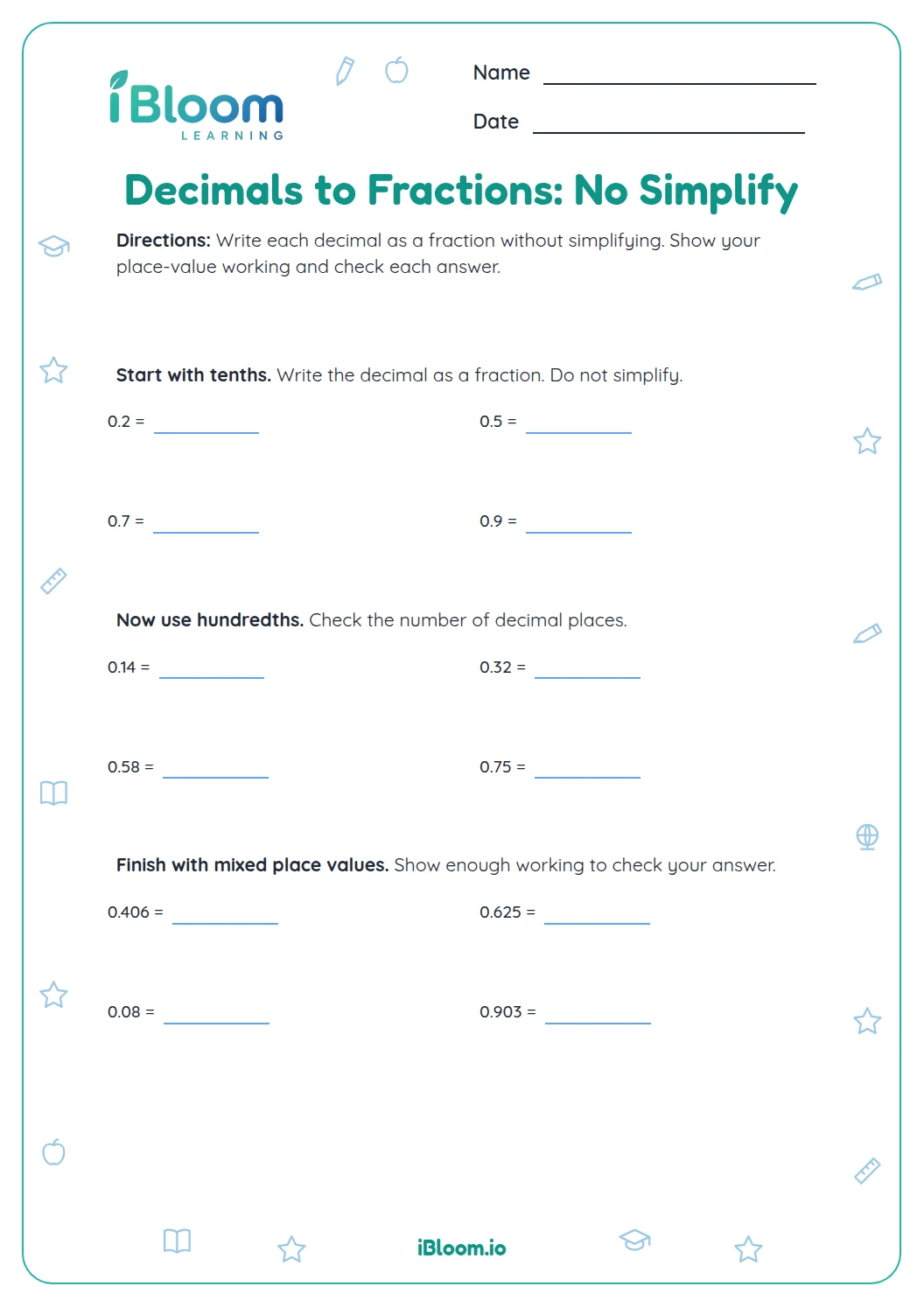
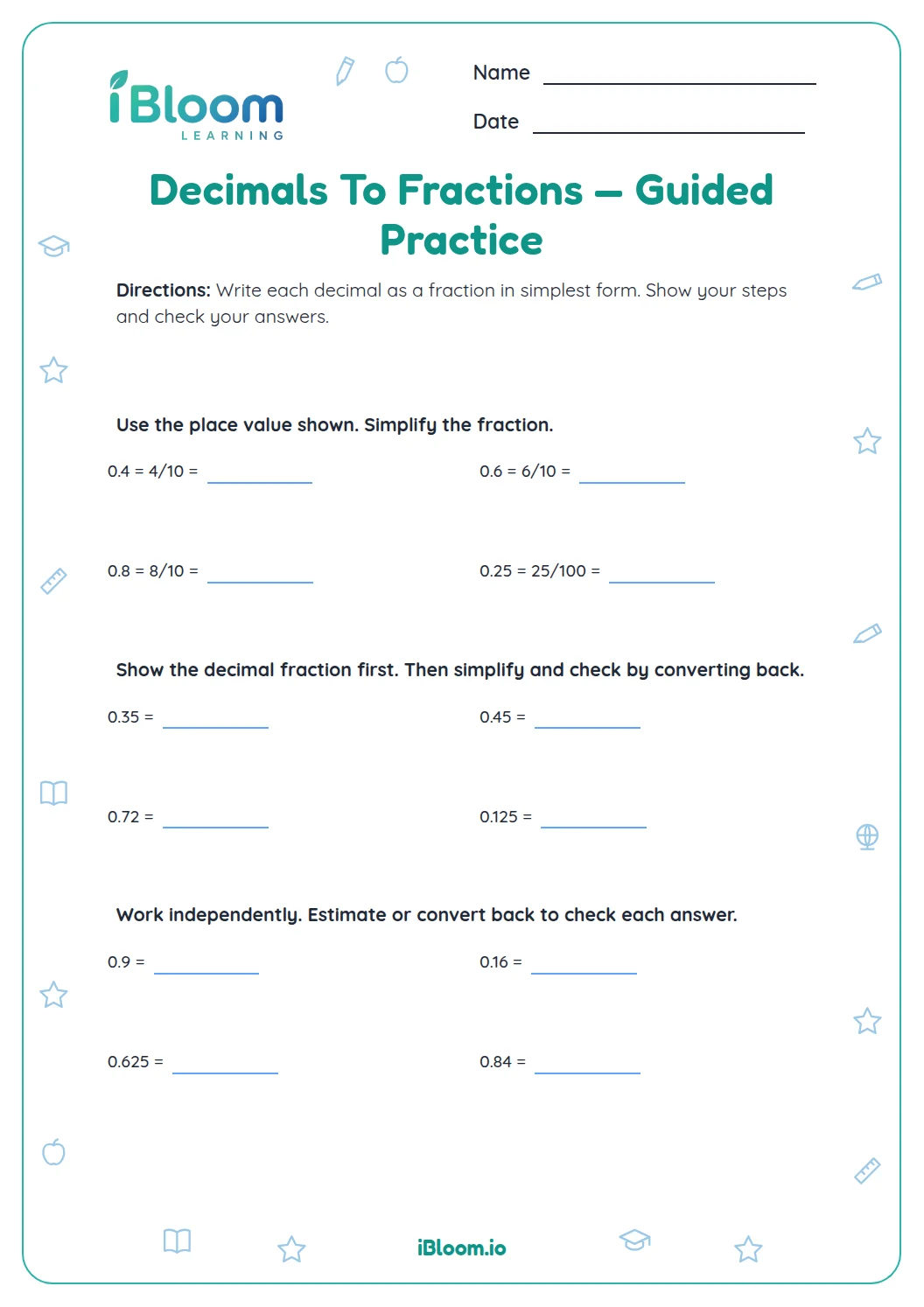
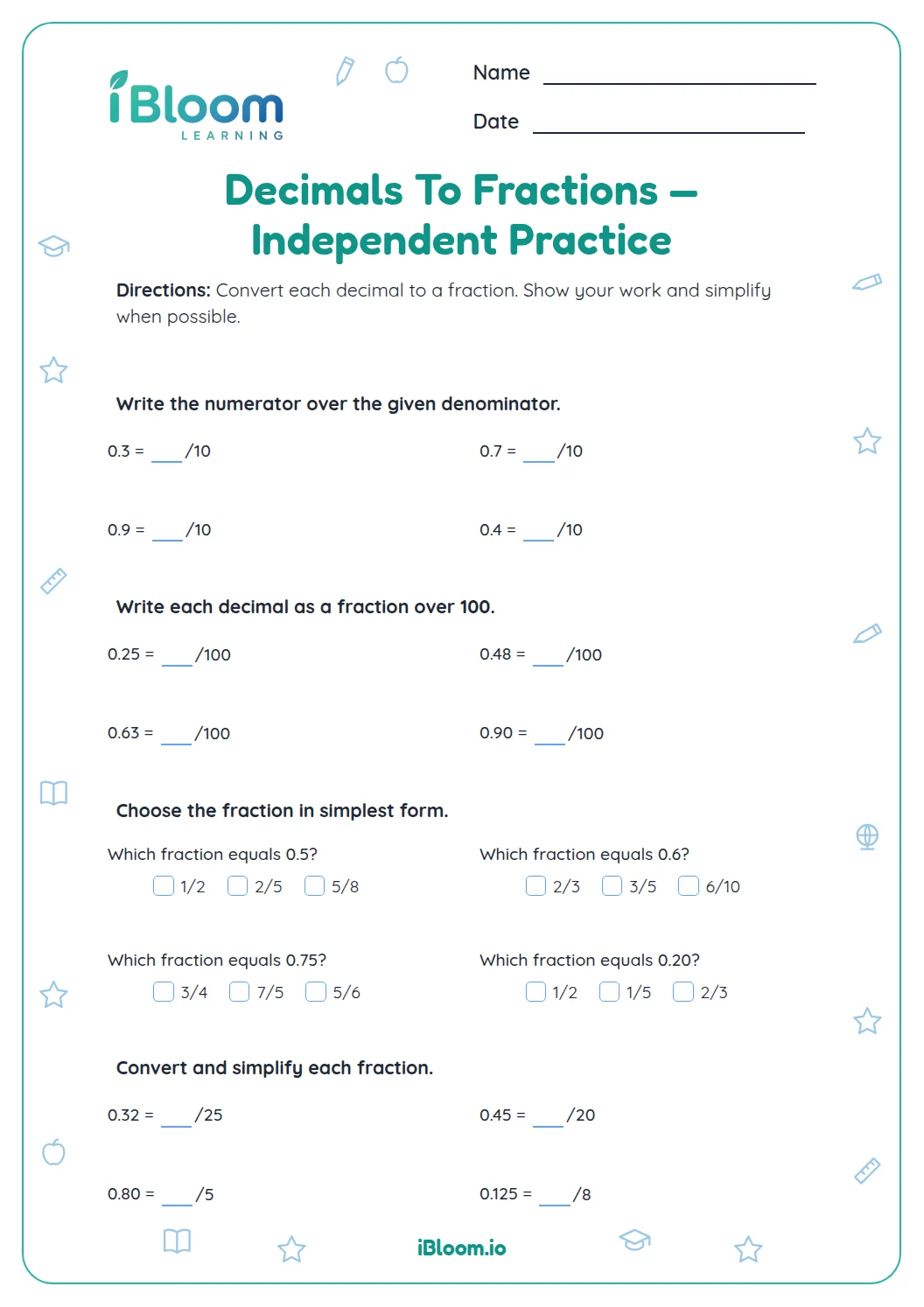
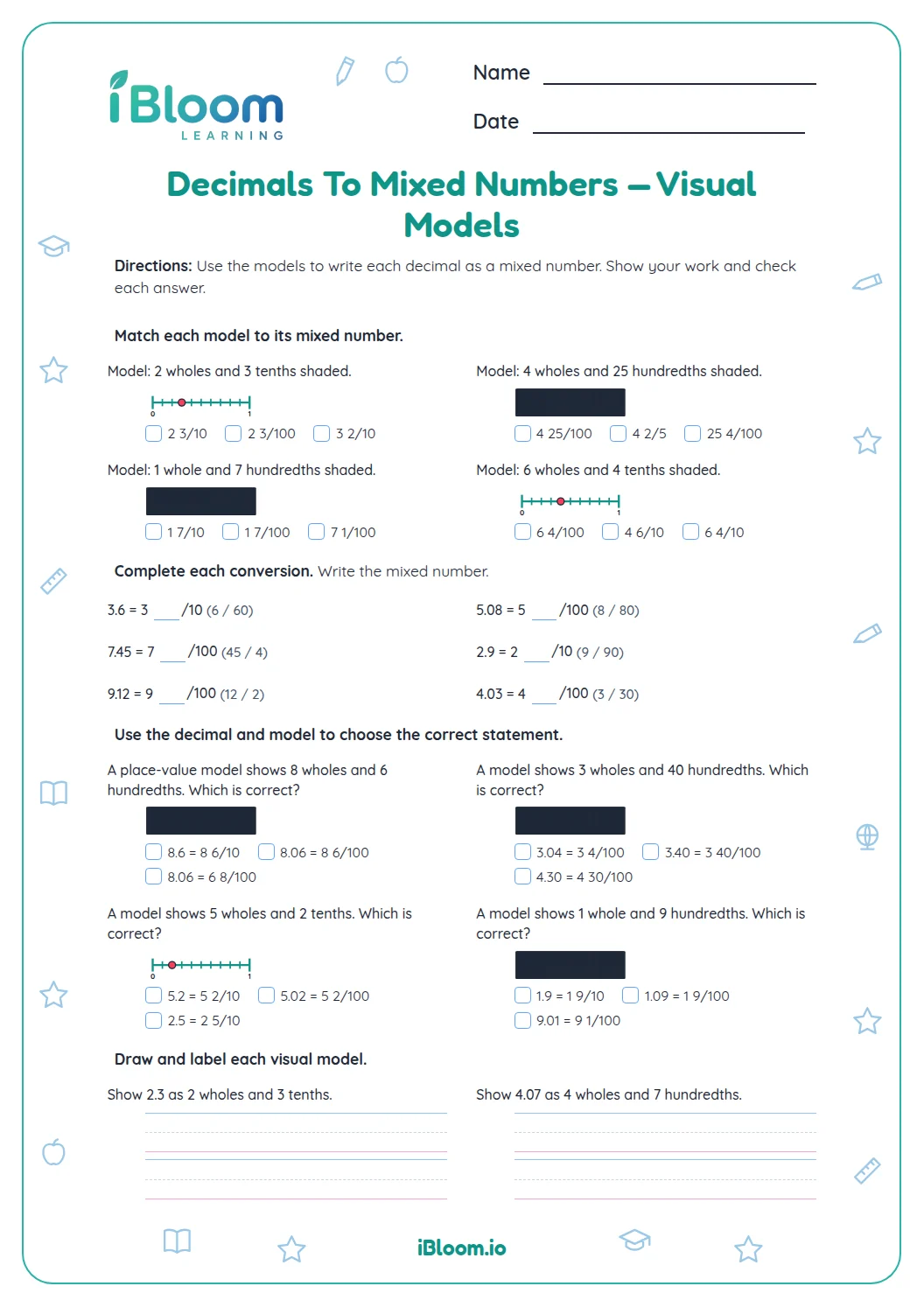
This printable Grade 5 worksheet uses decimal-to-fraction conversions to practice reasoning about place value. Learners check denominators, complete fraction equations, and correct a denominator error. The three parts retain the original sheet’s focus on writing fractions without simplifying, with a separate answer key.
How can decimal place value reveal an error?
Count the places to the right of the decimal. One place names tenths, two name hundredths, and three name thousandths. The denominator should match that place value.
- 10.6 has one decimal place, so it names tenths.
- 2Write 0.6 as 6/10, not 6/100.
How does the reasoning practice progress?
Part A checks place-value denominators, Part B completes decimal fractions, and Part C applies the reasoning to additional values and corrections. Every item keeps the fraction unsimplified.
How can a learner check a decimal fraction?
Read the denominator as tenths, hundredths, or thousandths. For example, 35/100 is thirty-five hundredths, or 0.35. Check that the written fraction has the same value as the decimal and remains unsimplified.
How to use this worksheet
- 1Read the decimal and count its places.
- 2Name the place value before choosing a denominator.
- 3Keep all decimal digits in the numerator.
- 4Use the equation to check the missing numerator or denominator.
- 5Check the answers with the key and explain one correction.
Decimal place-value mistakes
The mistake
Using 100 for 0.6.
The fix
One decimal place means tenths, so write 6/10.
The mistake
Writing 42/10 for 0.42.
The fix
Two decimal places mean hundredths, so use 42/100.
The mistake
Simplifying when asked to keep a fraction unsimplified.
The fix
Keep the denominator that matches the decimal place value.
What to practice next
Make more practice
Further reading
Questions parents and teachers ask
What does the decimal-to-fraction reasoning challenge include?
The two-page sheet has 14 questions in four parts. Learners diagnose claims, complete place-value reasoning, compare strategies, and explain corrections. The questions preserve the original focus on writing fractions without simplifying, and a separate two-page key is included. The key helps adults check each response.
How do you choose the denominator for a decimal?
Count the digits after the decimal point. One digit means tenths and a denominator of 10; two digits mean hundredths and 100; three digits mean thousandths and 1,000. Keep every digit in the numerator, including zeros between other digits. Keep each zero in its place.
Why is 0.6 equal to 6/10 instead of 6/100?
The digit 6 is one place to the right of the decimal, so it names six tenths. The fraction 6/100 names six hundredths, a smaller amount. One question asks learners to diagnose this exact kind of denominator error. The worksheet uses this distinction repeatedly.
Should learners simplify the fractions?
No. This worksheet asks learners to keep each fraction in the form that matches the decimal’s place value. For example, 0.5 is written as 5/10 here. Learners focus on the reasoning and denominator choice rather than reducing. The practice reinforces matching each denominator to the place named by the decimal.
How does the worksheet practice reasoning?
Learners check decimal place-value relationships, complete missing numerators or denominators, and correct a denominator error. Encourage them to explain why 1.03 uses hundredths. The separate two-page answer key shows the value each blank must have. Review the method together after checking.