



About this worksheet
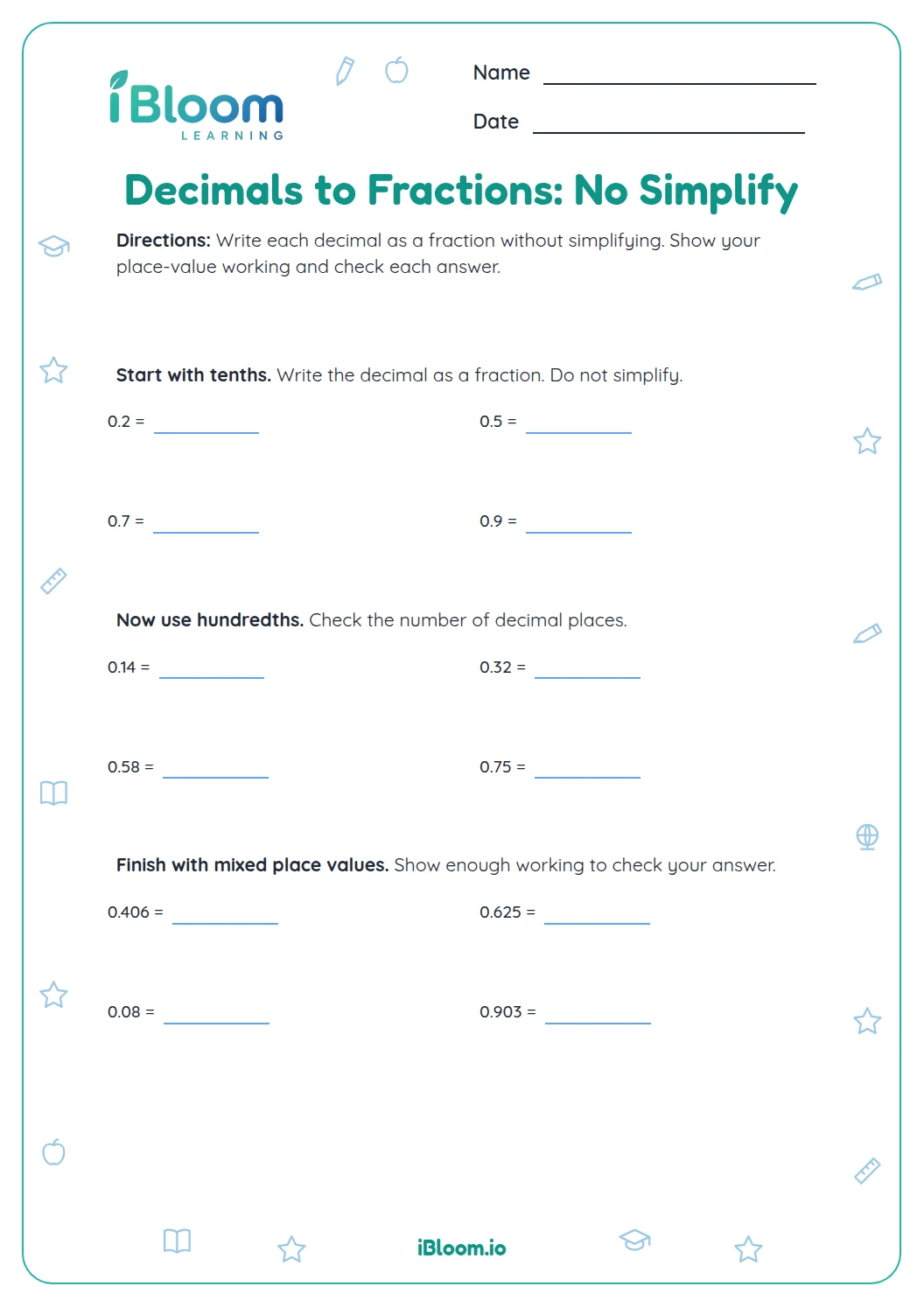
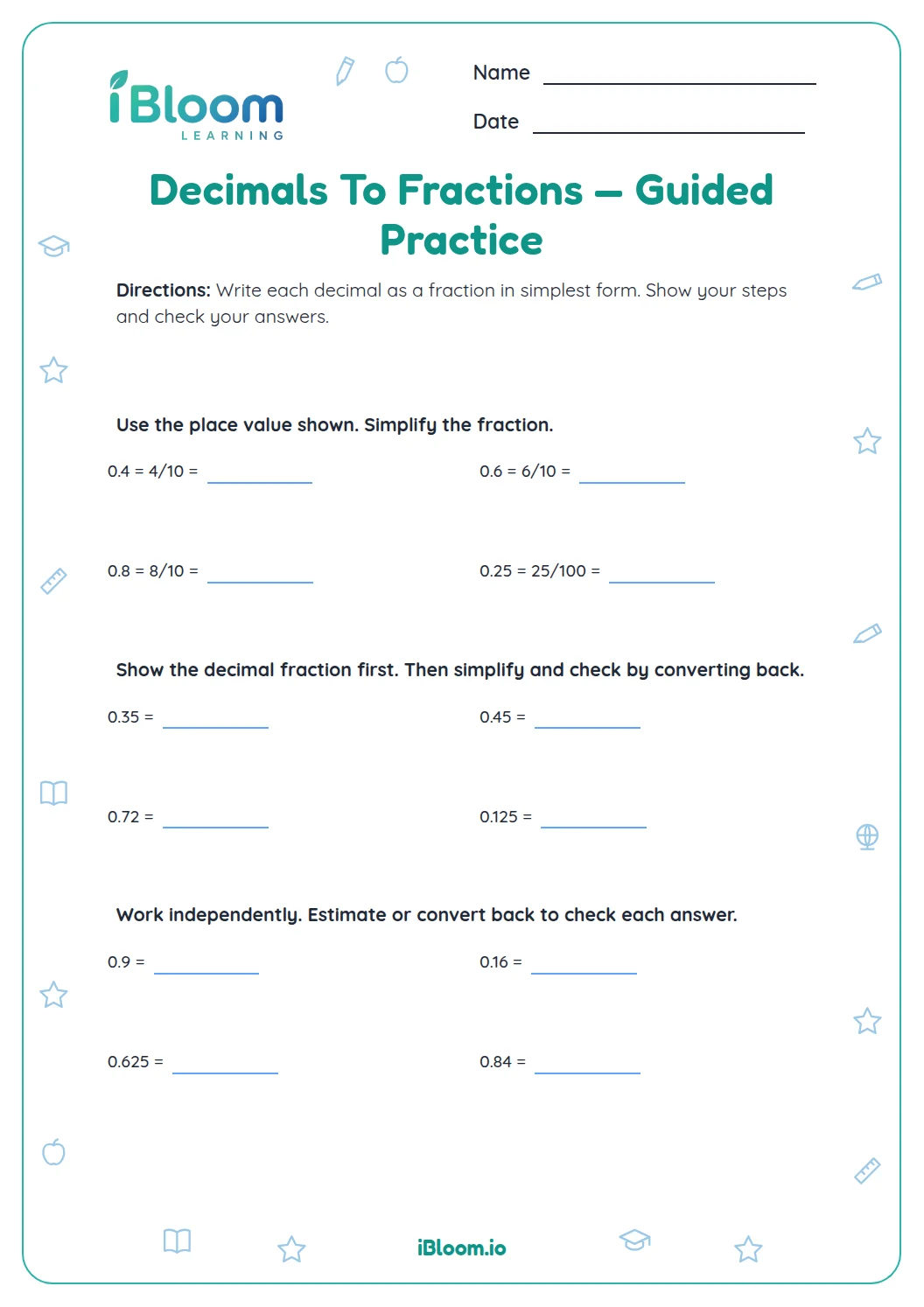
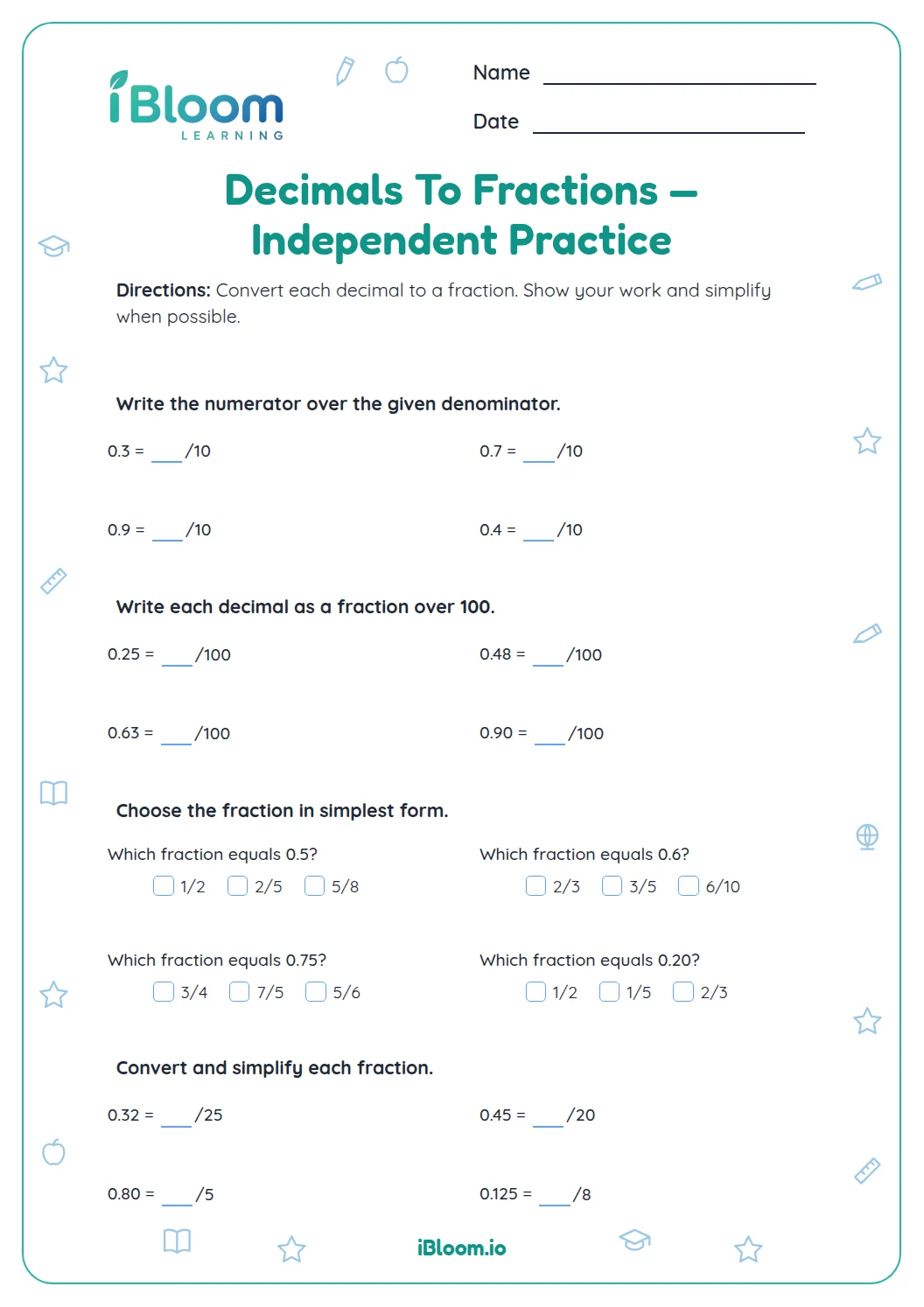
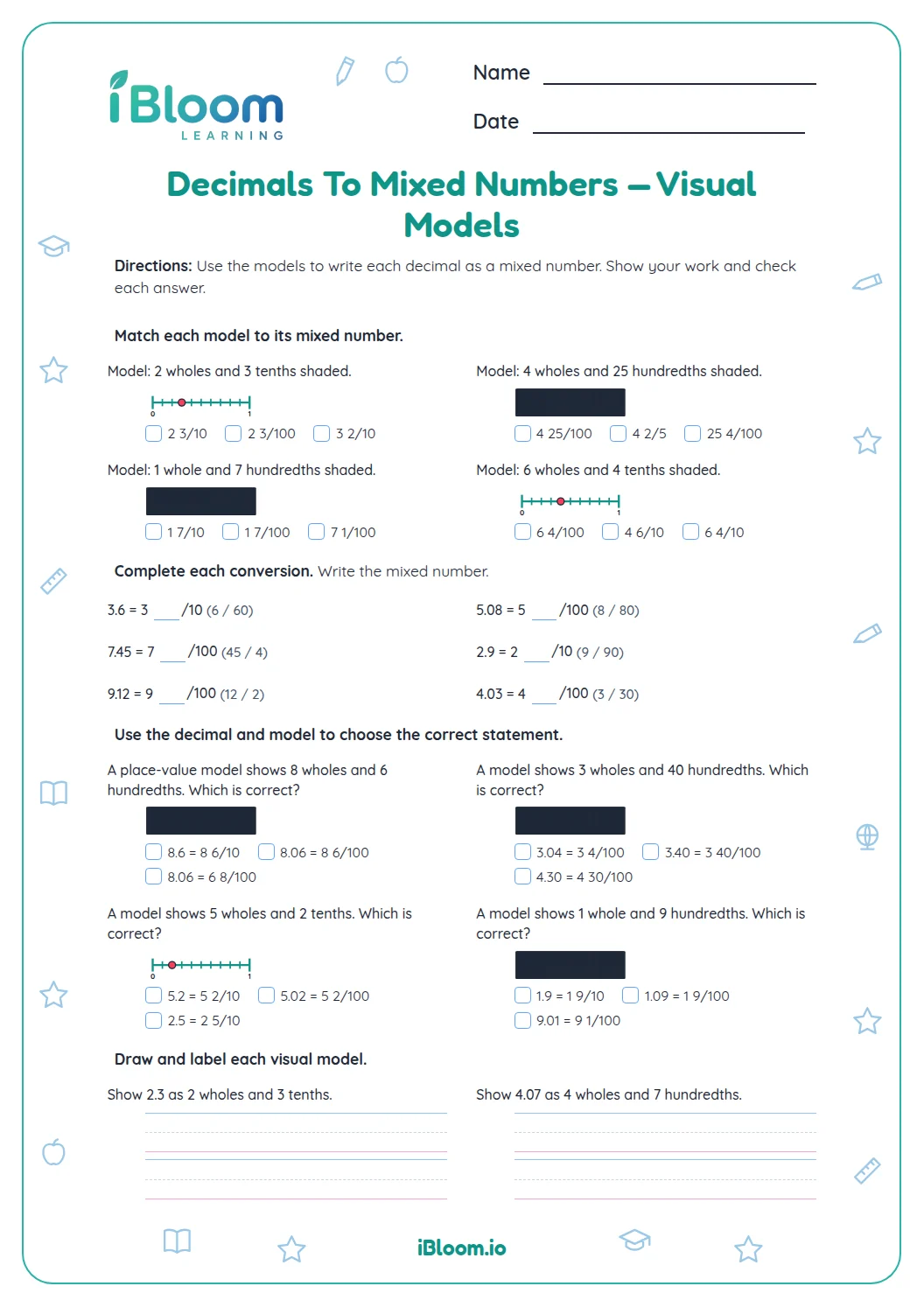
This free printable worksheet practices writing decimal amounts as fractions without simplifying. Learners answer 14 questions: eight shaded tenths or hundredths models and six fraction blanks, including one amount greater than one. The separate key gives the unsimplified fractions. The models make the denominator visible: tenths use 10 equal parts and hundredths use 100.
How do shaded tenths and hundredths become fractions?
Count the shaded parts for the numerator and the total equal parts for the denominator. Keep the fraction unsimplified.
A model with 3 of 10 equal parts shaded represents 3/10. A hundredths grid with 36 shaded squares represents 36/100.
- 13 of 10 parts are shaded
- 2Write shaded parts over total parts
- 3Answer: 3/10
How does the practice build?
Questions 1–4 show tenths, questions 5–8 show hundredths, and questions 9–14 give decimals with a missing numerator.
How can I use the answer key?
The key lists each fraction without reducing it. Check that tenths have denominator 10 and hundredths have denominator 100.
How to work through the page
- 1Read the direction at the start of each part.
- 2Try the first question carefully and check what it asks.
- 3Complete the rest of the part independently.
- 4Review answers with the key and correct any slips.
Common slips and quick checks
The mistake
Writing 36/10 for 0.36.
The fix
Two decimal places mean hundredths, so write 36/100.
The mistake
Putting the total parts in the numerator.
The fix
Count shaded parts for the numerator and all equal parts for the denominator.
The mistake
Reducing 6/10 to 3/5 when the question asks not to simplify.
The fix
Keep the denominator that matches the model or decimal place value.
What to practice next
Make more practice
Questions parents and teachers ask
How do the shaded models help with decimal-to-fraction work?
Count the shaded parts in each model, then write that number over the total equal parts. A strip with 2 of 10 parts shaded is 2/10; a hundredths grid with 3 squares shaded is 3/100. Keep the fraction unsimplified and match the model.
Why should the fractions stay unsimplified?
The task is to match decimal place value to a denominator of 10 or 100. Write the number of tenths over 10 or hundredths over 100. For instance, 0.36 is 36/100, even though it can be reduced. Keeping it this way shows the decimal’s place value.
How can a learner read a tenths model?
Count equal parts in the strip and compare the shaded count with the whole strip. In question 2, six of ten parts are shaded, so the model represents 6/10. The denominator stays 10 because the strip has ten equal parts.
What does 0.05 look like as a fraction?
The 5 is in the hundredths place, so 0.05 means five hundredths. Write 5/100 and leave it unsimplified. Question 12 uses this decimal in a missing-numerator sentence, while the hundredths grids make the denominator visible for learners to check on paper.
What does the answer key show?
Yes. The key gives the fractions for questions 1–8 and the missing numerators for questions 9–14. Check the first eight against their shaded counts, then confirm that the final fractions keep the denominator printed in each number sentence. It follows the same question order as the sheet.