





About this worksheet
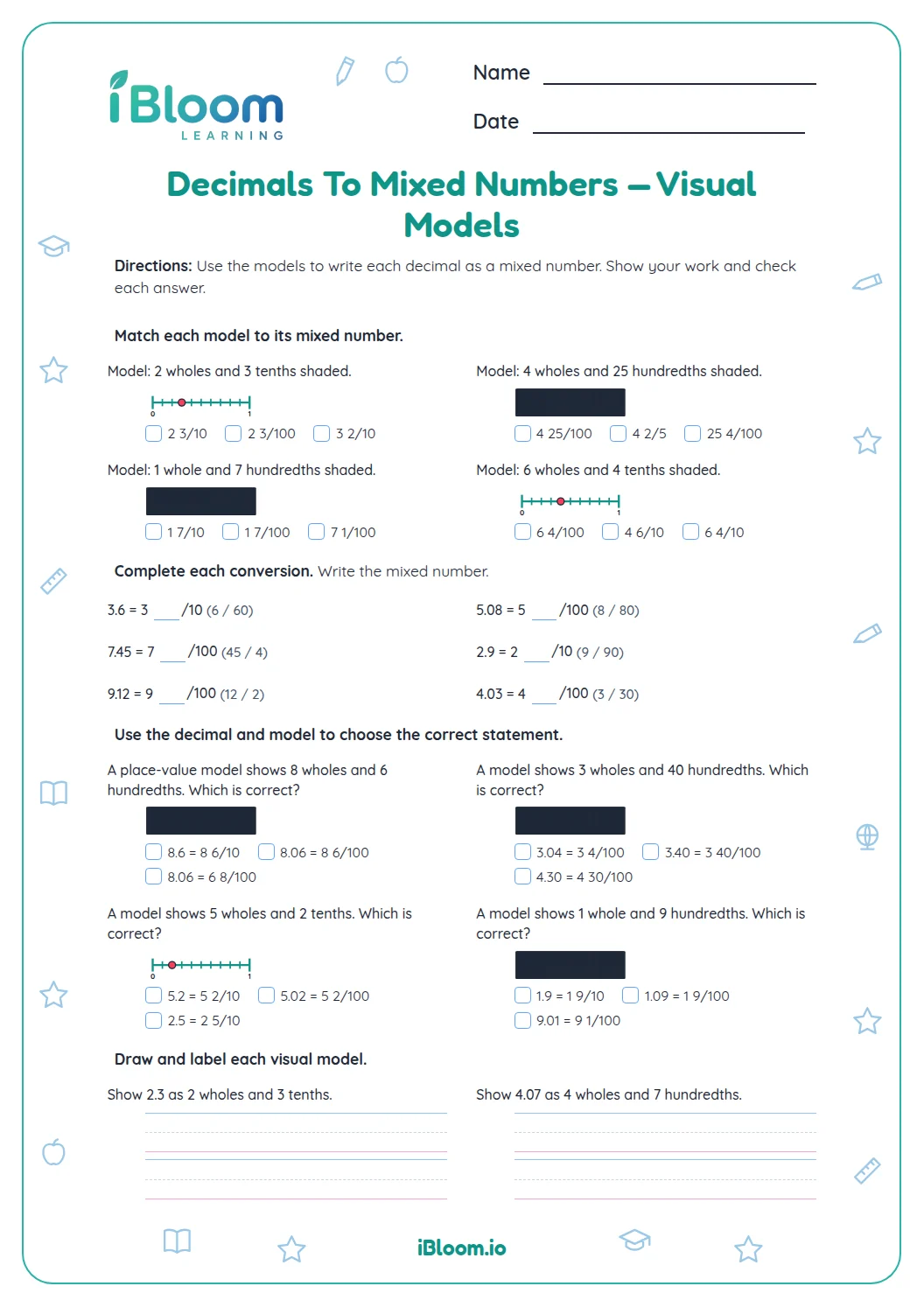
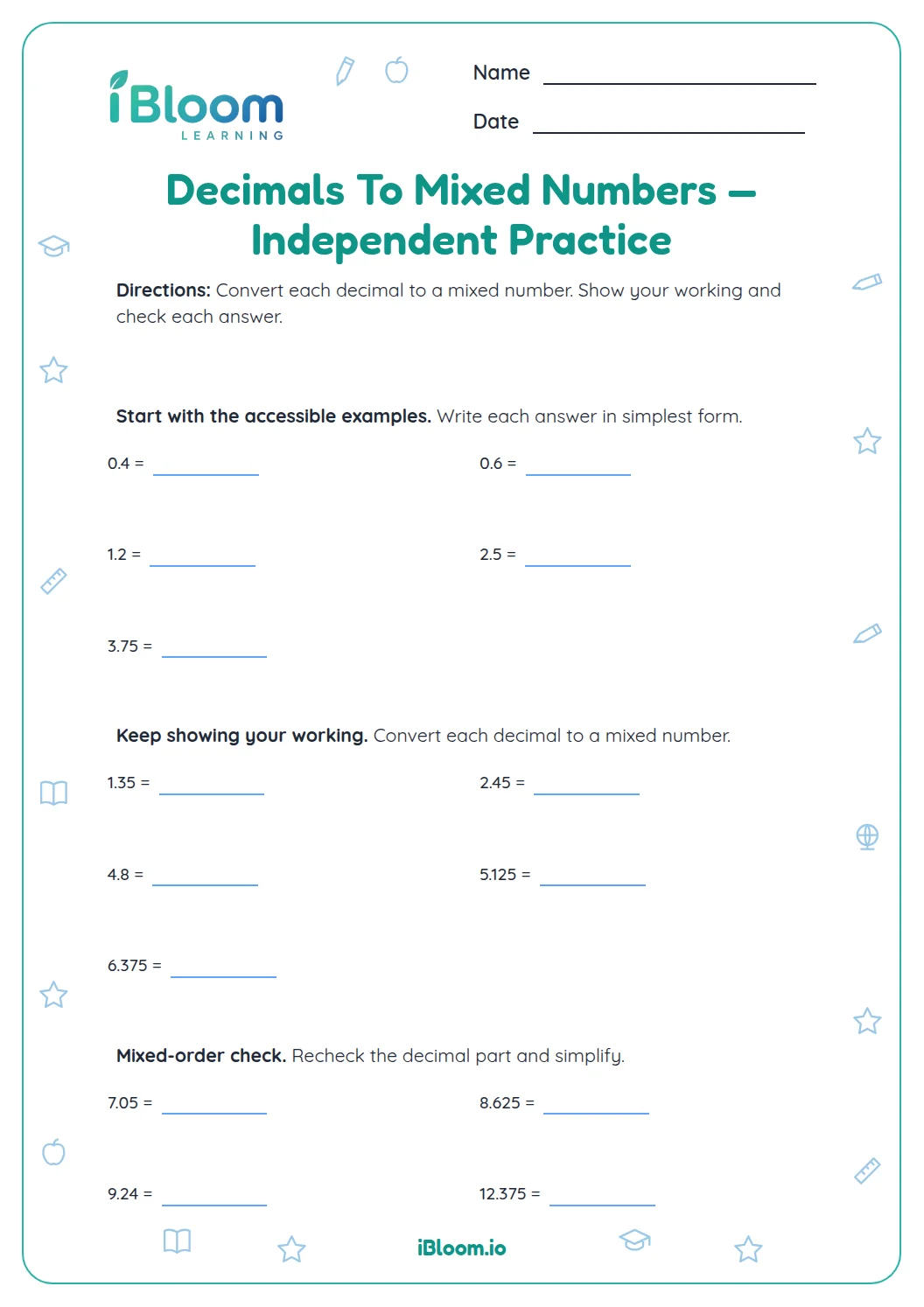
This Grade 5 worksheet connects decimal place value with fractions by asking students to write decimal amounts as mixed numbers. Sixteen questions move from direct conversions to shaded tenths and hundredths models and equivalent choices. Students simplify each fractional part where possible. The sheet connects decimal place value with fraction notation and includes a separate answer key.
How does place value make a decimal a fraction?
The first digit to the right of the decimal point names tenths; the second names hundredths; the third names thousandths. Keep the whole-number part, then write the decimal digits over the matching place-value denominator.
- 12.4
- 22 is the whole-number part
- 34 is 4 tenths, or 4/10
- 4Simplify 4/10 to 2/5
- 52.4 = 2 2/5
When should the fractional part be simplified?
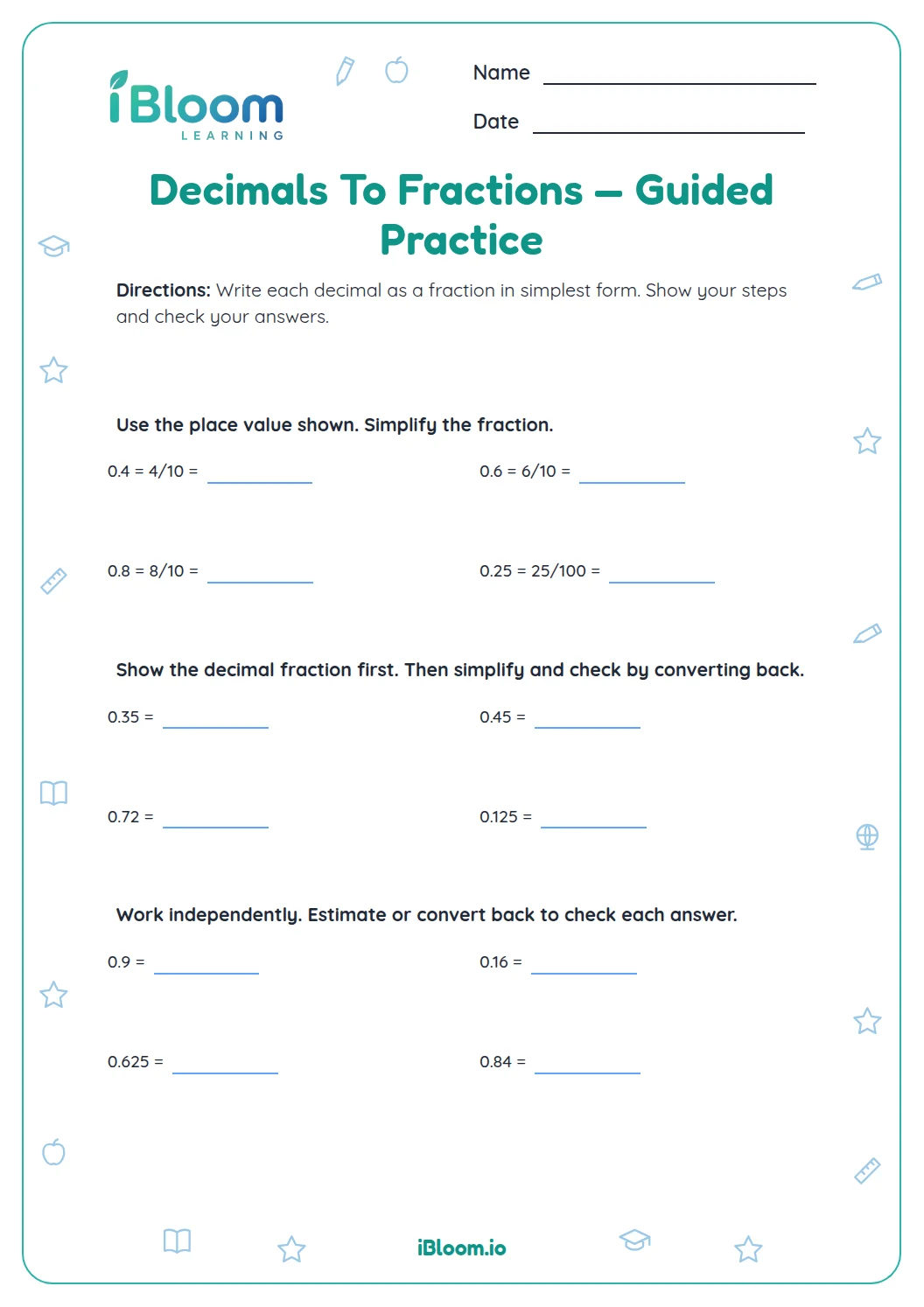
Simplify after writing the decimal digits as a fraction. For example, 0.50 is 50/100, which is 1/2. A decimal with thousandths may simplify too, such as 0.125 = 125/1000 = 1/8.
What do the shaded models show?
The tenths strip and hundredths grid make the decimal part visible. Count the complete wholes first, then name the shaded fraction and simplify it.
Convert one decimal at a time
- 1Read the digits before the decimal point as the whole number.
- 2Count the decimal places.
- 3Write the digits after the point over 10, 100, or 1,000.
- 4Simplify the fraction using a common factor.
- 5Check that the mixed number has the same value as the original decimal.
Conversion mistakes to catch
The mistake
Using 10 as the denominator for 0.25.
The fix
Two decimal places mean hundredths: 0.25 = 25/100.
The mistake
Leaving 6/10 unsimplified.
The fix
Divide numerator and denominator by 2 to get 3/5.
The mistake
Dropping the whole-number part in 3.08.
The fix
Keep 3 as the whole and write 8/100, then simplify to 2/25.
What to practice next
Make more practice
Further reading
Questions parents and teachers ask
How many questions are on the sheet?
The worksheet has 16 questions across four pages. Students convert decimals, use two shaded models, compare equivalent forms, and write several conversions with steps. A separate four-page key lists the expected mixed-number answers, including simplified fractional parts, for every printed question.
Should the fractions be simplified?
Yes. Write the decimal digits as a fraction over 10, 100, or 1,000, then reduce when possible. For instance, 0.4 is 4/10, which simplifies to 2/5, so 2.4 is 2 2/5 in simplest form. The answer key uses reduced fractions.
How do students choose the denominator?
Count the digits after the decimal point. One digit names tenths, two name hundredths, and three name thousandths. Those digits form the numerator before simplifying. The whole-number digits stay to the left of the mixed number’s fractional part.
What if the decimal is less than one?
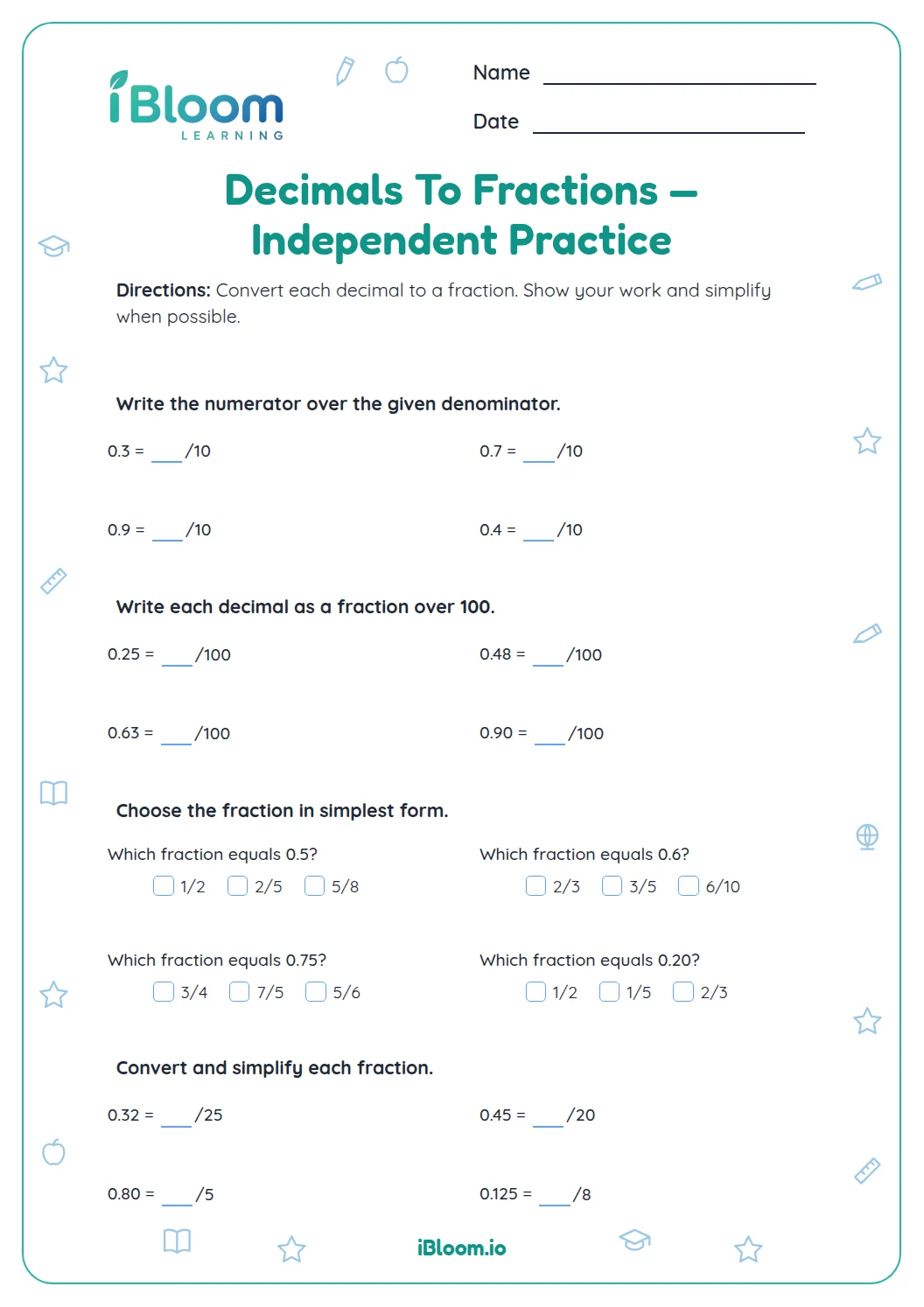
Write a decimal below one as a fraction with no whole-number part. For example, 0.25 is 25/100, which reduces to 1/4. The value remains exact even though the whole-number part is zero. This worksheet also includes a hundredths grid model.
What do the visual models represent?
One model has two full tenths strips and four tenths of another; the other shades eight cells in a hundredths grid. Count the whole shapes and shaded pieces, then simplify the partial fraction to connect the drawing to its decimal.