




About this worksheet
This free printable worksheet helps Grade 5 students write mixed numbers as decimals by reading drawn models. Each mixed number in Parts A and B sits beside its model: tenths strips with whole strips, or hundredths grids with a whole grid. Part C has three number lines, each spanning its point, where students count jumps of 0.1 or 0.05 to name the value. Part D asks for a short written explanation of why 2 8/100 is not 2.8. The sheet has 10 questions on two pages and practices Common Core 4.NF.C.6 and 5.NBT.A.3.a. A two-page answer key is included.
Aligned to 4.NF.C.6 and 5.NBT.A.3.a
How do you write a mixed number as a decimal?
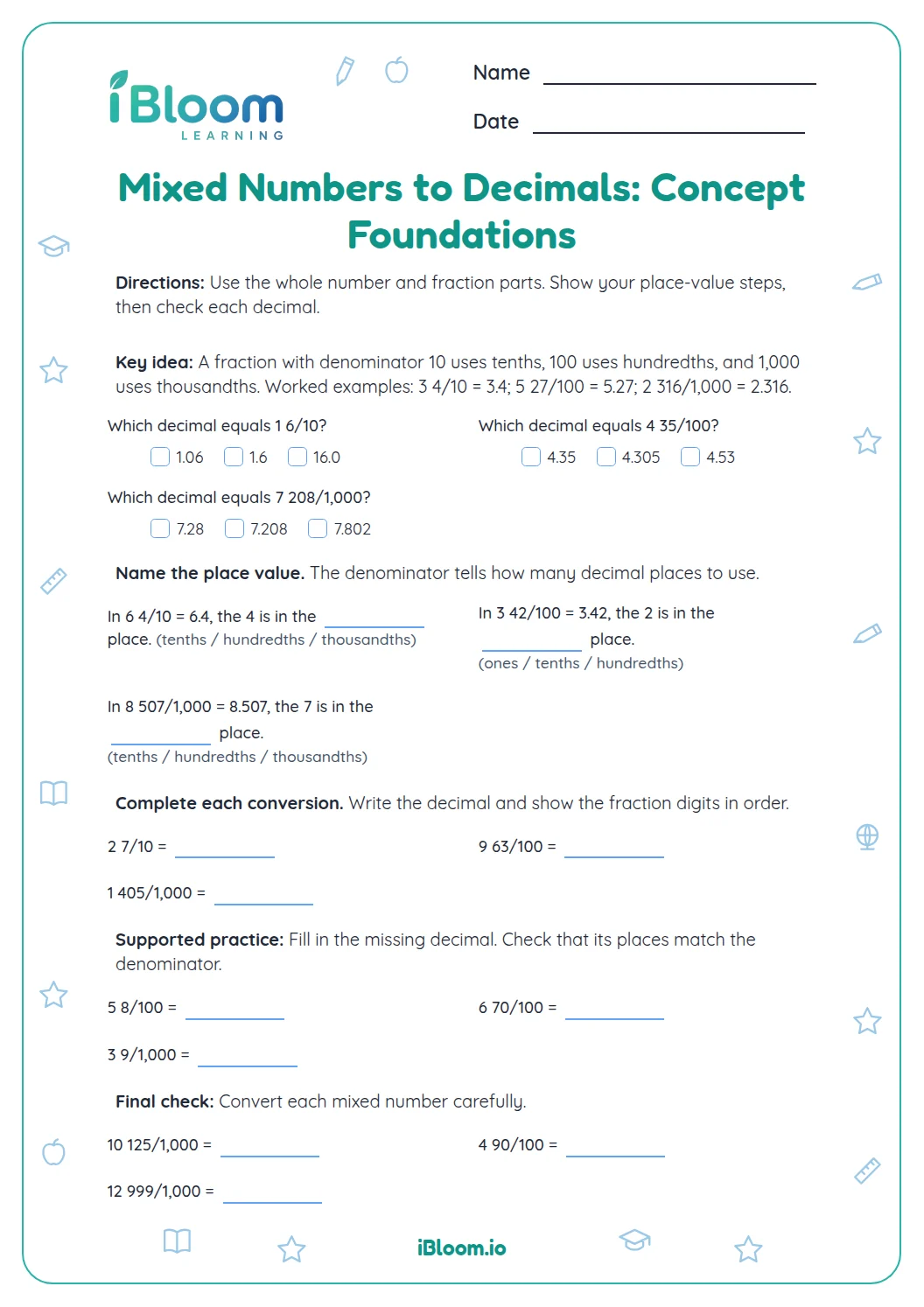
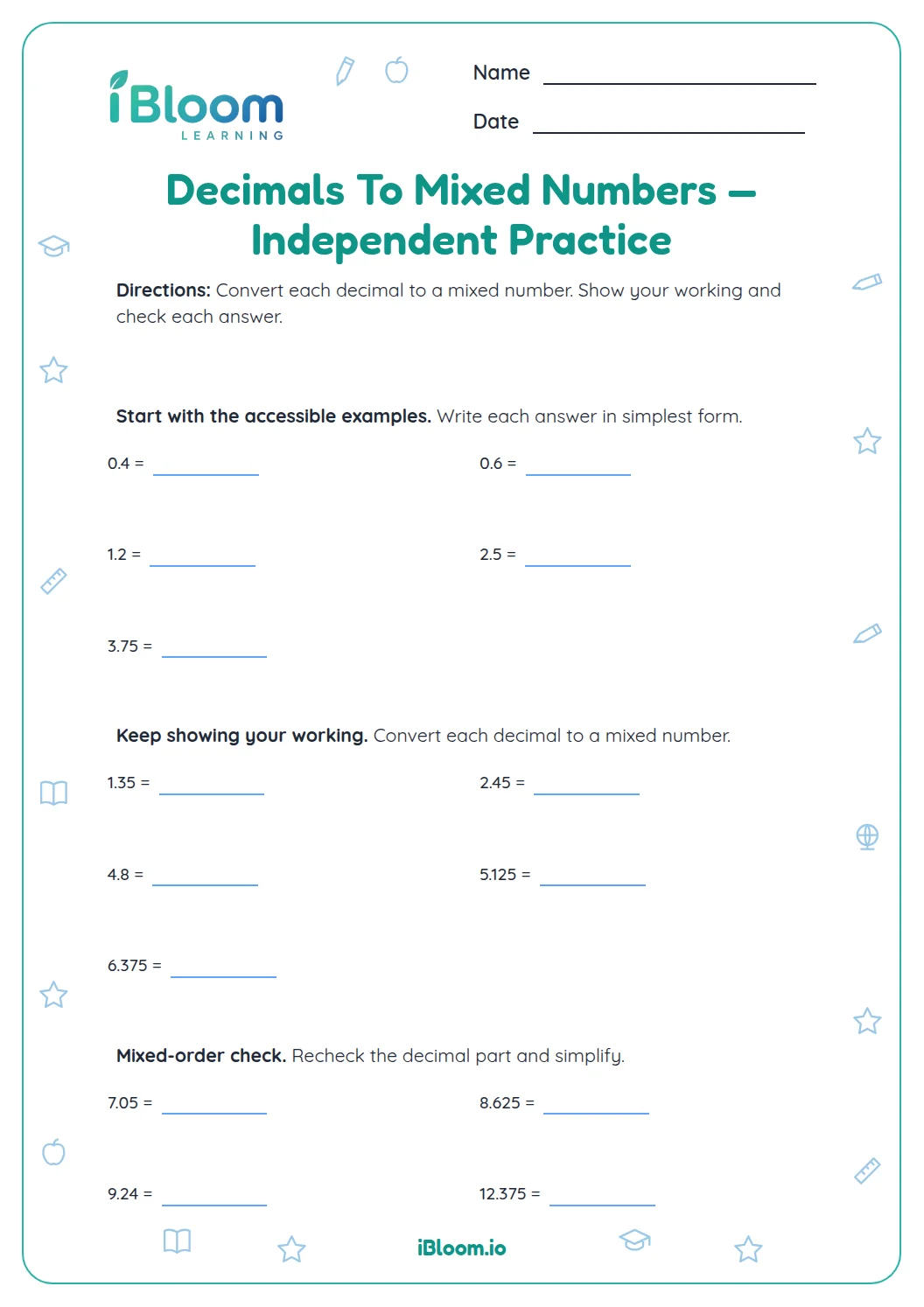
Split the mixed number into its two parts. The whole number goes to the left of the decimal point. The fraction goes to the right: a fraction over 10 fills the tenths place, and a fraction over 100 fills the hundredths place.
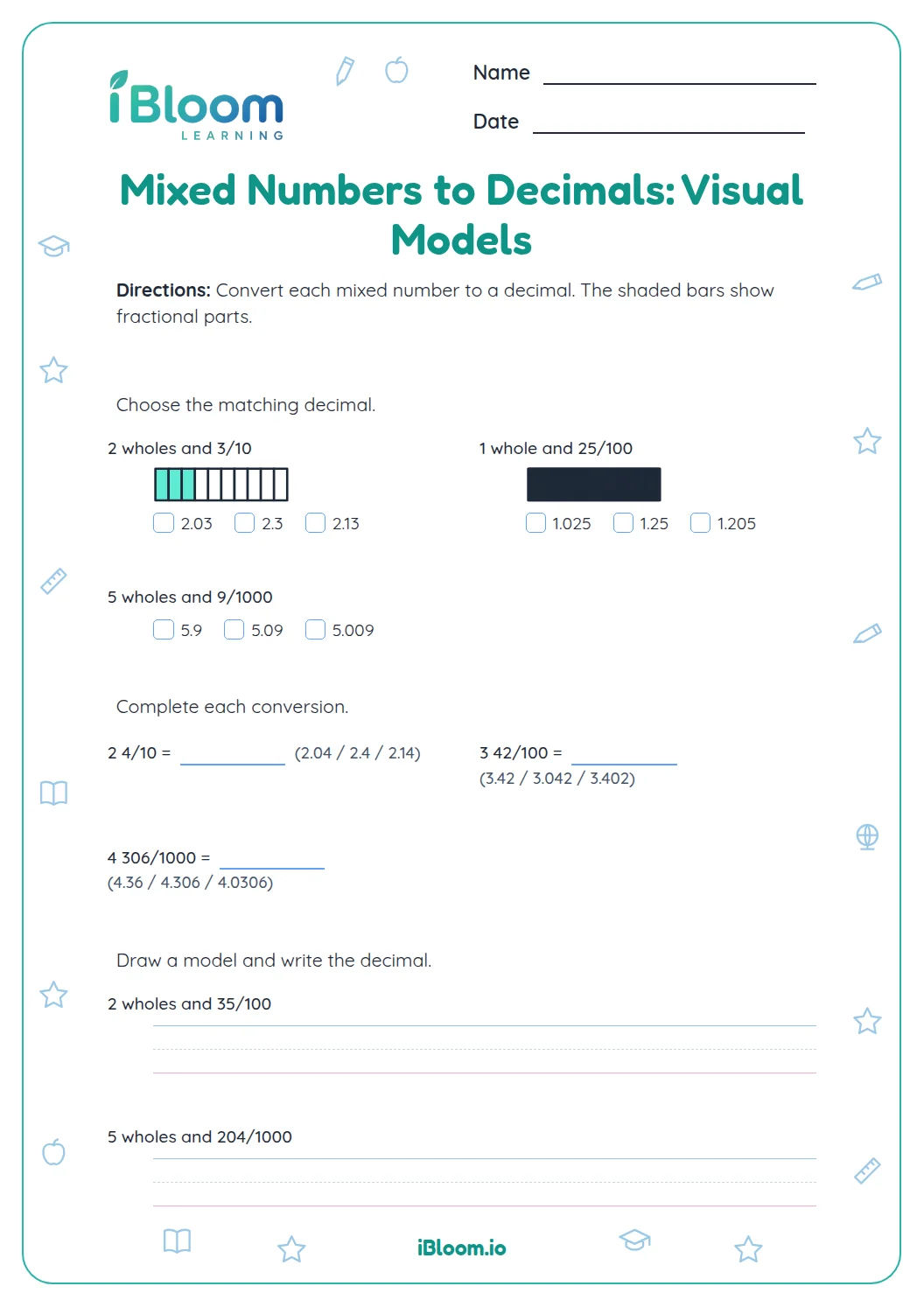
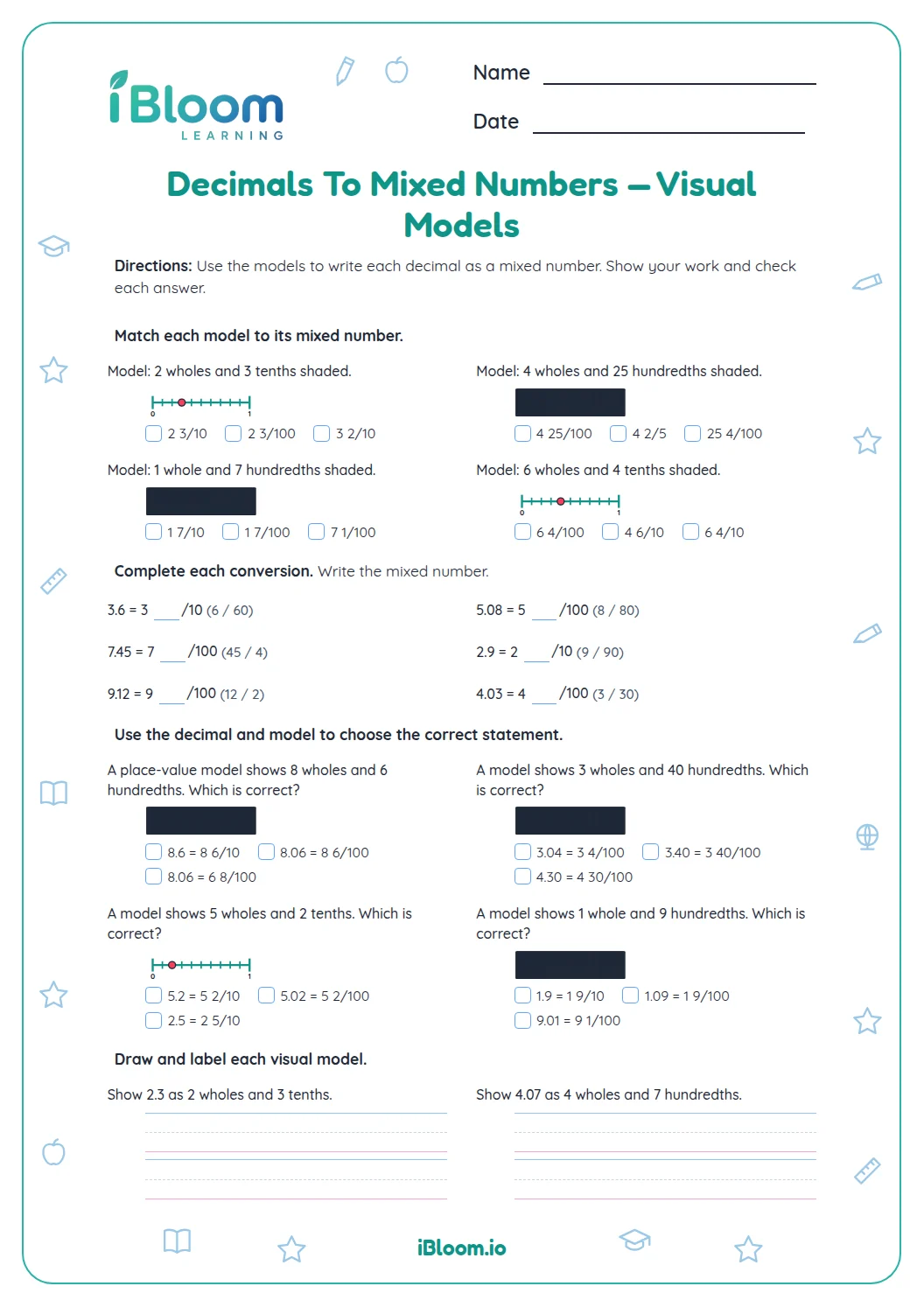
In Parts A and B, each mixed number is printed beside its model, so students can check the amount they see against the numbers they write. Question 5 is 1 7/100: one full grid plus 7 squares, which is 1.07 and not 1.7.
- 11 25/100 = ___
- 2The model has 1 full grid, so the whole number is 1.
- 3The second grid has 25 of 100 squares shaded: 2 full columns and 5 more squares.
- 425 hundredths needs two places after the point: 0.25
- 51 + 0.25 = 1.25
- 6Answer: 1.25
How do the models help?
A tenths strip has 10 boxes, and a fully shaded strip is 1 whole. Each shaded box is 1 tenth, so two full strips and 7 boxes is 2 7/10 = 2.7. A hundredths grid has 100 squares, and each column of 10 squares is 1 tenth, so students can see why 25 hundredths and 2 tenths and 5 hundredths are the same amount.
Part C adds three number lines. Each one spans its value: 2 to 3, 4 to 5 and 3 to 3.5. The first two have ten equal jumps of 0.1 and the third has ten jumps of 0.05, and only the two ends are labeled, so students count the jumps to find each point rather than guess.
What is on this worksheet?
Ten questions on two printed pages, in four parts. The whole numbers run from 1 to 4, and the fractions use tenths and hundredths.
- Part A, tenths strips: 4 conversions, 1 3/10, 2 4/10, 1 5/10 and 2 7/10, each written as a decimal
- Part B, hundredths grids: 2 conversions, 1 7/100 and 1 25/100
- Part C, number lines: 3 multiple-choice questions on points A, B and C
- Part D, explain it: 1 written answer correcting Mia, who wrote 2 8/100 as 2.8
- A separate two-page answer key with every answer and a sample explanation
Why do students mix up 2.8 and 2.08?
Both have a 2 and an 8, but one is 8 tenths and the other is 8 hundredths. In question 10, Mia writes 2 8/100 as 2.8, and students explain her mistake. The same trap shows up on the number line in question 7: point A is six jumps of 0.1 past 2, so it is 2.6, not 2.06.
Ask students to say each number in full: "two and eight tenths" or "two and eight hundredths." The place-value word tells them where the 8 goes.
How to use this worksheet at home or in class
- 1Warm up on a blank tenths strip: shade 3 boxes and ask for the fraction and the decimal.
- 2Do question 1 together. Count the full strip as 1, count the 3 boxes as tenths and say "one and three tenths" before writing 1.3.
- 3Have students do Part A alone, then check one strip against its decimal before moving to the hundredths grids.
- 4In Part B, ask students to point to the full columns first (tenths), then count the loose squares (hundredths) in question 6.
- 5For Part C, tell students to find each number line's jump size from its two labeled ends, then count jumps to the dot before looking at the choices.
- 6Finish with the written question in Part D, then check with the answer key and have students read their explanation aloud.
Common mistakes and quick fixes
The mistake
Putting hundredths in the tenths place, such as writing 1 7/100 as 1.7 or 2 8/100 as 2.8.
The fix
Look at the denominator. 100 means two places after the point, so 7/100 is 0.07 and the answer is 1.07.
The mistake
Assuming every number line counts by tenths, so point C, seven jumps past 3, looks like 3.7.
The fix
Find the jump size first. From 3 to 3.50 is 0.50 split into 10 jumps, so each jump is 0.05 and seven jumps is 0.35: point C is 3.35.
The mistake
Choosing 4 3/100 for point B because it is three jumps past 4.
The fix
Each jump on that line is 0.1, one tenth, so three jumps is three tenths: 4 3/10, or 4.3.
Common Core alignment
This sheet practices the two decimal standards below.
Write fractions with denominators 10 and 100 as decimals, and find them on a number line.
On this sheet: Parts A and B link tenths and hundredths fractions to decimals, and Part C reads points on number lines.
Show the official wordingHide the official wording
Use decimal notation for fractions with denominators 10 or 100. For example, rewrite 0.62 as 62/100; describe a length as 0.62 meters; locate 0.62 on a number line diagram.
Read and write decimals with base-ten numerals, using models of tenths and hundredths.
On this sheet: Students write decimals such as 1.07 and 1.25 from models and explain tenths and hundredths in words.
Show the official wordingHide the official wording
Read and write decimals to thousandths using base-ten numerals, number names, and expanded form, e.g., 347.392 = 3 × 100 + 4 × 10 + 7 × 1 + 3 × (1/10) + 9 × (1/100) + 2 × (1/1000).
What to practice next
Make more practice
Further reading
Questions parents and teachers ask
Why does the sheet use tenths strips and hundredths grids?
They show the amount before students write it. A full strip or grid is 1 whole, each strip box is a tenth, and each grid square is a hundredth. Parts A and B use these models for 1 3/10 through 1 25/100, so students can check each decimal against the picture.
How do the number lines work?
Each line spans its point and has ten equal jumps. Points A and B sit on lines from 2 to 3 and from 4 to 5 with jumps of 0.1. Point C sits on a line from 3 to 3.5 with jumps of 0.05, so it is read at 3.35.
What are the answers?
Part A is 1.3, 2.4, 1.5 and 2.7. Part B is 1.07 and 1.25. Part C is 2.6, 4 3/10 and 3.35. In Part D, 2 8/100 is 2.08, not 2.8. The two-page answer key shows each answer on the same layout as the worksheet, with a sample explanation.
How is the written question marked?
Look for the place-value idea, not exact wording. A good answer says 8/100 is 8 hundredths, or 0.08, so 2 8/100 is 2.08, while 2.8 means 2 and 8 tenths. A student who sketches a grid with 8 squares shaded has the right idea. The key gives one sample answer.
My student keeps writing 2.8 for 2 8/100. What helps?
Have them count the zeros in the denominator: two zeros mean two places after the point. Then point to the grid in question 5, where only 7 squares of the second grid are shaded, and say "one and seven hundredths." The 7 belongs in the hundredths place, so it is 1.07, and 2 8/100 is 2.08.
Is there an answer key, and how long does the sheet take?
Yes. The answer key is a separate two-page file with every answer filled in. Most students need about 15 minutes for the 10 questions. The written explanation in Part D takes the longest, so allow extra time if your student prefers to talk the answer through first.