



About this worksheet
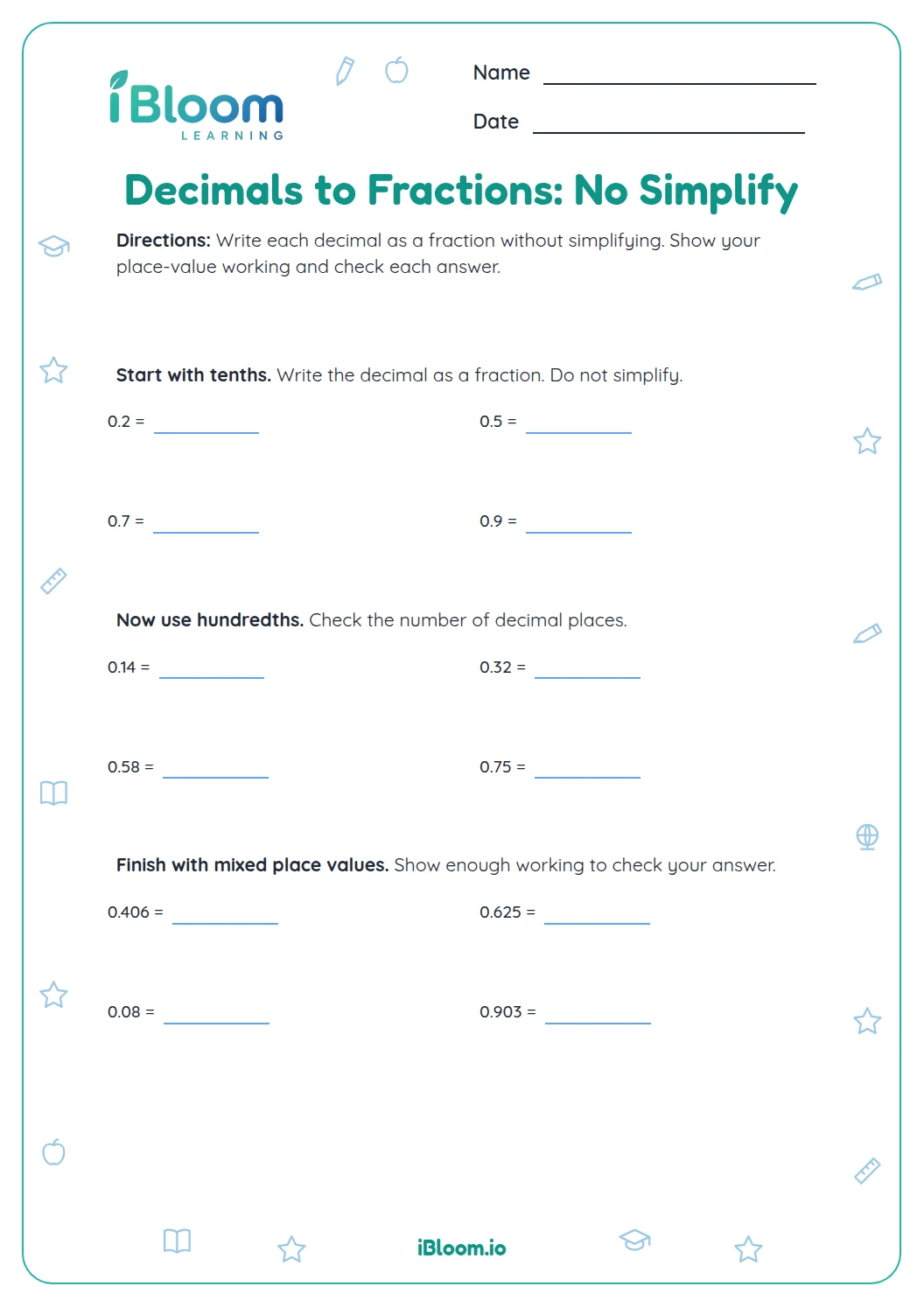
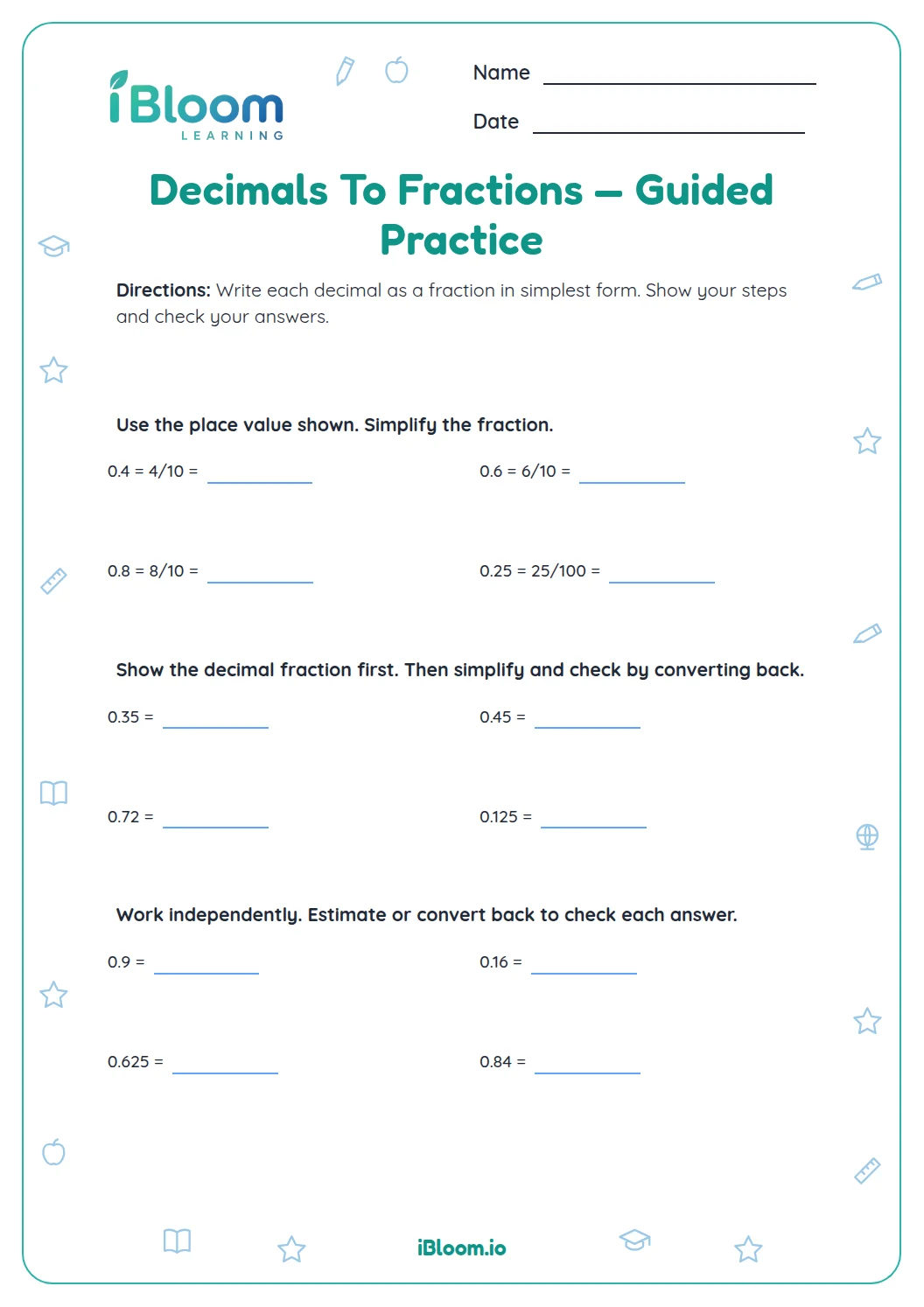
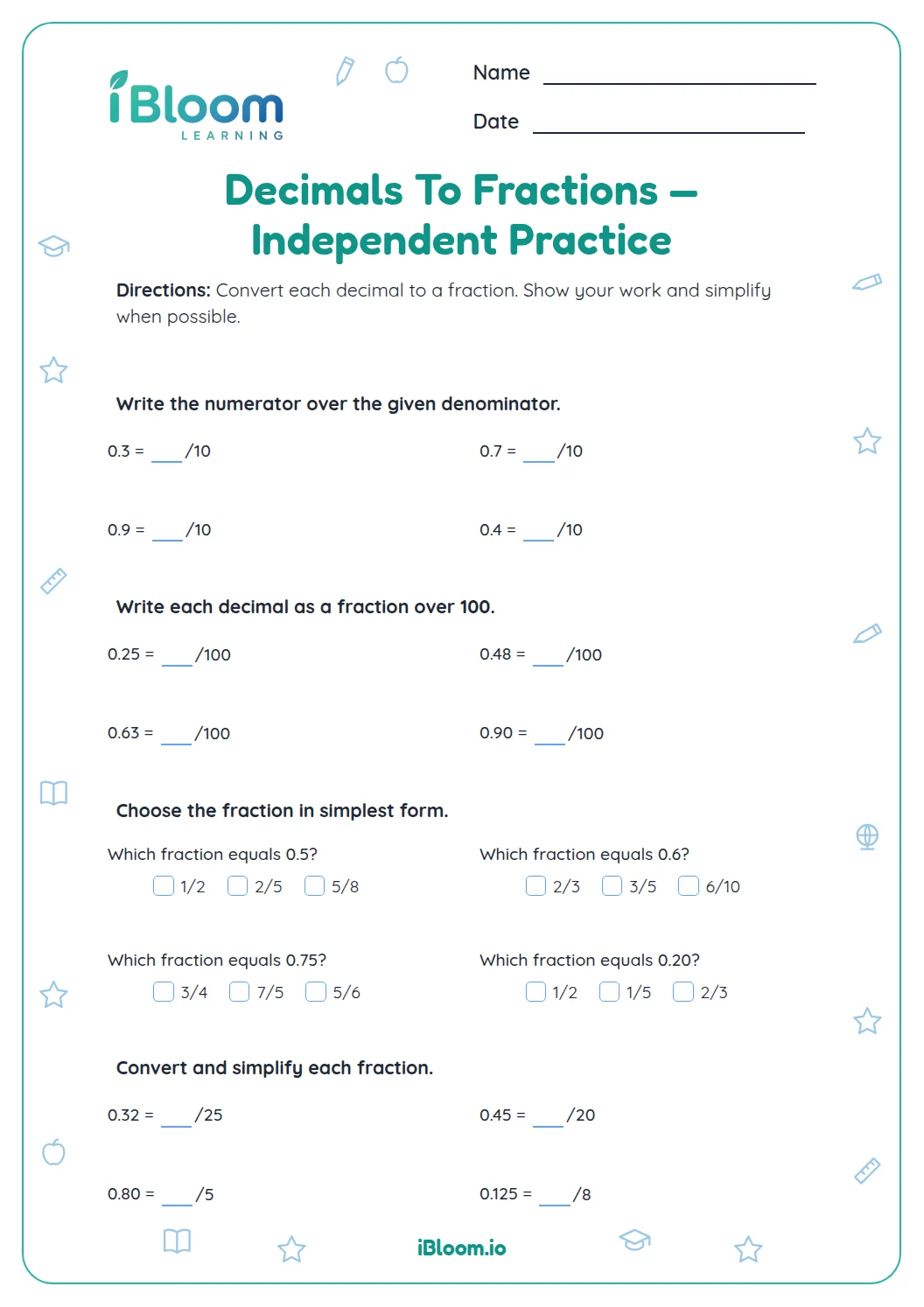
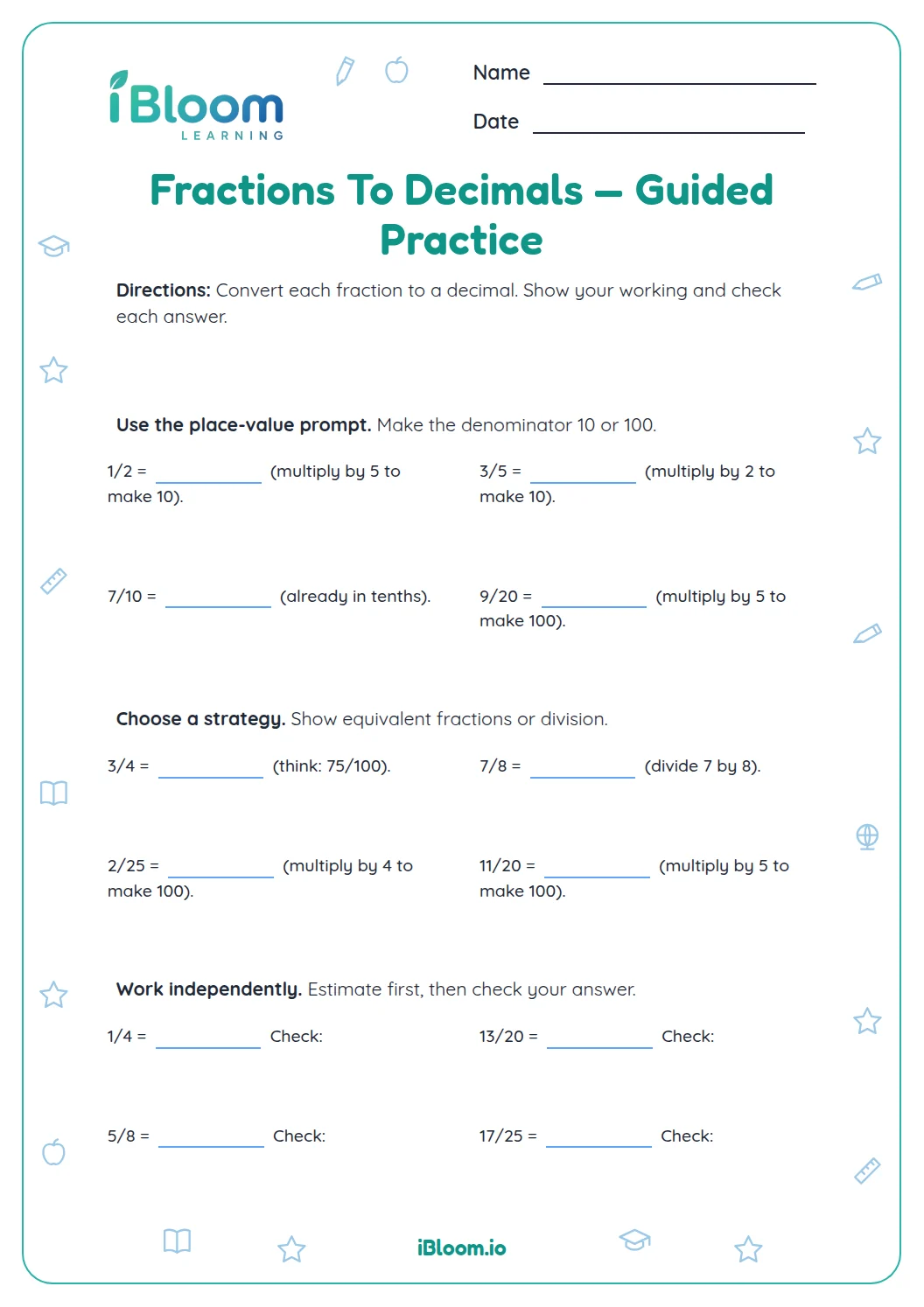
This Grade 5 printable gives 16 short real-world situations for converting decimal amounts to fractions without simplifying. Children work with tenths and hundredths in familiar measurements such as meters, liters, kilometers, and kilograms. Later items include values greater than one, such as 1.35 kilometers, so learners apply place value to both whole-number and fractional parts. The sheet practices CCSS 4.NF.C.6 and includes a separate answer key.
Aligned to 4.NF.C.6
How does place value set the denominator?
A digit in the tenths place names tenths, so 0.7 is 7/10. Two digits after the decimal name hundredths, so 0.36 is 36/100. Keep the denominator tied to the final decimal place.
How do the stories help?
Each question places the decimal in a measurement or amount, such as 0.4 meter of ribbon. The unit stays the same while the number is rewritten, which helps children read the fraction as part of one whole unit.
What changes when the decimal is greater than one?
The decimal’s digits still determine the denominator. For 1.2, write 12/10; for 1.35, write 135/100. The numerator includes the tenths or hundredths from the whole amount as well.
How to use this worksheet
- 1Look at how many digits are to the right of the decimal.
- 2Use 10 for tenths and 100 for hundredths.
- 3Write the digits as the numerator, keeping place value.
- 4Keep the measurement unit in mind while reading the fraction.
- 5Do not reduce the fraction because the directions ask you not to simplify.
- 6Check one answer by writing it back as a decimal.
Common mistakes and quick fixes
The mistake
Using 100 for every decimal.
The fix
Count decimal places: one means tenths; two means hundredths.
The mistake
Dropping a zero in a hundredths numerator.
The fix
For 0.08, keep both digits and write 8/100.
The mistake
Simplifying 25/100 to 1/4.
The fix
Leave the denominator and numerator as written from the decimal place value.
Common Core alignment
The questions connect decimal notation with fractions that name tenths and hundredths.
Write decimals as fractions with denominators 10 or 100.
On this sheet: Every item rewrites a decimal amount as an unsimplified fraction in tenths or hundredths.
Show the official wordingHide the official wording
Use decimal notation for fractions with denominators 10 or 100. For example, rewrite 0.62 as 62/100; describe a length as 0.62 meters; locate 0.62 on a number line diagram.
What to practice next
Make more practice
Questions parents and teachers ask
Why does 0.4 become 4/10?
The 4 is in the tenths place, so 0.4 means four tenths. Write 4 as the numerator and 10 as the denominator. Since the directions say not to simplify, keep the fraction as 4/10. The named unit stays understood from the problem.
Why is 0.25 written as 25/100?
There are two digits after the decimal point, so 0.25 names hundredths. Use 25 as the numerator and 100 as the denominator. The requested unsimplified form is 25/100, even though it can be reduced. Keep both decimal digits when writing the numerator.
How do you convert a decimal greater than one?
Use all the decimal digits as the numerator over the denominator named by the decimal places. For example, 1.35 has two decimal places, so it is 135/100. That fraction includes one whole and 35 hundredths, represented together as hundredths.
Should the unit appear in the fraction answer?
The context names a unit such as meters or liters, while the worksheet asks for the number as a fraction of that unit. Write the fraction alone, then read it as that fraction of the named amount, such as 4/10 of a meter.
What does “do not simplify” mean?
Keep the numerator and denominator that match the decimal digits and place value. For 0.75, write 75/100 rather than reducing it to 3/4. This preserves the direct connection between hundredths and the two decimal places shown in the original amount.
Does the worksheet include an answer key?
Yes. A separate answer key lists the unsimplified fraction for each of the 16 situations. Check that tenths use denominator 10, hundredths use denominator 100, and answers remain unsimplified as requested. The key also preserves the values greater than one.