






About this worksheet
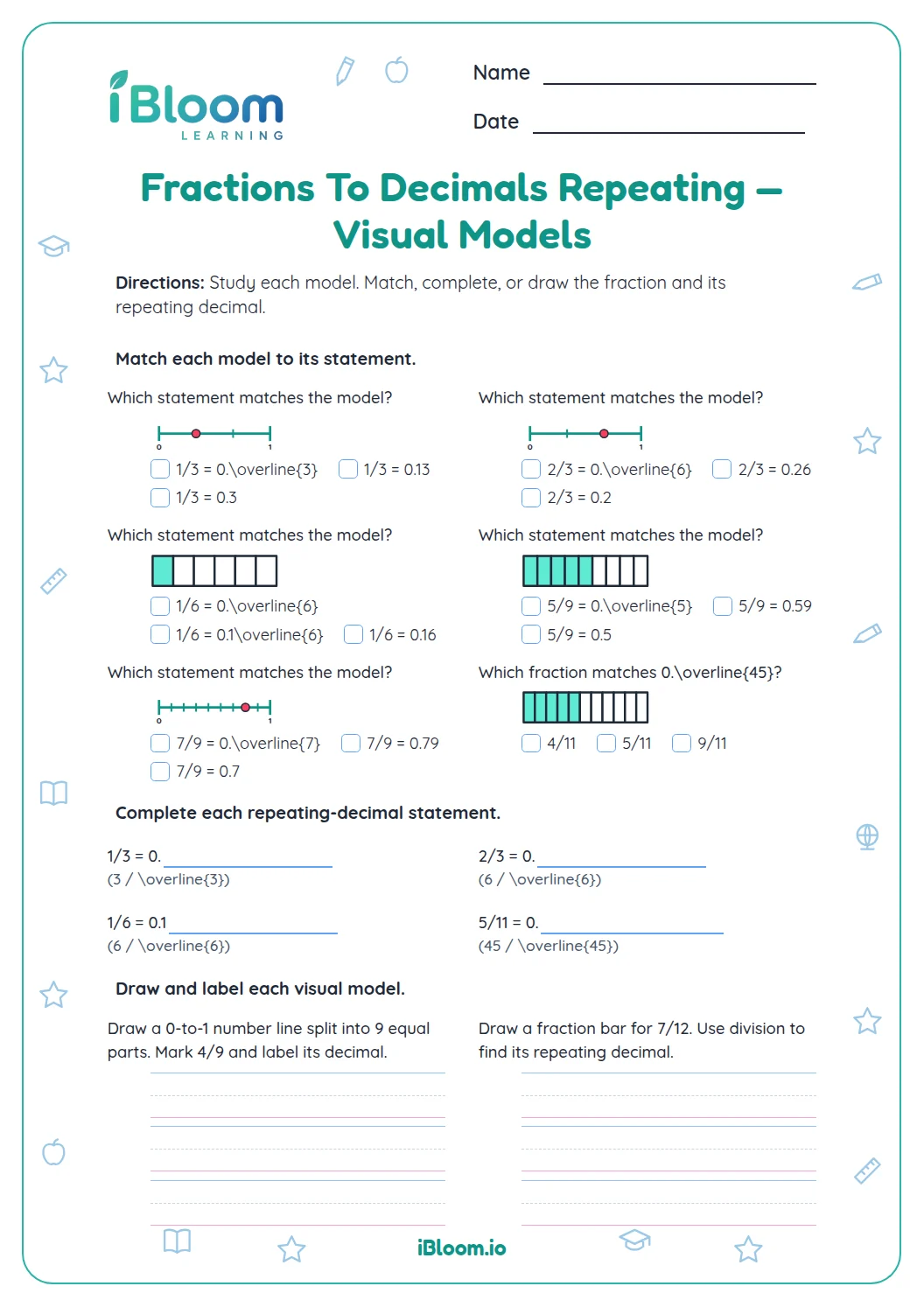
This free Grade 5 math worksheet introduces fractions that produce repeating decimals. Children connect fractions to division, convert fractions such as 1/3 and 5/11, and examine why a repeated remainder creates a repeating block of digits. The 14 questions include multiple-choice concepts and fill-in conversions or patterns. A separate answer key shows the decimal patterns and reasoning. It connects fraction meaning as division to Common Core 5.NF.B.3.
Aligned to 5.NF.B.3
How does division turn a fraction into a decimal?
A fraction a/b means a divided by b. Set up that division and continue past the decimal point. A remainder tells how much is still left to divide.
For question 5, 1 ÷ 3 gives 0 remainder 1. Bringing down a zero gives 10 ÷ 3 = 3 remainder 1 again, so the next digit is also 3 and the cycle continues.
- 11/3 means 1 ÷ 3
- 210 ÷ 3 = 3 remainder 1
- 3The remainder 1 returns, so the 3 repeats
- 41/3 = 0.333…
What does a repeating remainder tell you?
When the same remainder returns, the division repeats the same steps. The quotient digits cycle. For 2 ÷ 11, the digits 18 repeat: 2/11 = 0.1818….
How can you tell an ending decimal from a repeating one?
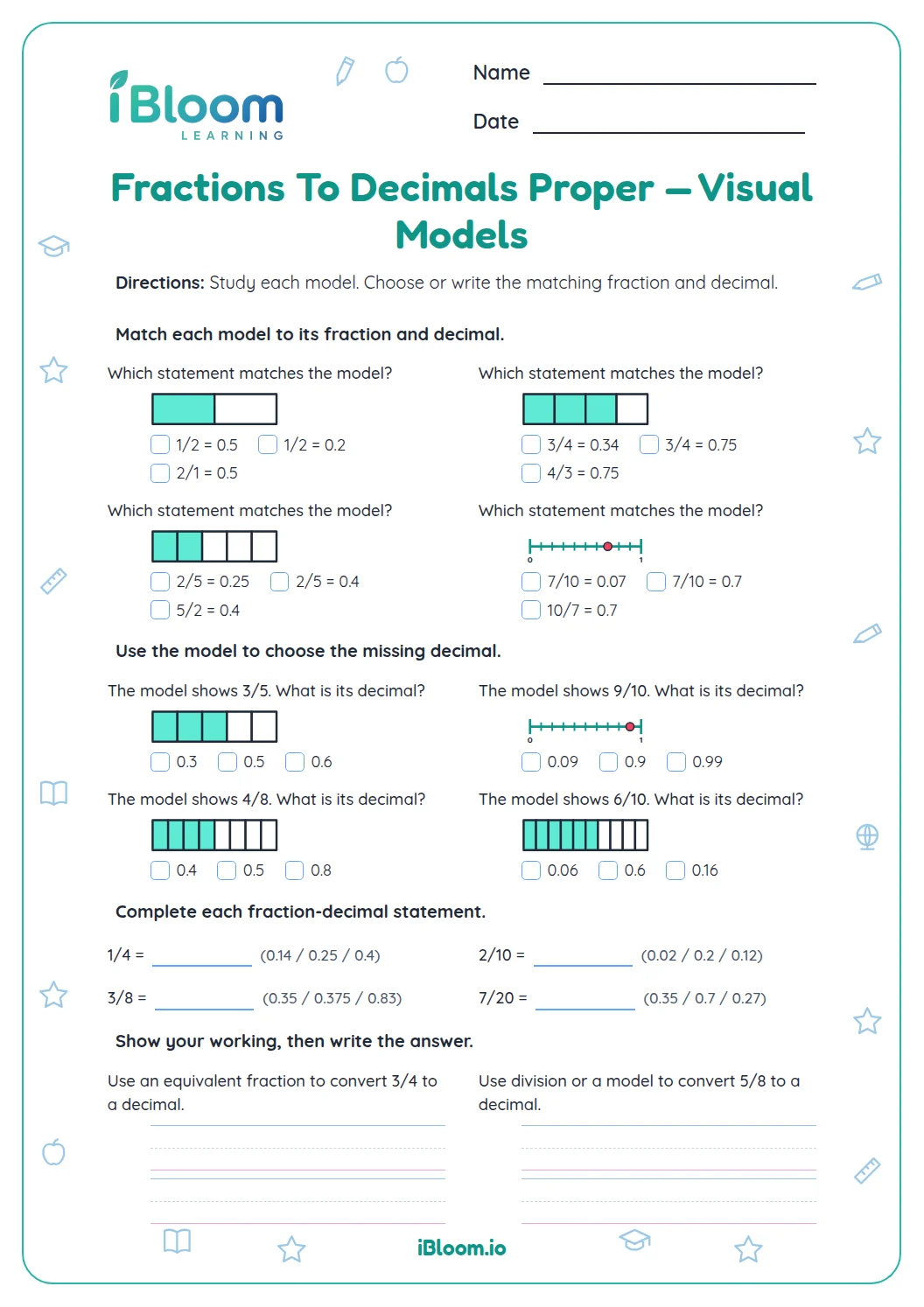
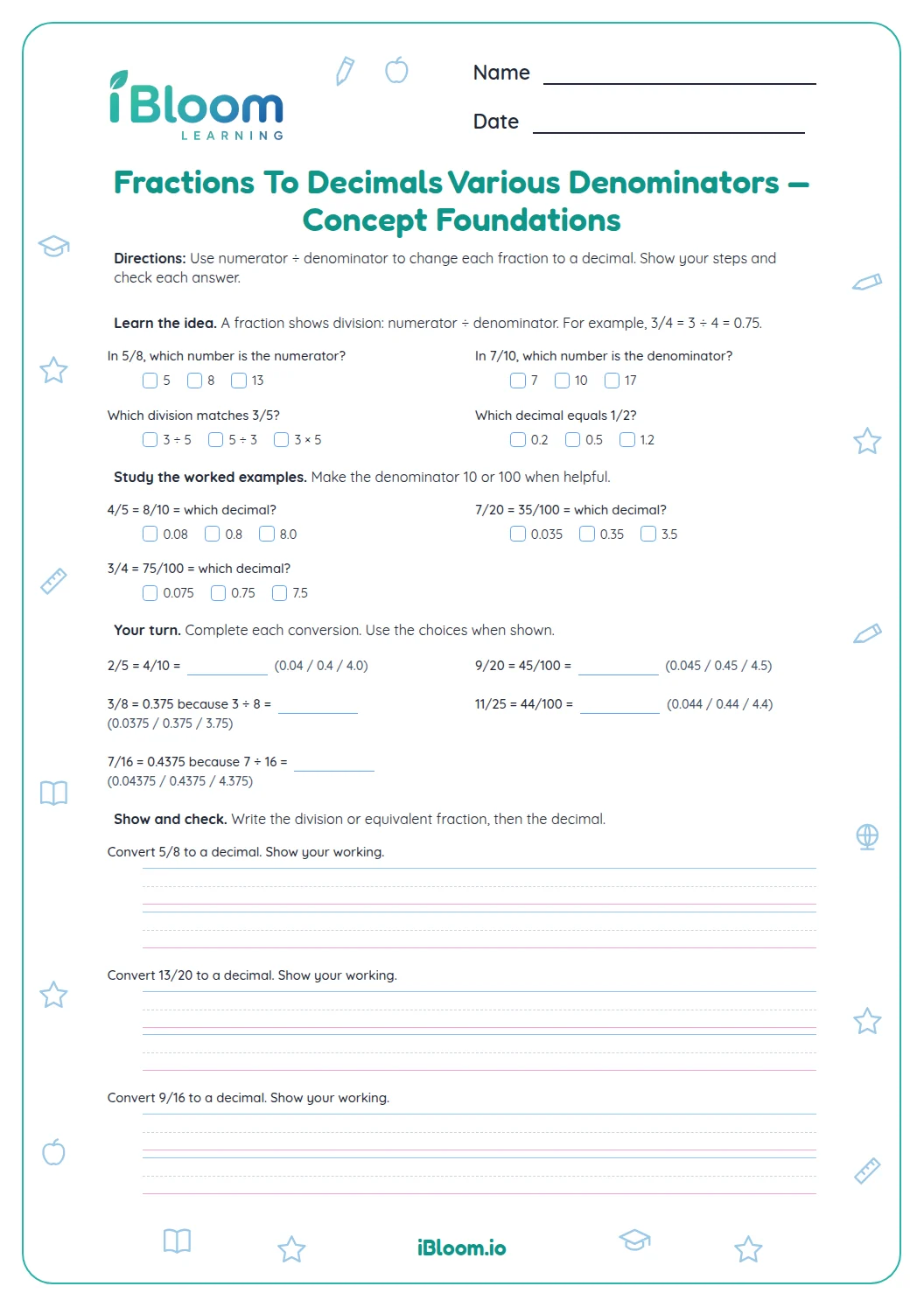
Continue the division and watch the remainders. A zero remainder ends the decimal, as with 3/8 = 0.375. A remainder that returns produces a repeating pattern.
How to use this worksheet
- 1Read each fraction as numerator divided by denominator.
- 2Set up long division and add a decimal point when needed.
- 3Record each remainder as you divide.
- 4If a remainder returns, compare the quotient digits from that point.
- 5Write an ellipsis after the repeating block.
- 6Check the division pattern with the answer key.
Common mistakes and quick fixes
The mistake
Stopping after only one decimal digit.
The fix
Continue dividing until a remainder repeats or reaches zero.
The mistake
Repeating the wrong digit block.
The fix
Mark each remainder and begin the block where the same remainder returns.
The mistake
Confusing a repeating decimal with an ending decimal.
The fix
Check whether division reaches remainder zero.
Common Core alignment
The sheet uses fraction meaning as division to make decimal quotients.
Use numerator ÷ denominator to connect a fraction with its decimal quotient.
On this sheet: Children interpret fractions as division and follow the quotient pattern when the remainder repeats.
Show the official wordingHide the official wording
Interpret a fraction as division of the numerator by the denominator (a/b = a ÷ b). Solve word problems involving division of whole numbers leading to answers in the form of fractions or mixed numbers, e.g., by using visual fraction models or equations to represent the problem. For example, interpret 3/4 as the result of dividing 3 by 4, noting that 3/4 multiplied by 4 equals 3, and that when 3 wholes are shared equally among 4 people each person has a share of size 3/4. If 9 people want to share a 50-pound sack of rice equally by weight, how many pounds of rice should each person get? Between what two whole numbers does your answer lie?
What to practice next
Make more practice
Further reading
Questions parents and teachers ask
Why do some fractions make repeating decimals?
When the numerator is divided by the denominator, a remainder can recur. The same next digit then appears again, as in 1 ÷ 3 = 0.333… and 2 ÷ 11 = 0.1818…. For example, 1 divided by 3 returns remainder 1, so the next division step repeats the same digit.
How should a child write a repeating decimal?
The worksheet uses an ellipsis after the repeating digits, such as 0.666…. A bar over the repeating block is another notation; the answer key shows the repeating pattern with ellipses. The key accepts ellipses and repeating bars when they show the same repeating block and decimal value.
How many questions are on the worksheet?
There are 14 items: four multiple-choice concept questions and ten fill-in conversions or pattern questions. A separate answer key shows the decimal forms and concise reasoning for each item. The fill-ins include repeating blocks, an ending decimal, and the fraction-to-division connection.
Does every fraction make a repeating decimal?
No. Some divisions end, such as 3 ÷ 8 = 0.375. Others repeat, such as 1 ÷ 3 = 0.333…. The worksheet asks children to compare both patterns. A zero remainder is the signal that no more nonzero digits are needed in the decimal.
What should children notice in long division?
They should track the remainder after each digit. When a remainder appears again, the quotient’s digits begin a repeating cycle. The digit pattern may be one digit or a longer block. Keeping a small remainder list can make a longer cycle, such as sevenths, easier to track accurately.
Why does the worksheet connect fractions and division?
A fraction names a division: 2/3 means 2 divided by 3. Thinking of the fraction as a quotient gives a clear way to find its decimal and explain why the digits repeat. Children can write the division sentence first, then use the quotient to justify the repeating decimal.