

About this worksheet
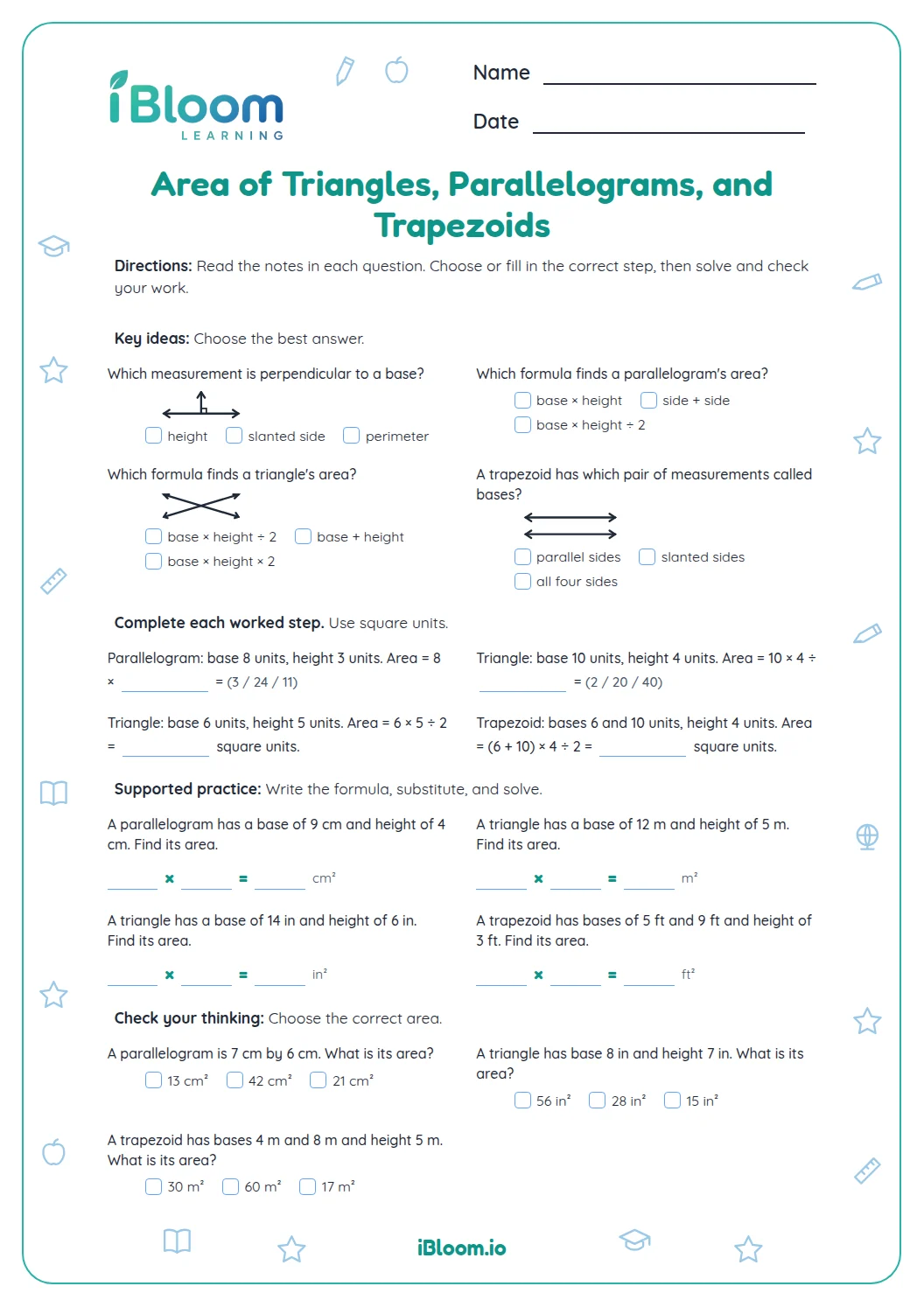
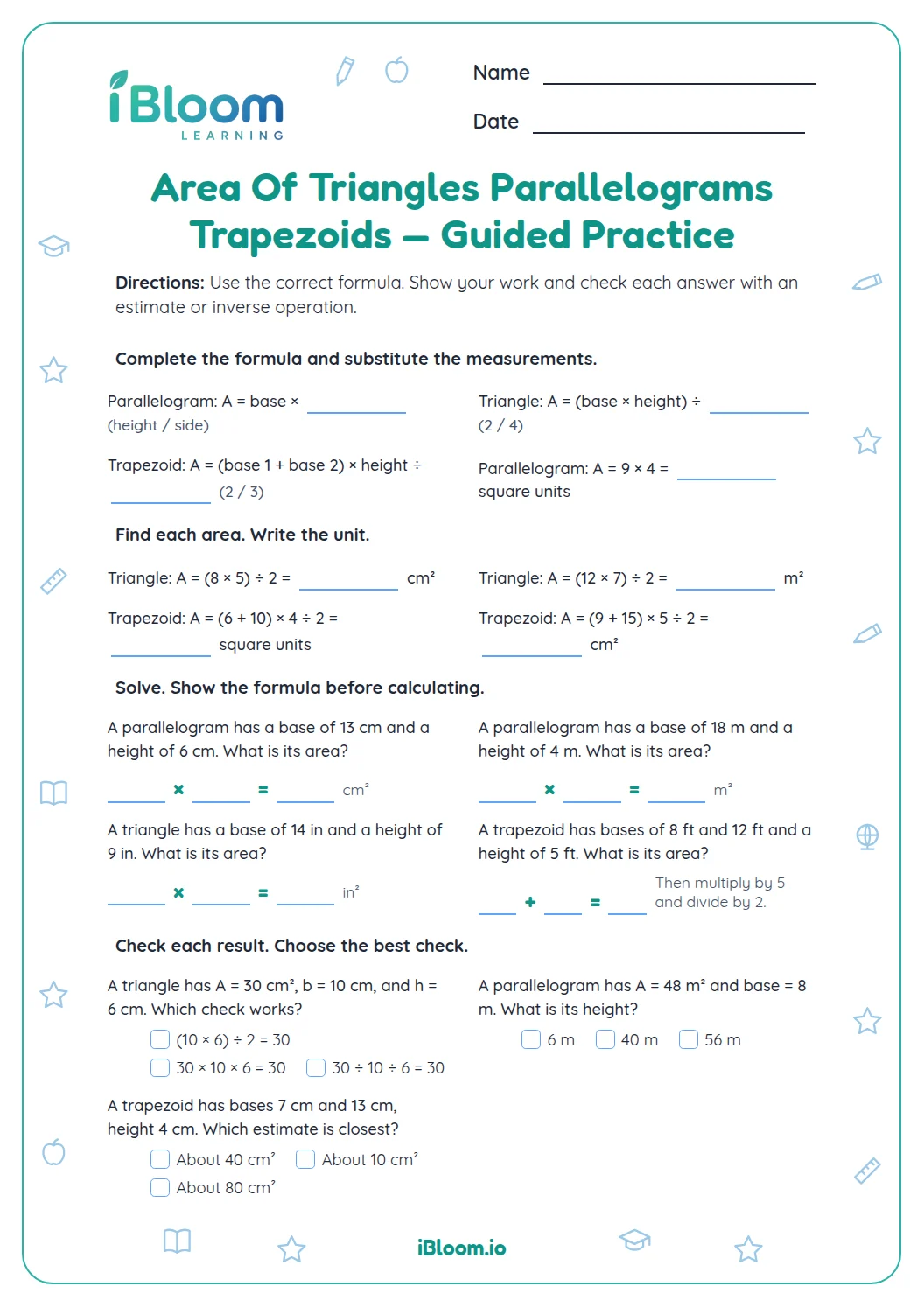
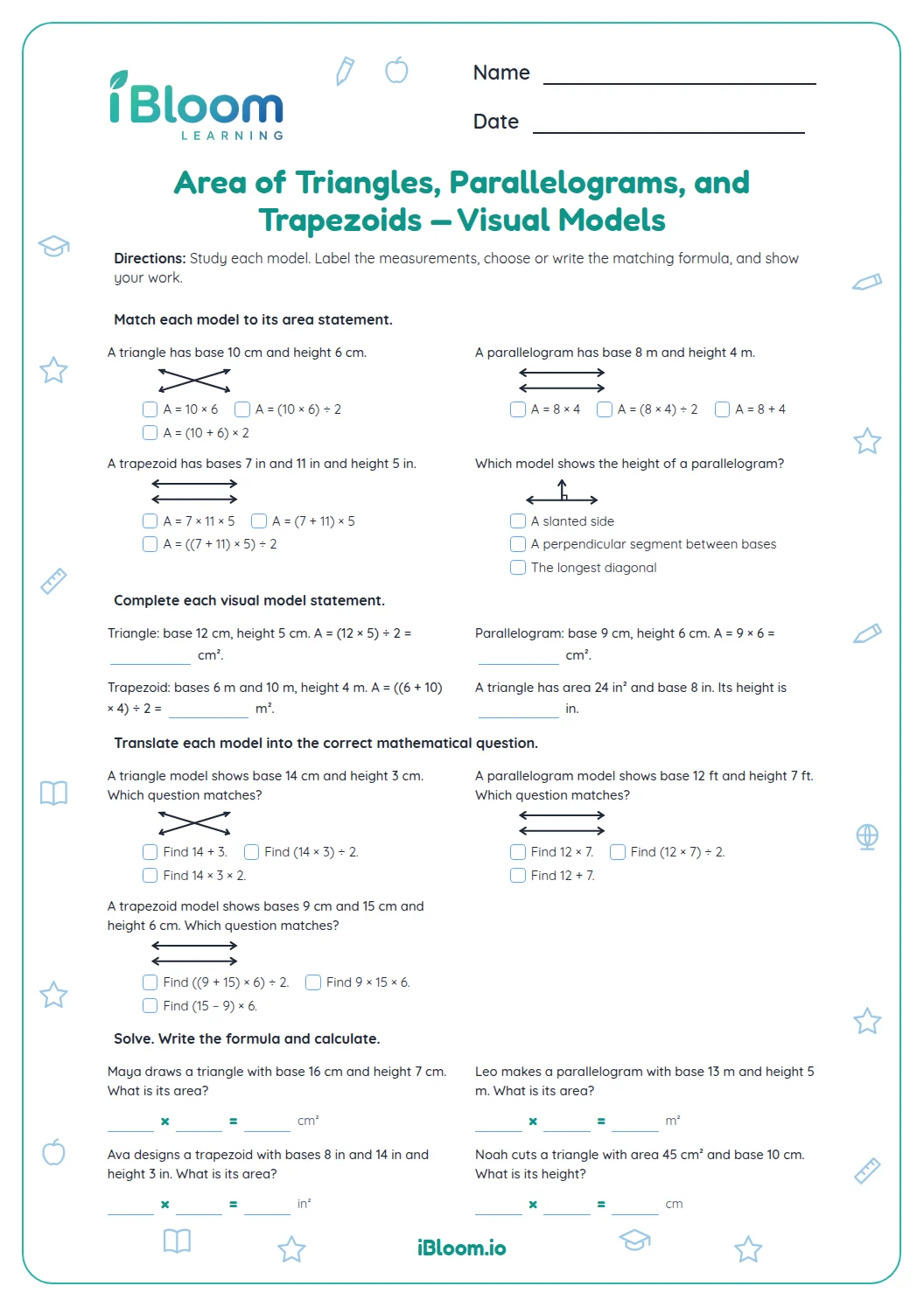
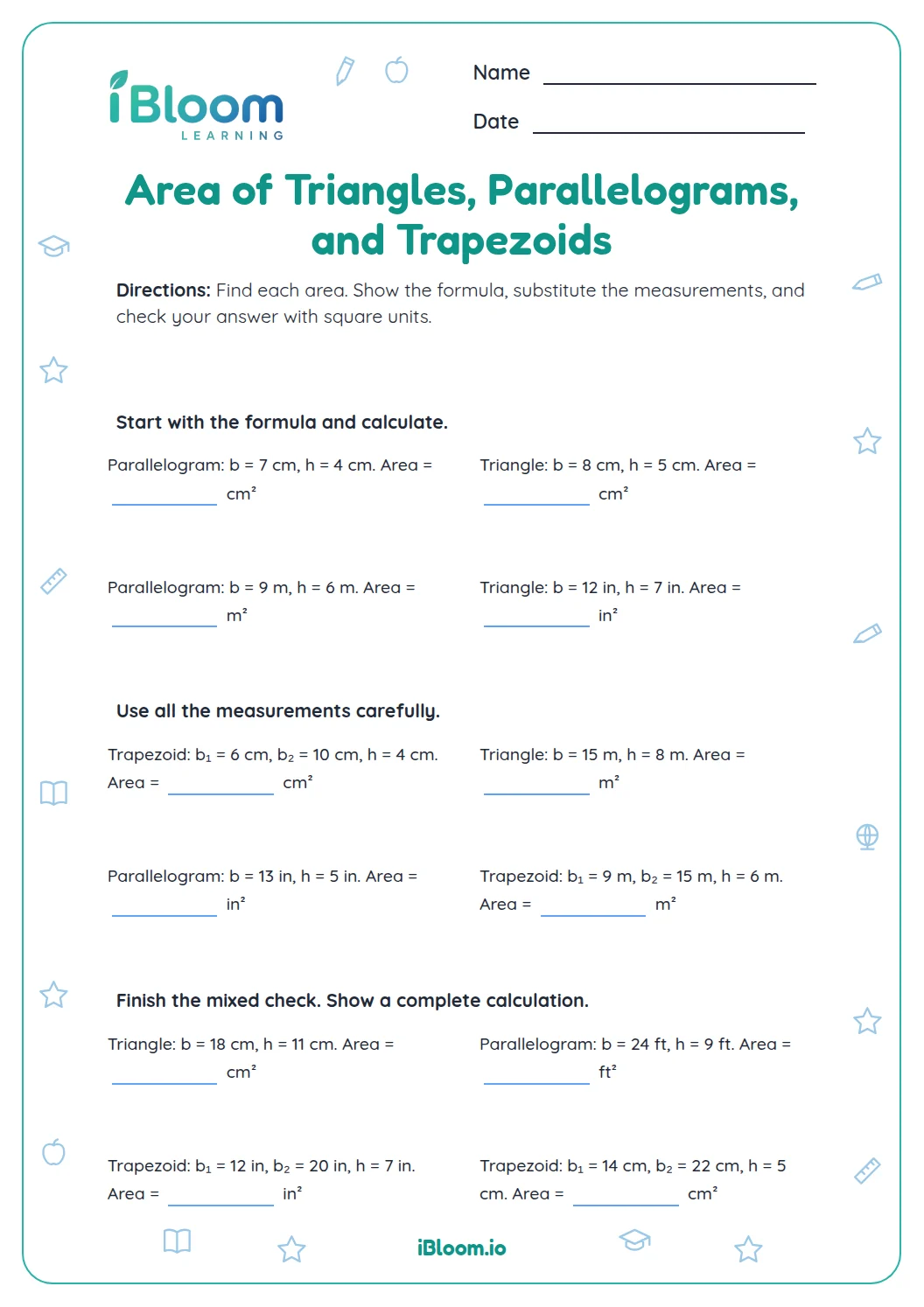
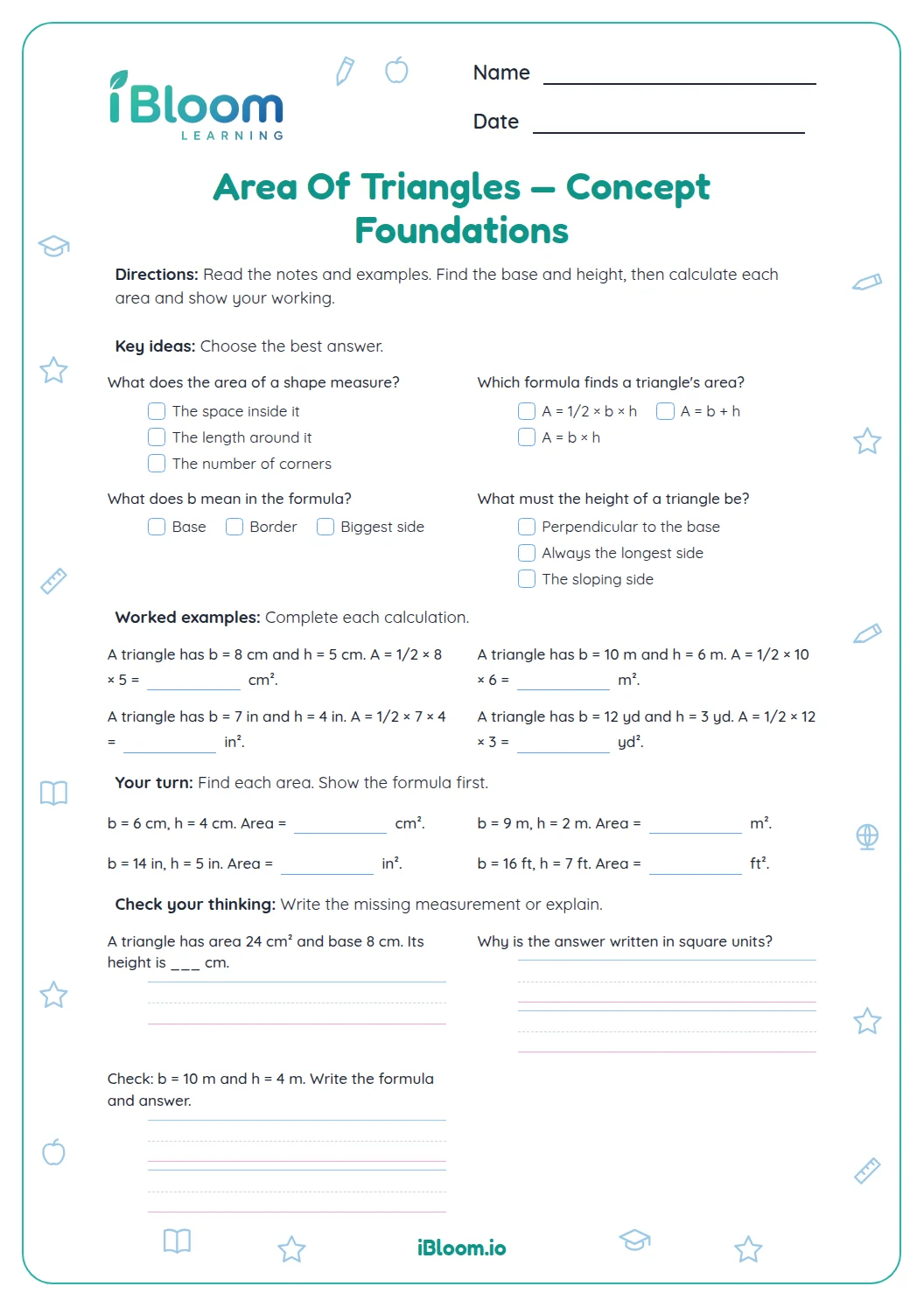
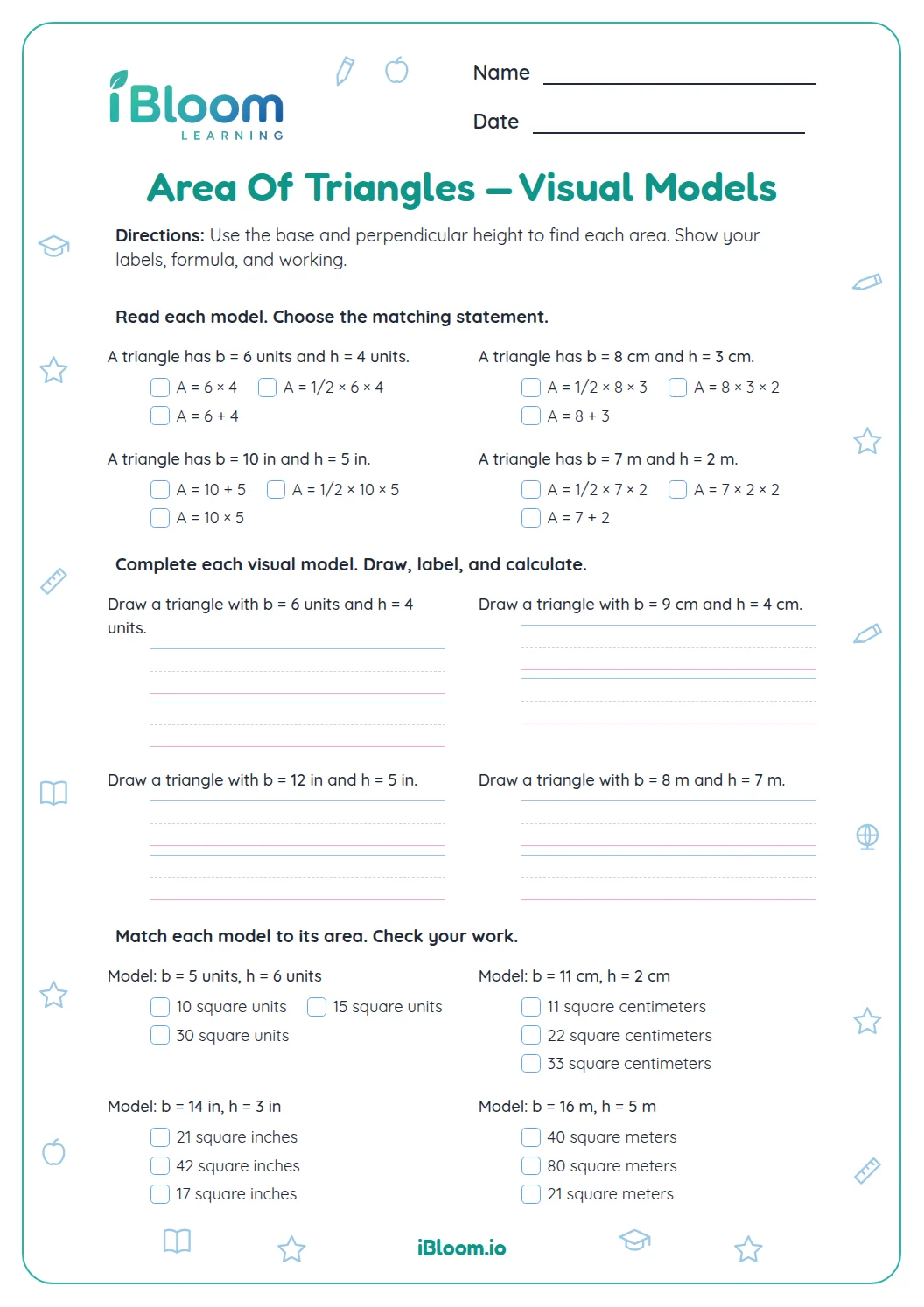
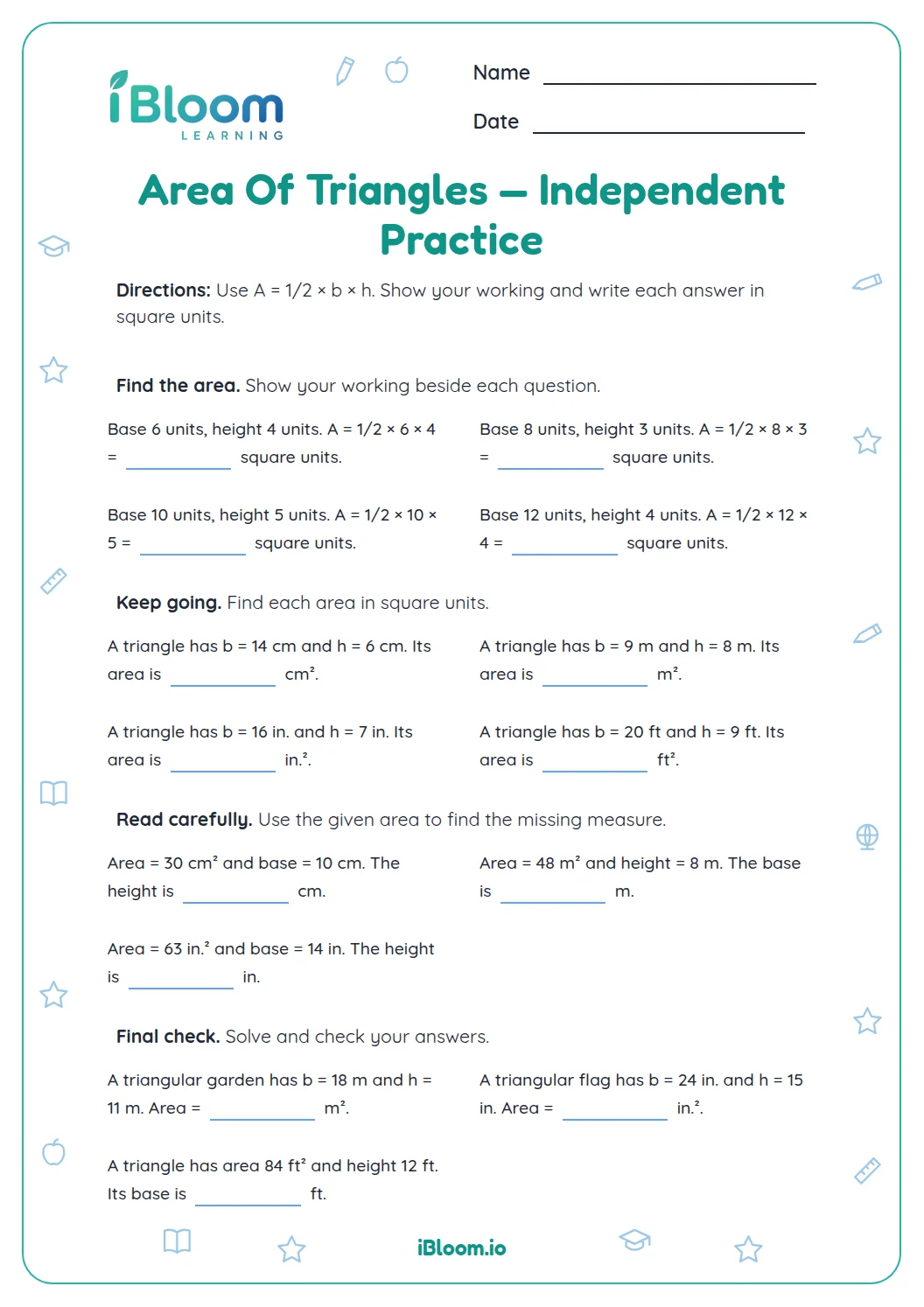
This Grade 5 printable gives students 14 area questions for triangles, parallelograms and trapezoids. They choose formulas, calculate areas from base and perpendicular height measures, and find missing dimensions. The worksheet includes a separate answer key with sample reasoning.
How do you find a triangle’s area?
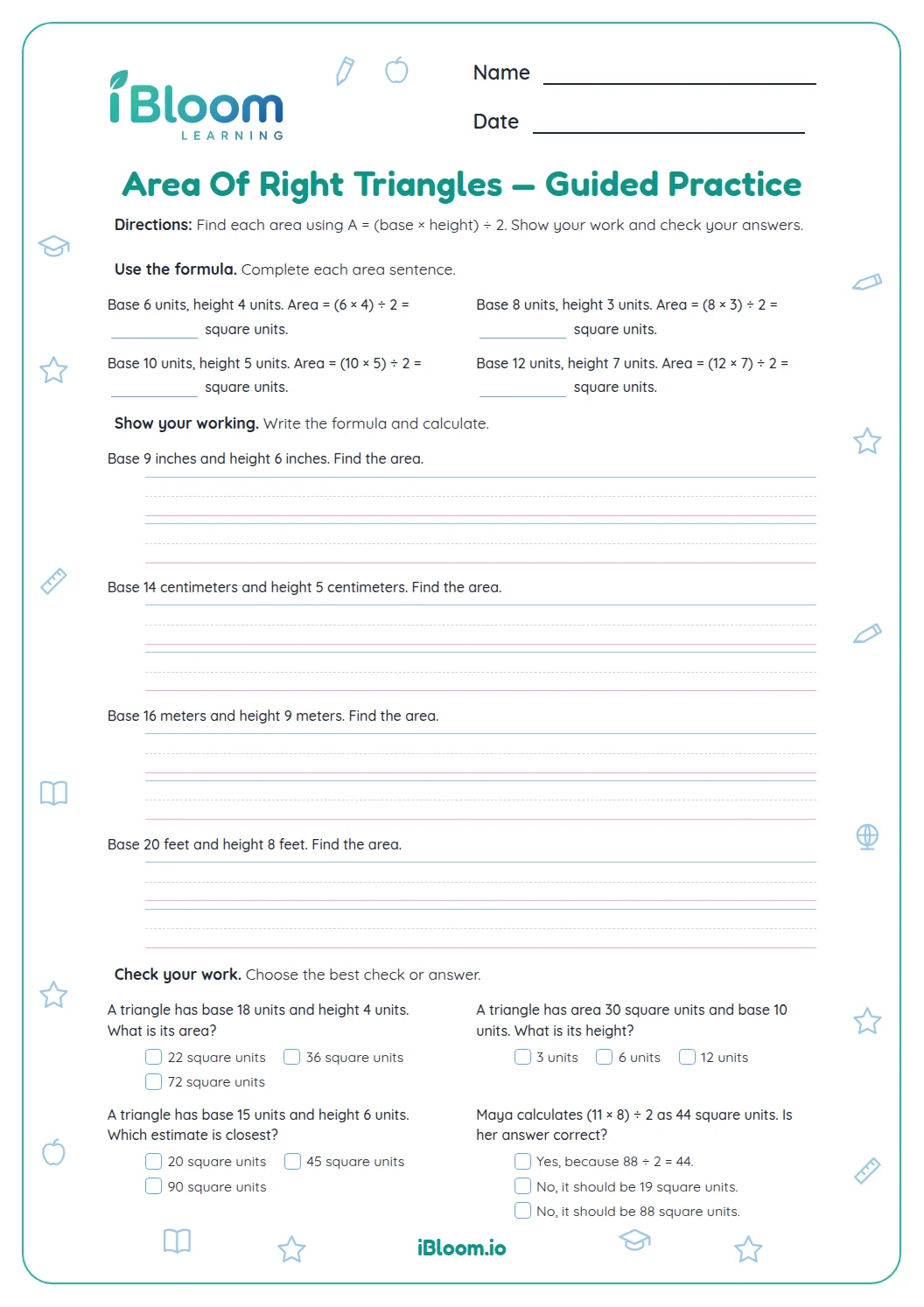
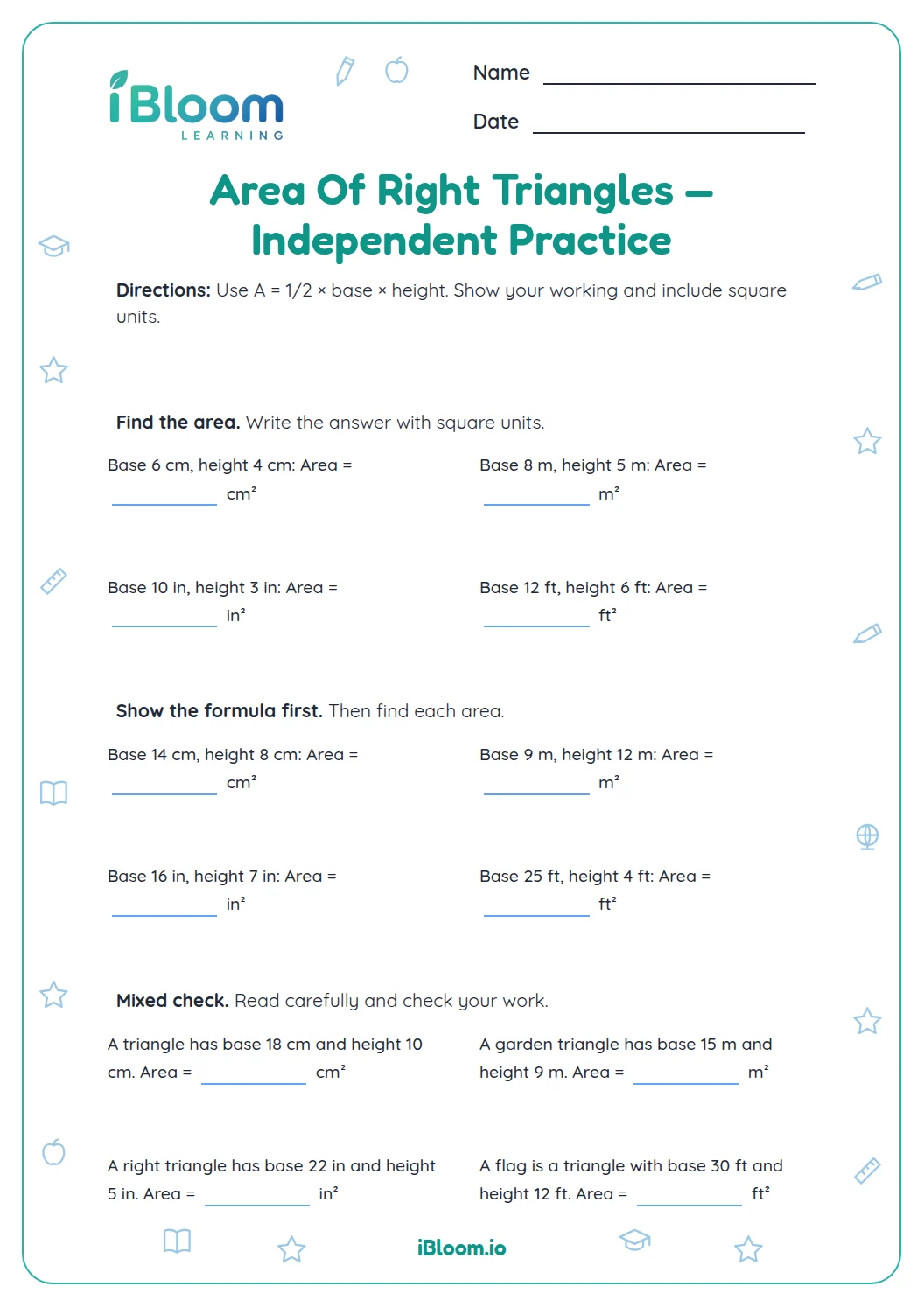
Multiply the base by the perpendicular height, then divide by two. Keep the unit and square it in the area answer.
- 18 × 5 ÷ 2 = 20
- 2Area = 20 cm²
How does parallelogram area work?
Multiply the base by its perpendicular height. A slanted side is not a substitute for height unless the problem says it is perpendicular.
- 111 × 4 = 44 cm²
How do you use both parallel sides?
Add the lengths of the parallel sides, divide by two to find their average, then multiply by height.
- 1(6 + 10) ÷ 2 × 4 = 32 cm²
How can area help find a missing dimension?
Undo the area formula to find the missing measure. For a parallelogram, divide area by base to find height. For a trapezoid, reverse the average-times-height relationship.
How to use this worksheet
- 1Mark the base, height and units given in the question.
- 2Choose the formula for the named shape.
- 3Substitute the measurements and calculate in order.
- 4Write square units with every area answer.
- 5For a missing dimension, reverse the formula and check by substitution.
Common mistakes and quick fixes
The mistake
Using a slanted side as a triangle’s height.
The fix
Use the perpendicular height given in the problem.
The mistake
Forgetting to halve a triangle’s base-times-height product.
The fix
Write the formula first and divide by two before labeling the area.
The mistake
Adding trapezoid sides but forgetting to average them.
The fix
Divide the sum of the parallel sides by two before multiplying by height.
What to practice next
Make more practice
Questions parents and teachers ask
What formulas are used?
For a triangle, multiply base by perpendicular height and divide by two. For a parallelogram, multiply base by perpendicular height. For a trapezoid, add the parallel sides, divide by two, then multiply by height. The calculation section gives dimensions and asks students to find each area.
Does a slanted side count as the height?
No. Height is the perpendicular distance between a base and the opposite side. It may be drawn inside or outside a shape, while a slanted side usually follows the edge. The questions name the height directly so students can focus on the area formulas.
How many problems are included?
There are 14 questions in four parts: choose a formula, calculate triangle and parallelogram areas, calculate trapezoid areas, and explain two missing measures. The key is separate and includes the expected results and sample reasoning for the written responses.
What units should students write?
Area uses square units, such as cm² or m². A missing side length or height uses regular units, such as centimeters or meters. Check the given dimensions before writing the unit; the worksheet includes both area calculations and missing-height answers.
Why does the triangle formula divide by two?
Two matching triangles can fit together to form a parallelogram with the same base and height. One triangle has half that parallelogram’s area, so its area is base times height divided by two. Question 4 checks whether students remember this step.
How should students check a missing-height answer?
Put the proposed height back into the original formula and see whether it gives the stated area. For question 14, 9 m × 8 m = 72 m², so a height of 8 m matches the parallelogram’s area. Keep the height in meters and the area in square meters.