

About this worksheet
This two-page worksheet builds integer multiplication from familiar positive equal groups to products with positive and negative factors. Students first read arrays and multiplication sentences, then apply sign patterns, find missing factors, compare two products, and interpret repeated decreases in two short contexts. The separate answer key gives each product and signed change.
How do arrays show multiplication?
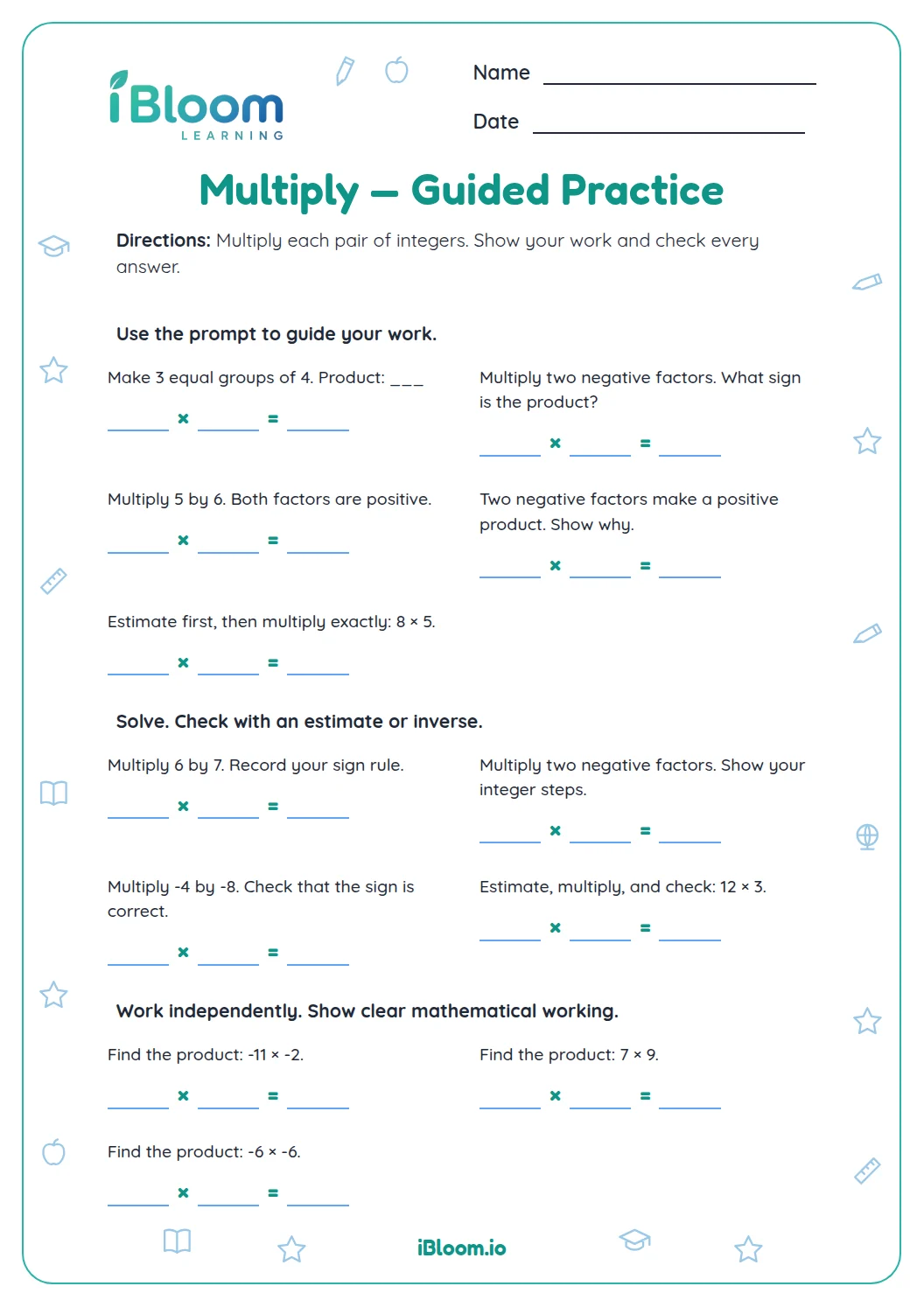
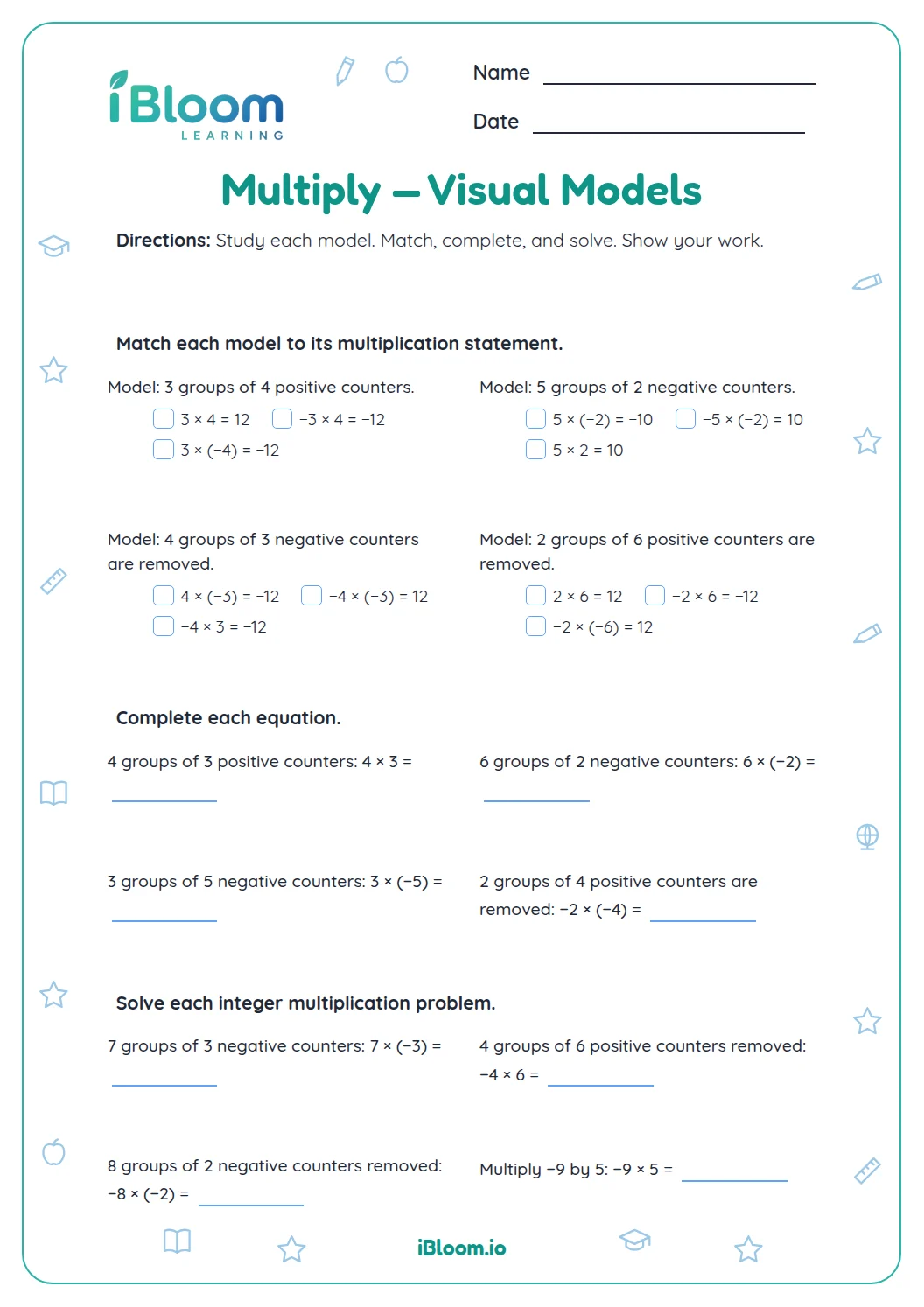
Part A reviews positive equal groups with arrays and multiplication sentences. For three groups of four, count 12 objects or multiply 3 × 4 to get 12.
- 13 groups of 4
- 23 × 4 = 12
- 3There are 12 objects.
How do factor signs affect the product?
Part B moves from positive products to factors with different signs. Multiply the absolute values first, then decide whether the signs make the result positive or negative.
How can you solve or compare signed products?
Part C asks students to find missing factors and compare two products. In ___ × 4 = −20, the missing factor is −5; the greater product in question 14 is 12.
How do negative products describe change?
Part D describes repeated decreases: a submarine descends 3 meters each minute, and a game score loses 4 points each turn. Represent each decrease with a negative factor and multiply to find the total change.
A routine for signed products
- 1Find the absolute value of each factor.
- 2Multiply those absolute values.
- 3If the factors have unlike signs, use a negative sign.
- 4If both factors are negative, use a positive sign.
- 5Check that the sign matches the story when a question describes a change.
Integer multiplication checks
The mistake
Adding the factors instead of multiplying
The fix
Use the multiplication fact for the absolute values first.
The mistake
Giving unlike signs a positive product
The fix
One positive and one negative factor produce a negative product.
The mistake
Making a two-negative product negative
The fix
Two negative factors make a positive product; then multiply their absolute values.
What to practice next
Questions parents and teachers ask
What is the product of two negative integers?
The product is positive. For example, (−4) × (−2) = 8: multiply 4 and 2, then use a positive sign because both factors are negative. Question 8 on the worksheet practices this sign pattern. The absolute values are 4 and 2, so their product is 8 before the sign is chosen.
How do arrays help with the first questions?
An array shows equal groups as rows and columns. The first three prompts pair an array with a multiplication sentence, so students can count the objects or multiply the number of rows by the number in each row. The arrays are confined to the positive warm-up; later problems add negative factors.
How can a student solve a missing-factor question?
Use the product and known factor to find the other factor, while keeping track of the signs. In ___ × 4 = −20, the missing factor must be −5 because −5 × 4 equals −20. The absolute values multiply to 20, and unlike signs make the product negative.
What do the last two word problems practice?
They represent repeated decreases with negative products. Descending 3 meters each minute for 5 minutes gives a change of −15 meters; losing 4 points on each of 6 turns gives −24 points. Each story describes one repeated change, so multiplying gives the total change over all turns.
How many questions and pages are there?
There are 16 questions in three parts: positive equal groups, sign patterns, and applications. The worksheet uses two pages, followed by a separate two-page answer key with the products and story results. Question 14 compares a negative product with a positive product to reinforce the sign rule.
What sign describes a repeated loss?
A repeated loss is represented by a negative product. The game score question uses a loss of 4 points on each of 6 turns, so the total change is −24 points. This is one way the worksheet connects multiplication with a familiar change.