


About this worksheet
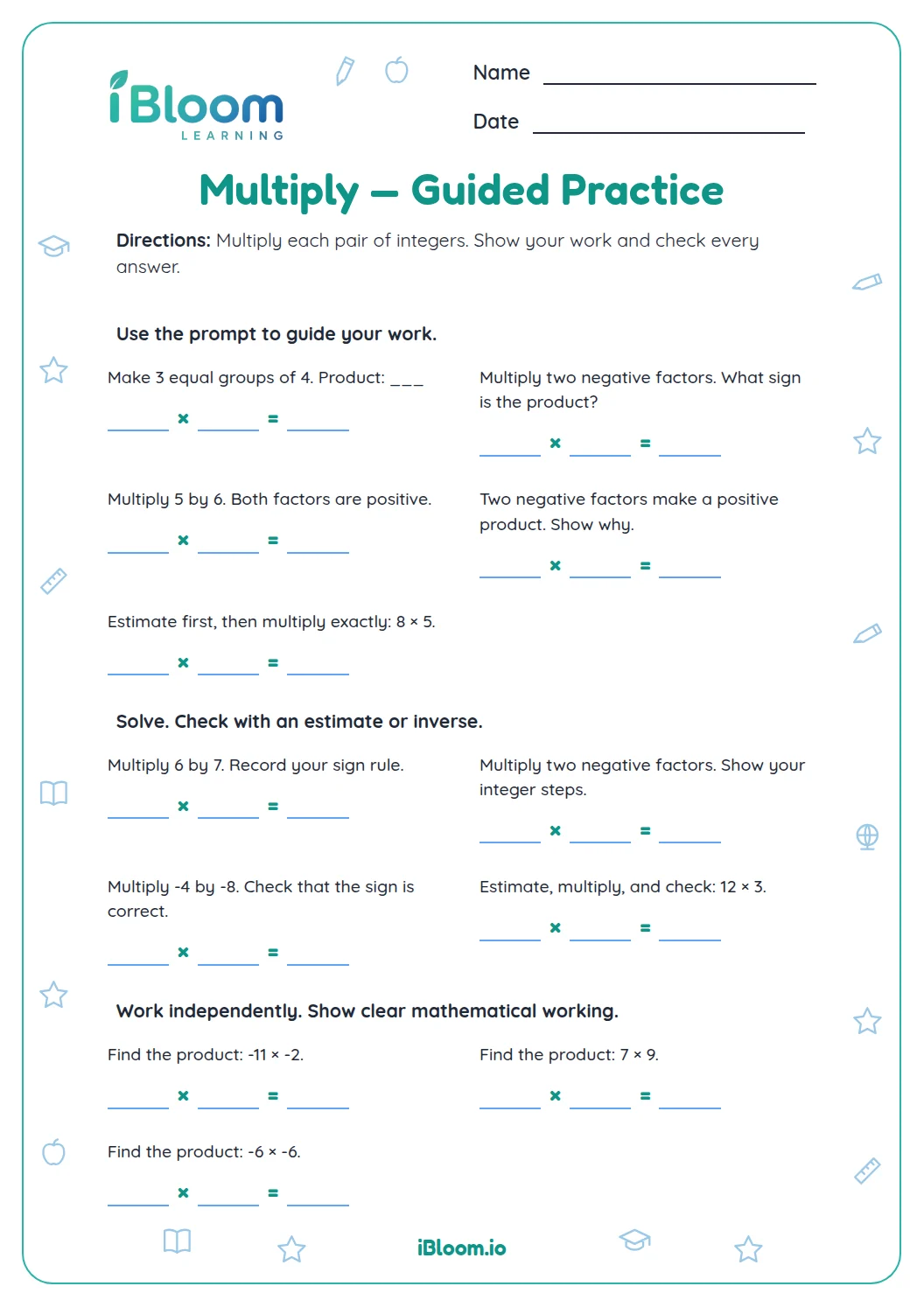
This free worksheet gives Grade 5 students independent practice with signed integer multiplication. Six products have factors with opposite signs, six use matching signs or zero, and four equations ask for a missing factor. Students decide the sign and then use familiar multiplication facts, keeping the numerical work small enough to focus on the rule. The 16 questions practice Common Core 7.NS.A.2.c through multiplying rational numbers and using related products. A separate answer key supplies each signed product or factor for a quick check after the student finishes.
Aligned to 7.NS.A.2.c
Which sign rules do students use?
Part A contains six opposite-sign products, with the negative factor on either side of the multiplication sign. Part B contains four products of two negative numbers, one product of two positive numbers, and one product with zero. Any factor multiplied by zero gives zero.
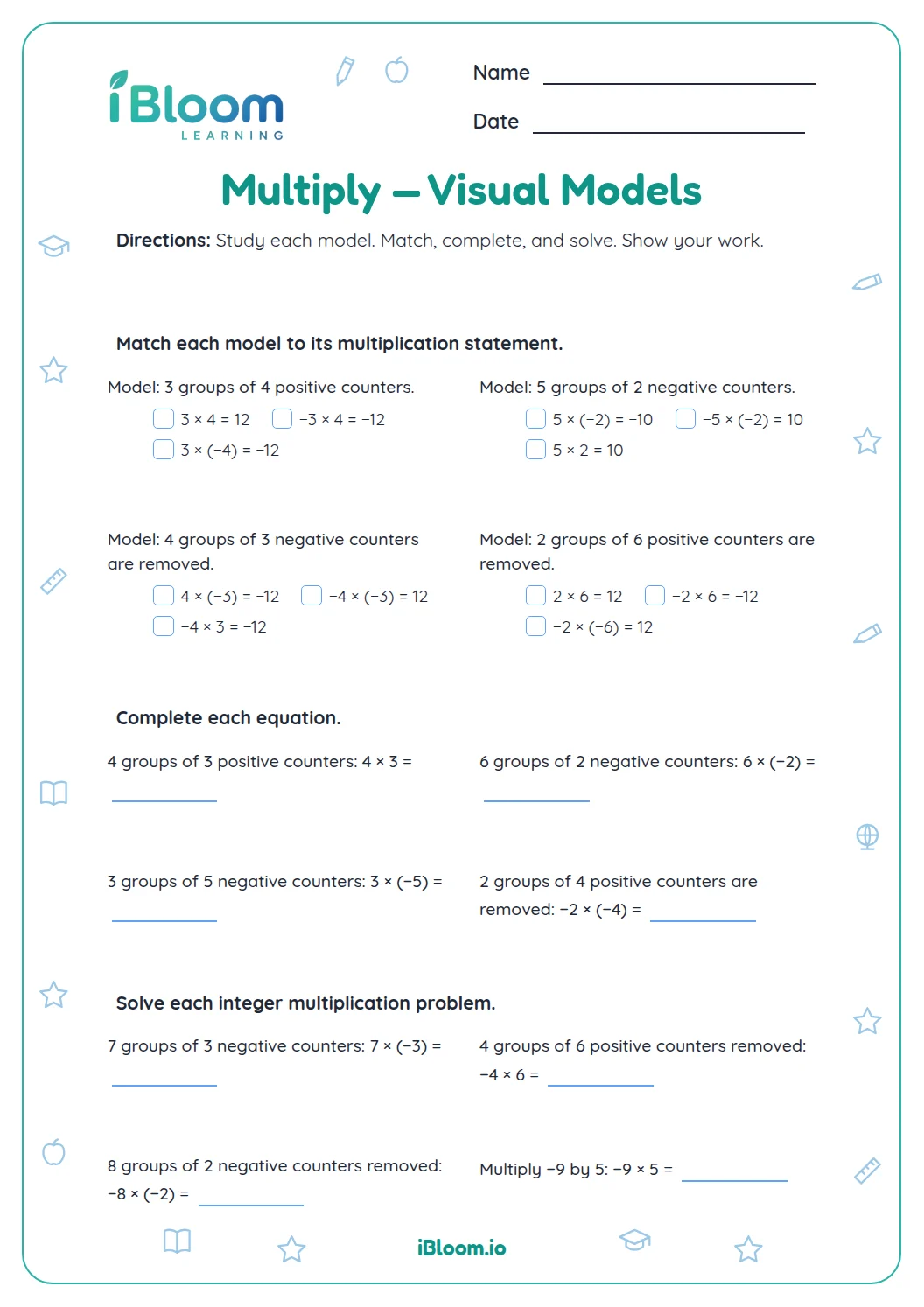
Use parentheses around a negative factor to keep its sign attached. For example, 7 × (−2) means seven groups of negative two, and the product is −14. Reversing the factors does not change that product.
Why is the answer to question 7 positive?
Both factors in (−3) × (−5) are negative. Their matching signs give a positive product, and their absolute values multiply to 15. This sign decision is separate from recalling the basic fact 3 × 5.
- 1(−3) × (−5) = ___
- 2The two nonzero factors have matching signs: positive product.
- 33 × 5 = 15
- 4(−3) × (−5) = 15
How do students find a missing signed factor?
Part C asks students to work backward from a product. In question 13, (−4) × ___ = 28, the missing factor must be negative because the known factor is negative and the product is positive. Since 4 × 7 = 28, the missing factor is −7.
Substitute each answer into its equation and check both the sign and the multiplication fact. This catches answers with the correct size but the wrong sign, such as 7 in question 13.
How to use this worksheet
- 1Read the three part directions and ask the student to work independently.
- 2Have the student decide the sign of each product before multiplying.
- 3Complete Part B carefully, including the zero product.
- 4In Part C, use the product to find the size and sign of the missing factor.
- 5Compare answers with the key, then substitute each corrected factor into its original equation.
Mistakes to check together
The mistake
Making every product with a negative factor negative.
The fix
Check both signs. Two negative factors give a positive product.
The mistake
Treating (−6) × 0 as −6.
The fix
Multiplying by zero gives zero, whatever the sign of the other factor.
The mistake
Writing 7 for (−4) × ___ = 28.
The fix
Check the sign as well as 4 × 7: the missing factor must be −7.
Common Core alignment
Multiply signed integers and use related products to find missing factors.
On this sheet: Multiply signed integers and use related products to find missing factors.
Show the official wordingHide the official wording
Apply properties of operations as strategies to multiply and divide rational numbers.
What to practice next
Make more practice
Further reading
Questions parents and teachers ask
What should students know before working independently?
Students should know basic multiplication facts and the sign rules for two integer factors. They should also recognize zero products and understand that a blank can stand for an unknown factor. The worksheet keeps factors small so students can concentrate on signs while applying those familiar facts.
Does the negative factor always come first?
No, Part A places the negative factor on either side of the multiplication sign. For example, question 2 is 7 × (−2), while question 3 is (−4) × 6. The sign rule depends on the two signs, so changing their order does not change it.
How is a product with zero different?
Any integer multiplied by zero equals zero. In question 12, (−6) × 0 is therefore 0. Students should handle this case before applying the positive-or-negative rule for nonzero factors. They can check it by recalling that any number of groups containing zero has no objects.
How do I check a missing-factor answer?
Put the proposed factor back into the original equation and multiply. For question 13, inserting −7 gives (−4) × (−7) = 28. That checks the size and sign together. Inserting positive 7 would give −28, so it would not satisfy the equation on the sheet.
What is included in the answer key?
The separate key gives all twelve products and all four missing factors, with negative signs where needed. Have students compare the sign before checking the numerical value. When only a sign is wrong, ask them to identify the signs of both factors and explain the rule they used.