

About this worksheet
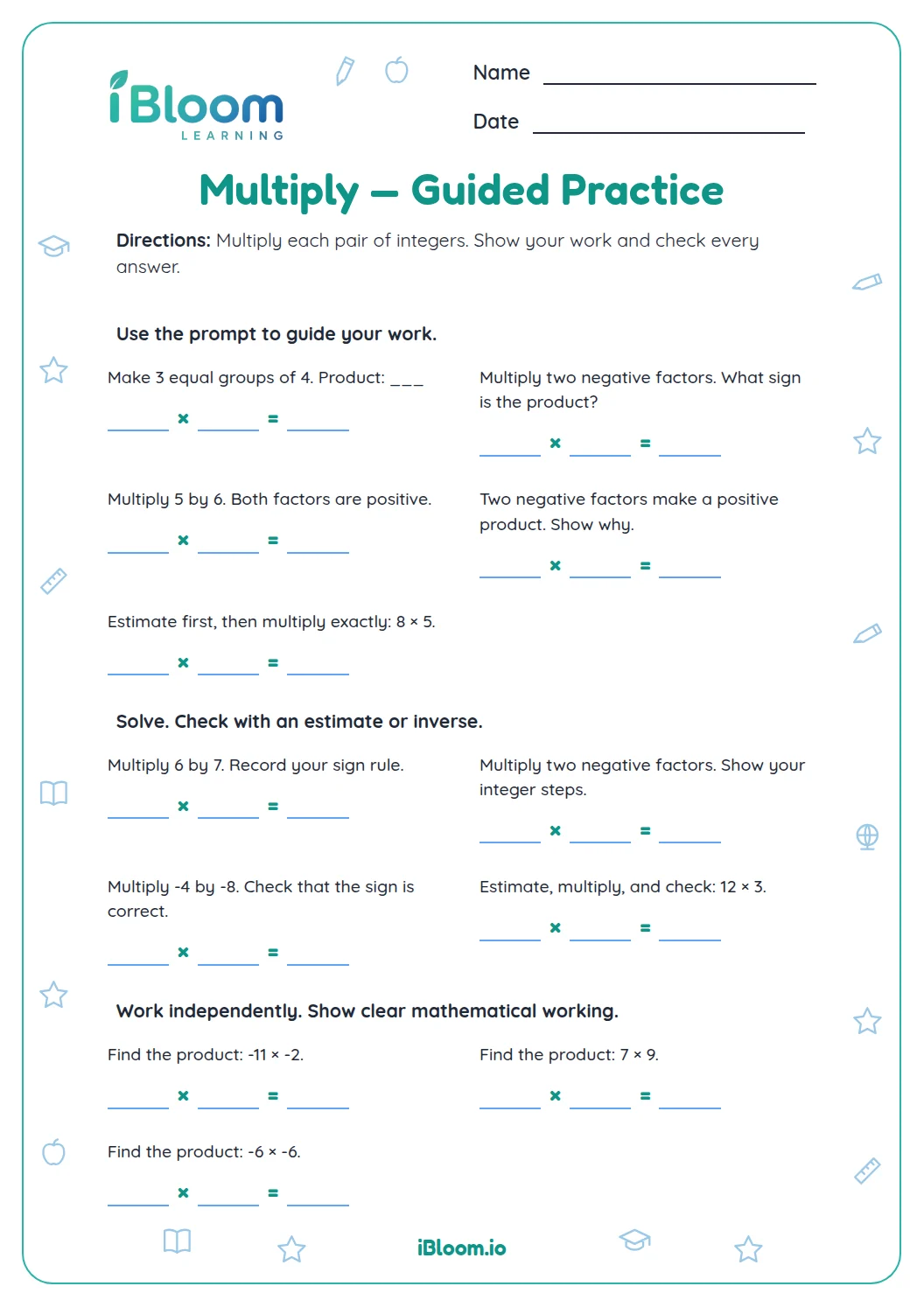
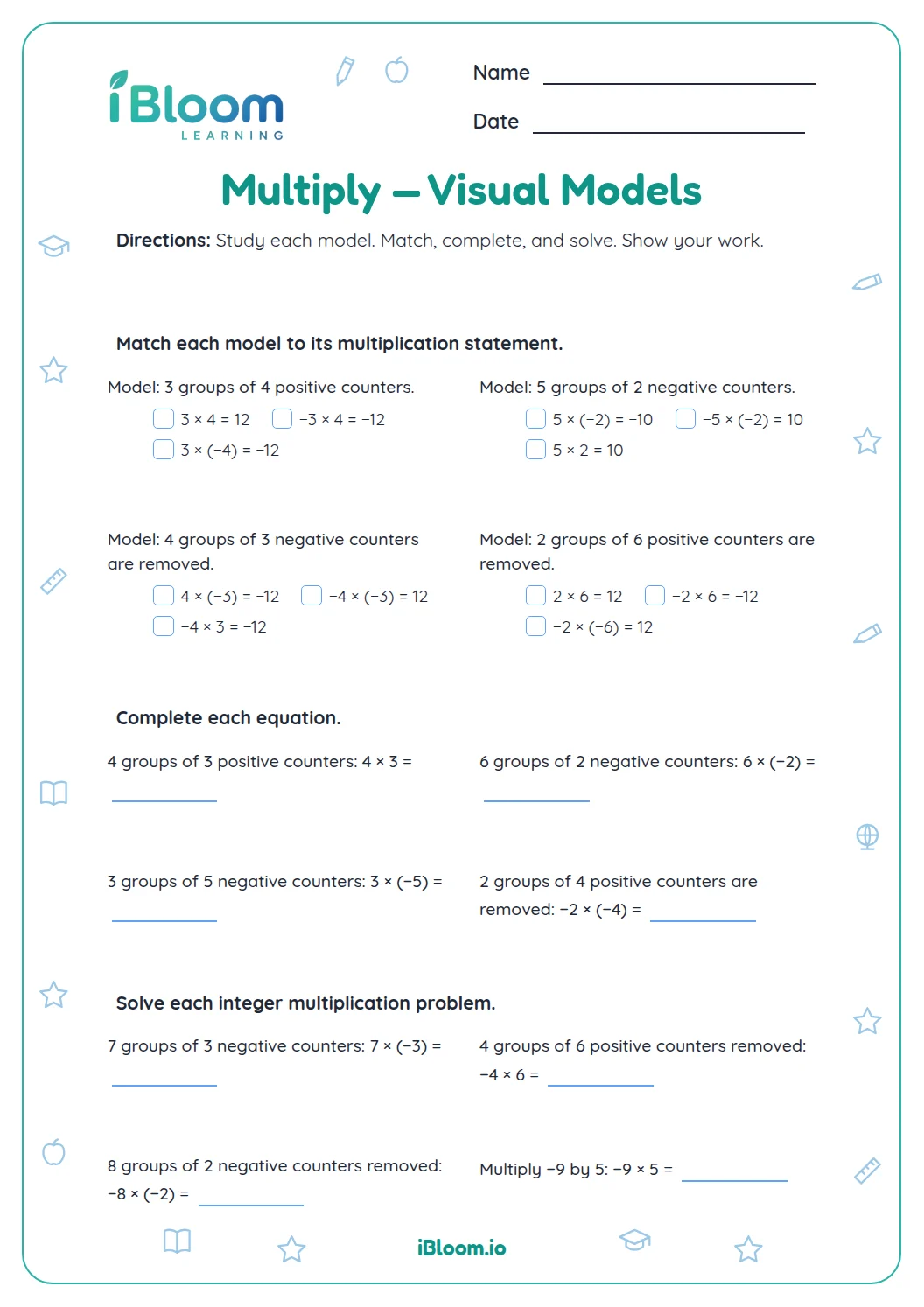
This integer multiplication worksheet has 17 questions in three parts. Part A practices signed products; Part B extends the sign-pattern practice; Part C asks students to find missing factors, compare negative products, and describe a product with a given sign. The separate answer key shows a response for each item. The page is labeled Grade 5 in the source, so an adult can decide whether this level matches the learner’s current course.
How do signs affect an integer product?
Multiply the absolute values, then use the signs: unlike signs give a negative product and two negative factors give a positive product. Parts A and B practice products and sign reasoning.
- 1−6 × 4 = −24
- 2The absolute values multiply to 24; unlike signs give a negative product.
How can a product help find a missing factor?
Use the product and known factor to identify the missing factor and its sign. For example, a product of 36 with a factor of −9 requires a negative factor of −4.
How do you compare negative products?
Find both products before comparing. The product closer to zero is greater when both values are negative.
How to use this worksheet
- 1Multiply the absolute values.
- 2Count negative factors to decide the sign.
- 3Compare negative products by their distance from zero.
- 4For a missing factor, divide and check the product.
Common mistakes and quick fixes
The mistake
Making every product with a negative factor negative.
The fix
Two negative factors make a positive product.
The mistake
Treating a negative result as a smaller absolute amount only.
The fix
Keep the sign attached to the value and unit.
The mistake
Comparing negative products by absolute value.
The fix
Place them on the number line; the value closer to zero is greater.
What to practice next
Make more practice
Questions parents and teachers ask
Why is the product of two negative integers positive?
Two negative factors have matching signs, so their product is positive. For example, −7 × −3 has an absolute value of 21 and a positive sign, giving 21. Students can use this pattern to check the sign before calculating.
How should a student compare two negative products?
Calculate both products, then compare their values on the number line. The value closer to zero is greater. In question 14, −7 × 8 is −56 and −7 × 6 is −42, so −42 is greater. Both products are negative.
What kinds of questions are included?
There are 11 signed multiplication expressions and six reasoning questions. The final part includes missing factors, comparing products, choosing an expression with a negative product, and identifying the sign of two negative factors. Each answer can be checked by multiplying.
Can students solve the reasoning items in different ways?
Yes. A student may reason with factor facts, sign patterns, or a number line, as long as the response is correct. For question 15, any multiplication expression with integer factors whose product is negative 42 works; the key gives one example.
Is integer multiplication a Grade 5 Common Core standard?
The worksheet provides signed integer multiplication practice labeled for Grade 5. The page does not assign a Common Core standard to these questions. An adult can compare the skill with the learner’s current course sequence before using the challenge.