


About this worksheet
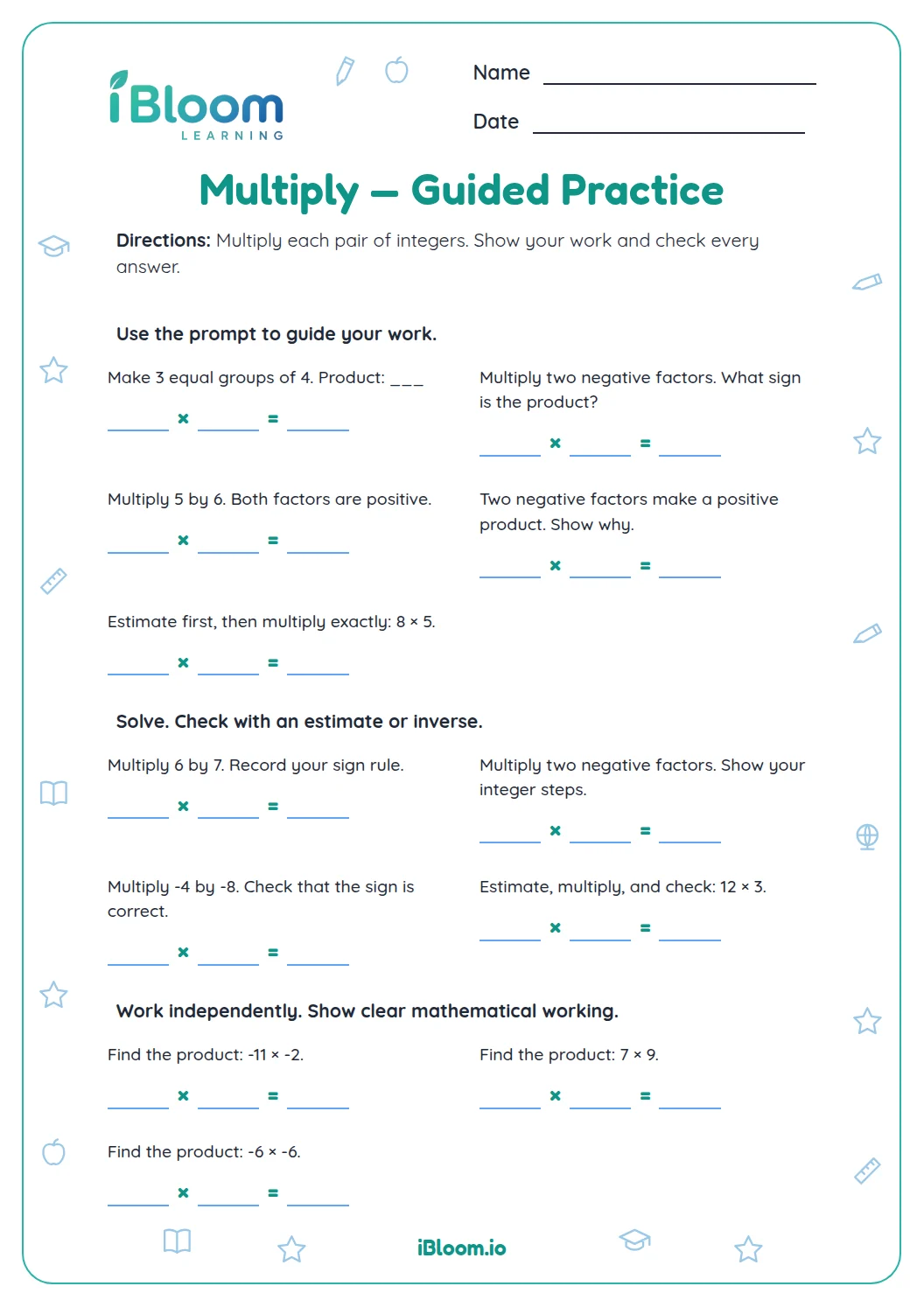
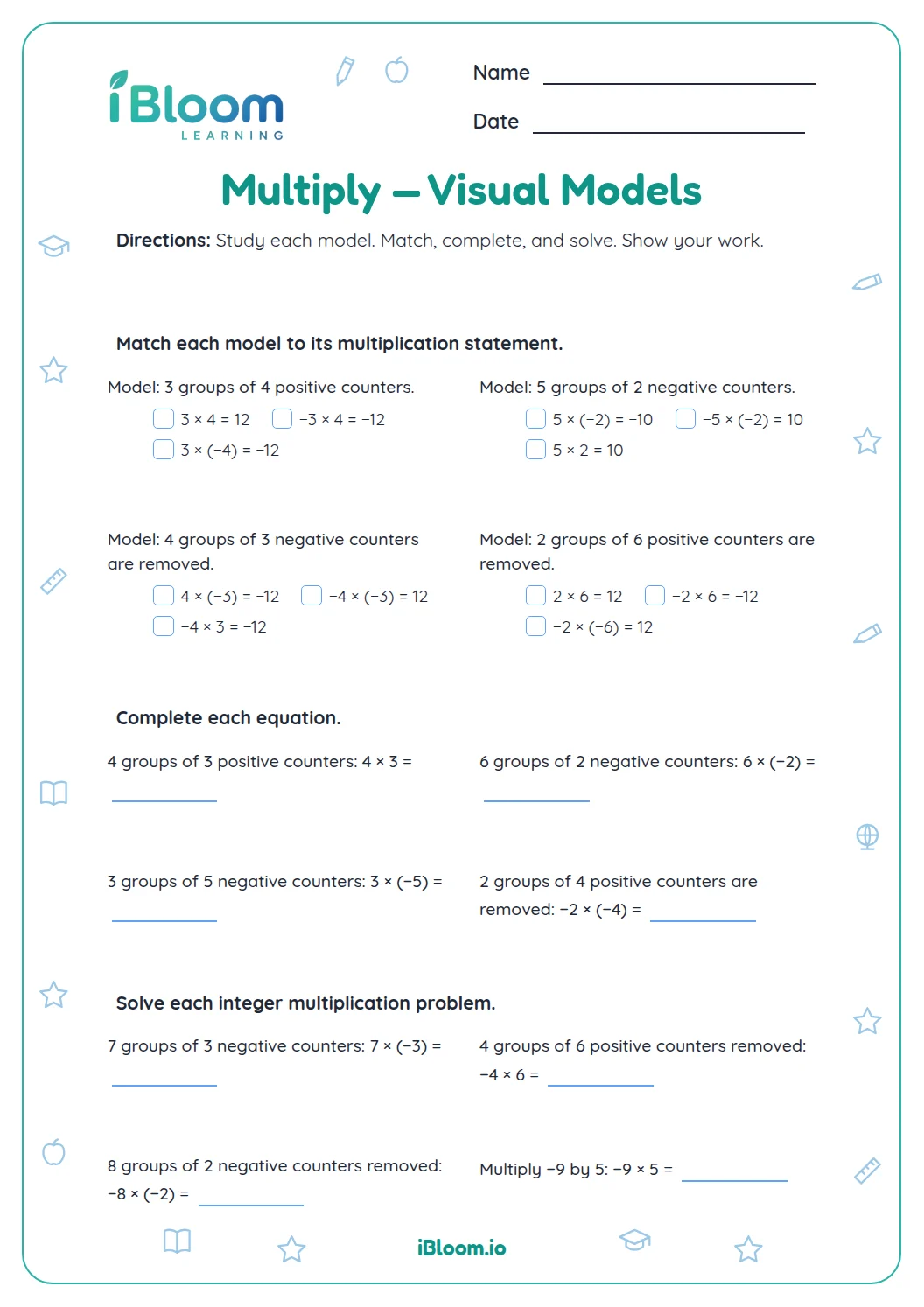
This Grade 5 worksheet uses repeated gains, losses, rises, and drops to practice multiplying signed numbers in context. Students choose a sign, write a multiplication equation, solve, and include a unit when the situation calls for one. The answer key gives the signed product and unit.
How does the story tell which sign to use?
Words such as descends, drops, loses, and moves down describe negative changes. Climbs, rises, gains, and raises describe positive changes. A negative amount repeated several times stays negative in the total.
- 11) Descends 120 feet each hour for 3 hours: 3 × (−120) = −360 feet.
- 2The negative sign records movement downward.
How can a repeated change become a product?
The number of equal changes is one factor; the signed amount of each change is the other. A $18 monthly account charge for 4 months is 4 × (−18) = −72 dollars, a decrease in the account balance.
Why include a unit with the answer?
A number alone does not tell whether the story concerns feet, degrees, meters, dollars, or points. Include the unit named in the question, and check that the sign matches the direction or account change described.
How to use this worksheet
- 1Circle or underline the repeated amount and the number of times it occurs.
- 2Mark whether each change is a gain or a loss, rise or drop.
- 3Write a multiplication equation using the signed change.
- 4Multiply the absolute amounts and decide the sign of the product.
- 5Include the unit and reread the story to check the meaning.
Common mistakes and quick fixes
The mistake
Using a positive answer for a repeated loss.
The fix
Write a negative sign with each loss before multiplying.
The mistake
Multiplying the amount by the wrong number.
The fix
Find how many hours, turns, trips, or weeks the change repeats.
The mistake
Leaving off the unit or reversing the context.
The fix
State the signed change and name what is being measured.
What to practice next
Questions parents and teachers ask
How do I know whether an integer product should be positive or negative?
Read what happens in each story. Repeated losses, drops, and downward movement are negative changes; repeated gains and upward movement are positive. For instance, losing 8 points in 7 rounds gives 7 × (−8) = −56 points. The context helps determine the sign.
What does the negative answer mean in a word problem?
The negative sign records the direction or type of change, such as a decrease in an account balance or a drop in elevation. The unit names what changed. A result of −360 feet means the hiker’s elevation changed downward by 360 feet over the stated time.
Should students write an equation before the answer?
Yes. The equation space lets students show the repeated quantity and its signed amount. For a monthly charge, 4 × (−18) = −72 shows four decreases of $18. Including the unit then makes clear that the account balance changed by −72 dollars.
Why are there both gains and losses?
Both kinds of situations help students connect integer signs to changes in context. Positive changes describe increases or upward movement, while negative changes describe decreases or downward movement. Students can use the story details to decide which signed amount to multiply.
What should be included in the final answer?
Include the signed total and the unit named in the story, such as −30°F or 64 feet. The sign describes the direction or type of change, and the unit tells what was measured. Writing both makes the numerical result easier to interpret.