



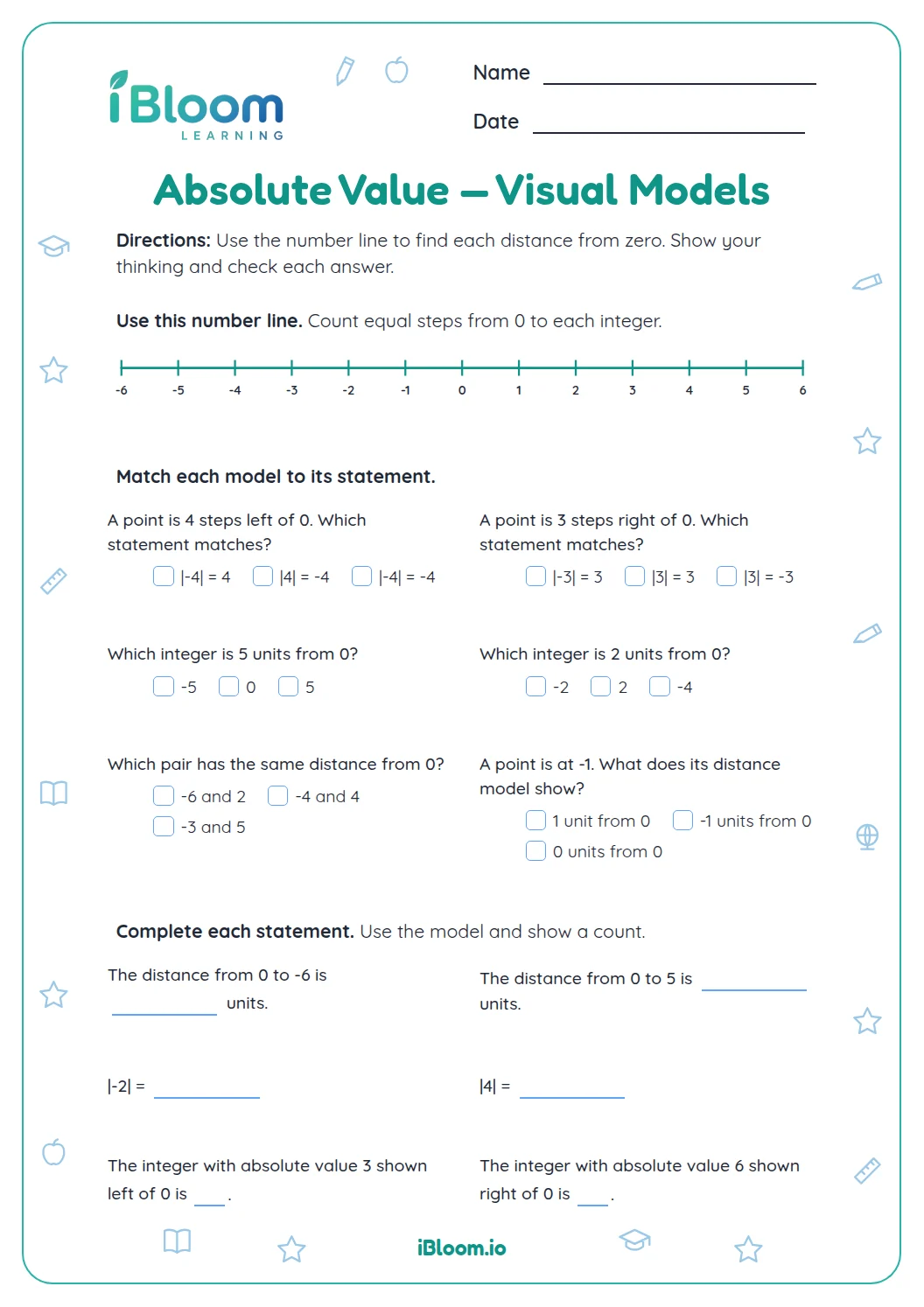
About this worksheet
This printable worksheet practices signed integer changes in number-line and familiar real-world contexts such as temperature, elevation, floors, and balances. Students subtract starting values from ending values and interpret positive or negative results. It includes 14 questions across two parts and a separate answer key. Its integer work aligns with CCSS 6.NS.C.6c.
Aligned to 6.NS.C.6.c
What do positive and negative integers show?
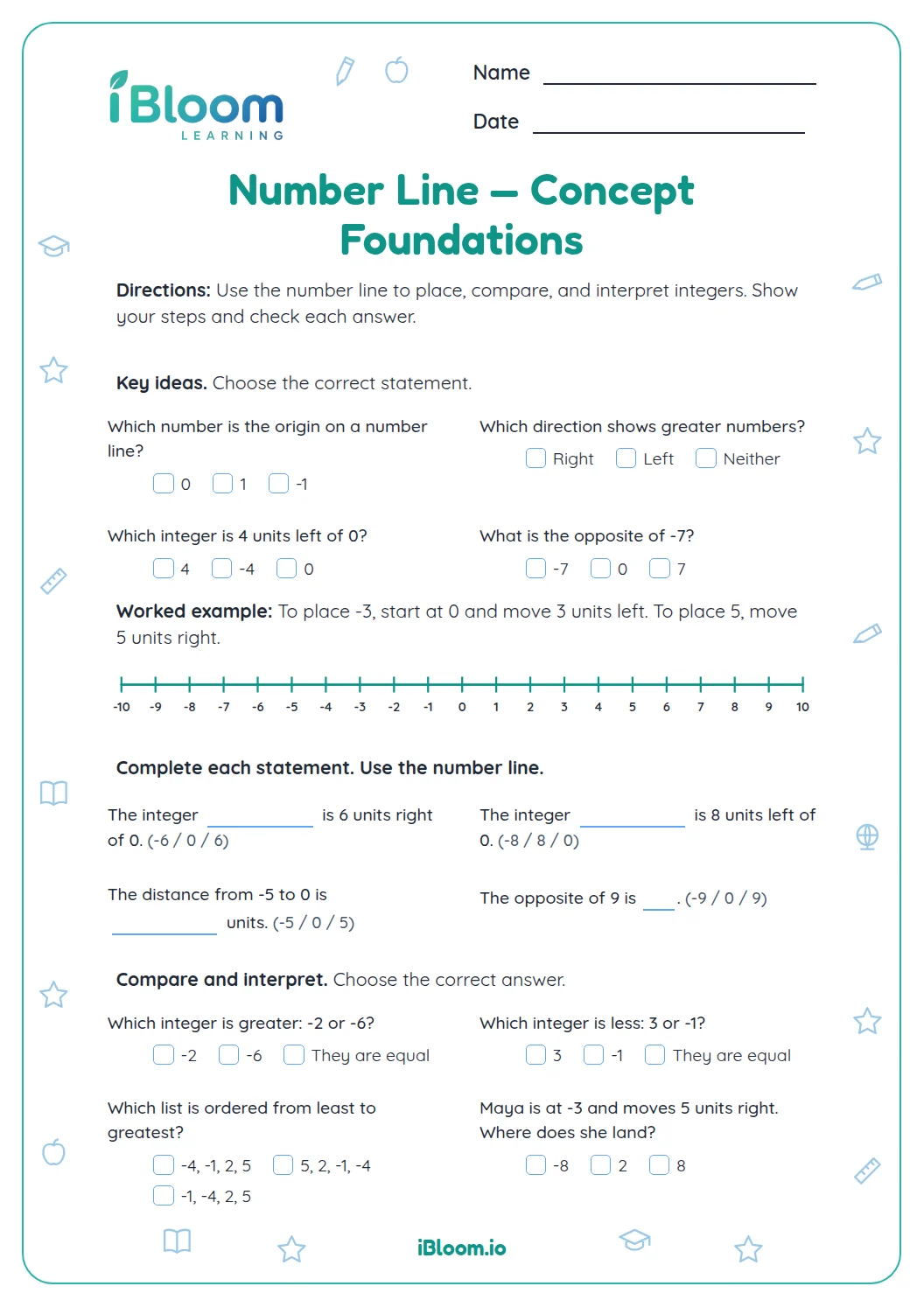
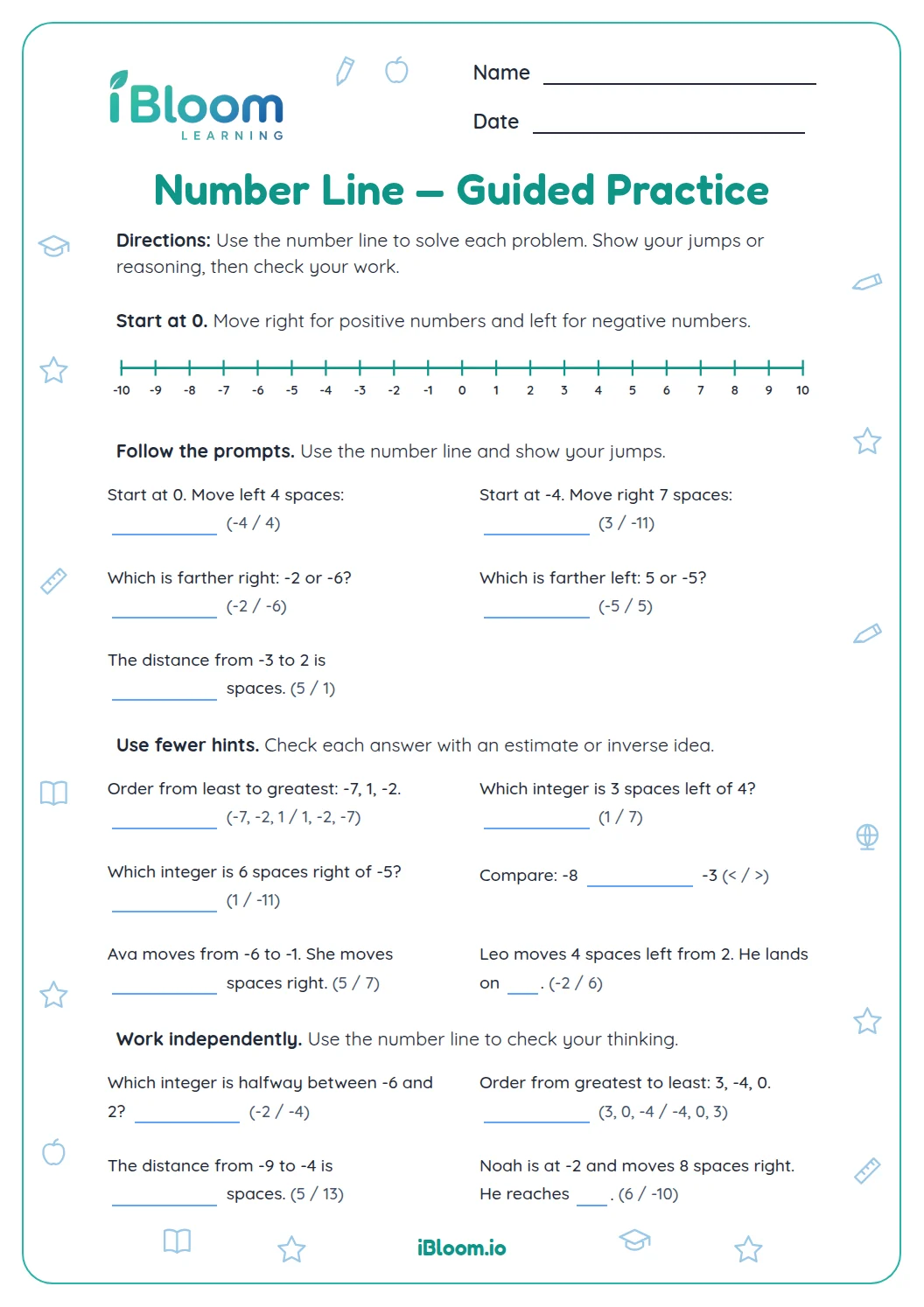
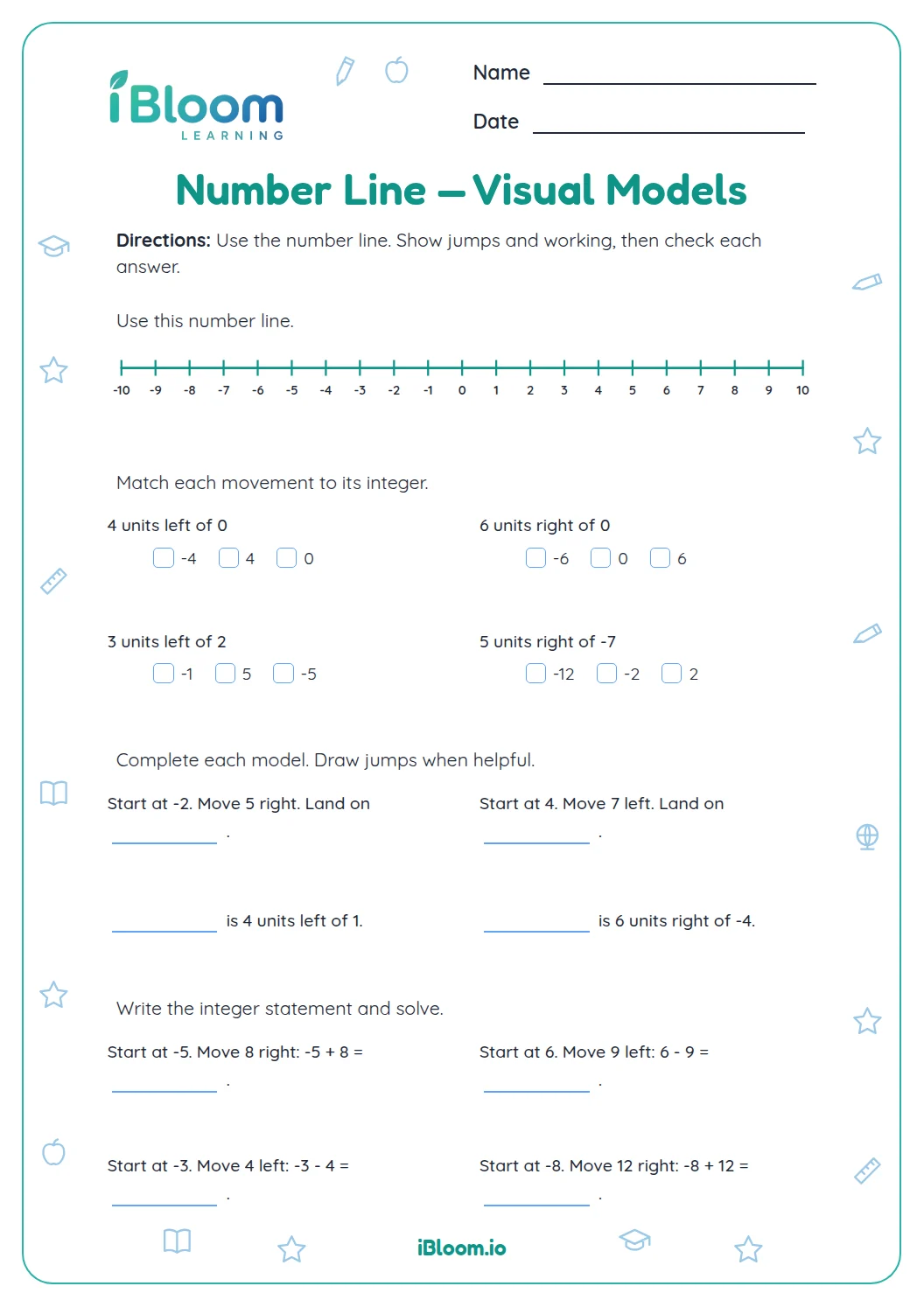
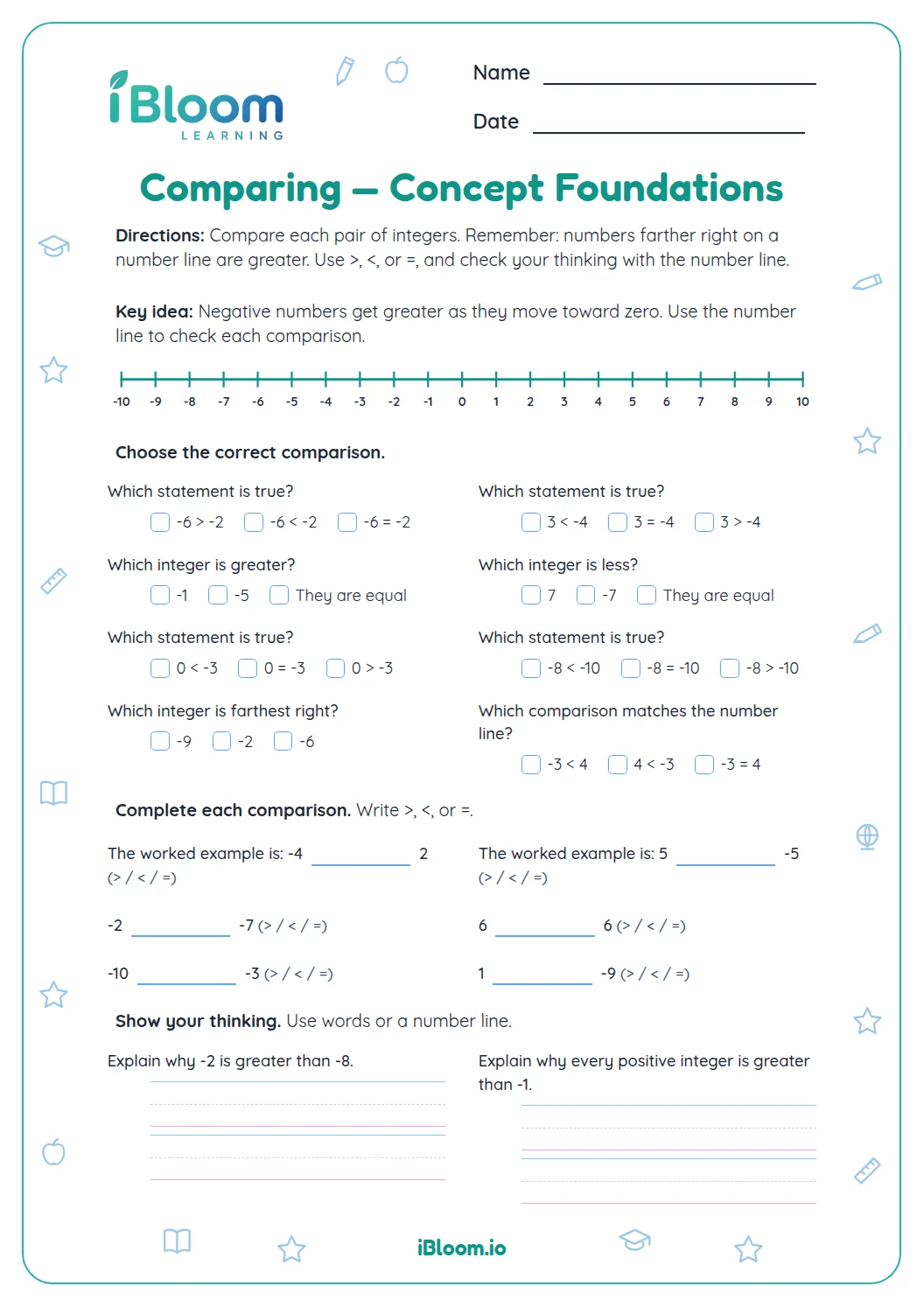
Part A gives six number lines with labeled start and end positions. Mark both integers and identify the signed change. For example, moving from −3 to −1 is a change of 2.
Part B uses eight contexts. Subtract the starting value from the ending value and keep the unit.
- 1Start at −3 and end at −1.
- 2Compute −1 − (−3) = 2.
- 3The move is 2 units right.
How can a number line show a change?
On a left-to-right number line, values increase to the right. A move from a smaller value to a larger one has a positive change; a move to a smaller value has a negative change.
How does the story tell you what zero means?
Zero is the reference point: sea level for a diver, the lobby for an elevator, or no money owed for an account. The context tells what each signed ending value means.
How to use this worksheet
- 1Identify what zero represents in the situation.
- 2Write the starting value as an integer.
- 3Decide whether the change moves right (increase) or left (decrease).
- 4Count the number of unit steps.
- 5State the ending integer with its context or unit.
Common mistakes and quick fixes
The mistake
Writing 4 for four feet below zero.
The fix
Below the reference point is negative, so write -4.
The mistake
Moving left for an increase.
The fix
On a left-to-right number line, values increase to the right.
The mistake
Forgetting to cross zero when counting steps.
The fix
Count every tick from the starting point, including the step across zero.
Common Core alignment
This worksheet gives focused practice with the standard below.
Position integers on horizontal or vertical number lines.
On this sheet: Learners read marked integers and track signed changes on horizontal number lines.
Show the official wordingHide the official wording
Find and position integers and other rational numbers on a horizontal or vertical number line diagram; find and position pairs of integers and other rational numbers on a coordinate plane.
What to practice next
Make more practice
Further reading
Questions parents and teachers ask
What does a negative integer mean in a real-world problem?
A number line shows integers in order, with negative values left of zero and positive values right of zero. This sheet asks students to mark starting and ending positions, then find the signed change. The separate answer key lists each endpoint and change.
How do I show an increase on a number line?
Start at the given integer and move right for an increase. For example, starting at -3 and rising 5 floors lands at 2. Count five equal steps, crossing zero along the way; the number line makes the direction and distance visible.
How do I show a decrease?
Start at the given integer and move left for a decrease. A temperature of 2°F that drops 6 degrees ends at -4°F. Moving left shows the value getting smaller, and counting the ticks shows when the path crosses zero.
Why do the situations use different units?
Temperature, floors, depth, and account balances each use zero as a reference point in a different context. The story explains what positive and negative values mean; the integer records the position or balance relative to that reference point, with the unit attached.
How many questions are included?
There are 14 questions in two parts: six number-line readings and eight signed-position situations. The separate answer key lists each marked integer and each ending value, so students can check signs, direction, and units. Each situation is short enough to solve mentally or with a quick number-line sketch.
Is there an answer key?
Yes. A separate key page gives the integer at each marked point and the ending value for every situation. Check that the sign matches the direction and reference point described in the story before marking the answer correct.