
About this worksheet
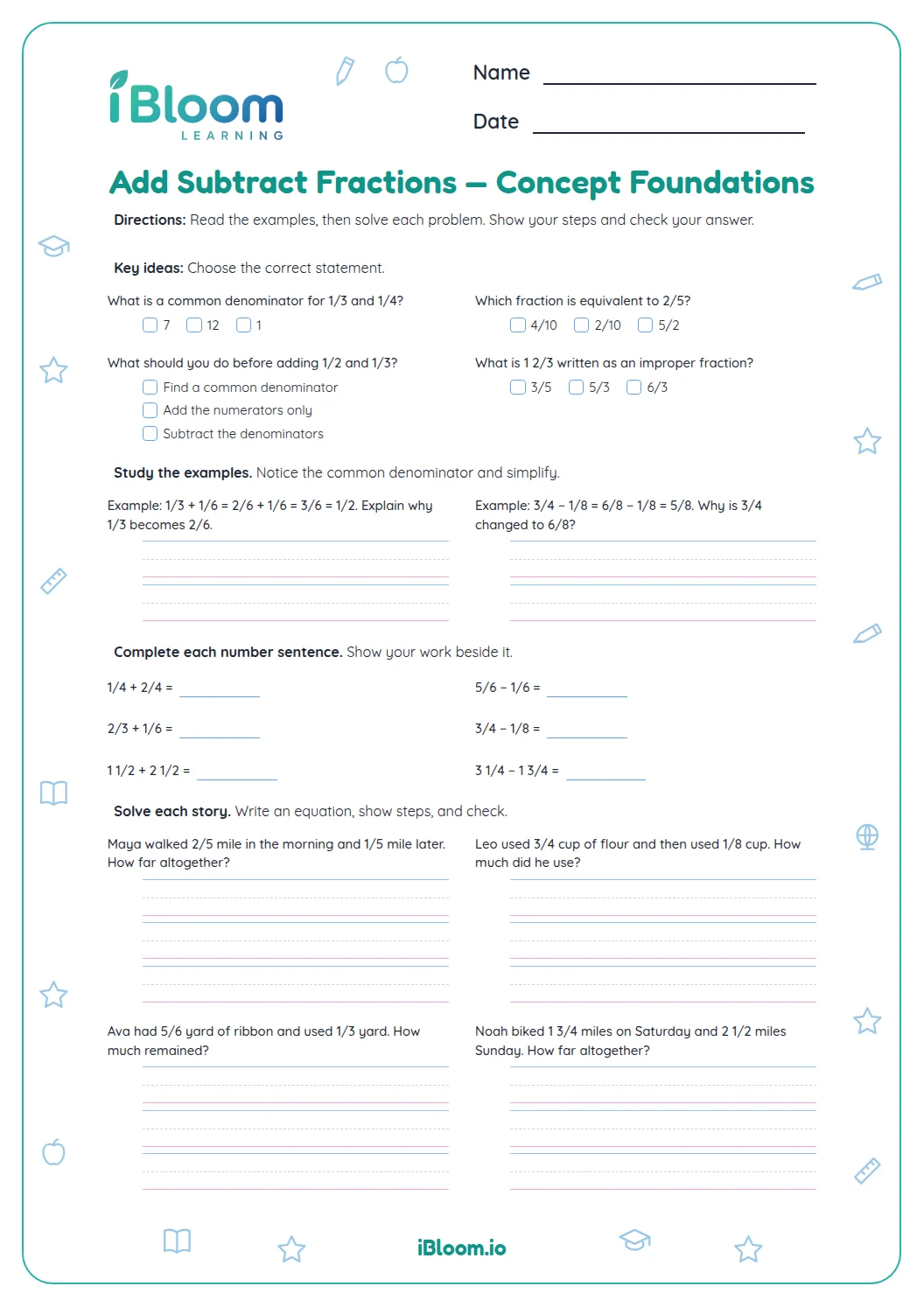
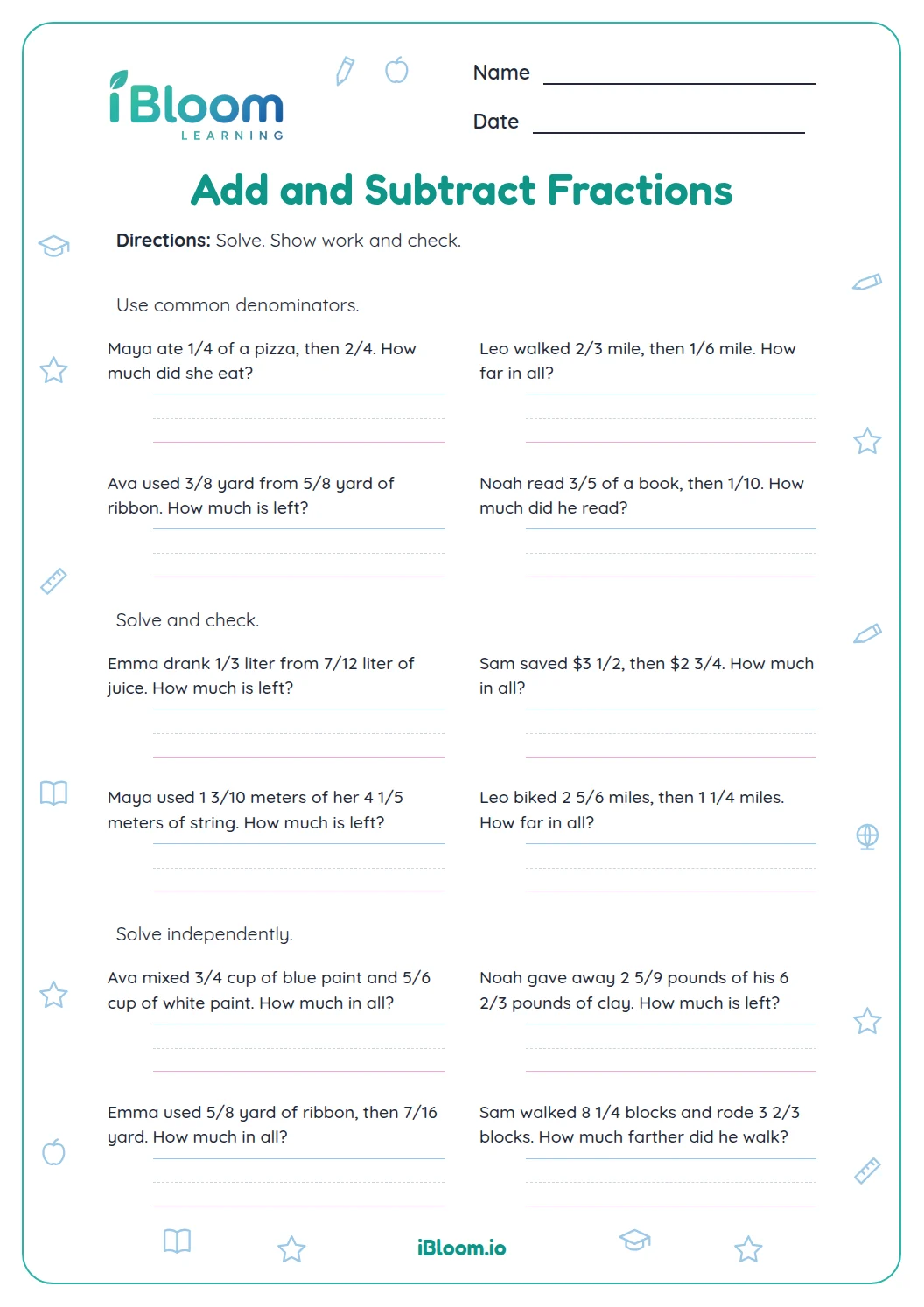
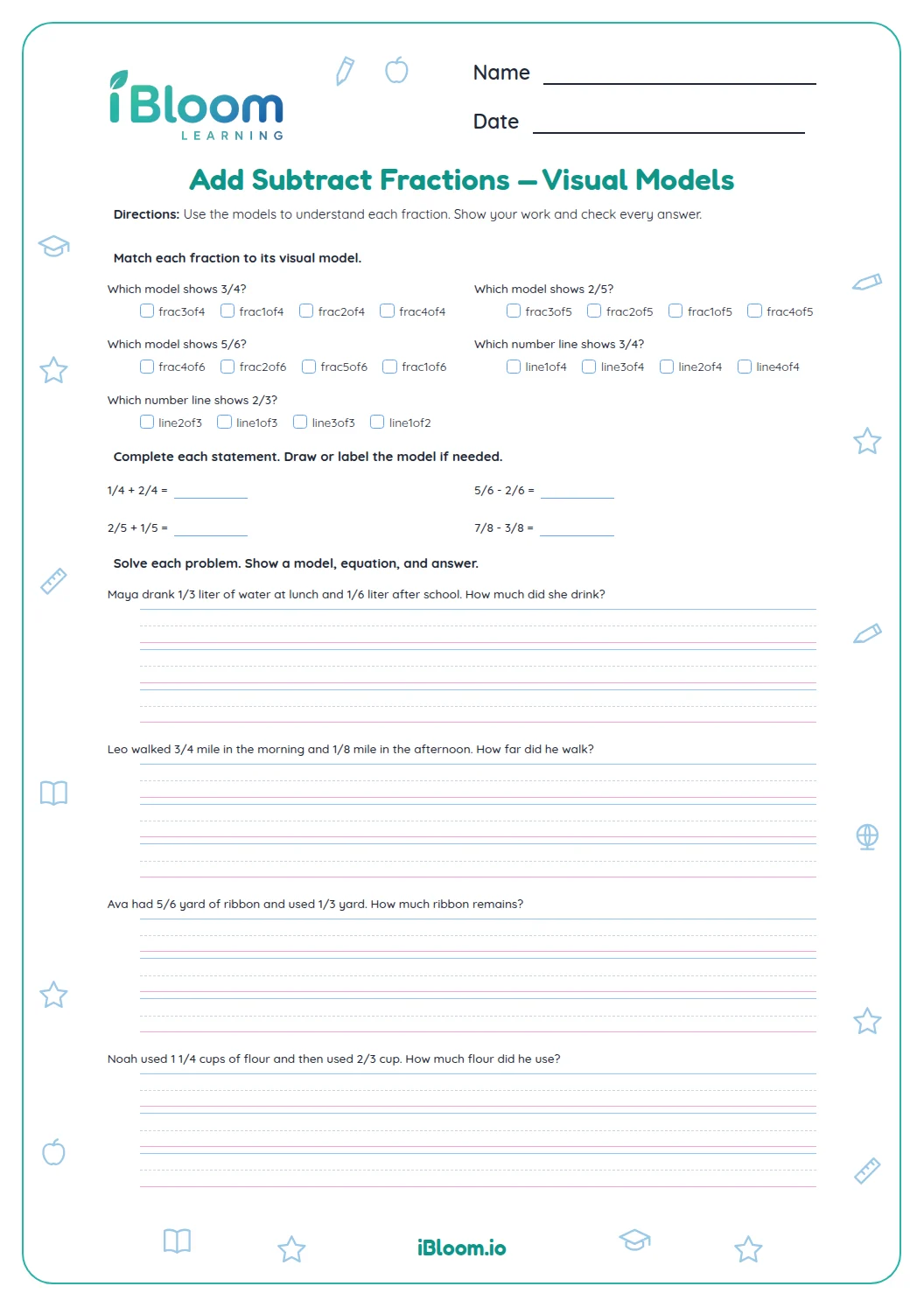
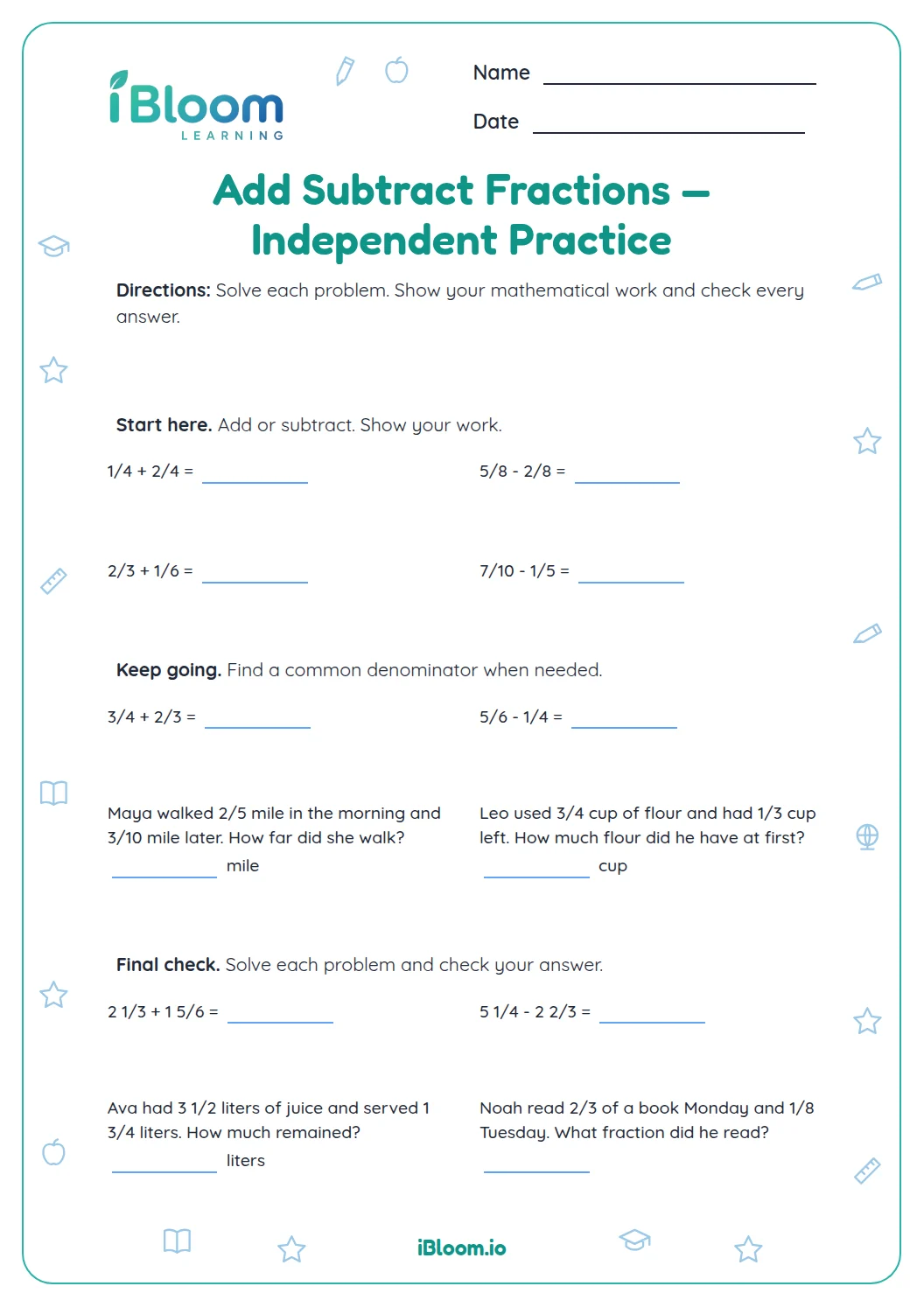
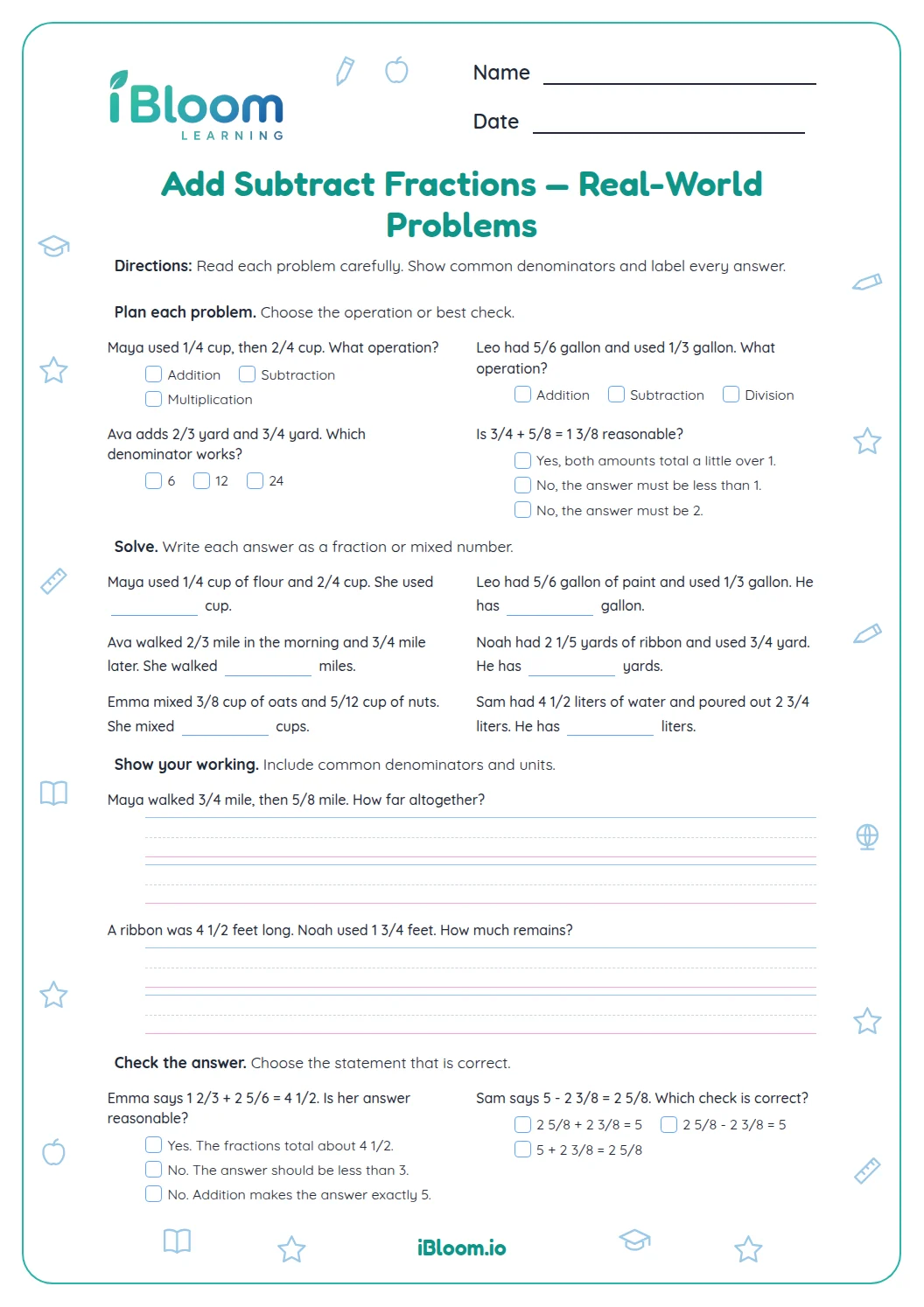
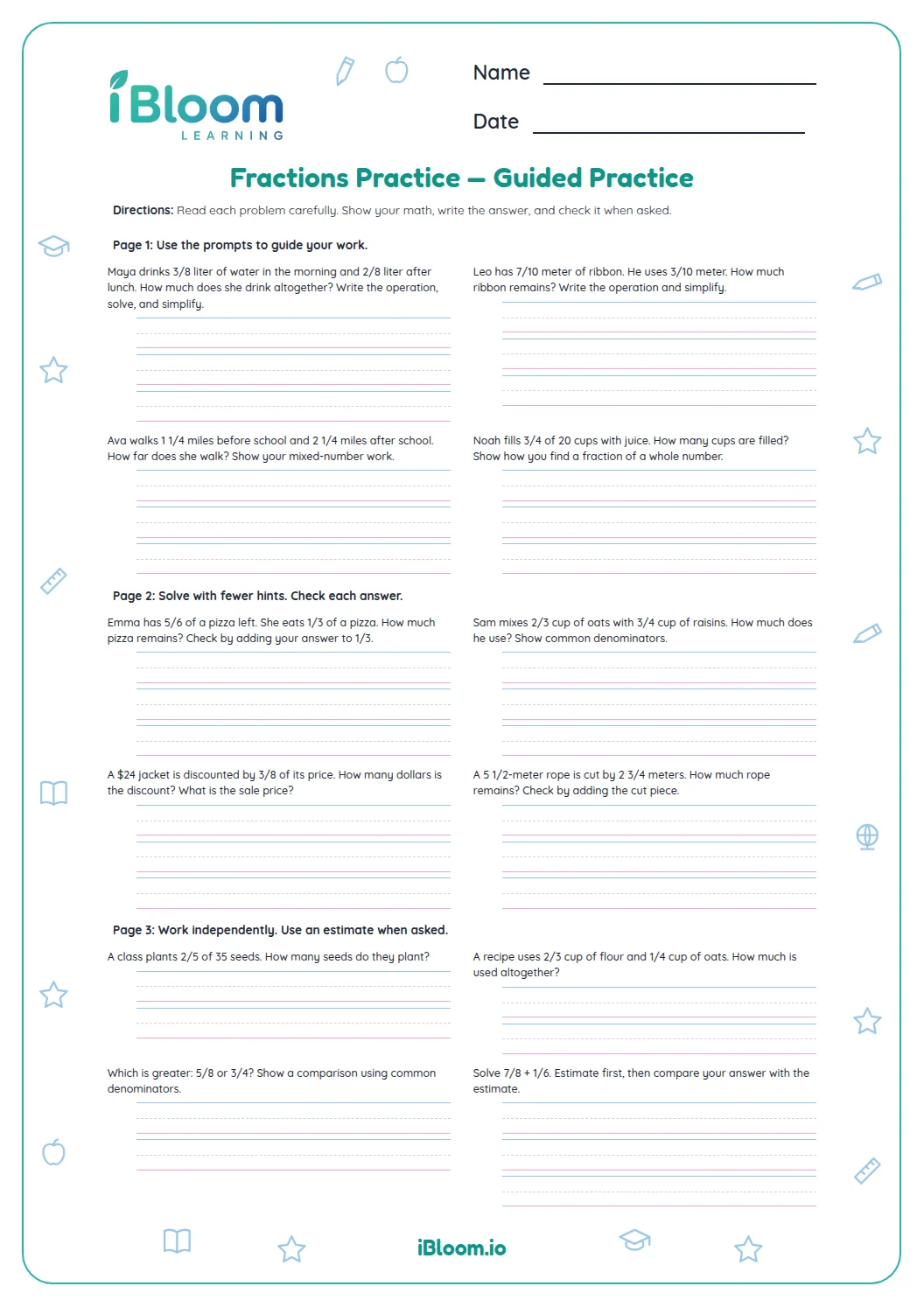
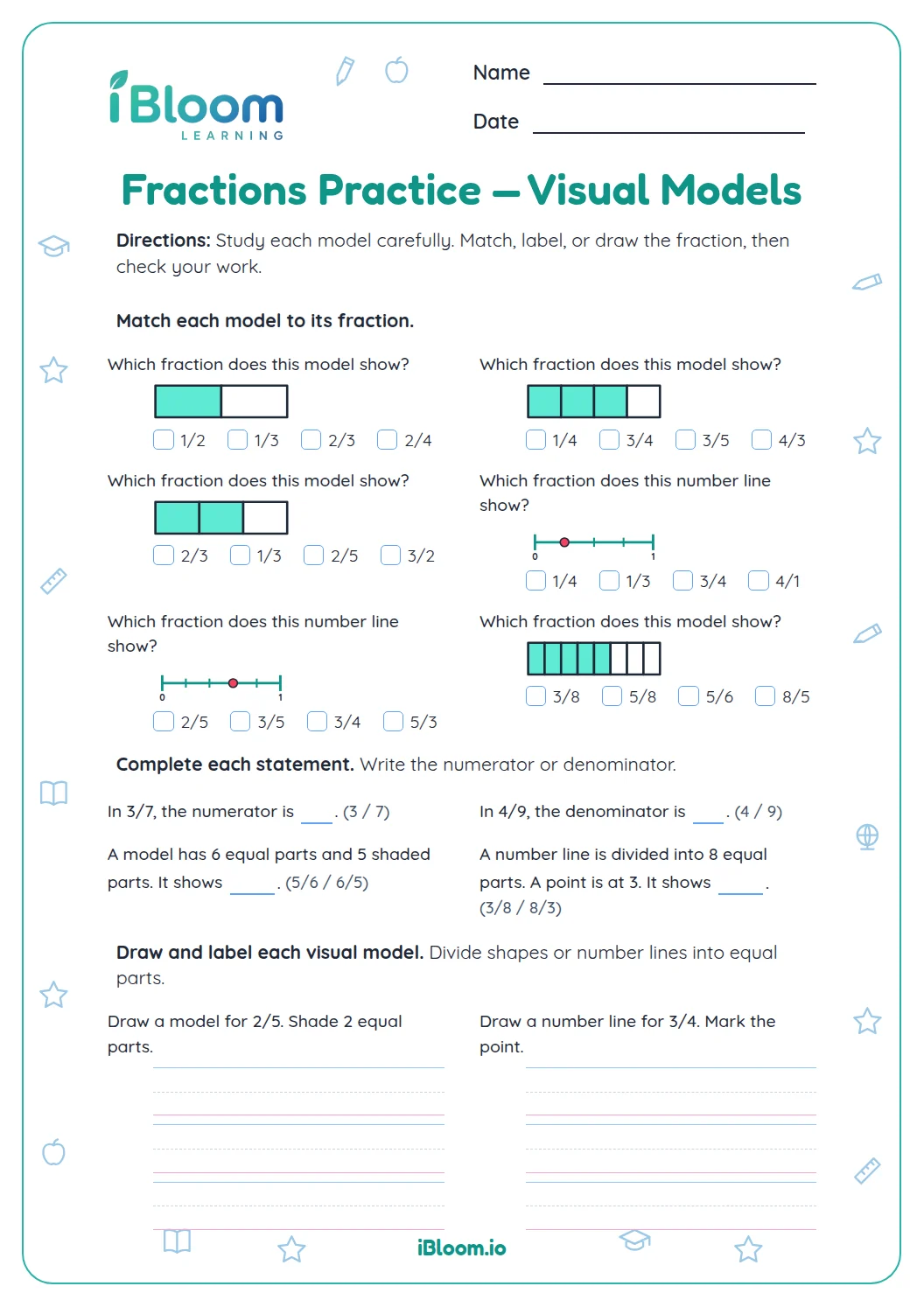
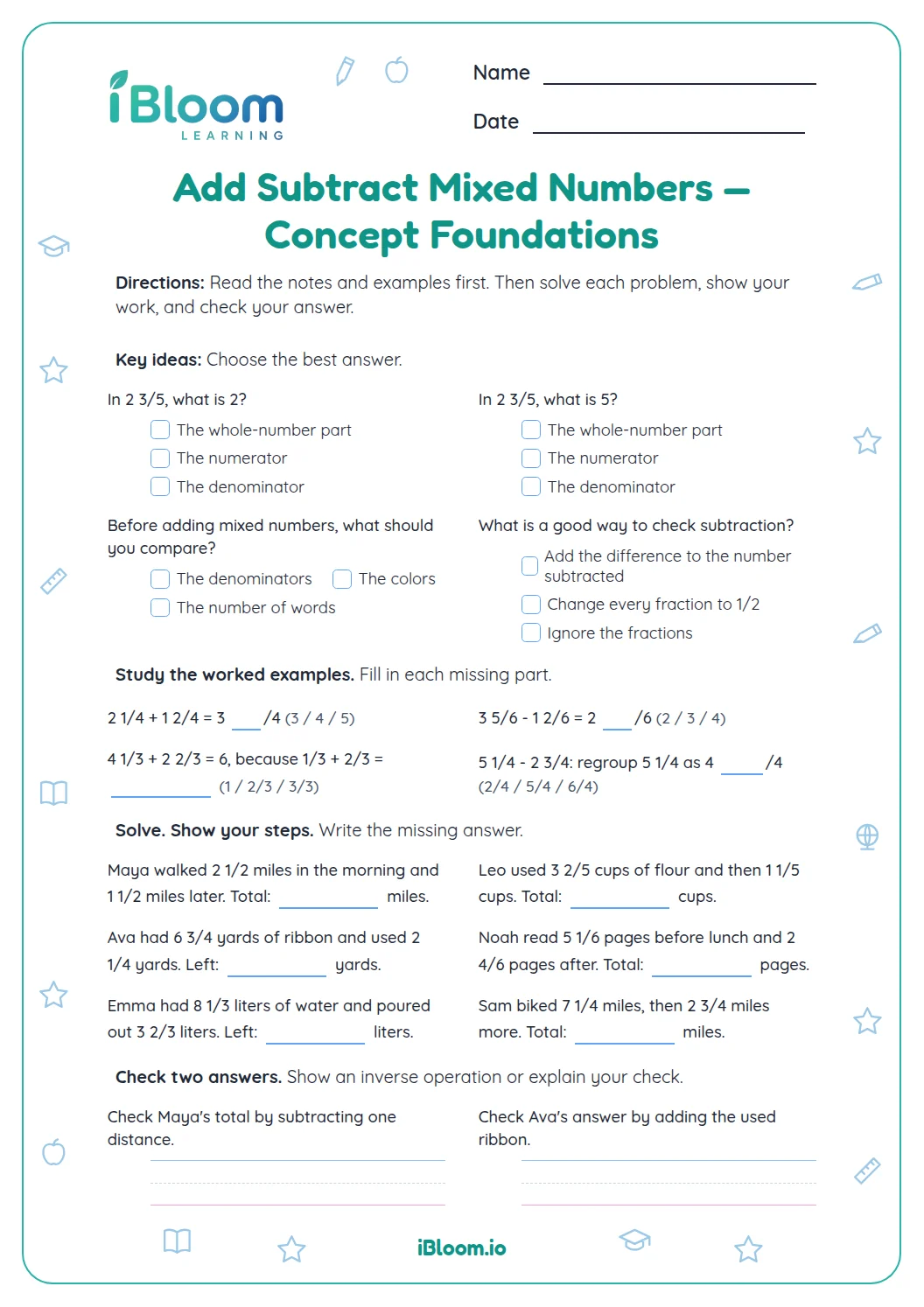
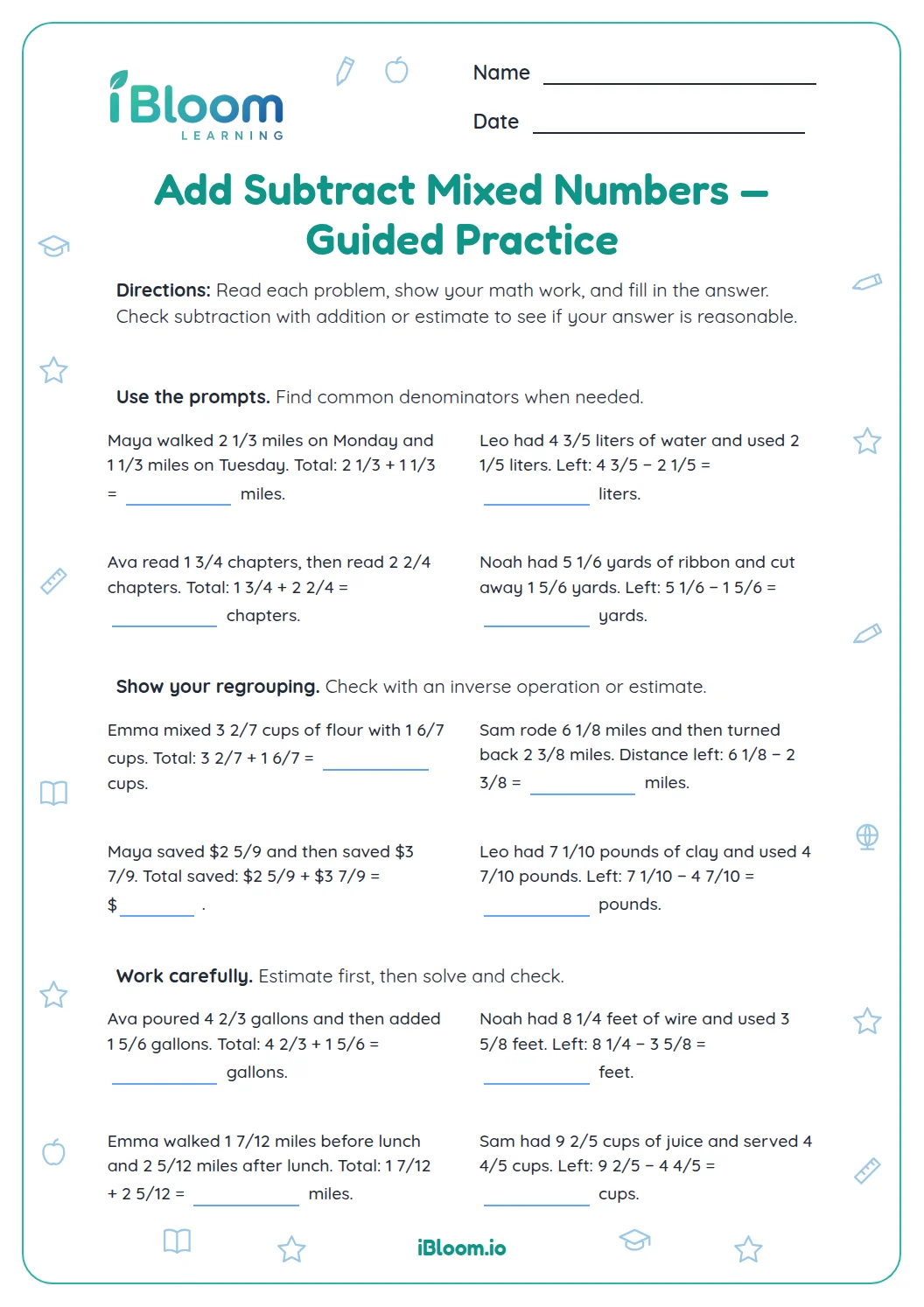
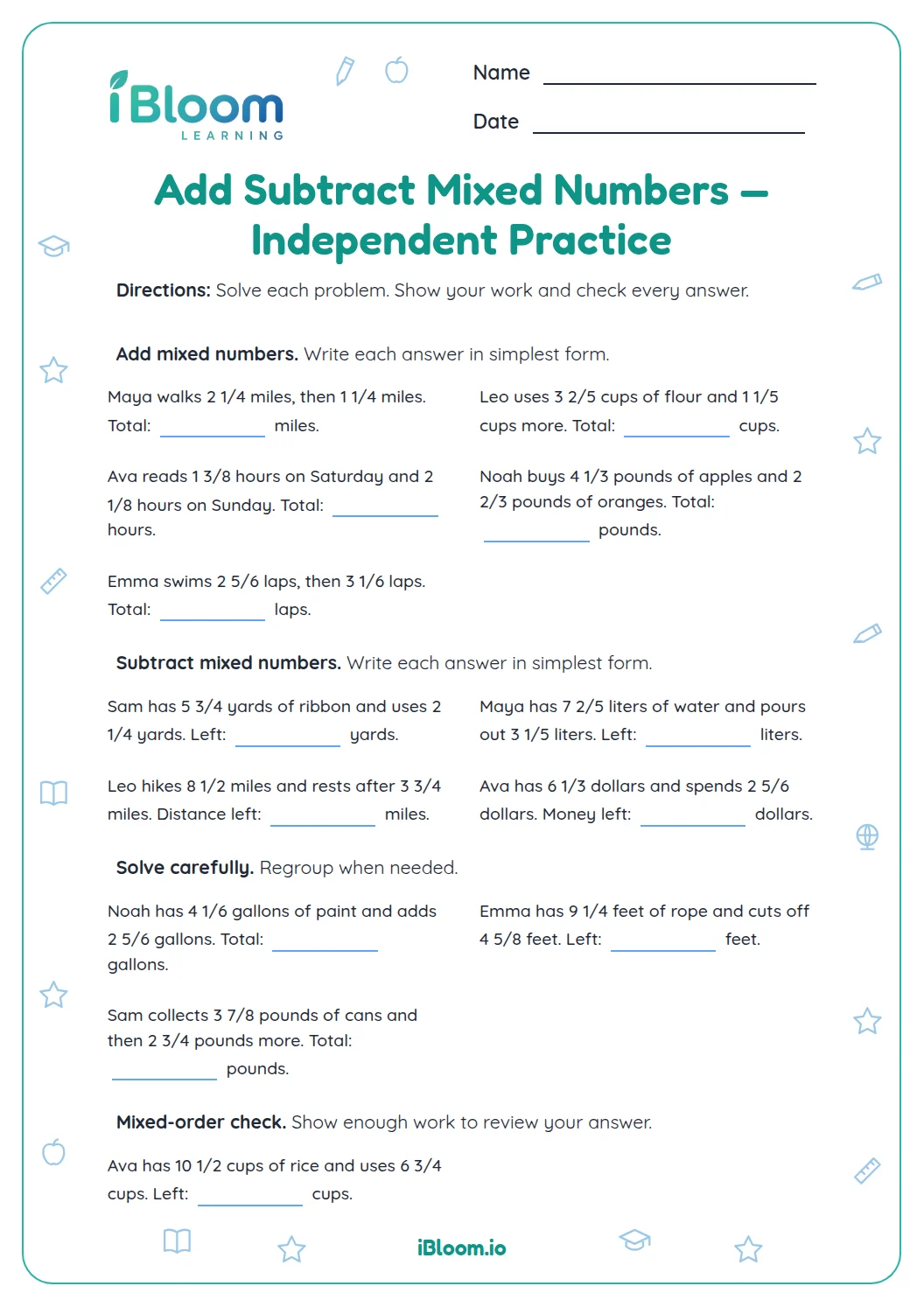
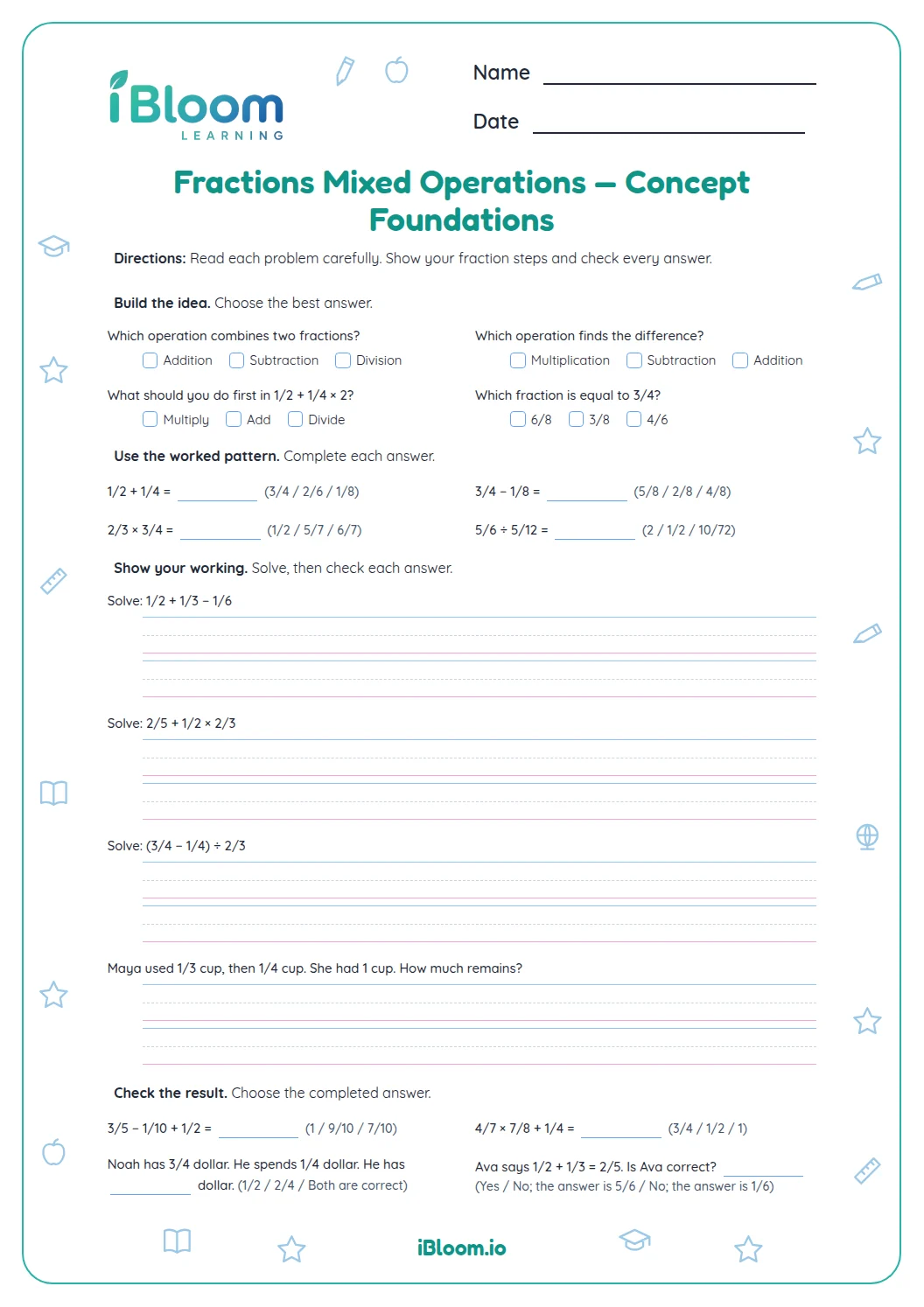
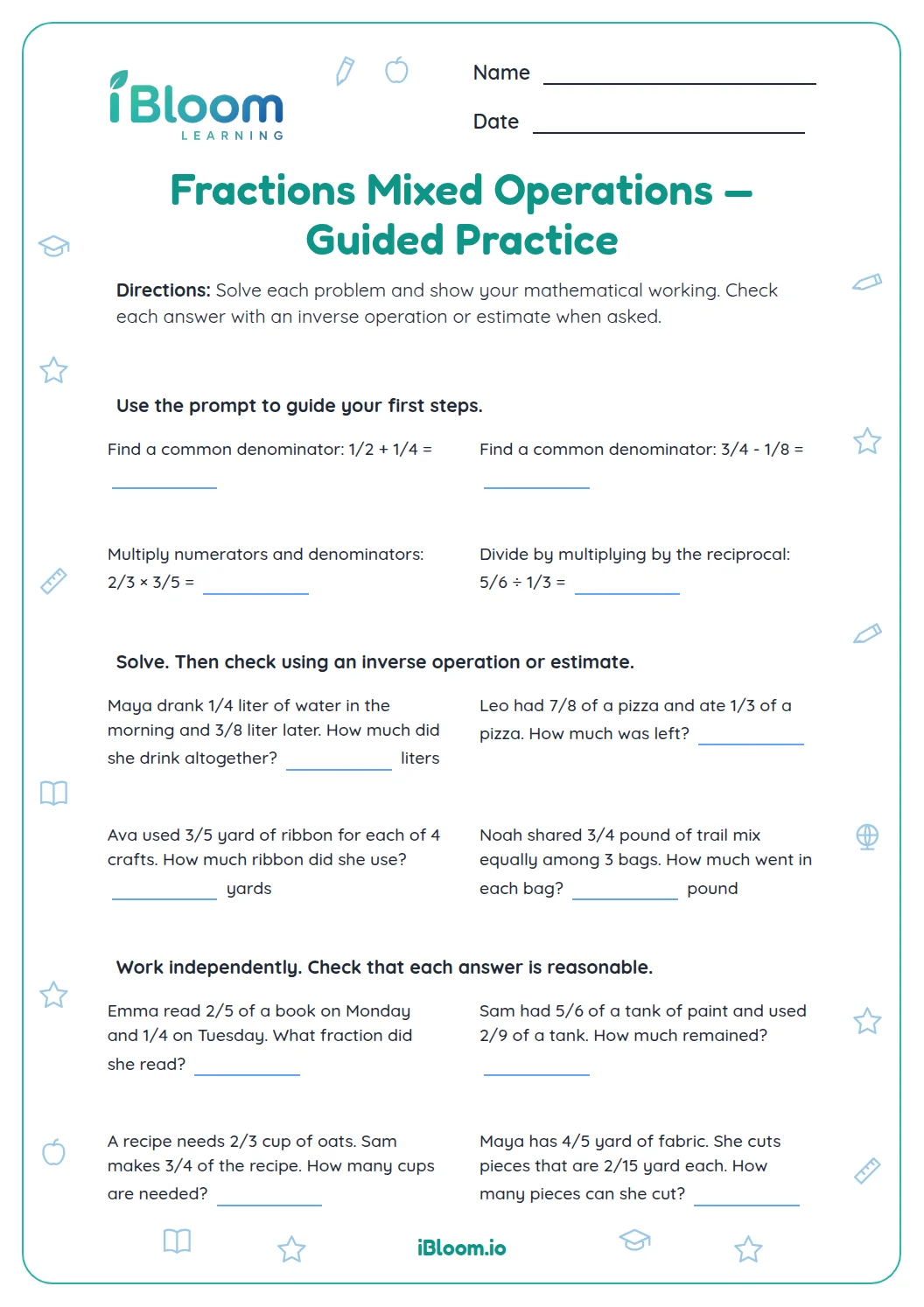
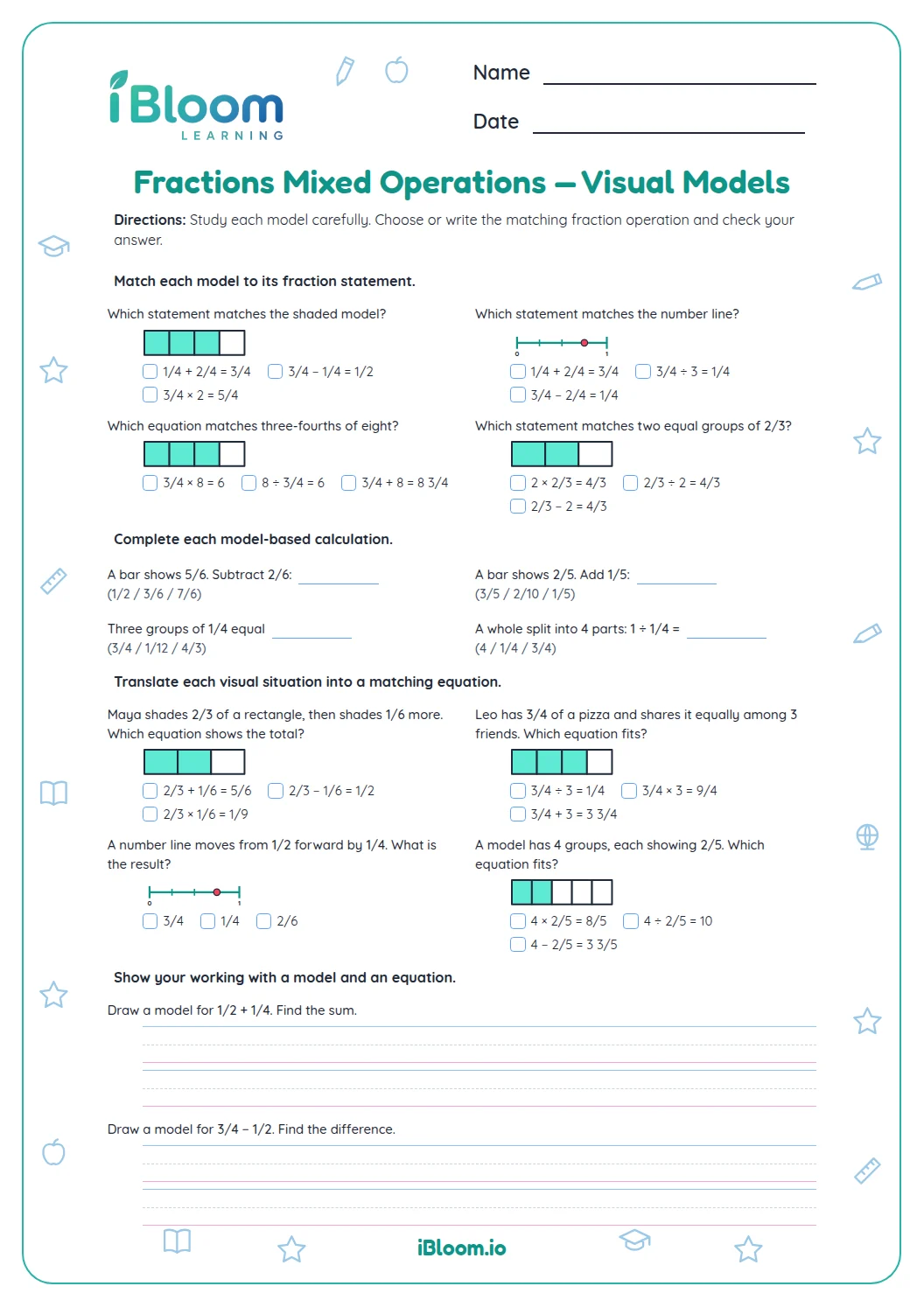
This free printable is for Grade 5 learners solving addition and subtraction fraction stories. Fourteen questions move from correcting common calculation slips to estimating, comparing, and completing real-world problems with unlike denominators. Learners write answers for same-whole situations and can use scratch paper to check whether each result is reasonable. A separate answer key lists the expected values. The worksheet practices CCSS 5.NF.A.2 through fraction problems and benchmark estimates.
Aligned to 5.NF.A.2
How do learners spot a fraction mistake?
Part A asks learners to repair errors such as adding denominators or subtracting unlike denominators without renaming. They write the correct result or missing numerator, making each correction concrete.
- 1Question 2 asks what to do before 5/8 − 1/4.
- 2Rename 1/4 as 2/8, then subtract the numerators: 3/8.
How can benchmarks help check an answer?
Part B asks learners to use benchmarks to judge a sum and compare addition with subtraction. These choices make the size and direction of each operation part of the reasoning.
What should go into a fraction story equation?
Part B provides eight brief situations involving the same whole. Decide whether to add or subtract, rename fractions when needed, and complete each equation with a result and unit when the story has one.
How to use this worksheet
- 1Read the whole story and identify the shared whole or unit.
- 2Decide whether the situation combines amounts or finds a difference.
- 3Rename the fractions with a common denominator when needed.
- 4Calculate and simplify, then write a result that fits the story and unit.
- 5Use a benchmark or the story context to check that the answer makes sense.
Common mistakes and quick fixes
The mistake
Adding the denominators when adding fractions.
The fix
Rename the fractions with a common denominator, then add the numerators.
The mistake
Subtracting unlike fractions without renaming.
The fix
Rewrite the fractions as equivalent fractions with matching denominators first.
The mistake
Keeping a computed result that conflicts with the story.
The fix
Estimate with 0, 1/2, or 1 and check the answer’s size against the context.
Curriculum alignment
The questions use fraction equations, benchmark estimates, and same-whole story problems.
Learners solve fraction stories, estimate with benchmarks, and check whether answers make sense.
On this sheet: Learners diagnose fraction work, estimate a sum, and solve addition and subtraction stories with common and unlike denominators.
Show the official wordingHide the official wording
Solve word problems involving addition and subtraction of fractions referring to the same whole, including cases of unlike denominators, e.g., by using visual fraction models or equations to represent the problem. Use benchmark fractions and number sense of fractions to estimate mentally and assess the reasonableness of answers. For example, recognize an incorrect result 2/5 + 1/2 = 3/7, by observing that 3/7 < 1/2.
What to practice next
Make more practice
Further reading
Questions parents and teachers ask
What makes this a fraction reasoning challenge?
Learners first repair incorrect fraction work by writing a valid result or missing equivalent numerator. They then estimate, compare, and complete eight short stories. The questions use addition and subtraction with like and unlike denominators, so the page practices reasoning as well as calculation.
Do the word problems use unlike denominators?
Yes. The stories include sums and differences with unlike denominators, such as 2/3 cup plus 1/2 cup and 2 1/4 miles minus 5/6 mile. Learners can write an equation, rename fractions when needed, and include the unit in an answer.
How can a learner check an estimate?
Use familiar benchmarks such as 0, 1/2, and 1 to judge the size of each fraction. For example, 3/4 is more than 1/2 and 5/12 is close to 1/2, so their sum must be greater than 1; exact calculation can confirm the estimate.
Is there space to show the calculations?
Each problem has a short line for the answer. Learners can use scratch paper to write an equation, show equivalent fractions, and track units such as cups, miles, liters, or yards before recording the result. Two early prompts also ask for an estimate and comparison.
What does the answer key include?
The separate key gives the selected corrections, sample reasoning for the two explanation prompts, and simplified results for each story. Equivalent fraction or mixed-number forms are acceptable when they name the same amount, and a matching unit should appear for measured quantities.