









About this worksheet
This free Grade 6 worksheet gives students 14 real-world problems involving prime factorization and equal groups. Learners factor totals such as 84 and 150, use division to find how many objects fit in each bag or pile, and check whether factor products are correct. The worksheet has three parts that move from factoring to application and explanation, plus a separate answer key.
How do you break a number into prime factors?
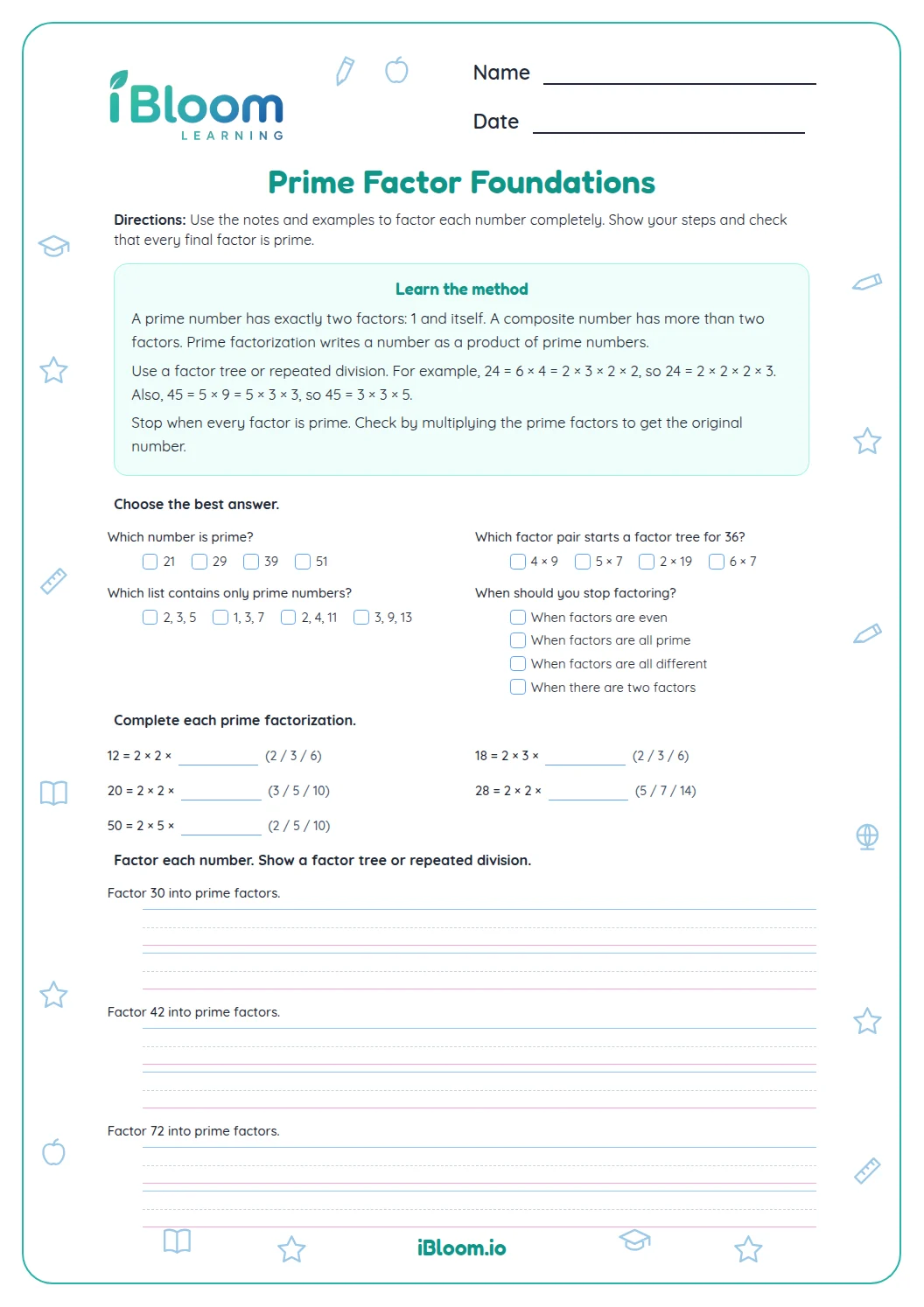
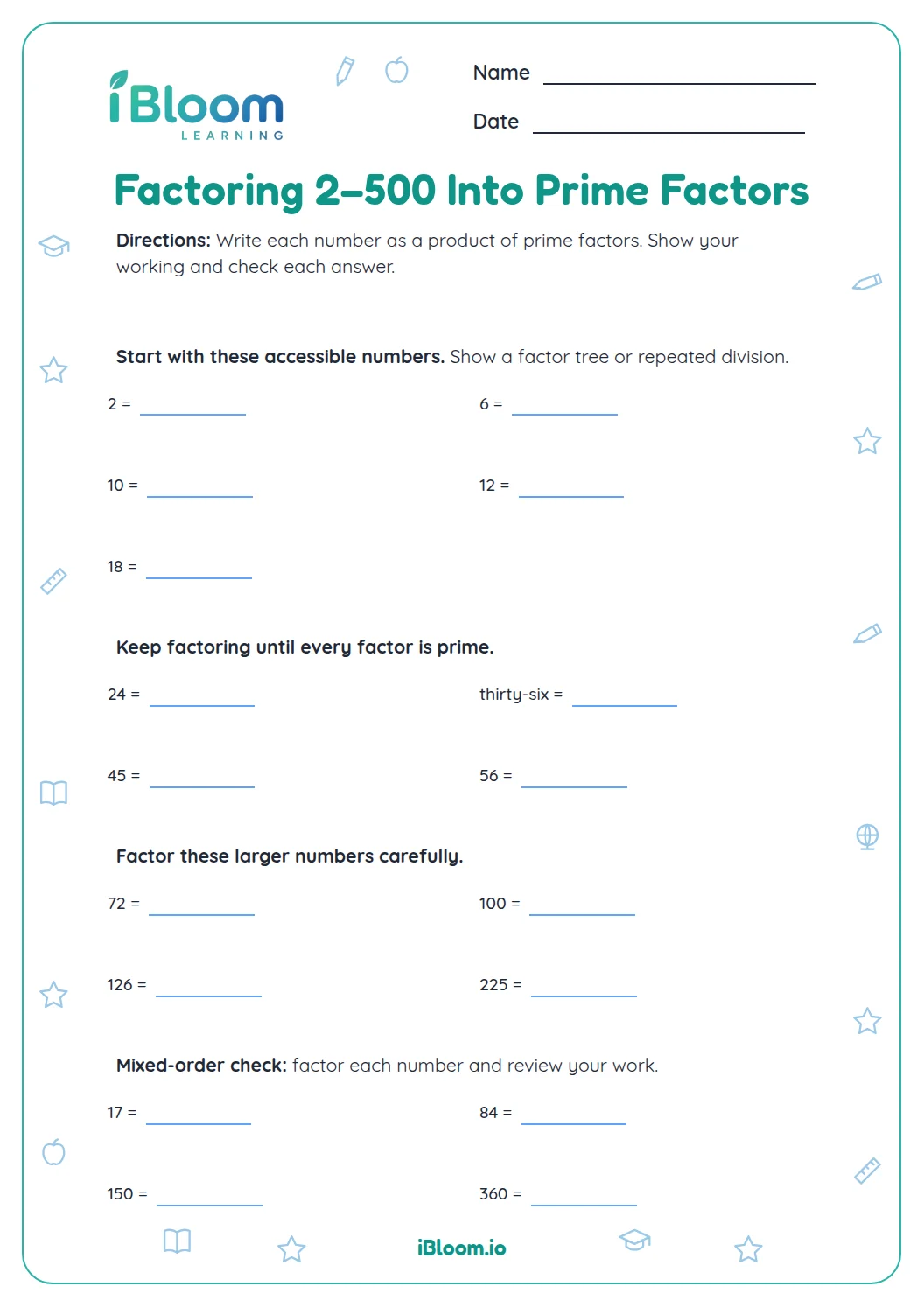
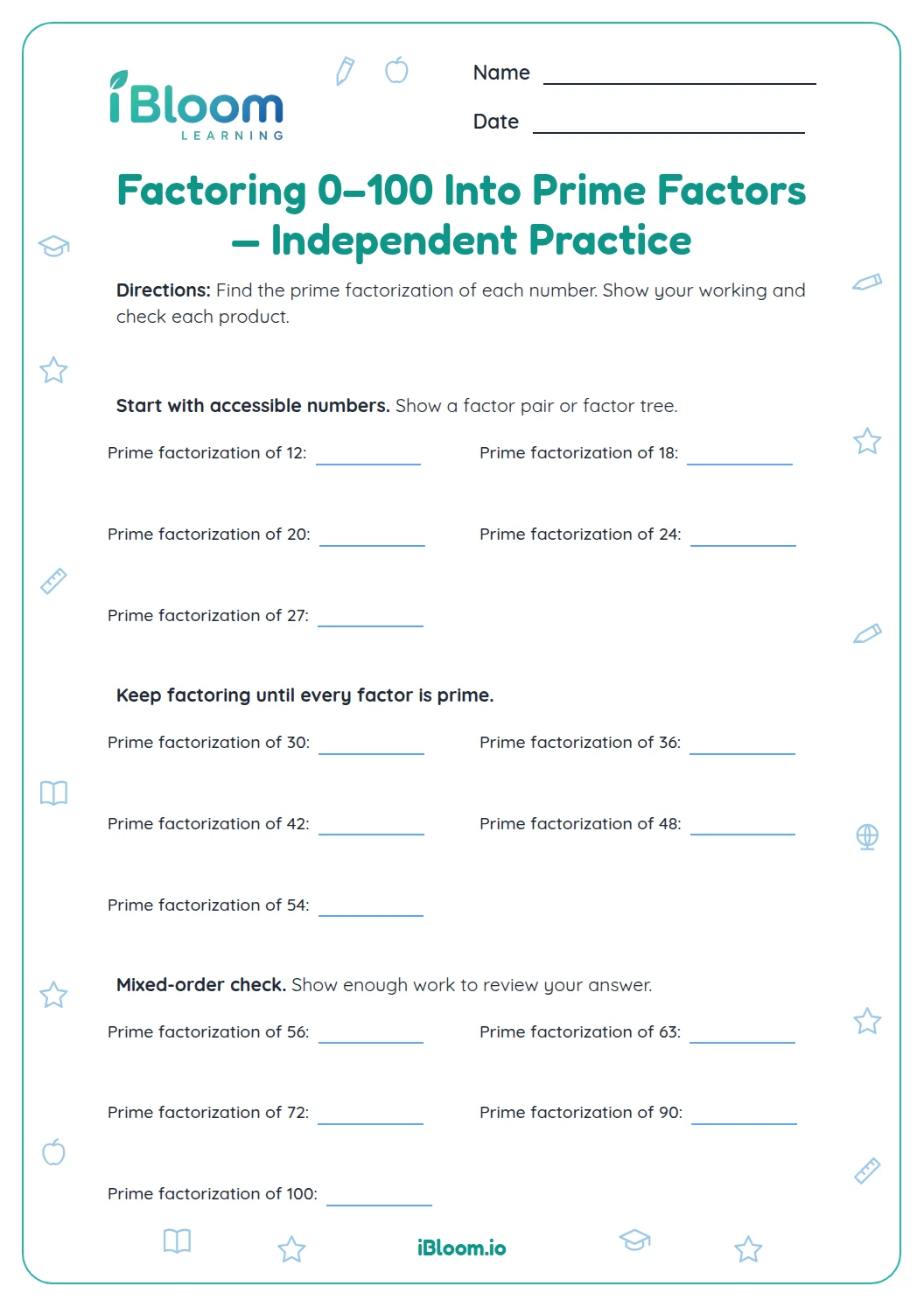
Divide by a prime number, then keep factoring each quotient until every factor is prime. A factor tree is one way to organize the steps. In Part A, question 1 asks for 84: 84 = 2 × 42 = 2 × 2 × 21 = 2² × 3 × 7.
- 184 ÷ 2 = 42
- 242 ÷ 2 = 21
- 321 = 3 × 7
- 4So 84 = 2² × 3 × 7
How do the factors help with equal groups?
A factor is a number that divides a total without a remainder. If 168 counters are divided among 7 team bags, calculate 168 ÷ 7 = 24 counters per bag. The prime factorization 168 = 2³ × 3 × 7 includes the 7 that matches the number of bags.
How can you check a factorization?
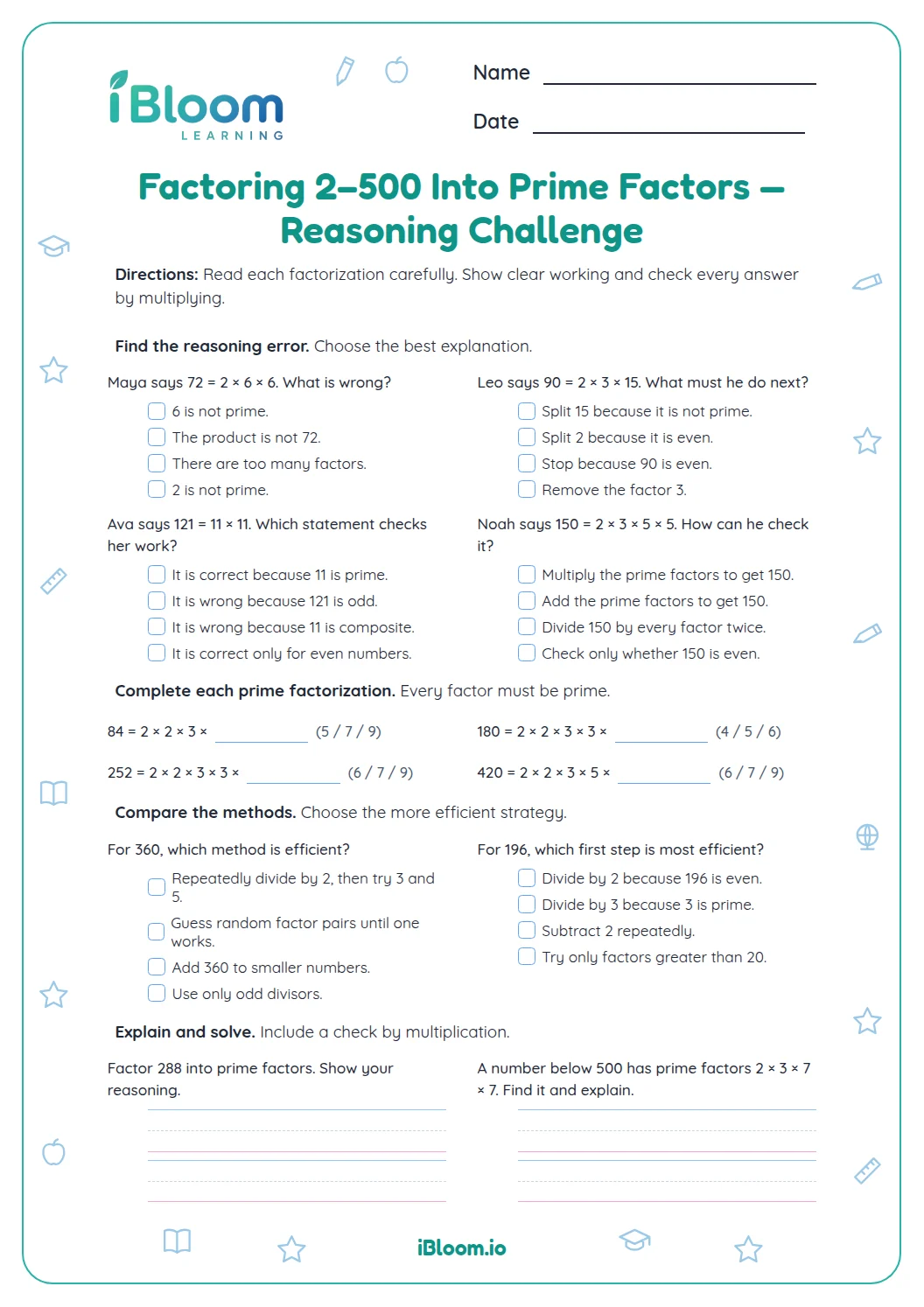
Multiply the prime factors back together. For 150, 2 × 3 × 5 × 5 = 150. Also check that every factor is prime; a product such as 2 × 3 × 25 is equal to 150, but 25 still needs to be factored into 5 × 5.
- Part A: factor each total in a short story.
- Part B: use division to solve equal-group situations.
- Part C: select, verify, and explain prime factor products.
How to use this worksheet
- 1Write a factor tree for the first total, splitting by a small prime such as 2 or 3.
- 2Continue factoring each branch until every end number is prime.
- 3Write the prime factors in increasing order; use an exponent for repeats if you like.
- 4For a group story, divide the total by the number of groups or objects per group.
- 5Multiply the prime factors back together to check the original total.
Common mistakes and quick fixes
The mistake
Stopping at a composite factor such as 9 or 25.
The fix
Break it again: 9 = 3 × 3 and 25 = 5 × 5.
The mistake
Dropping a repeated prime factor.
The fix
Keep every leaf from the factor tree; 2 × 2 is 2², not just 2.
The mistake
Dividing the story total by the wrong quantity.
The fix
Underline whether the story gives the number of groups or the size of each group, then choose the matching division.
What to practice next
Make more practice
Further reading
Questions parents and teachers ask
What does prime factorization mean?
Prime factorization writes a whole number as a multiplication sentence using only prime numbers. For example, 84 = 2 × 2 × 3 × 7, or 2² × 3 × 7. A prime number has exactly two factors, 1 and itself, so none of these factors can be broken down further. This makes the final product easy to check.
How does the worksheet connect factors to real situations?
The stories describe totals such as pencils, seedlings, badges, seats, and craft supplies. Children find the prime factors first, then use division to answer questions about equal bags, cartons, piles, or groups. Each answer can be checked by multiplying the group size by the number of groups.
Can a number have a factor that is not prime?
Yes. For 84, 2, 3, 4, 6, 7, 12, 14, 21, and 28 are factors, but only 2, 3, and 7 are prime. Prime factorization keeps breaking composite factors into smaller prime factors until none can be split. Then multiply the prime factors to check the product.
How do I check a prime factorization?
Multiply every listed prime factor, including repeated factors, and see whether the product is the original number. For 150, 2 × 3 × 5 × 5 = 150. If the product differs, check whether a factor was skipped or multiplied incorrectly.
What is included in the answer key?
The separate key gives the prime products, quotient answers for equal groups, and sample explanations for the reasoning prompts. For open responses, answers can use equivalent wording as long as all prime factors multiply to the stated total and the group claim is accurate.
How many questions are on the printable?
There are 14 questions in three parts. Part A asks for prime factorization in short stories, Part B applies division to equal groups, and Part C checks factorization and explains a choice. The worksheet is set across two worksheet pages, with a separate answer key.