



About this worksheet
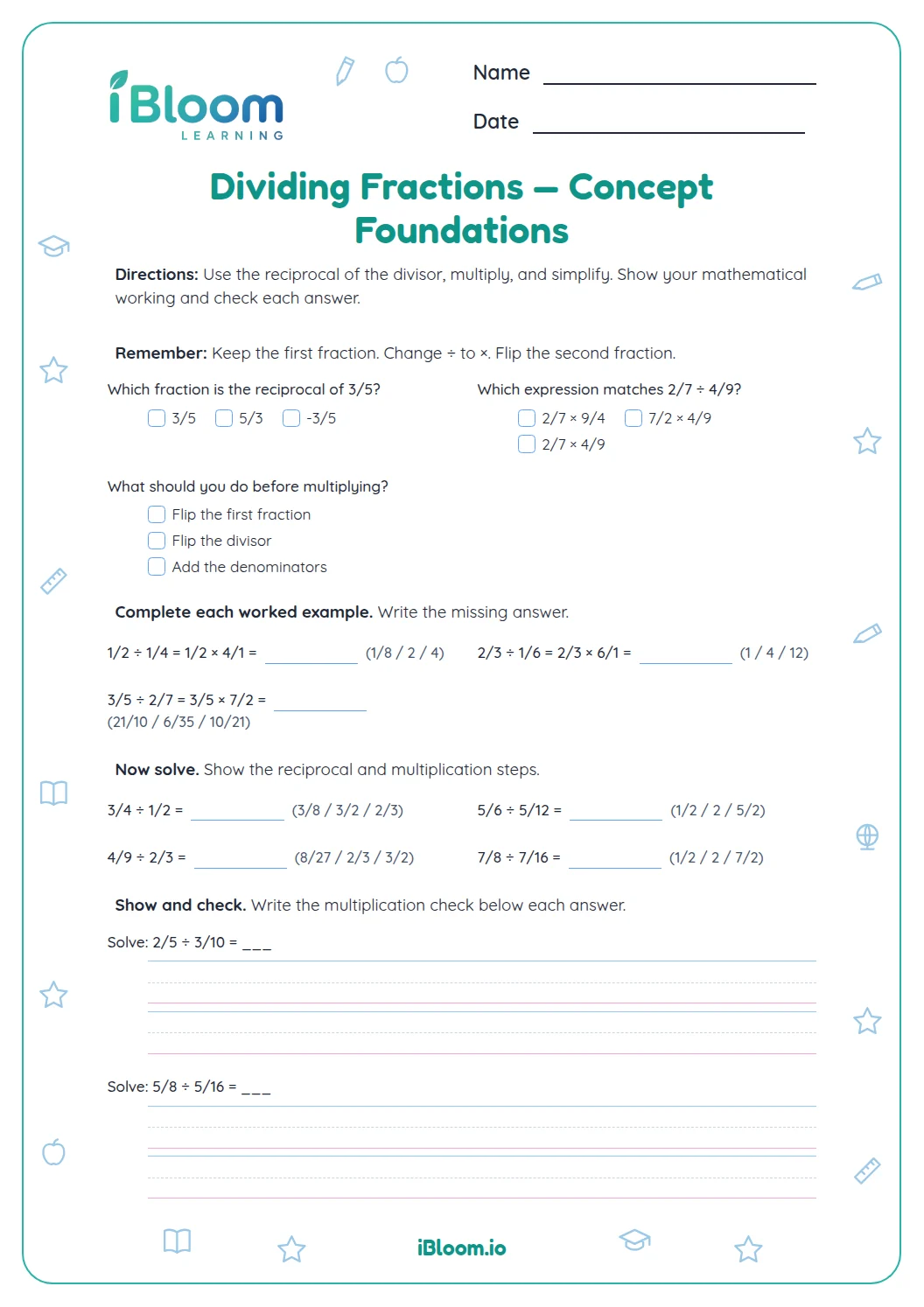
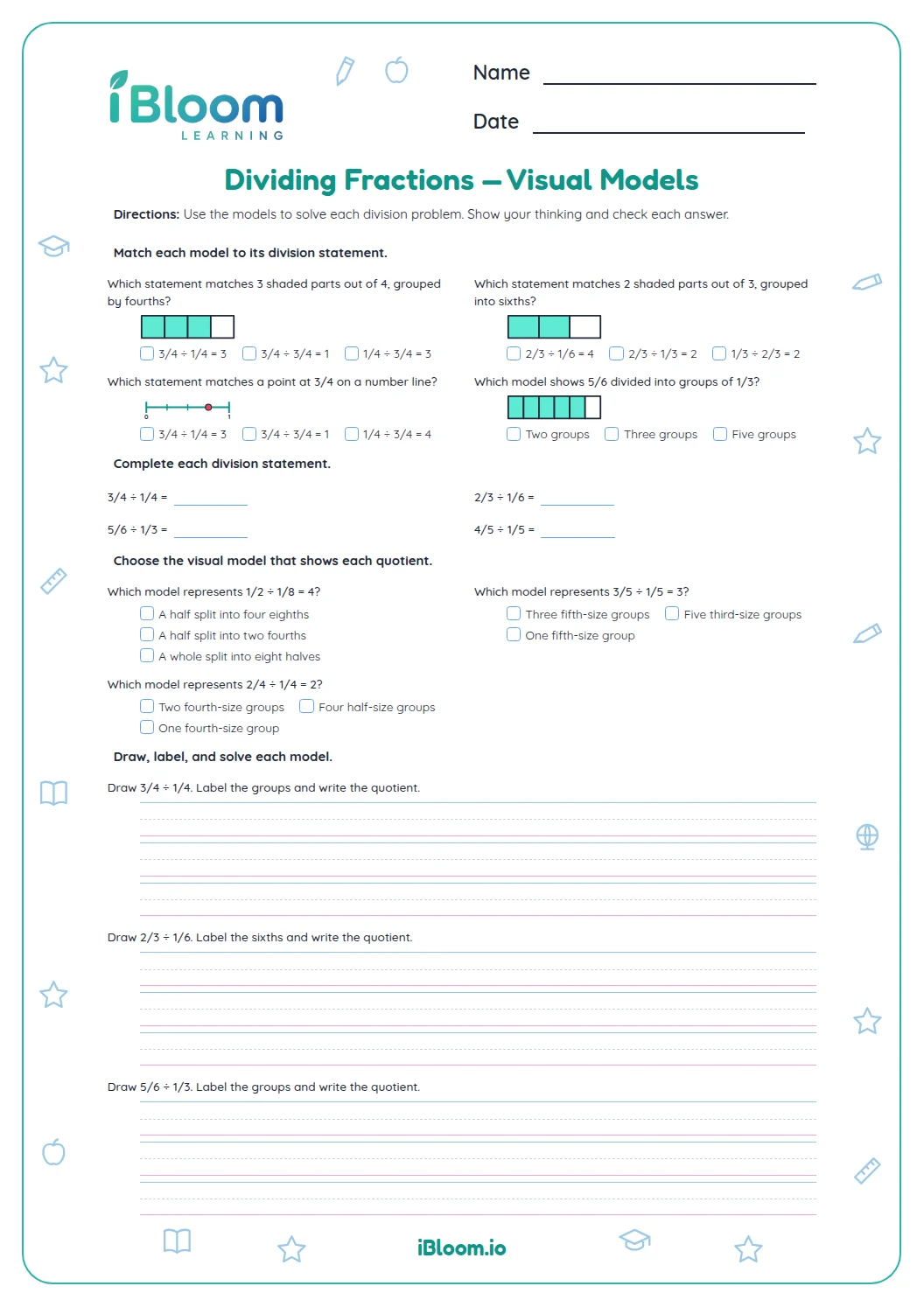
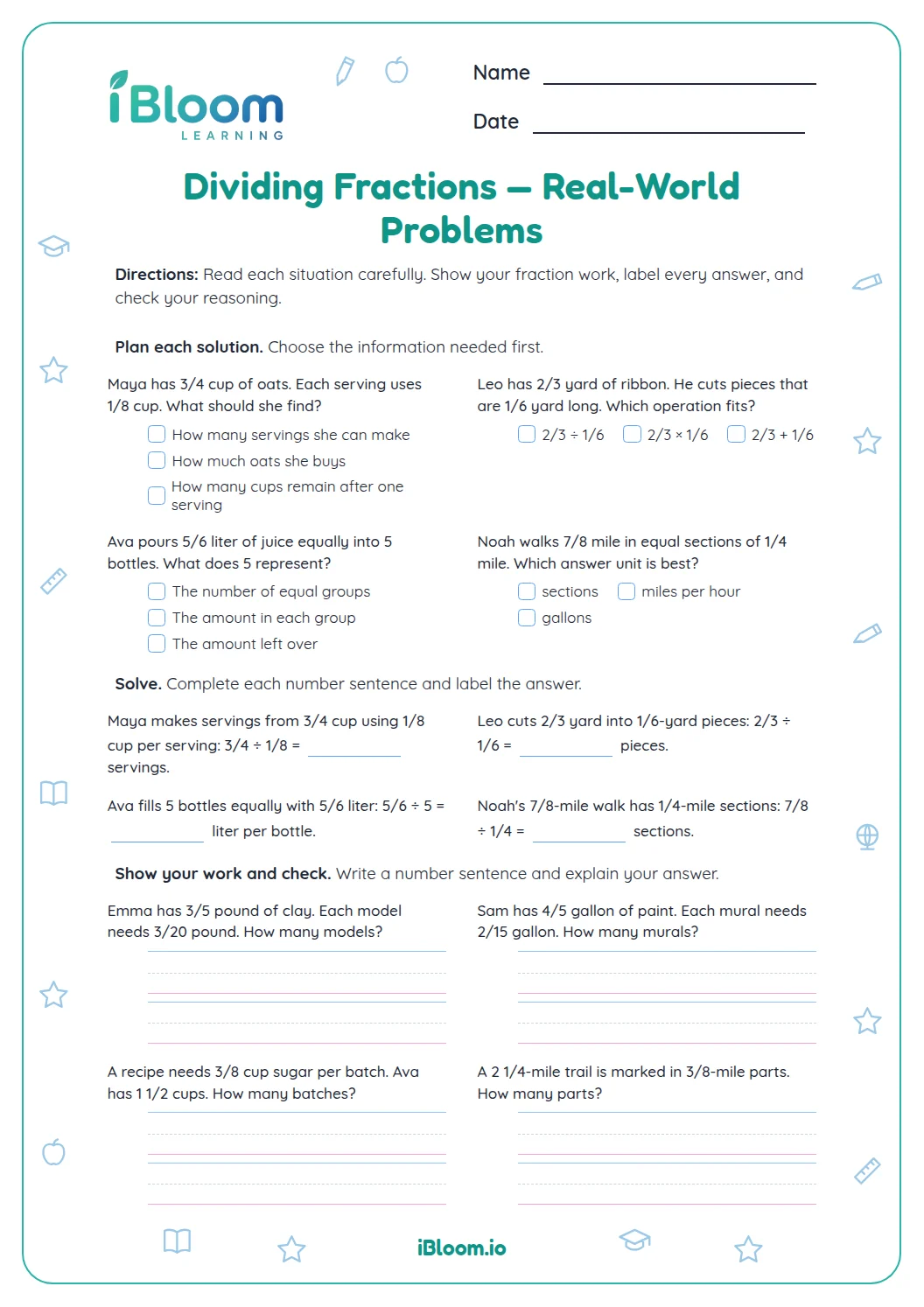
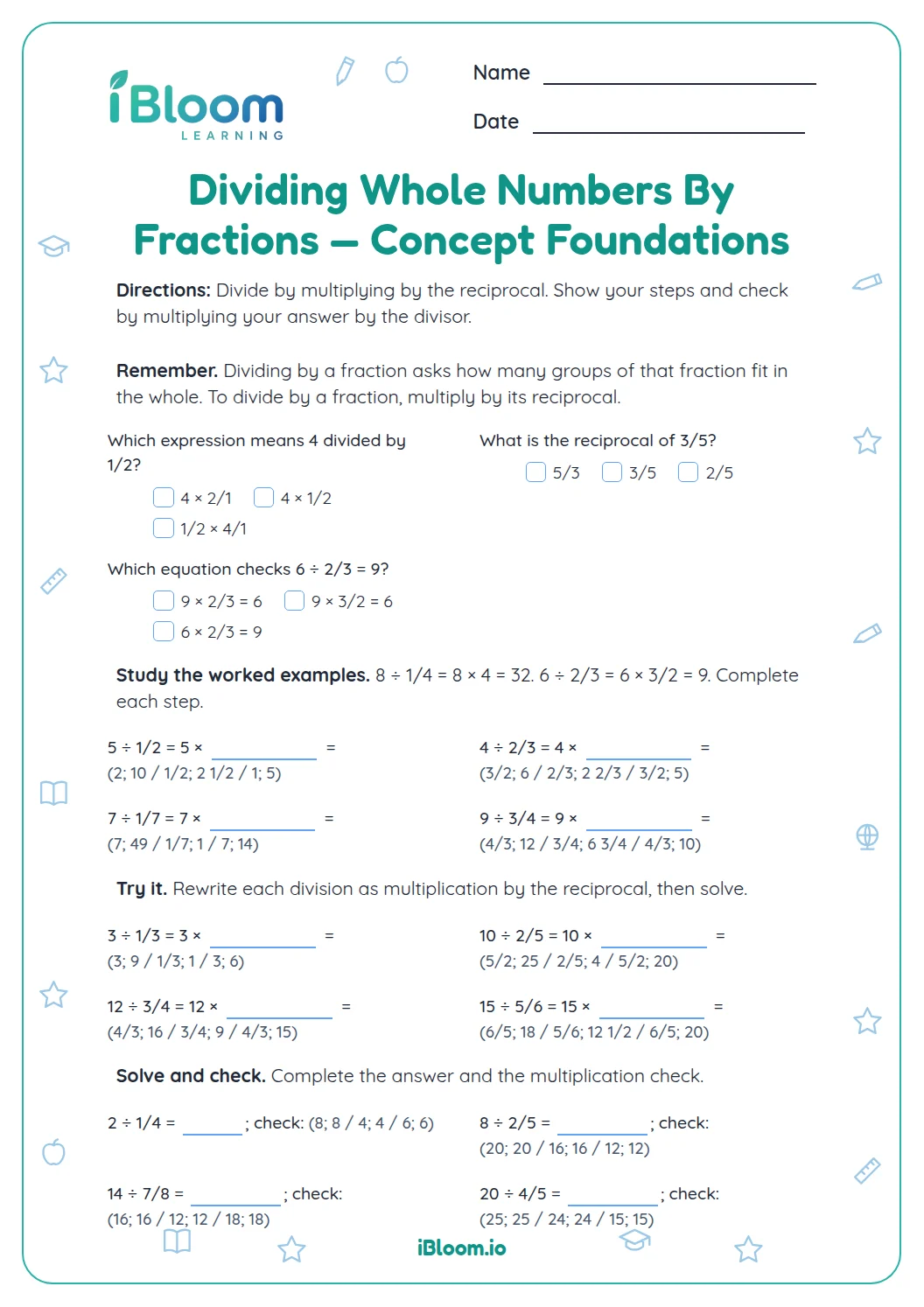
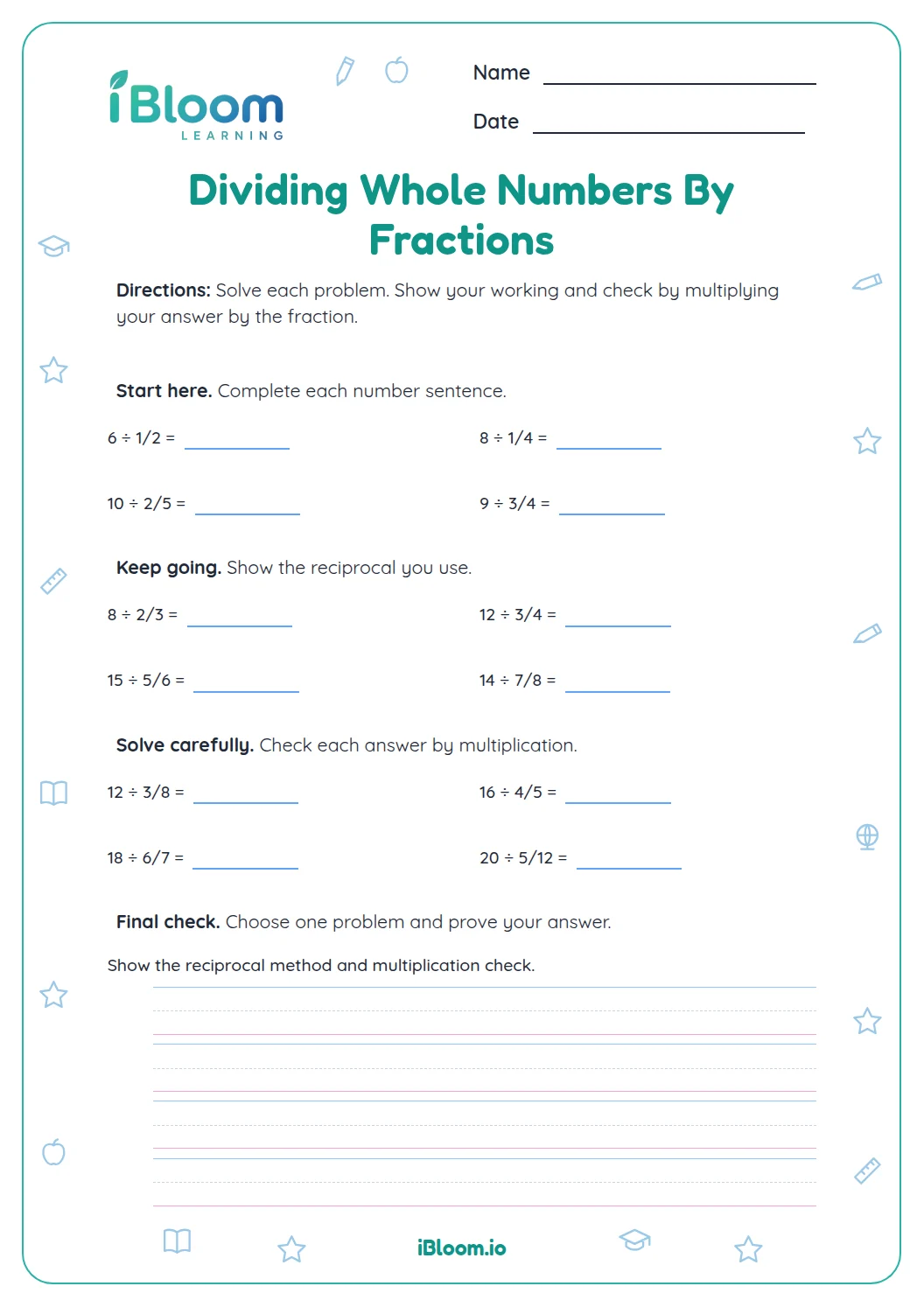
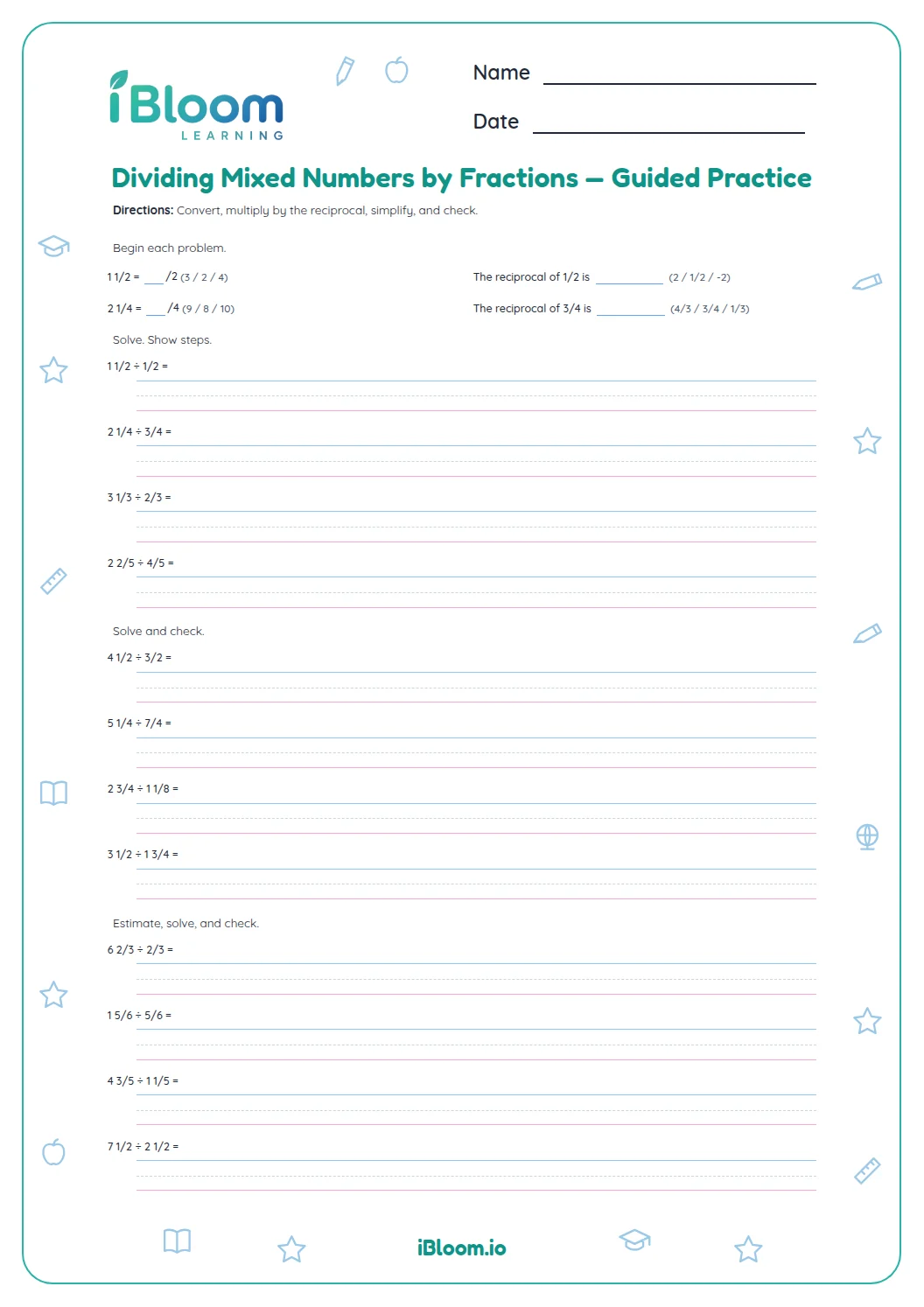
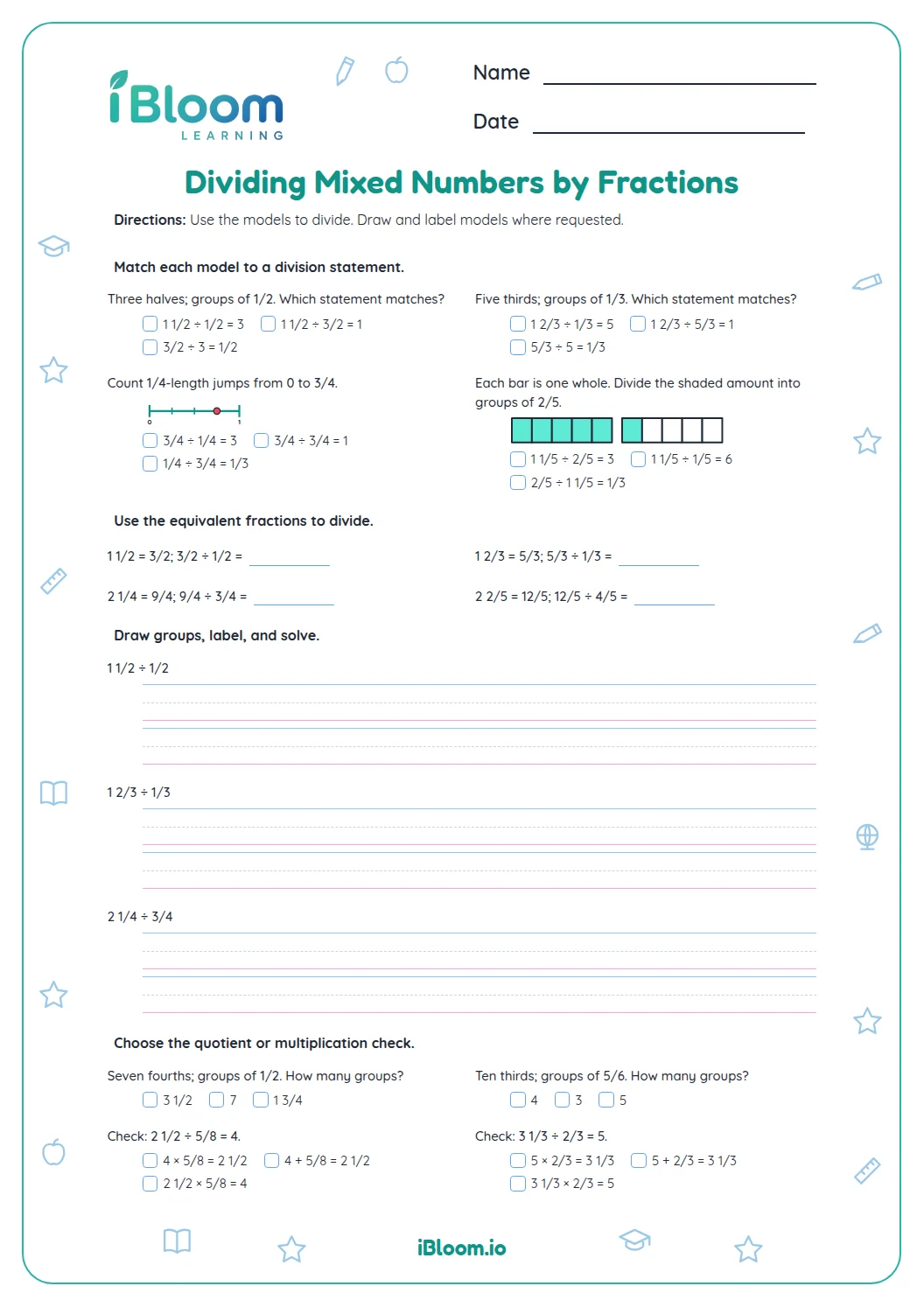
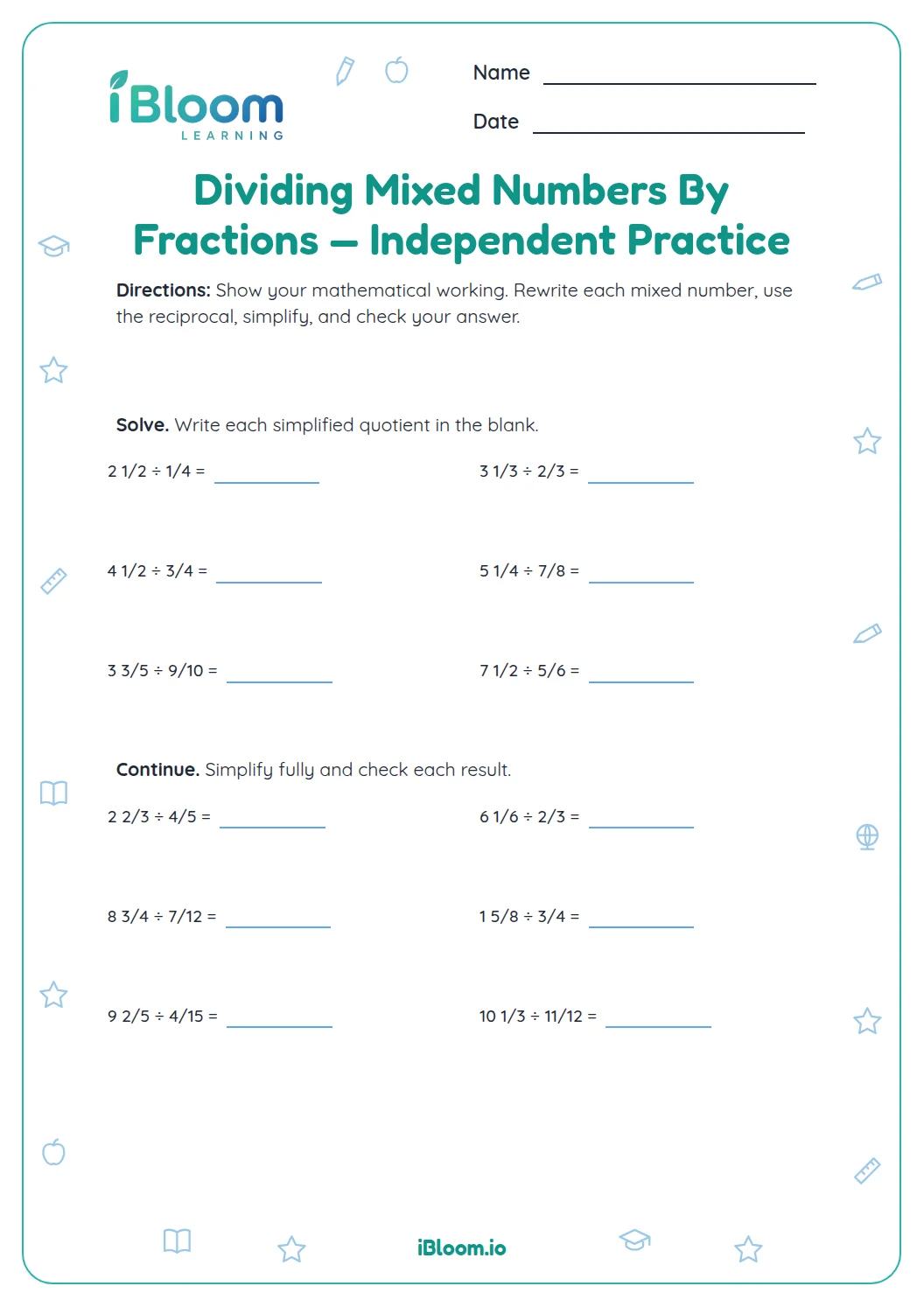
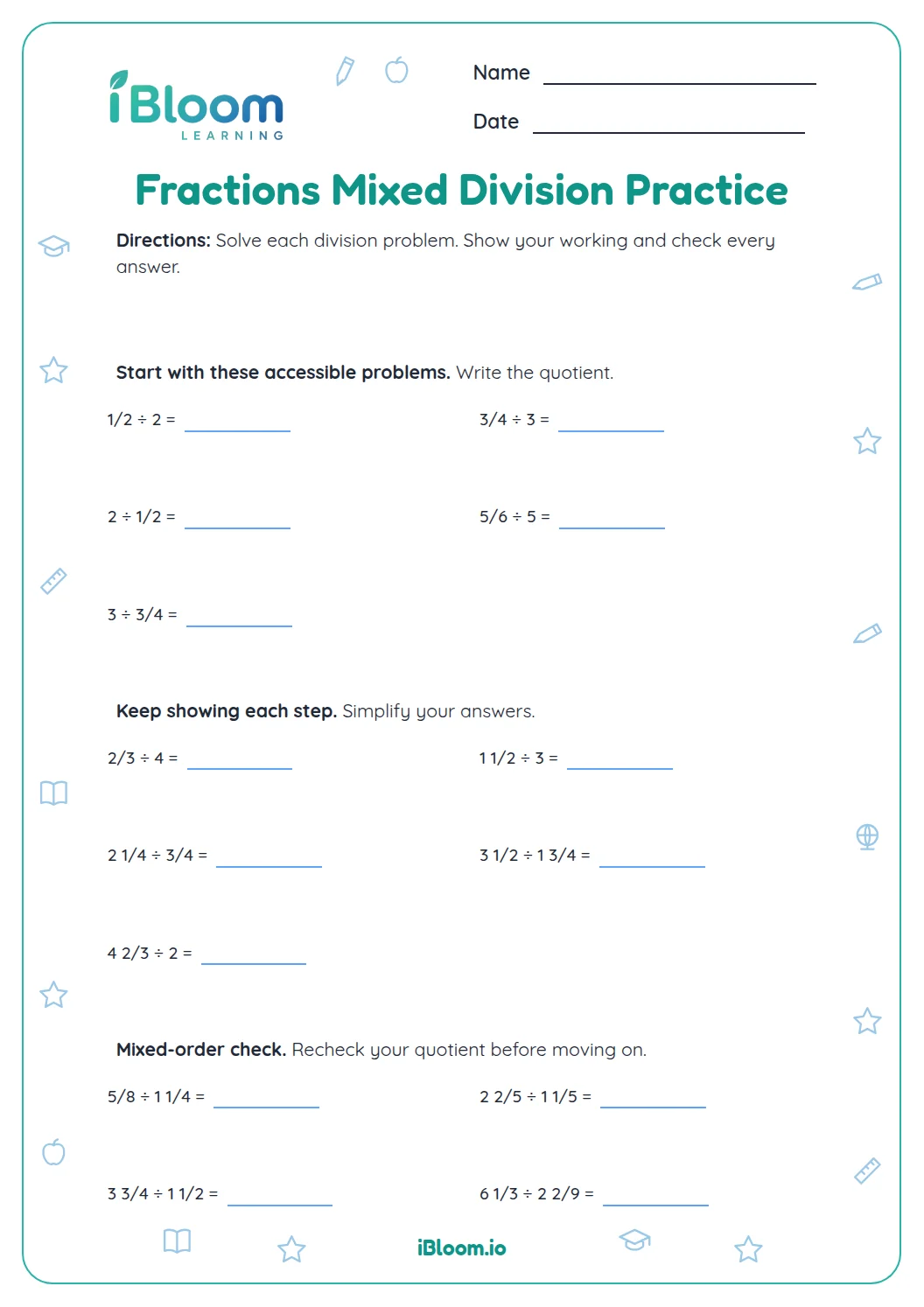
This Grade 6 printable practices dividing fractions by fractions, simplifying quotients, and interpreting division in equal-size groups. Learners multiply by the reciprocal, compare quotient sizes, and solve short measurement situations. The page practices Common Core 6.NS.A.1: interpreting and computing quotients of fractions and solving fraction-division word problems.
Aligned to 6.NS.A.1
How does multiplying by the reciprocal work?
Keep the first fraction, change division to multiplication, and flip the second fraction. In Question 2, 3/4 ÷ 1/8 becomes 3/4 × 8/1 = 6.
What does a fraction quotient count?
It counts how many groups of the divisor fit in the dividend. Six pieces of 1/8 yard fit in 3/4 yard, so 3/4 ÷ 1/8 = 6 pieces.
How can you check the quotient?
Multiply the quotient by the divisor and see whether the product is the dividend. For 4/5 ÷ 2/3 = 6/5, check 6/5 × 2/3 = 12/15 = 4/5.
How to use the worksheet
- 1Keep the first fraction unchanged.
- 2Replace division with multiplication.
- 3Use the reciprocal of the second fraction.
- 4Multiply and simplify the quotient.
- 5For a word problem, name what one group represents and check by multiplying back.
Check for these slips
The mistake
Taking the reciprocal of both fractions.
The fix
Keep the dividend as written and flip only the divisor.
The mistake
Multiplying straight across without changing division.
The fix
Rewrite the division as multiplication by the divisor’s reciprocal first.
The mistake
Giving a fraction count without interpreting the context.
The fix
State how many pieces or servings fit and keep the unit from the problem.
Curriculum alignment
This worksheet practices the listed Common Core math skills.
Compute and interpret quotients of fractions in problems.
On this sheet: The questions give direct practice with this skill.
Show the official wordingHide the official wording
Interpret and compute quotients of fractions, and solve word problems involving division of fractions by fractions, e.g., by using visual fraction models and equations to represent the problem. For example, create a story context for (2/3) ÷ (3/4) and use a visual fraction model to show the quotient; use the relationship between multiplication and division to explain that (2/3) ÷ (3/4) = 8/9 because 3/4 of 8/9 is 2/3. (In general, (a/b) ÷ (c/d) = ad/bc.) How much chocolate will each person get if 3 people share 1/2 lb of chocolate equally? How many 3/4-cup servings are in 2/3 of a cup of yogurt? How wide is a rectangular strip of land with length 3/4 mi and area 1/2 square mi?
What to practice next
Make more practice
Further reading
Questions parents and teachers ask
How do I divide one fraction by another?
Keep the first fraction, change division to multiplication, and multiply by the reciprocal of the second fraction. For example, 3/4 ÷ 1/8 becomes 3/4 × 8/1, which equals 6. Simplify the product when the numerator and denominator share a factor.
Why can dividing make the answer larger?
A quotient counts how many groups of the divisor fit into the dividend. When the divisor is a small fraction, many such pieces may fit. For example, six pieces of size 1/8 fit into 3/4, so 3/4 ÷ 1/8 equals six.
What does the ribbon question measure?
It asks how many pieces of length 1/8 yard can be cut from 3/4 yard. Divide the total length by the length of one piece. The quotient is six pieces, and multiplying six by 1/8 yard checks the original 3/4 yard.
How can I check a fraction quotient?
Multiply the quotient by the divisor and see whether the product equals the dividend. For 4/5 ÷ 2/3, the quotient is 6/5; multiplying 6/5 by 2/3 gives 12/15, or 4/5. This reverses the division and confirms the result. The units match the original measurement.
Does the key show simplified answers?
Yes. The answer key lists simplified quotients and the correct reasoning choices. For story problems, check that the answer counts equal-size groups and that the unit matches the question, such as pieces of ribbon or servings of a cup. The contexts use yard, meter, and cup measures.