

About this worksheet
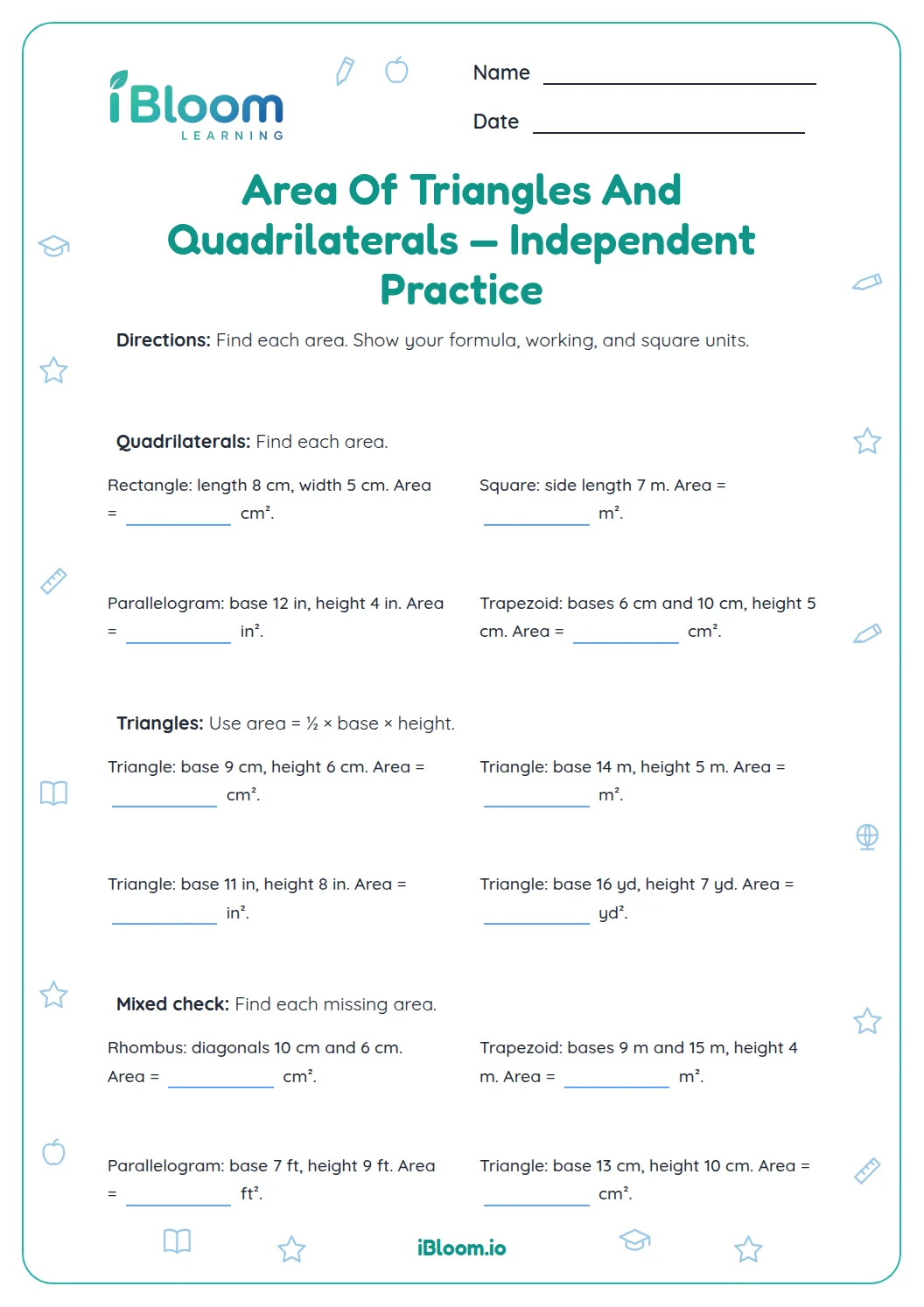
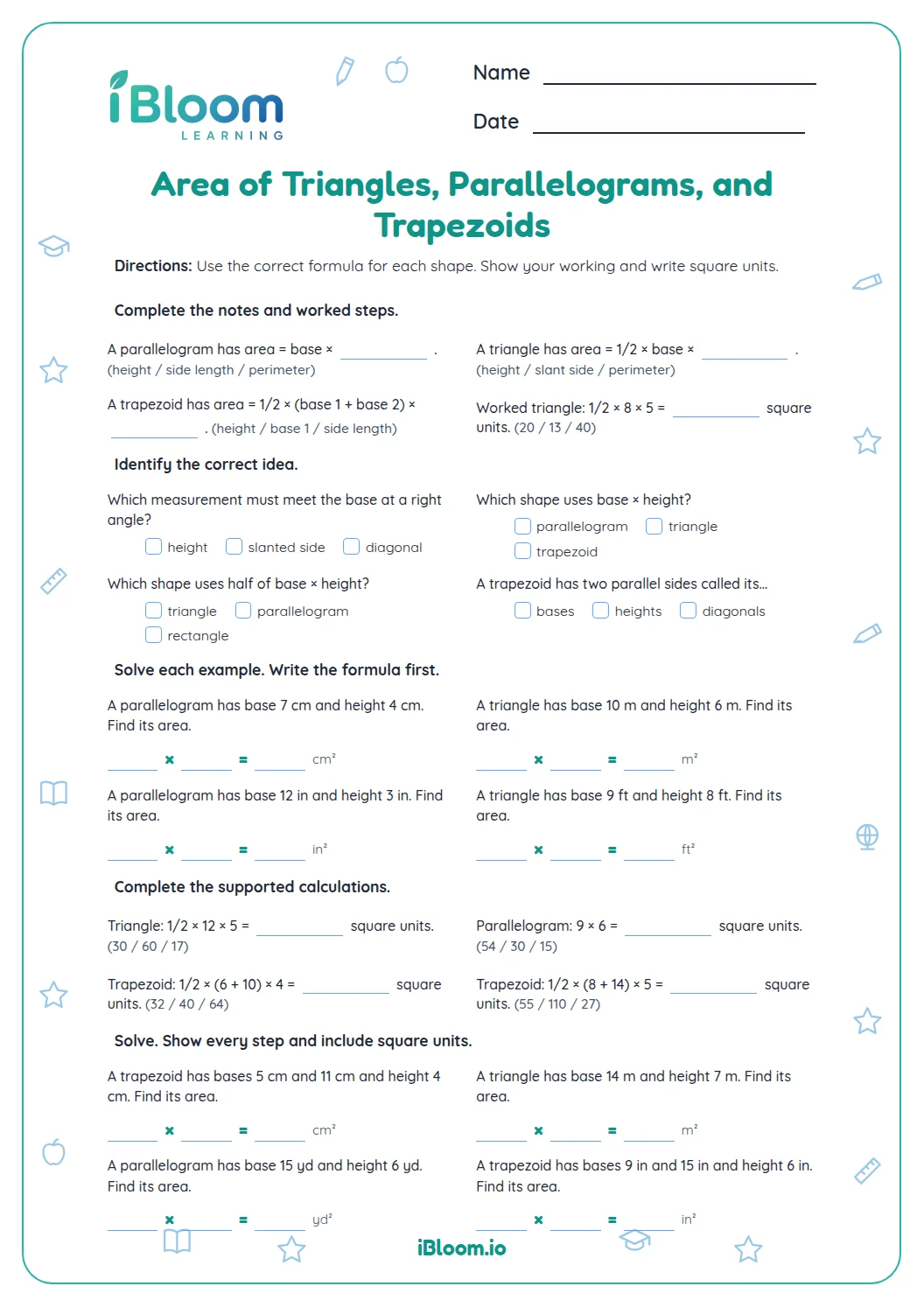
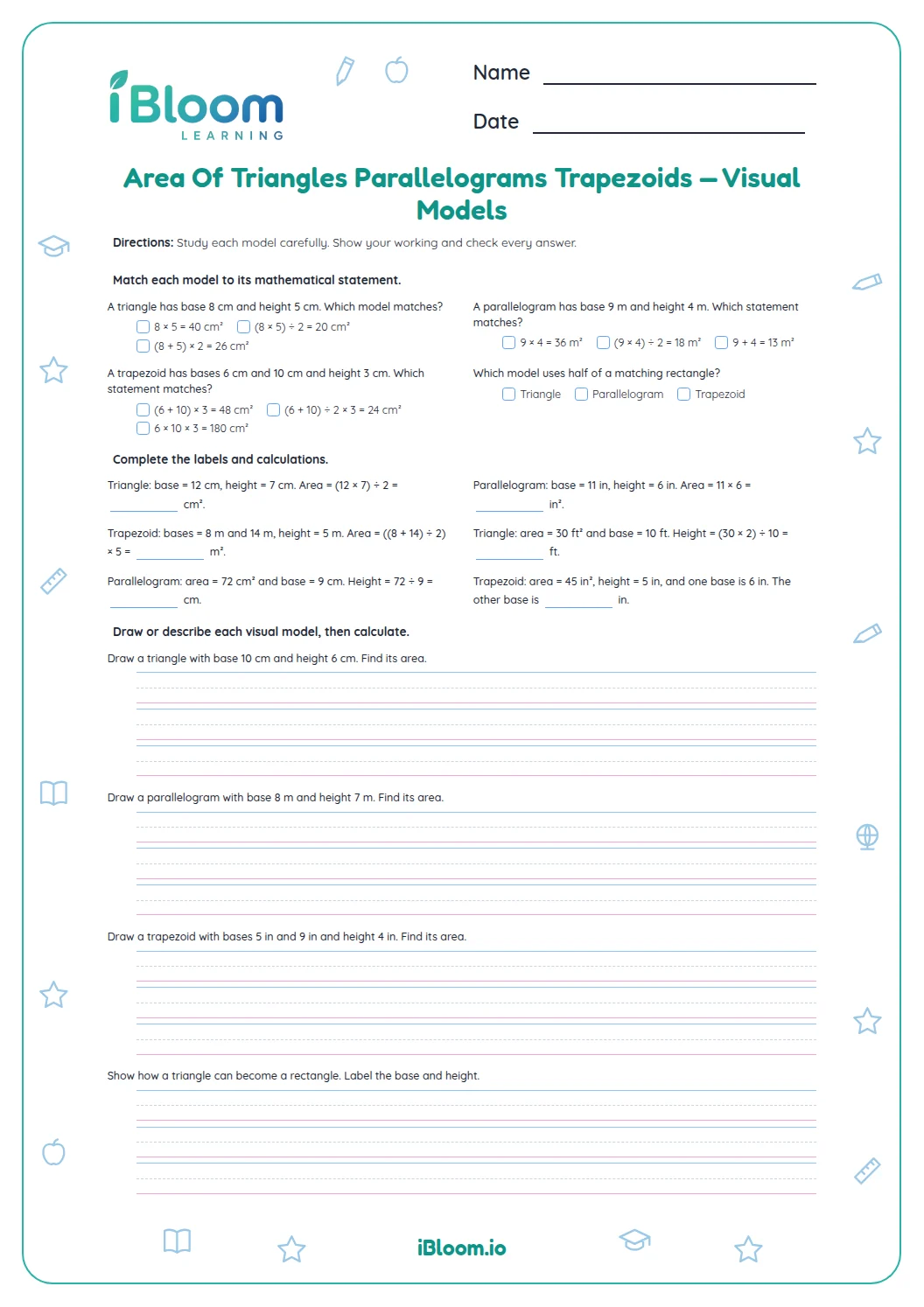
This free printable Grade 6 worksheet helps students practice triangle area applications. It aligns with Common Core 6.G.A.1: apply the triangle area formula to measurements in practical contexts. The sheet moves from supported models into independent practice and applied problems. A separate answer key gives concise answers for checking each item.
Aligned to 6.G.A.1
How do you find a triangle’s area?
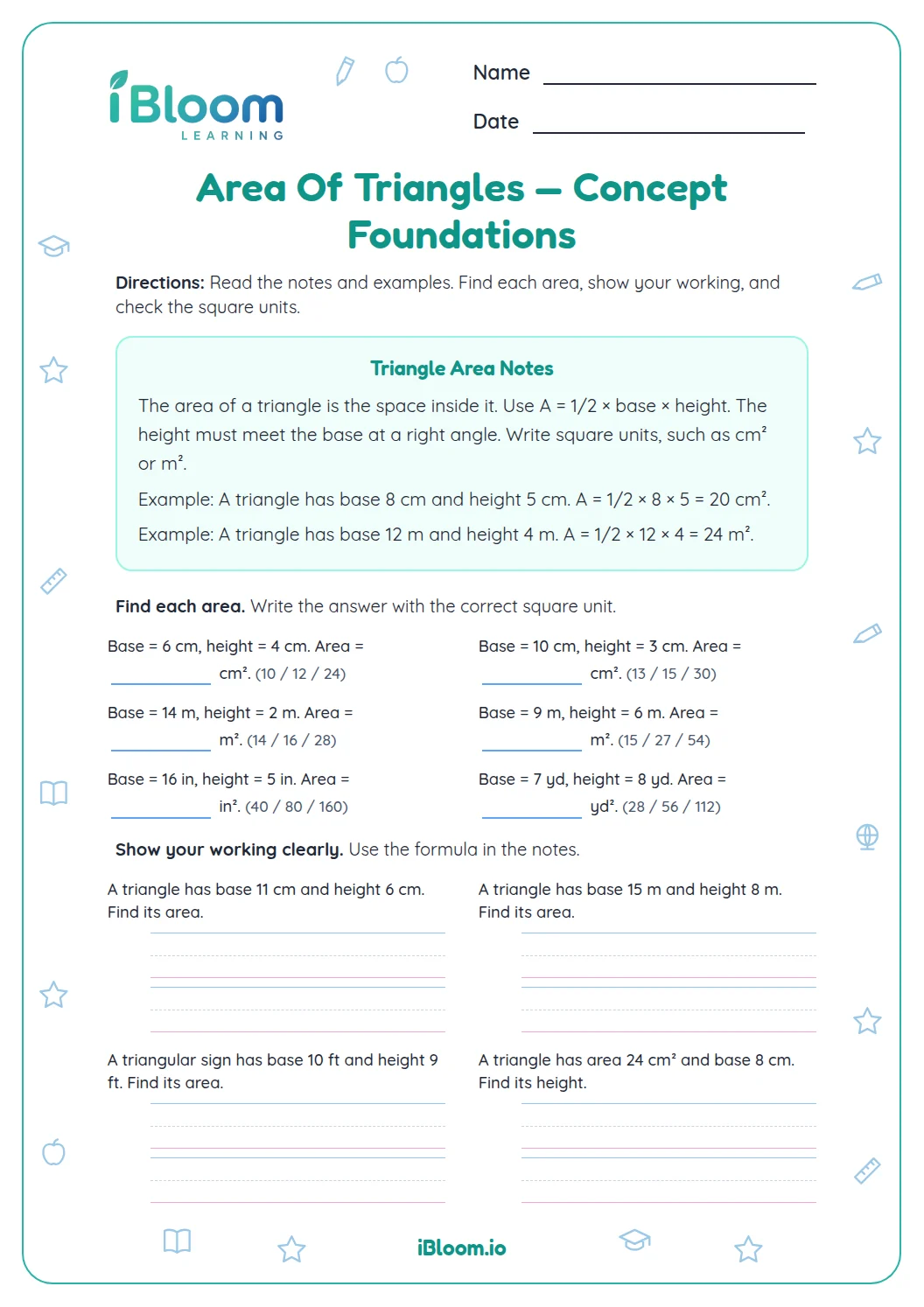
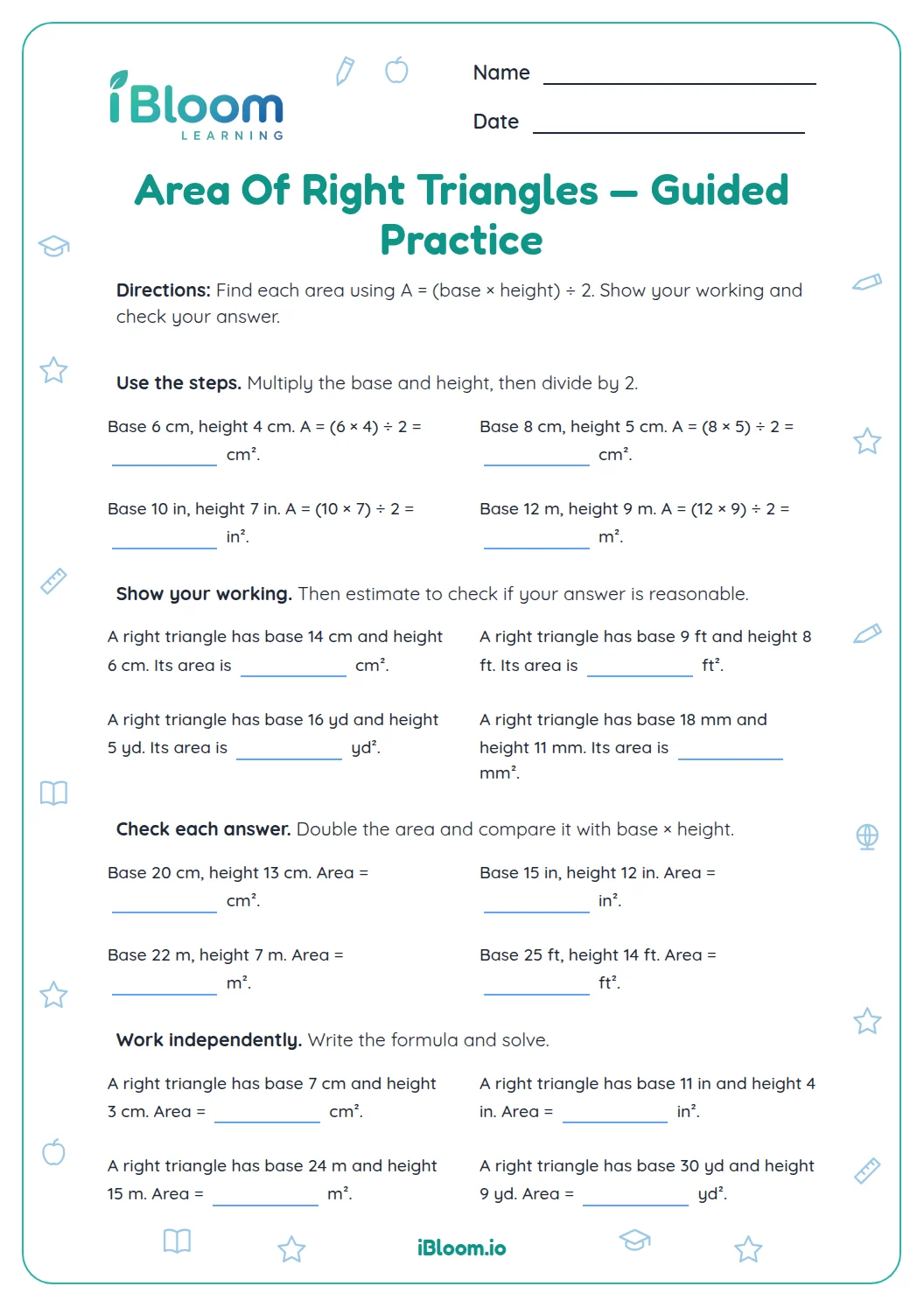
Multiply the base by its perpendicular height, then take half. In question 1, 1/2 × 8 × 5 = 20 square centimeters. The height must meet the base at a right angle.
- 1Base = 8 cm; height = 5 cm
- 2A = 1/2 × 8 × 5
- 3A = 20 cm²
Which measurements belong in the formula?
Use the stated base and its perpendicular height, not a slanted side. Multiply the two lengths, then divide by two.
How can a real-world answer be checked?
Compare the result with the enclosing rectangle: the triangle should have half that rectangle’s area when it shares its base and height. Include square units.
How to use this worksheet
- 1Read the part heading and directions before starting.
- 2Work through Part A slowly, naming the place or operation involved.
- 3Use Part B to explain or check a strategy before writing an answer.
- 4Finish Part C independently and show calculations where space is provided.
- 5Compare each result with the answer key and correct the first step that changed the answer.
Common mistakes and quick fixes
The mistake
Multiplying base by height but forgetting to take half.
The fix
Compare with the rectangle using the same base and height; the triangle is half its area.
The mistake
Using a slanted side as the height.
The fix
Use the perpendicular height that meets the base at a right angle.
The mistake
Writing square centimeters as cm.
The fix
Area counts square units, so use cm², m², or another square unit.
Common Core alignment
This practice connects each question to a concrete grade-level math skill.
Apply the triangle area formula to measurements in practical contexts.
On this sheet: Apply the triangle area formula to measurements in practical contexts.
Show the official wordingHide the official wording
Find the area of right triangles, other triangles, special quadrilaterals, and polygons by composing into rectangles or decomposing into triangles and other shapes; apply these techniques in the context of solving real-world and mathematical problems.
What to practice next
Make more practice
Further reading
Questions parents and teachers ask
What formula finds the area of a triangle?
Multiply the base by the perpendicular height, then divide by 2: A = 1/2 × base × height. For question 1, 1/2 × 8 cm × 5 cm = 20 cm². The height must meet the selected base at a right angle. Matching question numbers make checking each response straightforward.
How many questions are on this worksheet?
There are 14 questions in three parts: five direct area calculations, four garden-area problems, and five missing-measure, error-check, or application problems. Students practice finding area as well as recovering a base or height from a known area. Matching question numbers make checking each response straightforward.
Can any side of a triangle be its height?
A height is perpendicular to the chosen base, so a slanted side is not automatically the height. Use the perpendicular height named in the problem. In question 6, the base is 10 m and the perpendicular height is 6 m. Matching question numbers make checking each response straightforward.
Why do area answers use square units?
Area counts unit squares covering a surface, so multiply the length units: centimeters times centimeters gives square centimeters. For question 10, the unknown is a height, so its answer is 8 ft, a length rather than a square unit. Matching question numbers make checking each response straightforward.
Is an answer key included?
Yes. A separate key gives an answer for every problem, including the unknown base and height questions. Students can check the formula and arithmetic, then confirm that area answers use square units while missing lengths use ordinary units. Matching question numbers make checking each response straightforward.