

About this worksheet
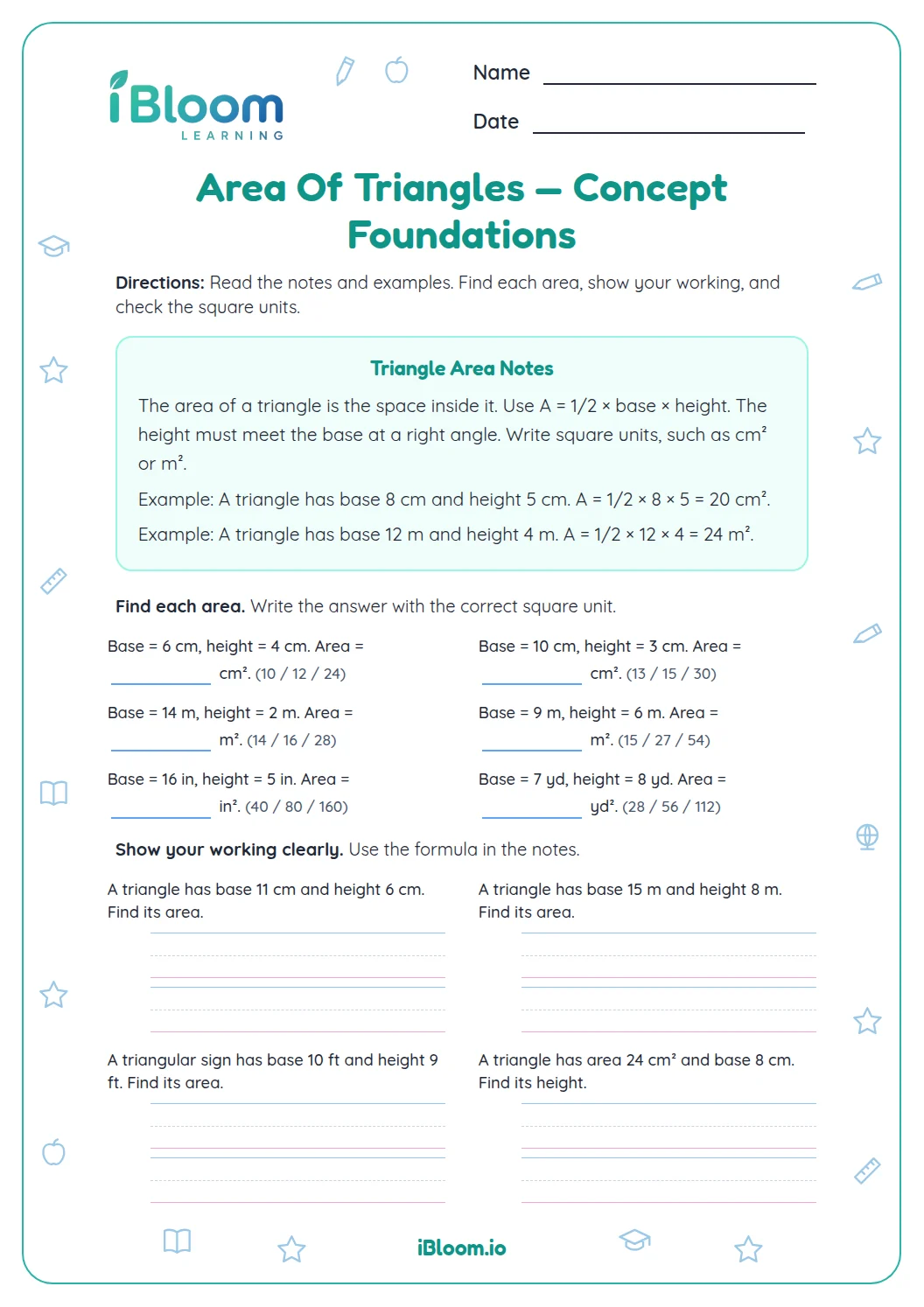
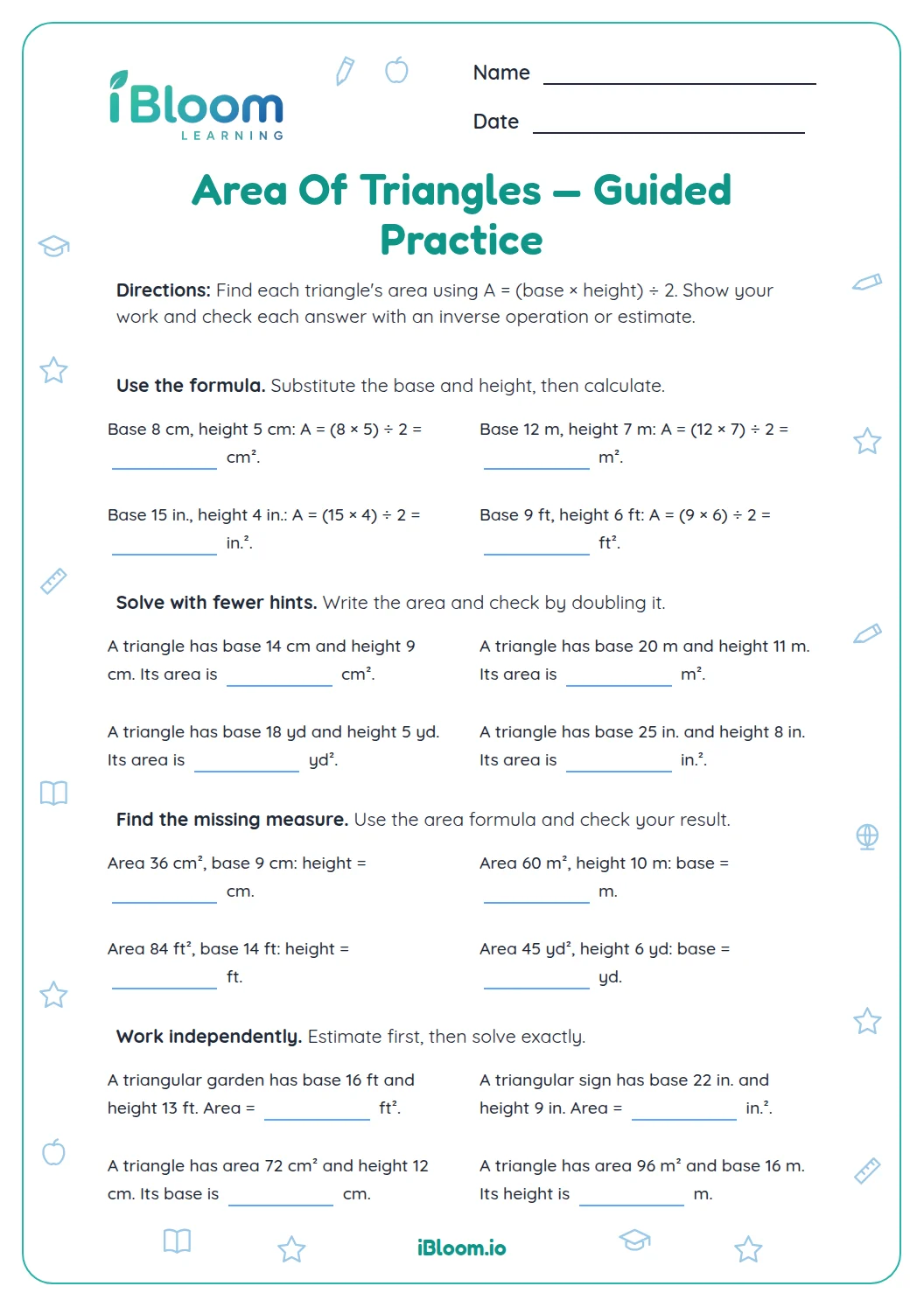
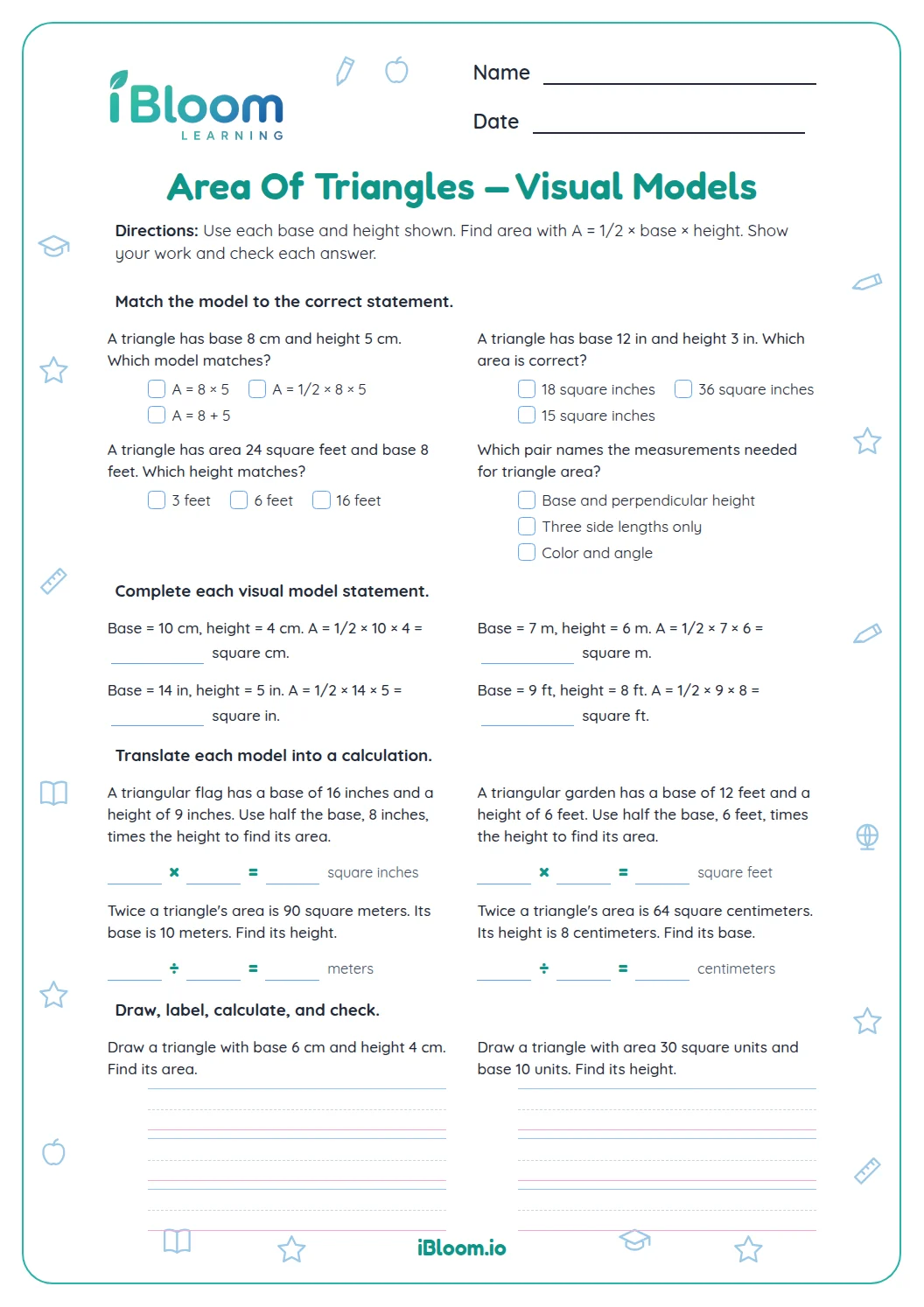
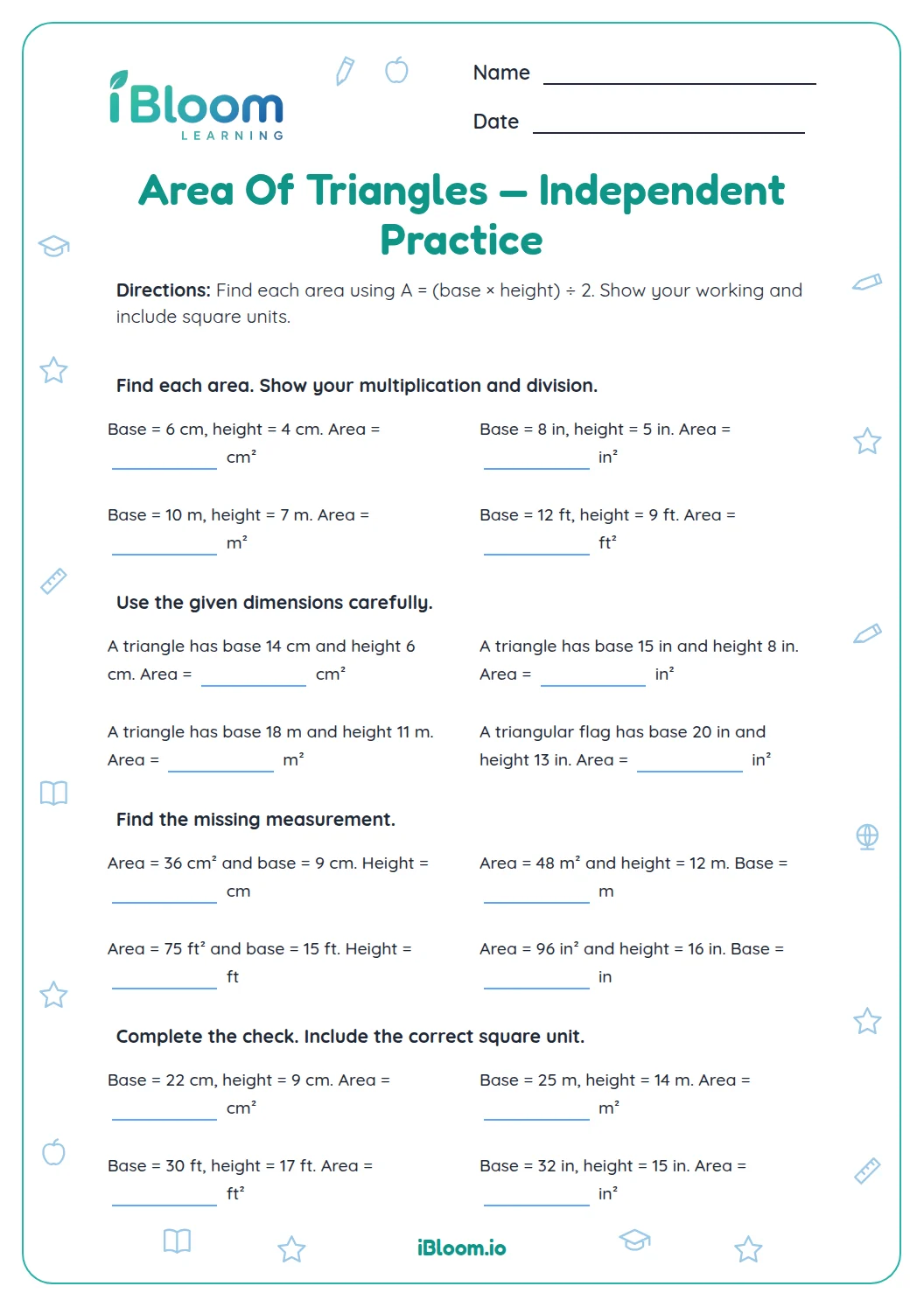
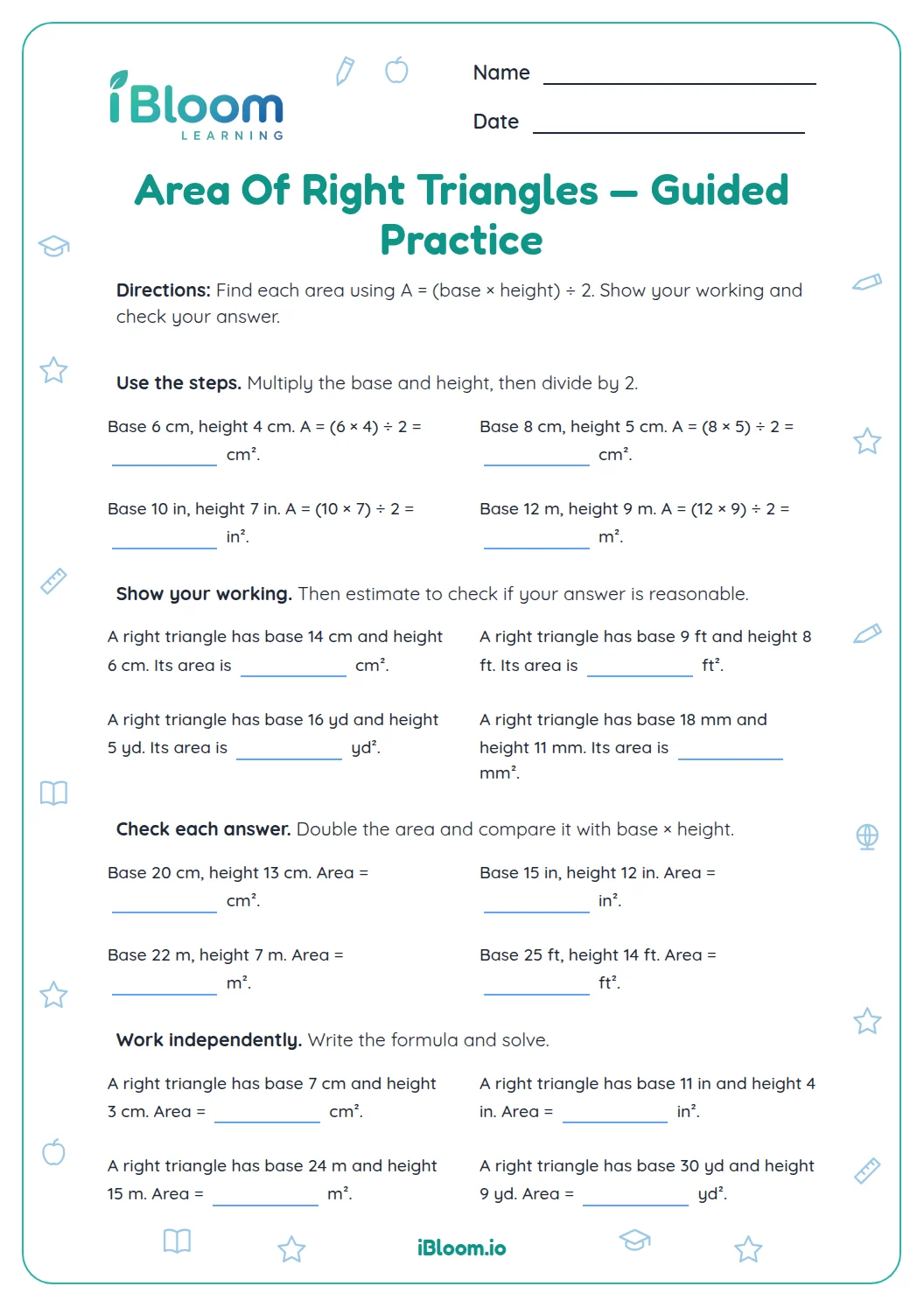
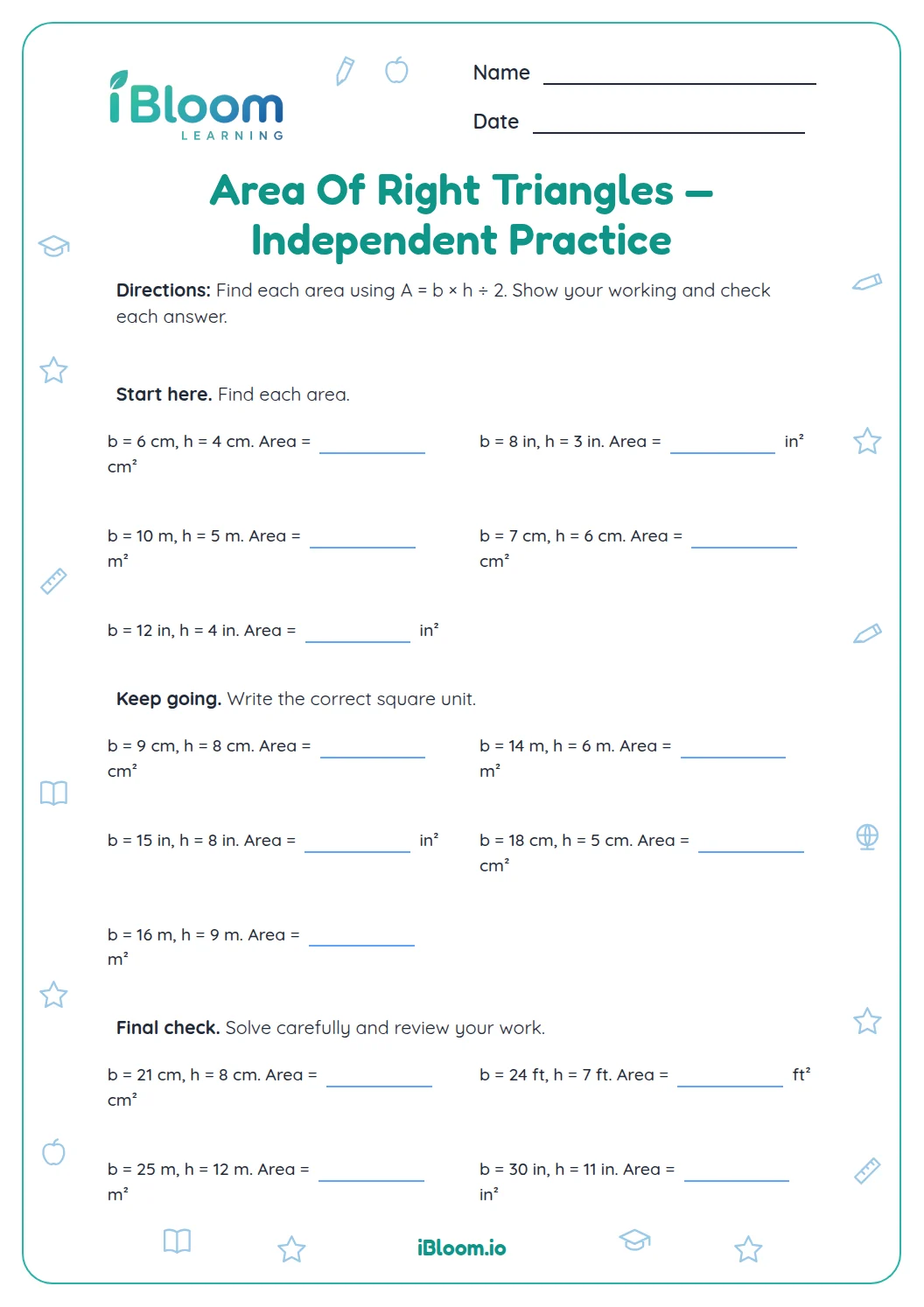
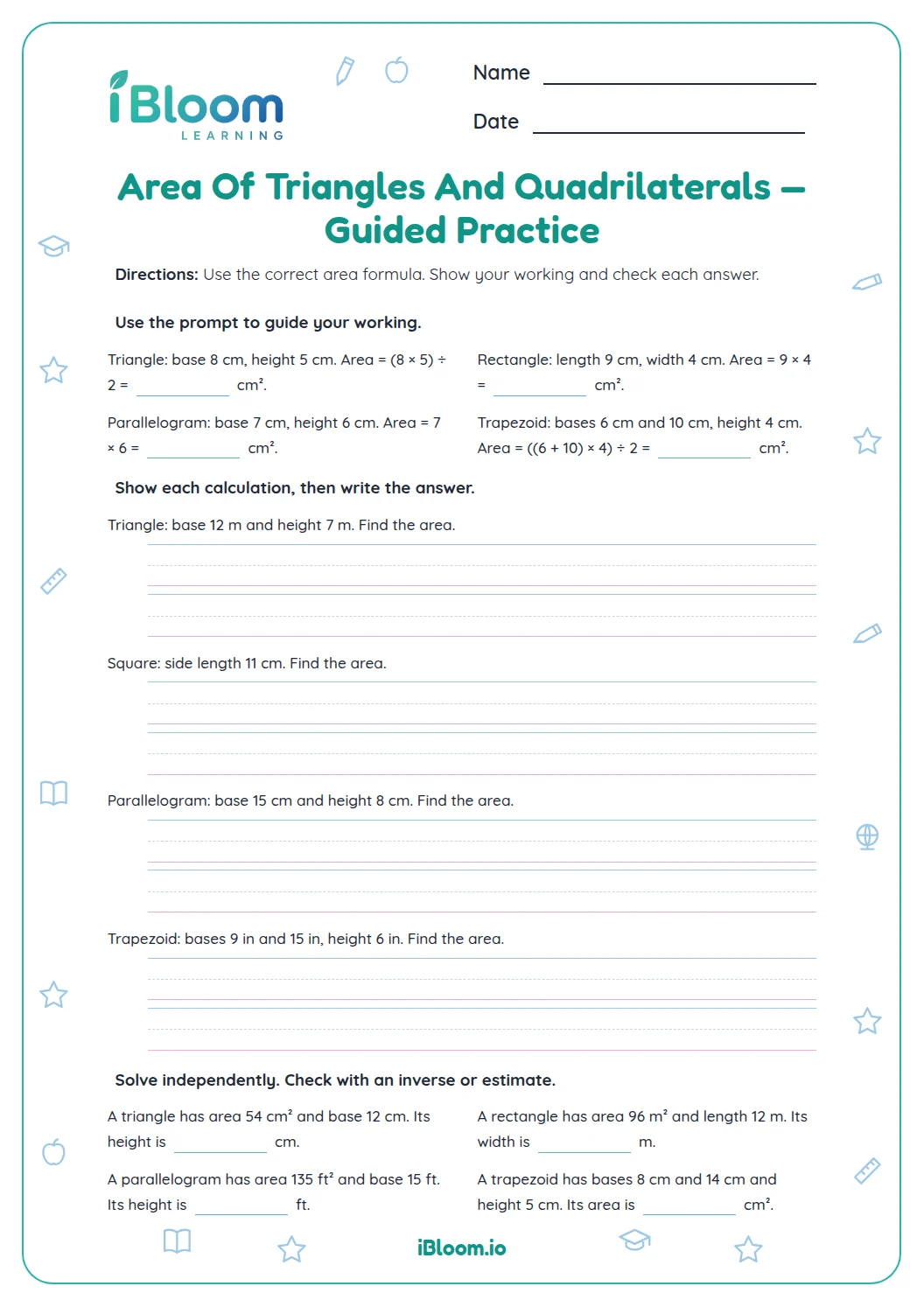
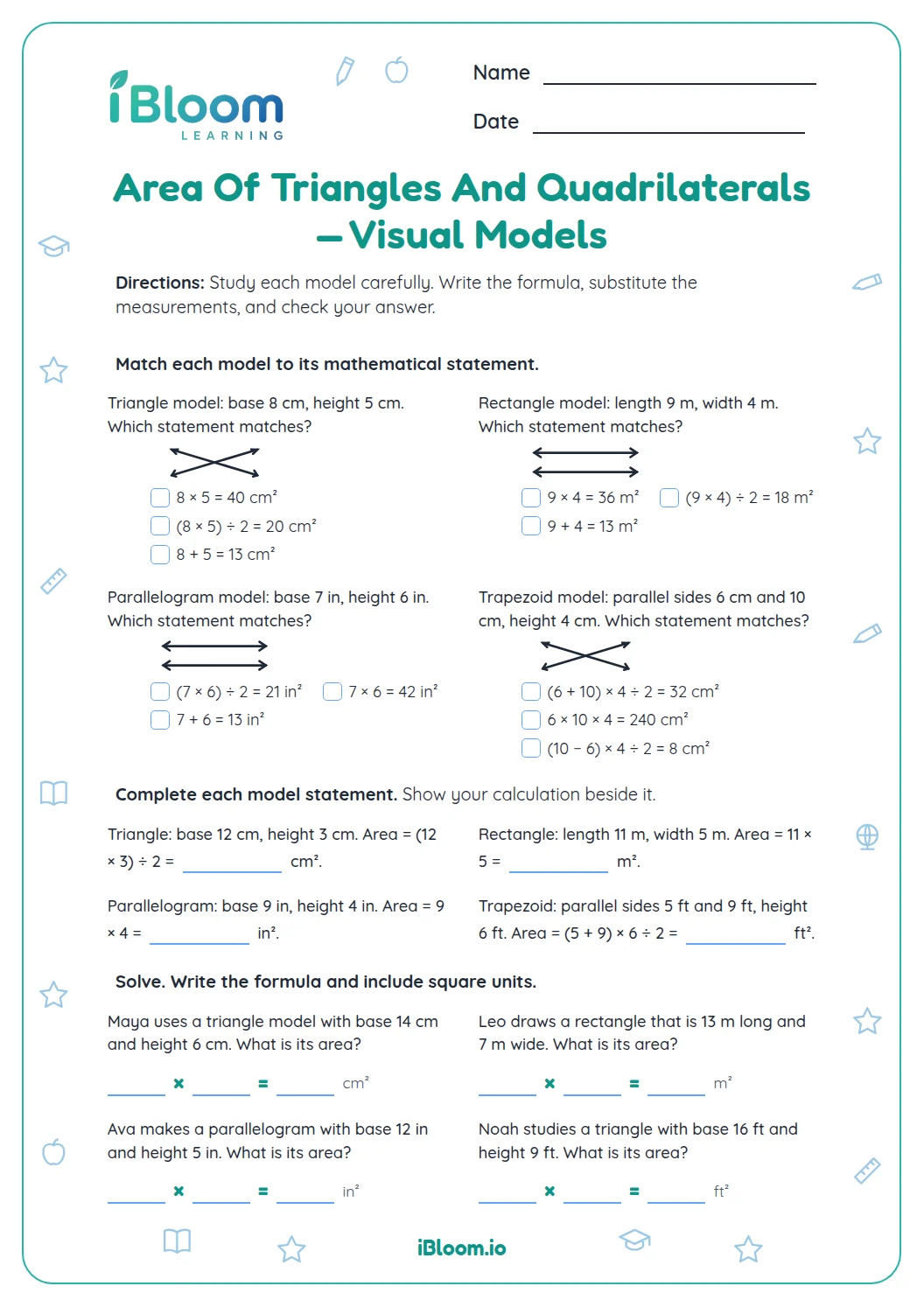
This free Grade 6 worksheet asks students to reason about triangle area using a base and its perpendicular height. Part A has four choices about rectangles, formulas, and equal areas. Part B has six problems with working space, including missing bases and heights, a flag, and a garden. Part C asks students to correct a calculation and explain why two different triangles have equal areas. The 12 questions practice Common Core 6.G.A.1. A separate answer key gives numerical answers and sample explanations. Students should already be able to multiply and divide whole numbers and simple decimals.
Aligned to 6.G.A.1
Why does dividing by two give triangle area?
Cutting a rectangle diagonally makes two equal-area right triangles. Each has the rectangle’s length as its base and width as its perpendicular height. For any triangle, two matching copies form a parallelogram with area base × height, so one triangle has area base × height ÷ 2.
Question 2 uses this relationship to choose an expression. Questions 3 and 4 then ask what happens when different dimensions produce the same product or when just the height doubles.
- 1Rectangle: 8 cm × 5 cm = 40 cm²
- 2Two equal triangles share 40 cm².
- 3One triangle: 40 ÷ 2 = 20 cm²
How can students find a missing base or height?
Work backward from the area. Twice the triangle’s area equals base times perpendicular height. In question 7, double 36 cm² to get 72 cm², then divide by the 9 cm base to find an 8 cm height.
Substitute the result into the original formula to check: 9 × 8 ÷ 2 = 36. Question 8 uses the same reasoning with a missing base. Keeping units alongside the numbers distinguishes a length from an area.
What makes these questions a reasoning challenge?
Students must select useful information and explain relationships. The flag problem includes a slanted side as well as a perpendicular height. The garden problem asks for the uncovered area after a triangle is used.
In Part C, students correct a result that is twice the triangle’s area, then compare two triangles by their base-height products. The final explanation can be short, but it should say why both products lead to the same area.
Work from area meaning to explanations
- 1Review that perpendicular means meeting the base at a right angle.
- 2Use question 1 to connect the rectangle’s area to one of its two triangles.
- 3Choose each Part A answer before checking it by calculation.
- 4For Part B, write base × height ÷ 2 or an equivalent equation in the working space.
- 5Check missing dimensions by putting them back into the area formula.
- 6Use Part C to explain the factor of one-half and equal base-height products.
Mistakes to catch and correct
The mistake
Reporting 60 cm² for the triangle in question 11.
The fix
The product 10 × 6 is twice the triangle’s area; divide by two to get 30 cm².
The mistake
Multiplying the flag’s base by its slanted side.
The fix
Use the stated perpendicular height of 5 ft with the 12 ft base.
The mistake
Writing cm² for a missing height.
The fix
Height is a length measured in cm; only area uses square units.
Common Core alignment
Connect rectangle and triangle areas, then solve problems using base and perpendicular height.
On this sheet: Students connect triangles to rectangles, calculate areas, recover missing dimensions, and explain equal areas.
Show the official wordingHide the official wording
Find the area of right triangles, other triangles, special quadrilaterals, and polygons by composing into rectangles or decomposing into triangles and other shapes; apply these techniques in the context of solving real-world and mathematical problems.
What to practice next
Make more practice
Further reading
Questions parents and teachers ask
Are the heights in this worksheet perpendicular?
Yes, use a height perpendicular to the chosen base in every question. The sheet’s directions establish this rule, and Part B repeats it. In the triangular flag problem, use the 5 ft height with the 12 ft base; the 13 ft slanted side is extra information.
Does my child need a ruler or protractor?
No measuring tools are needed for these questions because the necessary measurements are supplied in words. Students use the given base and perpendicular height rather than measuring a drawing. Pencil working space is provided for the six calculation problems, and the final two questions have space for written explanations.
How should a missing height be calculated?
Double the area first, then divide by the known base. In question 7, twice 36 is 72, and 72 divided by 9 is 8, so the height is 8 cm. Check that 9 times 8 divided by 2 returns the original area of 36 cm².
Can different triangles have the same area?
Yes, different base and height pairs can produce the same area. The final question compares 12 cm with 5 cm and 10 cm with 6 cm. Both products equal 60, so both areas equal 30 cm² after division by two, even though their stated dimensions are different.
What does the answer key include for reasoning questions?
The key includes a sample explanation for each final question and a fixed answer for each earlier item. Accept other clear explanations that use the correct area relationship. In question 11, a complete correction should identify the missing division by two and give the corrected area with square units.