
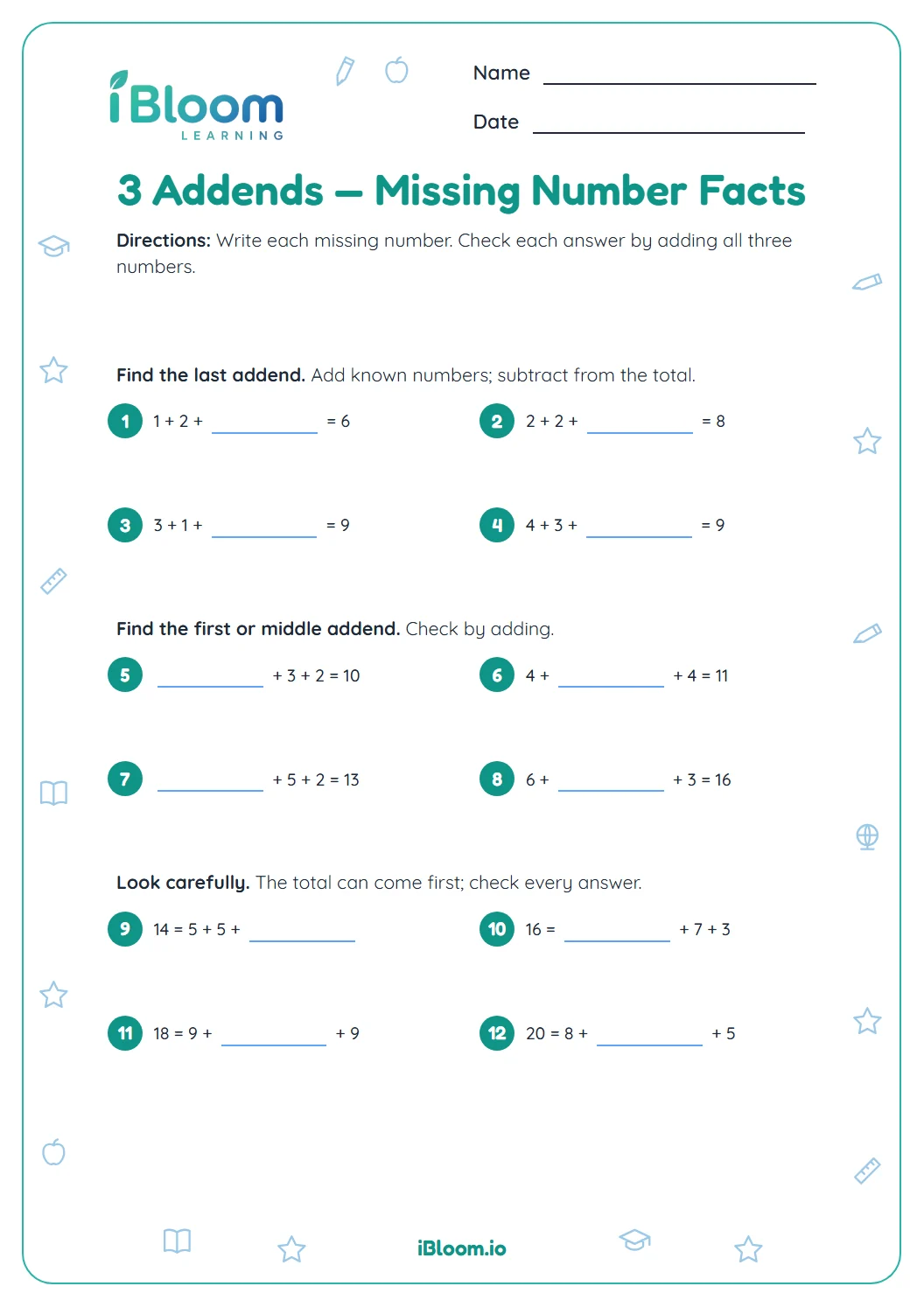
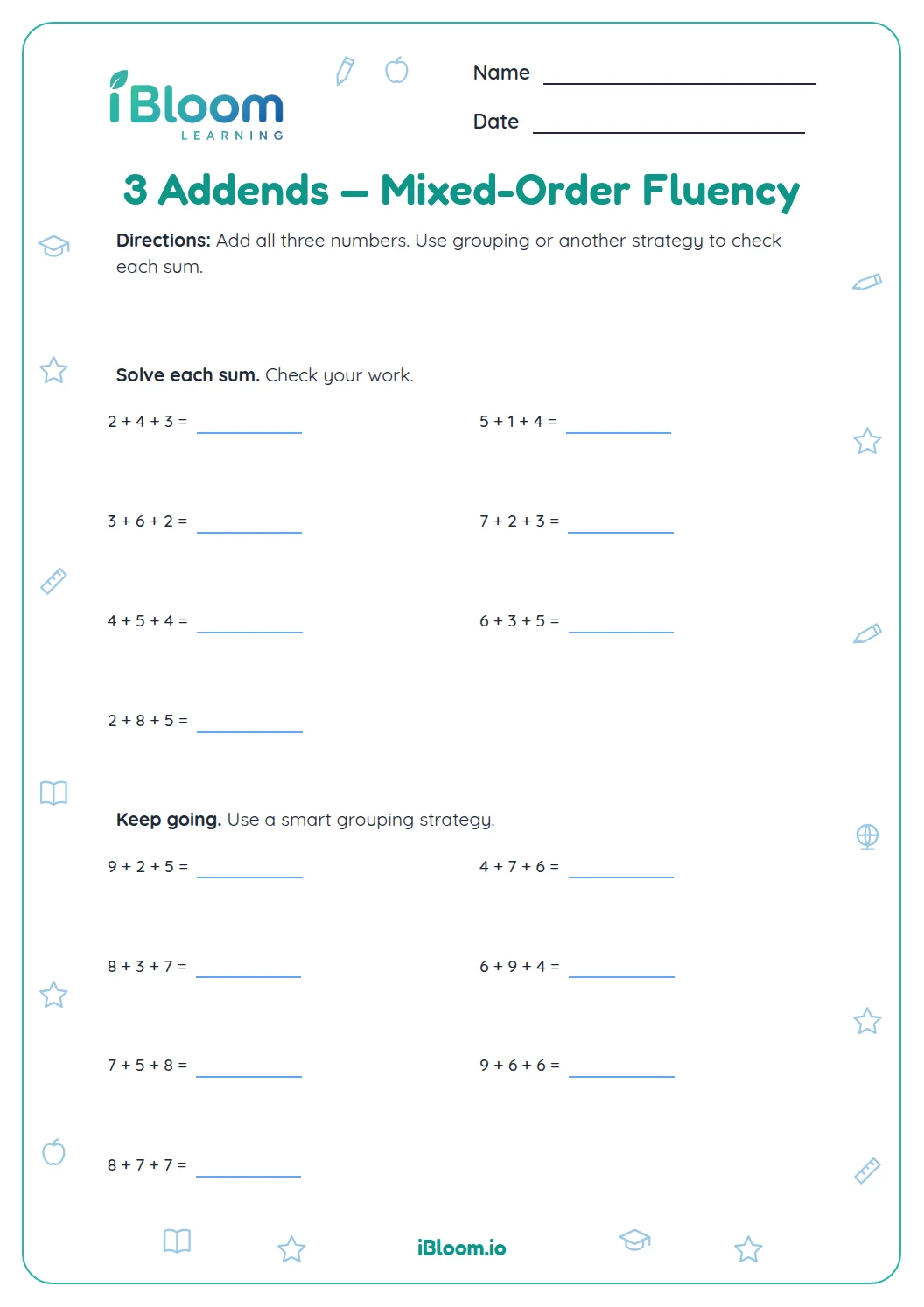
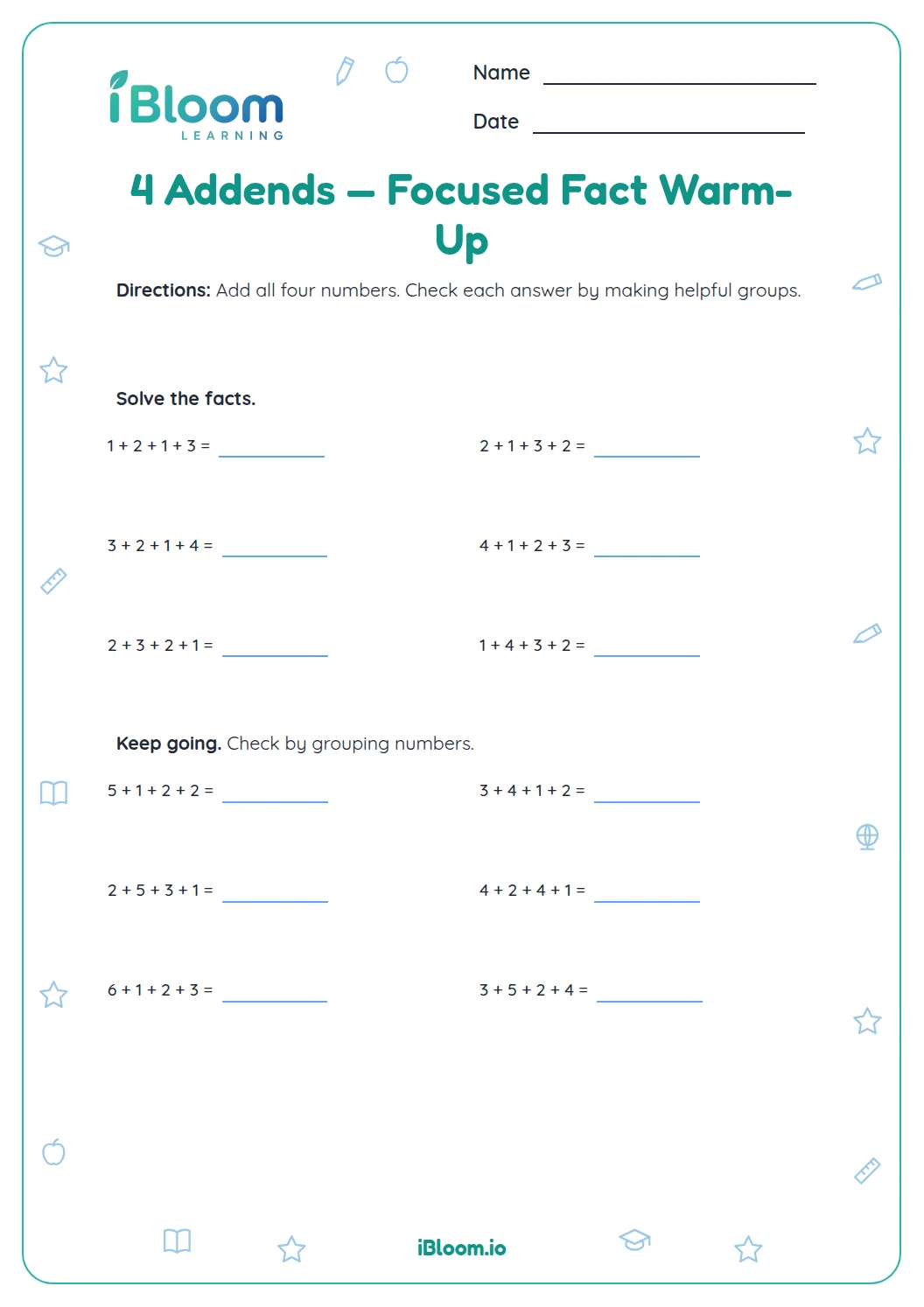
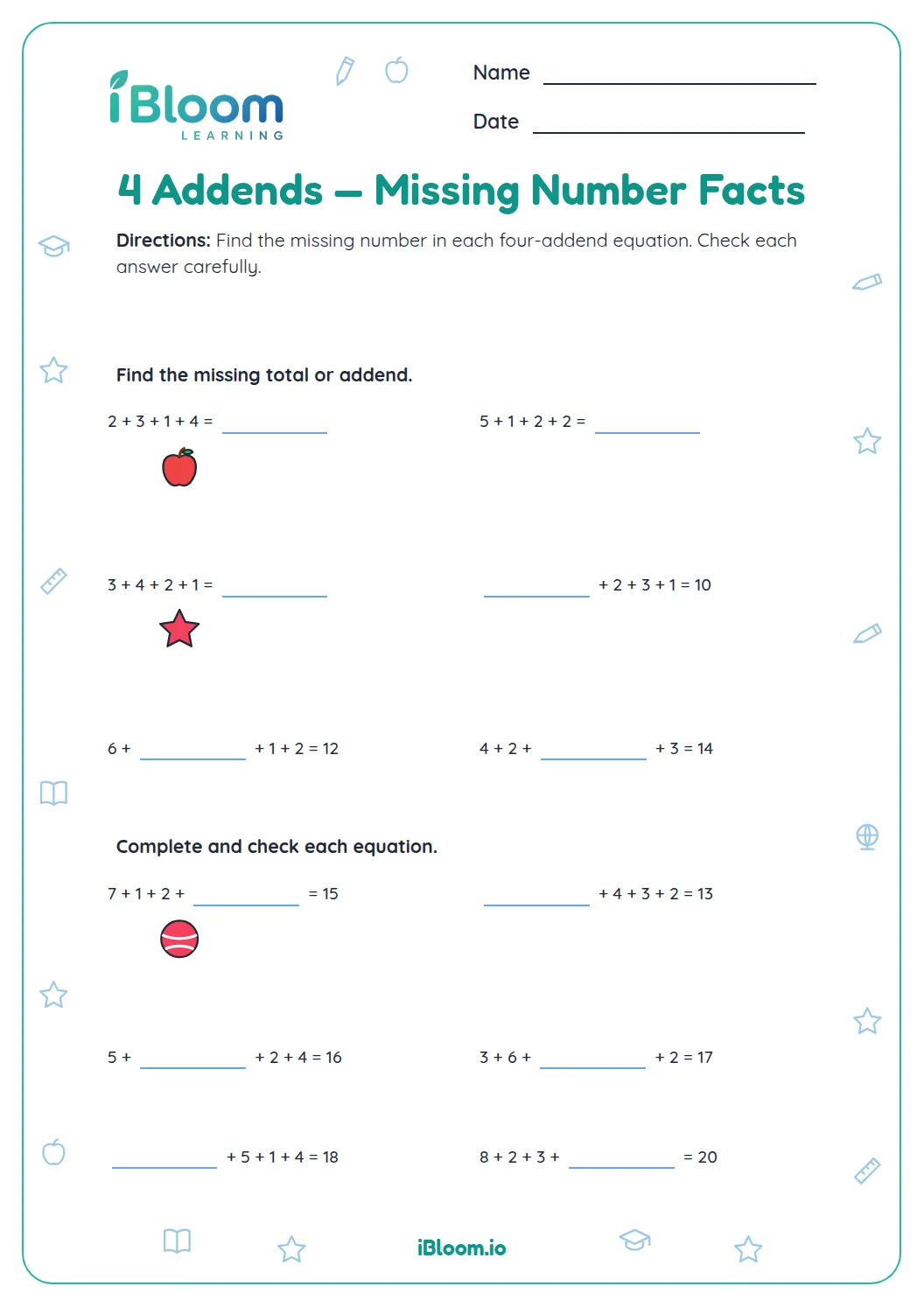

About this worksheet
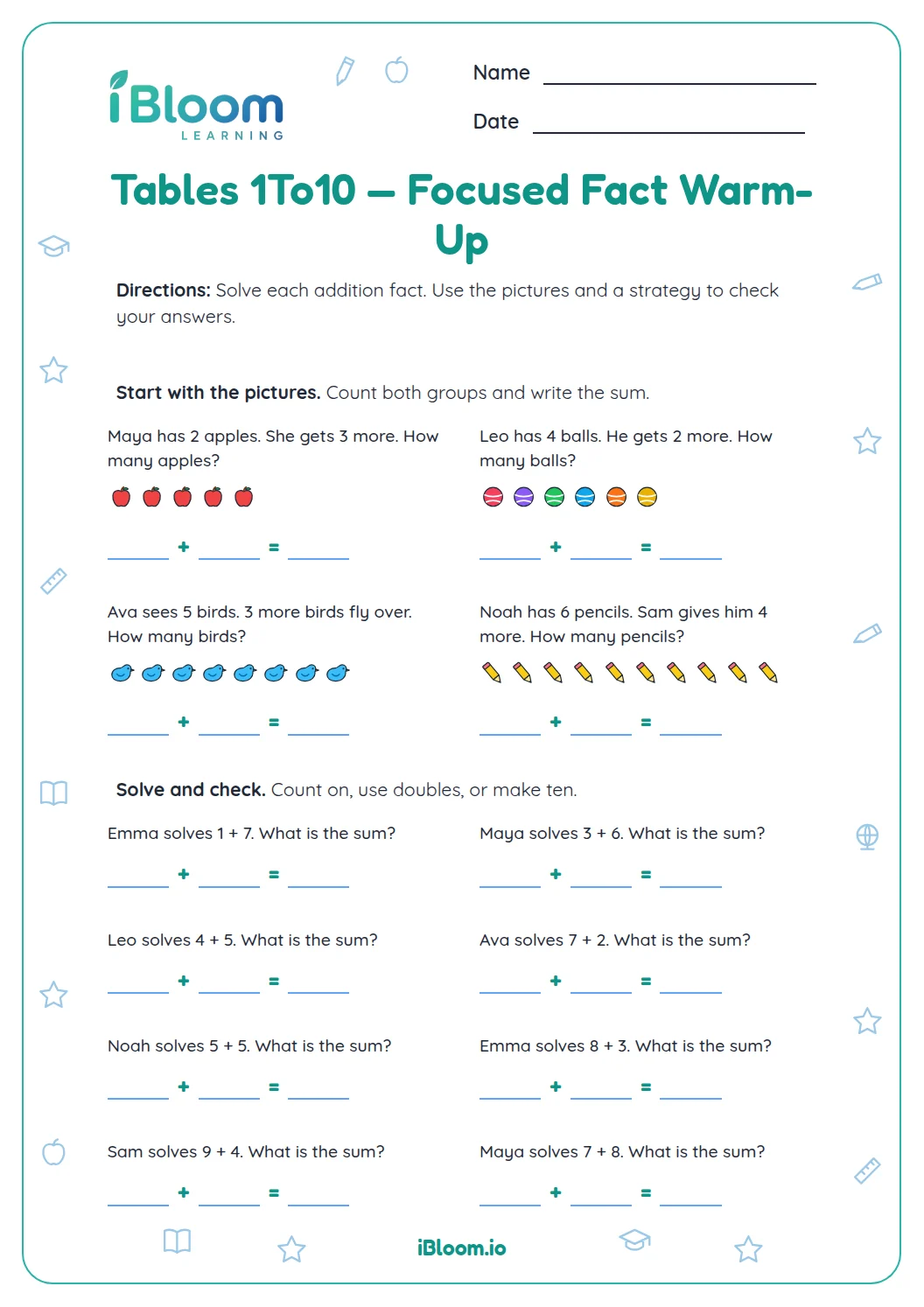
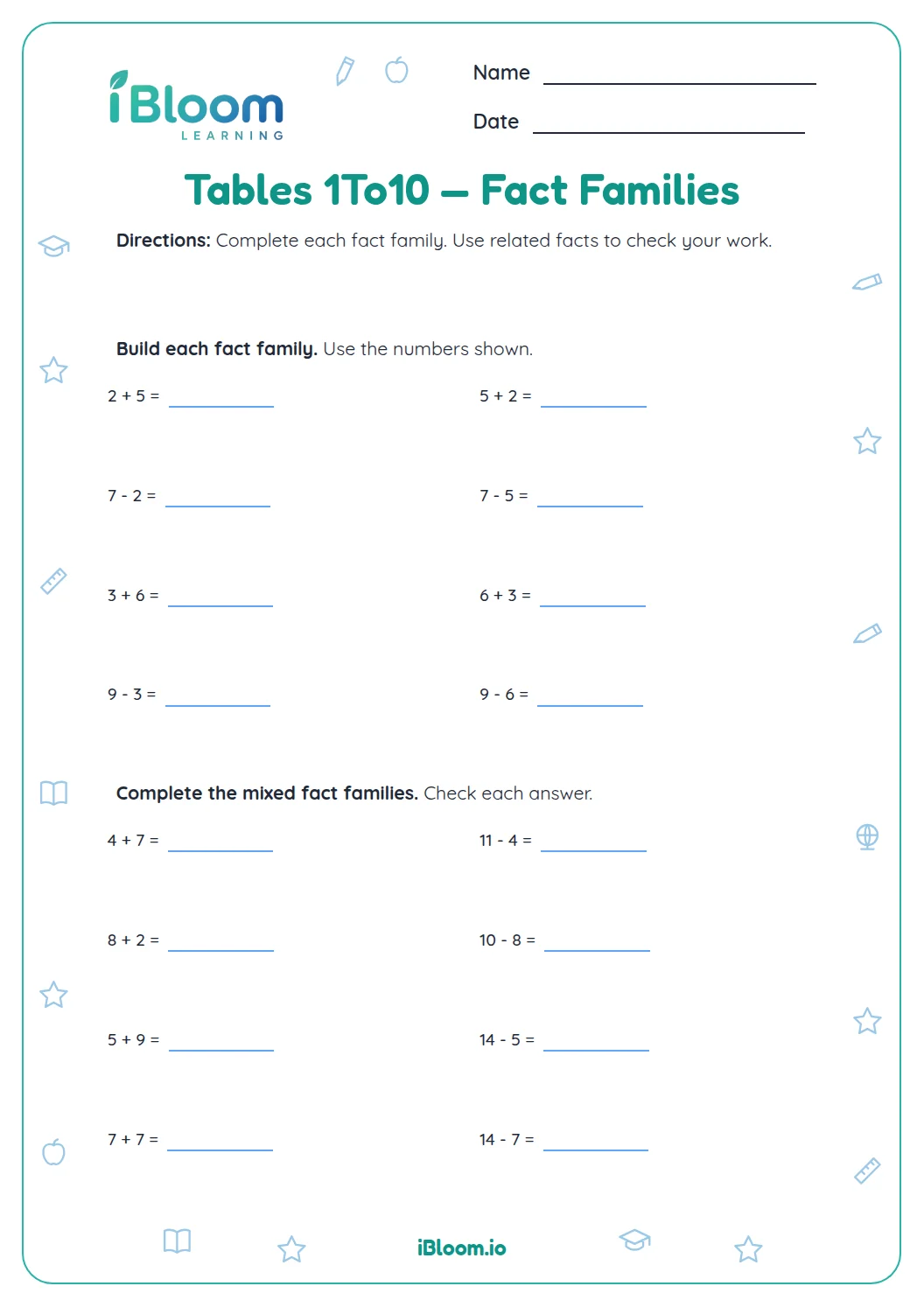
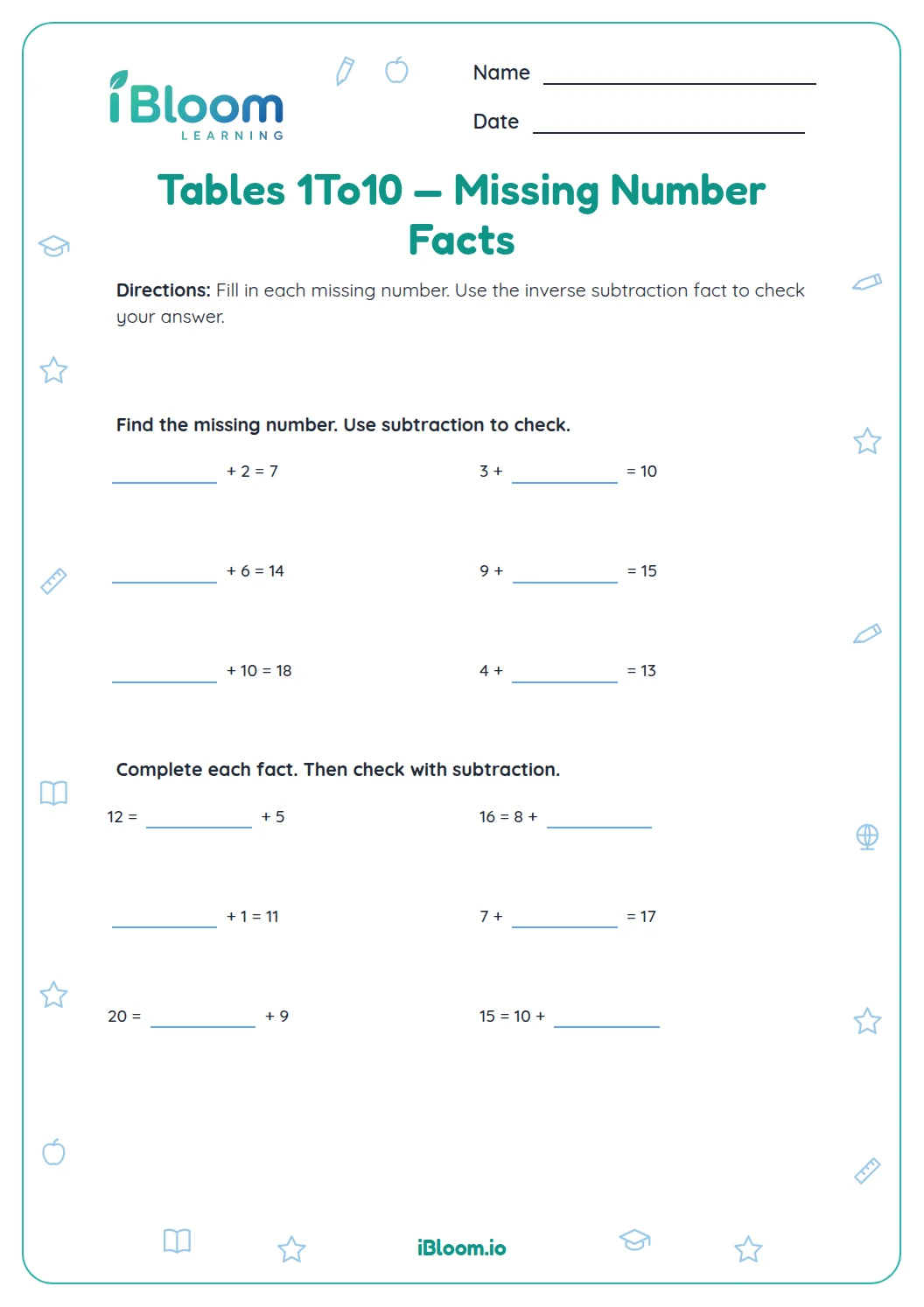
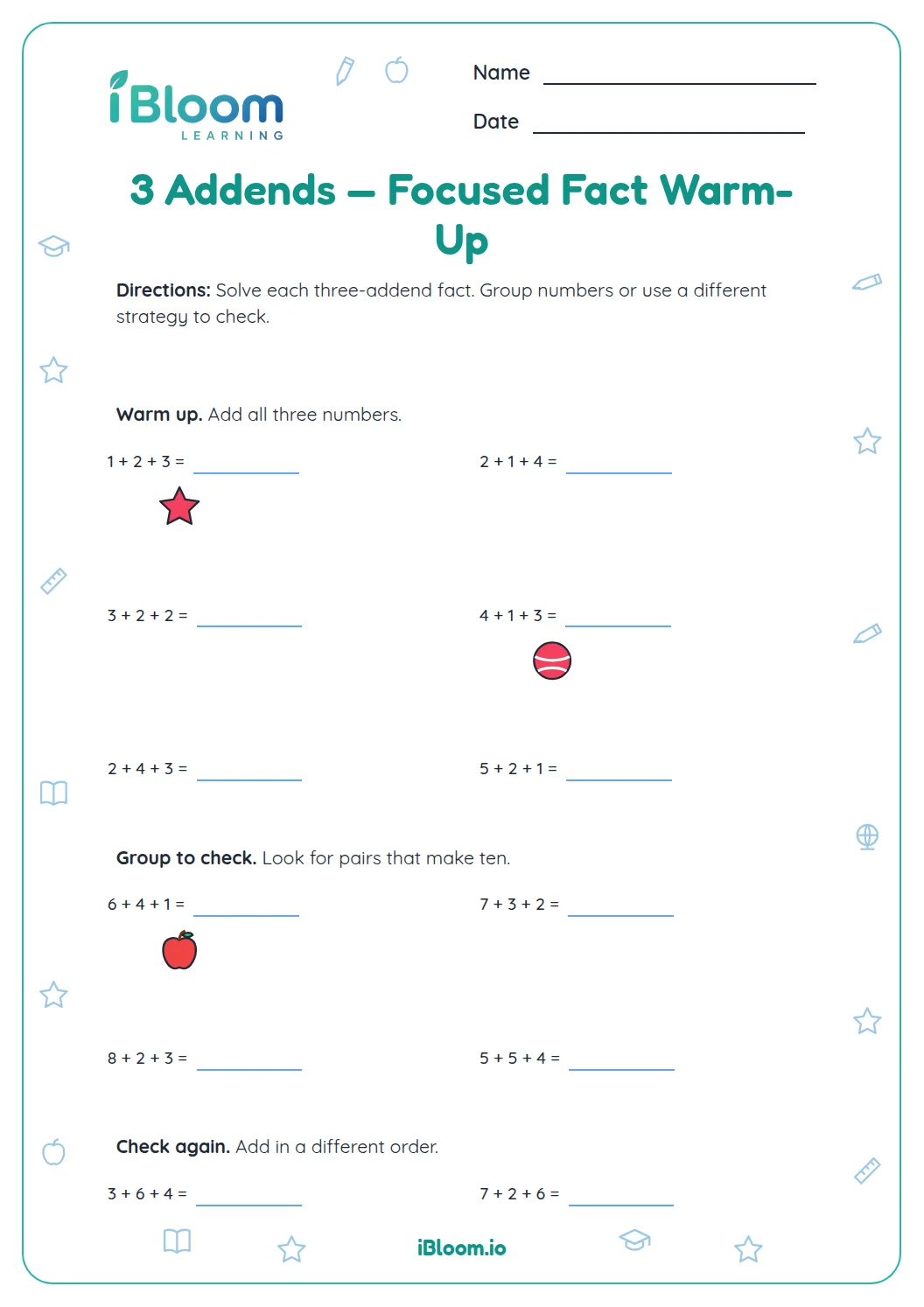
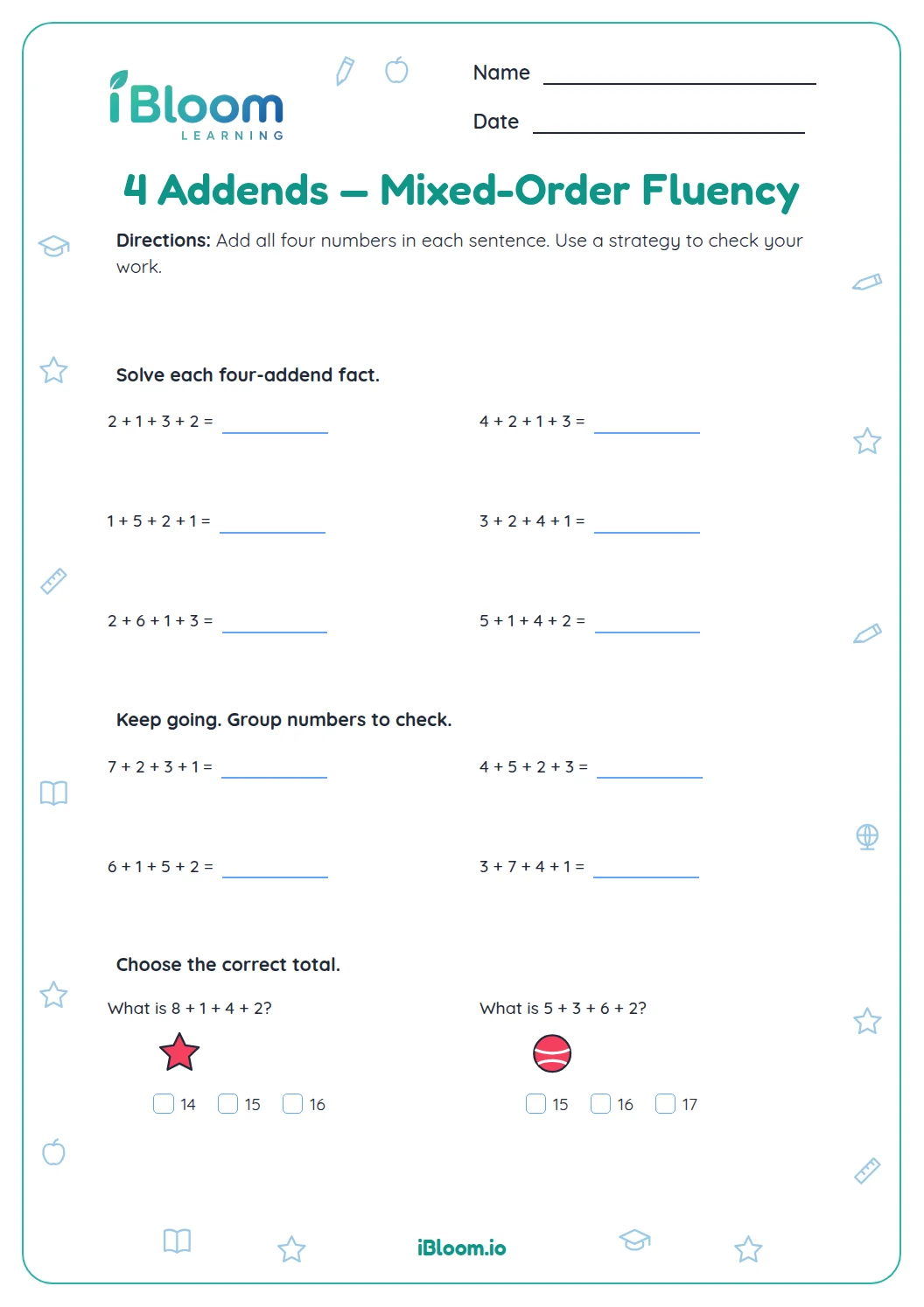
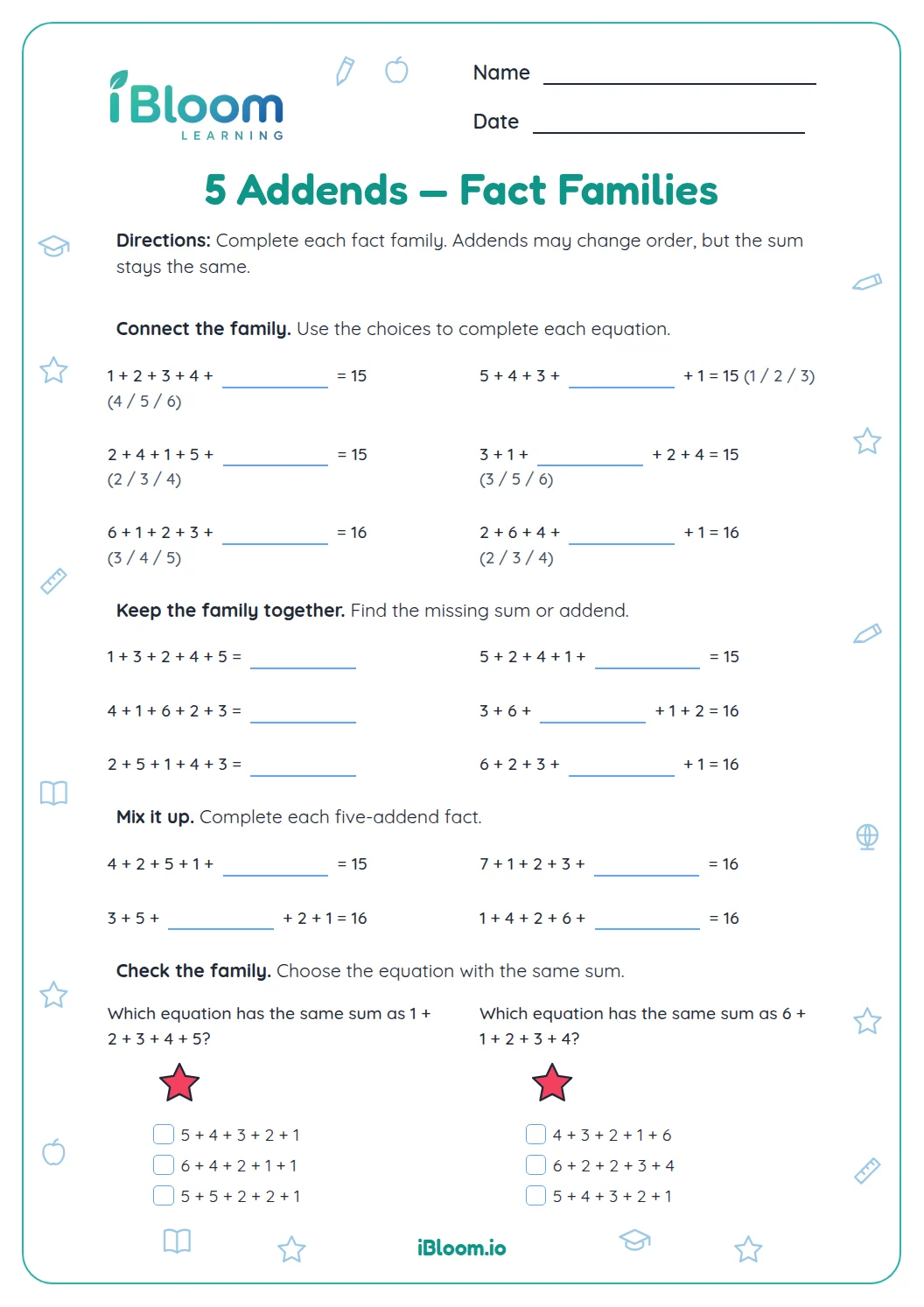
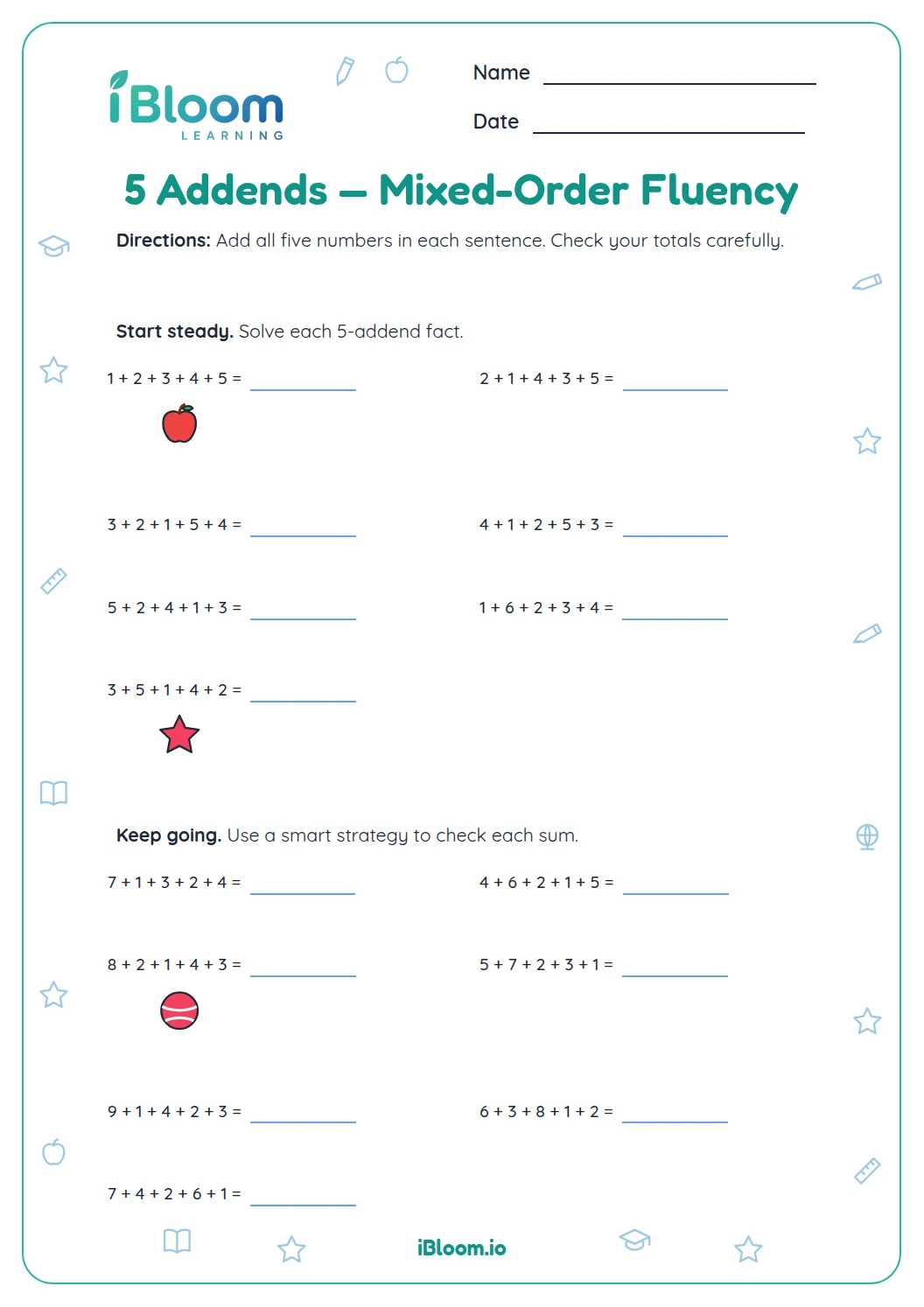
This printable gives students 20 mixed-order addition facts with both addends from 1 through 10. Every addend in that range appears, and every sum is 20 or less. Students can use doubles, make-ten, or count-on strategies, then check their work with the separate answer key.
Aligned to 2.OA.B.2
Which addition facts will students practice?
The 20 equations mix addends from 1 through 10 instead of following a table row. The range includes doubles and non-doubles, with every addend represented at least once.
How can a student find a fact they do not know yet?
Use a familiar fact to build a nearby one. For 8 + 7, think 8 + 8 = 16, then subtract 1 to get 15.
- 18 + 7 is one less than 8 + 8.
- 28 + 8 = 16
- 3So 8 + 7 = 15.
How can students check each sum?
Switching the addends keeps the total the same. A learner can also count on from the larger number or use a related double, then compare each answer with the key.
How can you use this worksheet?
- 1Read both addends before calculating.
- 2Use a known double, make-ten fact, or count-on strategy.
- 3Write one sum in each blank.
- 4Check by reversing the addends or using a fact family.
- 5Review missed facts once more after completing the page.
What errors should you watch for?
The mistake
Counting both addends from one, so 8 + 7 is counted as 15 steps after 8.
The fix
Start at the larger addend and count on only the other addend.
The mistake
Writing 14 for 7 + 8 after stopping one count early.
The fix
Touch or say each count-on number once: 8, then seven steps ends at 15.
The mistake
Treating a reversed fact as a different total.
The fix
Use the turn-around fact: changing the order of addends does not change the sum.
Common Core alignment
The mixed-order equations support accurate and increasingly fluent addition fact recall.
Practice addition facts within 20 until answers become increasingly fluent.
On this sheet: All 18 questions add two one-digit addends and produce sums within 20.
Show the official wordingHide the official wording
Fluently add and subtract within 20 using mental strategies. By end of Grade 2, know from memory all sums of two one-digit numbers.
What to practice next
Make more practice
Further reading
Questions parents and teachers ask
Do the addends include every number from 1 to 10?
Yes. Across the 20 equations, each addend from 1 through 10 appears at least once. Students see the numbers in mixed combinations, which means they need to read each fact rather than follow a predictable counting pattern. Learners can scan the page to find a specific addend, then see it paired with several other numbers.
Are any sums greater than 20?
No. The largest sum is 18, from 9 + 9. All the problems use one-digit addends from 1 to 10, so every answer stays within 20 and fits the fact-fluency focus of the page. Students can verify a sum by switching the addends or building the fact with counters.
Can students use strategies instead of memorizing each fact?
Yes. Count on, make ten, or use a known double to solve a fact. For example, 8 + 7 is one less than 8 + 8. These strategies help students check their reasoning while they build accurate recall.
Is the question order grouped by addend?
No. The facts appear in mixed order, and both addends vary across the page. Students should read both numbers in each equation before solving rather than assume they are moving through a row or column. This makes each item a fresh fact to read and solve.
Does this worksheet include story problems?
This reviewed version focuses on 20 equations so learners can practice the mixed-order facts directly. Students can say a matching story aloud if they want to connect an equation to objects or points, then verify the sum in the answer key.