


About this worksheet
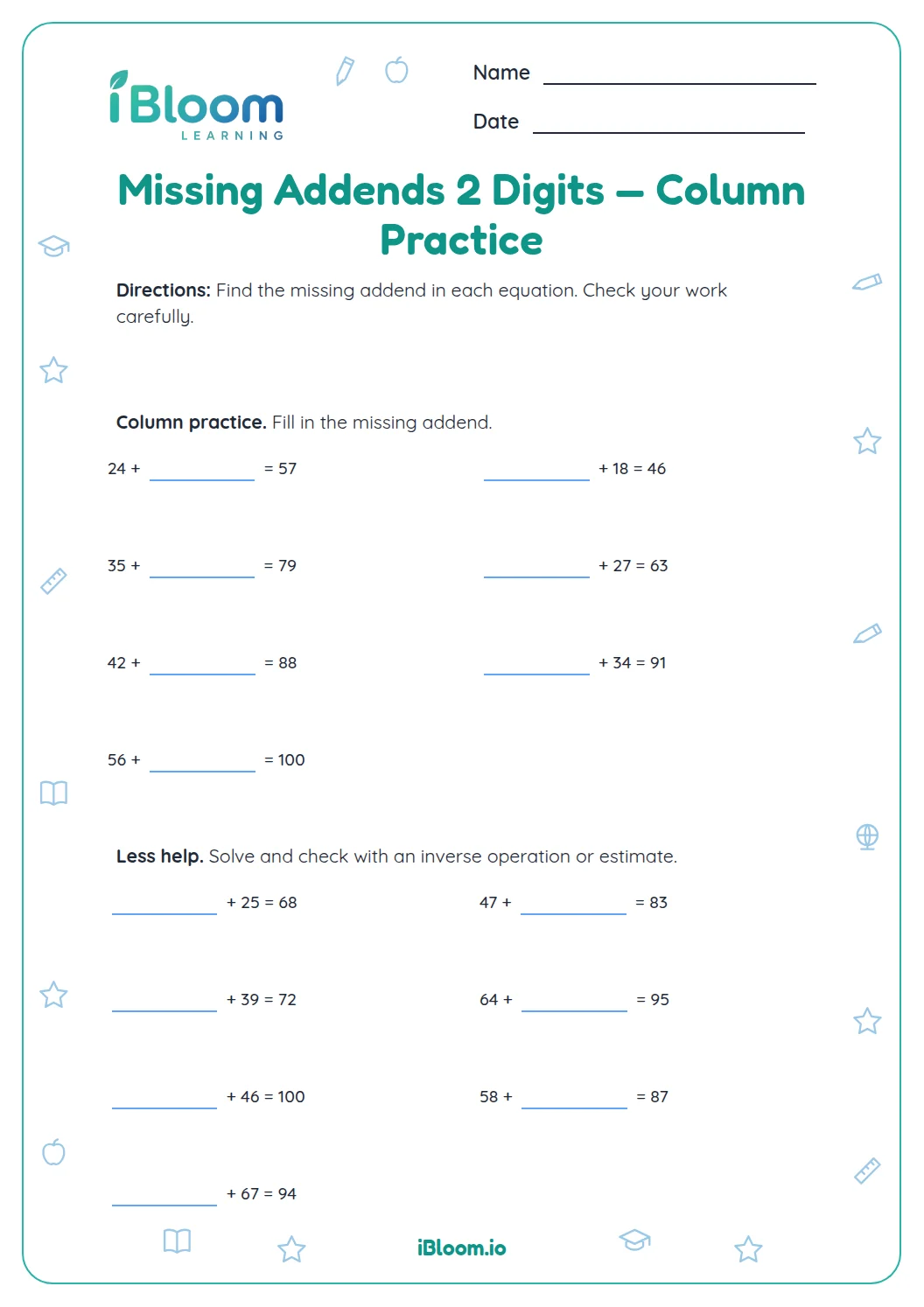
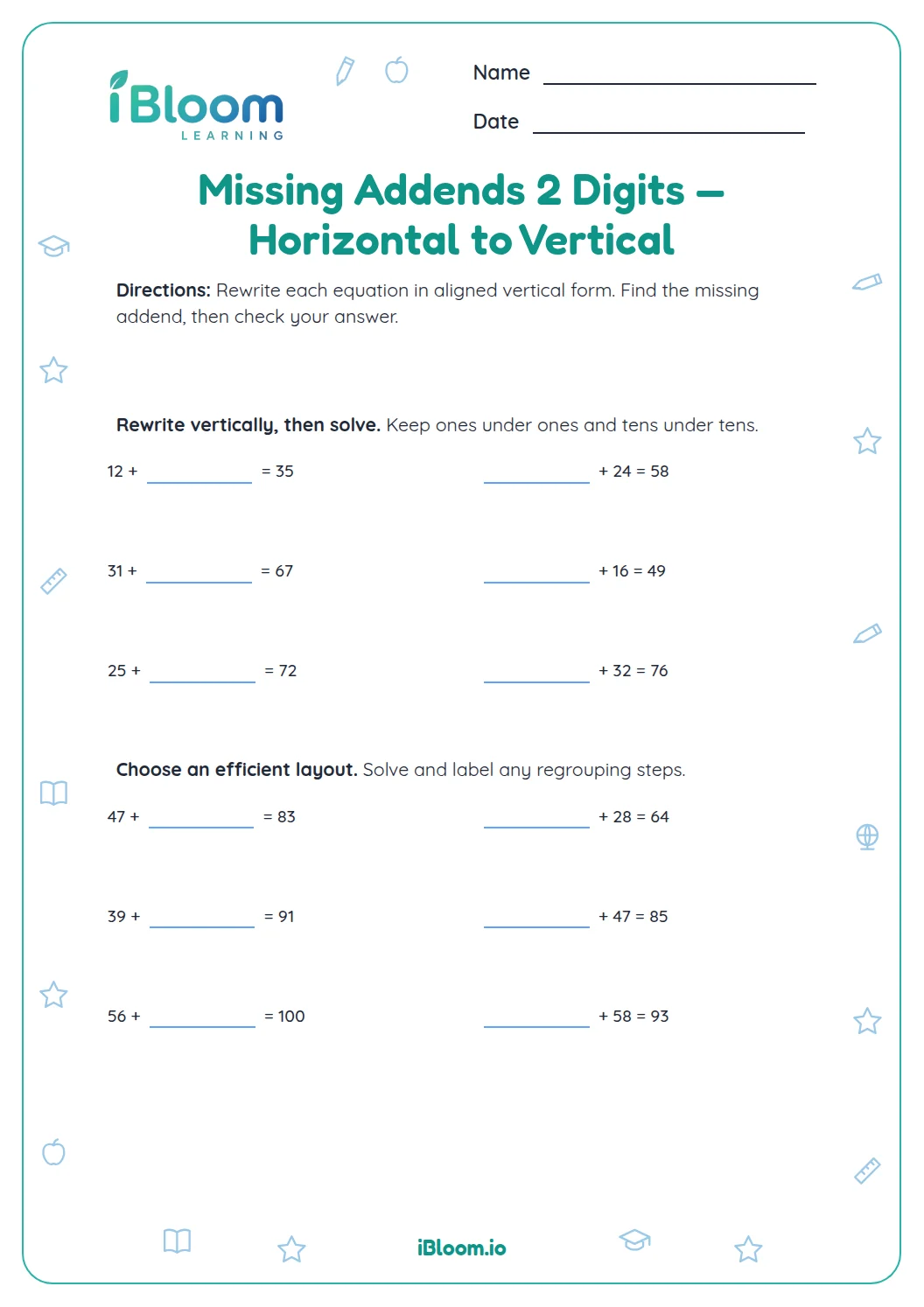
This free two-page addition worksheet gives students in Grades 2–4 sixteen problems about horizontal sums under 100. Part A mixes correct and incorrect claims. Part B presents six wrong sums to repair. Part C asks students to choose a valid checking strategy, including adding a nearby ten and adjusting. Part D asks for explanations of two place-value errors. The work practices Common Core 2.NBT.B.5 through addition strategies based on tens and ones. A separate key supplies every answer and sample explanations.
Aligned to 2.NBT.B.5
Why are some answers already correct?
Part A includes two correct sums and two incorrect ones. Students must calculate before deciding, so they cannot assume that every printed answer needs changing.
For 32 + 46, tens make 70 and ones make 8. The written answer, 78, is correct. For 47 + 18, 60 misses the five remaining ones, so students choose Incorrect.
How do students repair a regrouping error?
Question 6 shows 46 + 27 = 63. Adding 6 and 7 makes 13 ones. The extra ten belongs with the tens; it cannot disappear when the ones digit is written.
Students write the corrected sum in Part B. Ask for an oral explanation if you want to hear the strategy behind a correct answer.
- 146 + 27
- 240 + 20 = 60
- 36 + 7 = 13
- 460 + 13 = 73, so replace 63 with 73.
What counts as a good error explanation?
Part C practices another way to check a total. For 47 + 19, adding 20 reaches 67, but that adds one too many. Subtracting 1 gives 66. The choices also check how tens and ones combine without dropping any value.
The last two questions supply the student’s thinking, so children can name a specific mistake. One student keeps only the ones digit of 12; another treats 6 as six tens.
A complete response describes the slip and gives the correct total. The answer key uses brief model responses, but different wording is welcome if the place-value reasoning is sound.
How to work through the sheet
- 1Read the labels Correct and Incorrect before starting Part A.
- 2Solve each sum independently before judging the printed answer.
- 3For Part B, separate tens and ones on scrap paper if needed.
- 4Check that every corrected total is greater than either positive addend.
- 5Choose a checking step in Part C, then explain the missing or misplaced value in Part D.
Mistakes to discuss and fix
The mistake
Discarding the ten in a ones total such as 13.
The fix
Rename 13 ones as one ten and three ones, then add the new ten.
The mistake
Treating 6 as 60 in 54 + 6.
The fix
Break 54 into 50 + 4 and add 6 to the ones: 4 + 6 = 10.
The mistake
Calling every printed answer incorrect.
The fix
Calculate first; two Part A claims are correct and should stay as written.
Common Core alignment
Check sums under 100 by adding tens and ones and regrouping when needed.
On this sheet: Students correct addition errors and explain how place value gives the correct sum.
Show the official wordingHide the official wording
Fluently add and subtract within 100 using strategies based on place value, properties of operations, and/or the relationship between addition and subtraction.
What to practice next
Make more practice
Further reading
Questions parents and teachers ask
Are all the printed sums wrong?
No. Part A contains two correct sums and two incorrect sums, so students need to calculate each one before choosing. Part B explicitly asks students to fix six wrong sums. Part C has four strategy choices; Part D asks students to explain two mistakes and give the correct totals.
What does sums under 100 mean here?
Every correct total is less than 100. The sheet uses one-digit and two-digit addends, with and without regrouping. A deliberately wrong answer can be larger, as in Mia’s 114. Students correct that claim to 60 by treating the 6 in 54 + 6 as ones instead of tens.
Should this error-analysis sheet be timed?
Use it without a timer so students can inspect the reasoning behind each answer. Speed is less useful here than noticing a lost ten or a misplaced digit. If a student finishes quickly, ask them to explain a corrected sum with tens and ones before checking the key.
How should students explain question 15?
They should say that 12 ones include one ten as well as two ones. The student in question 15 combines 50 with only the final 2 from 12 and gets 52. Restoring the missing ten gives 62, the correct answer to 28 + 34.
Can older students use this worksheet for review?
Yes. The worksheet is labeled for Grades 2–4 and focuses on addition within 100. Older students can use it to explain regrouping precisely rather than simply calculate. Ask them to identify the place value that was lost or changed, then verify the corrected sum with another addition strategy.