
About this worksheet
This Grade 2 worksheet builds addition accuracy through error analysis. Students first decide whether seven claims about two-digit sums are correct; some are accurate and others contain a plausible mistake. In the second part, they solve seven addition problems within 100. The answer key makes it easy to compare a claim with the correct total and review place-value regrouping.
Aligned to 2.NBT.B.5
How can I tell whether an addition claim is correct?
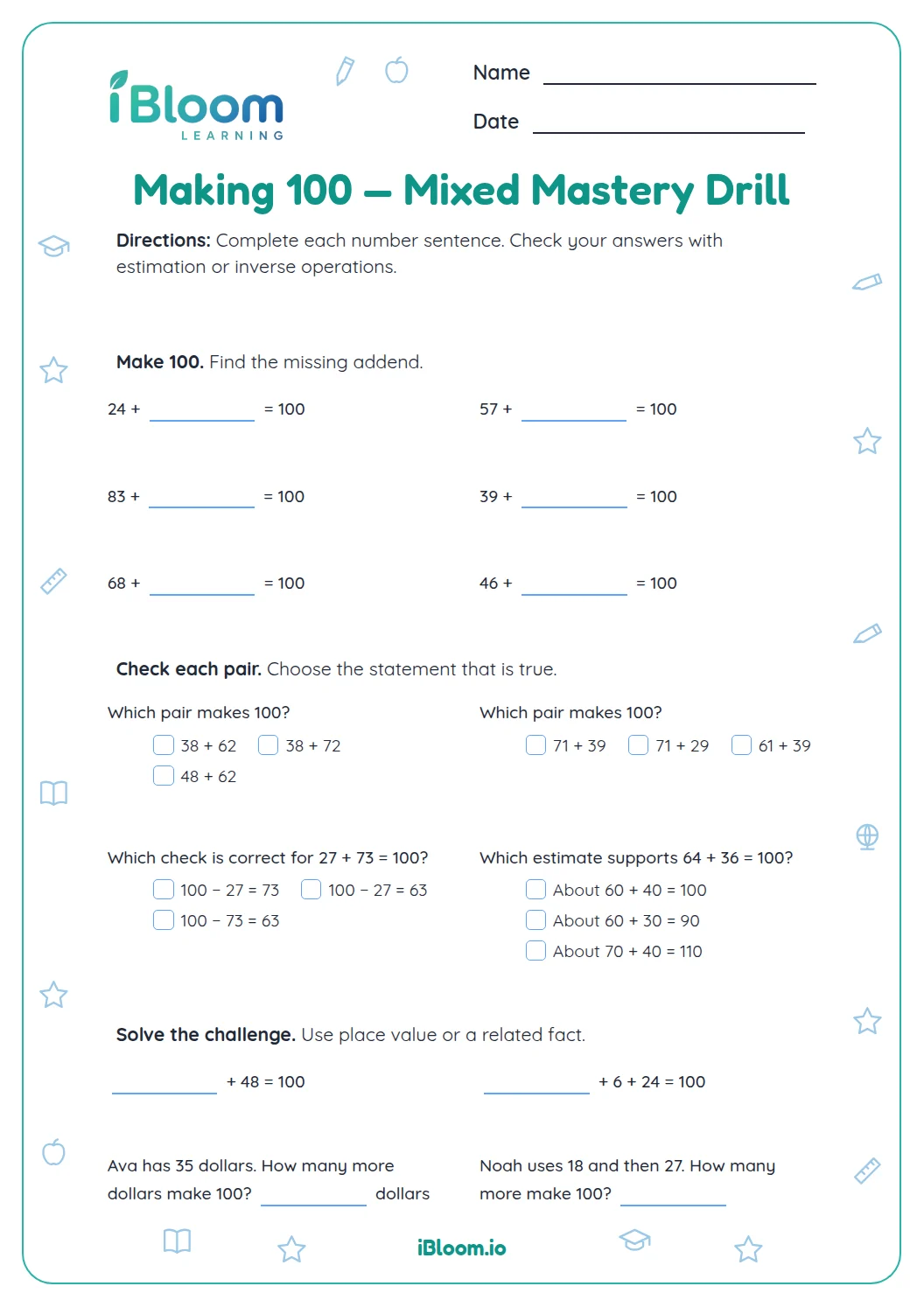
Part A includes accurate claims and plausible errors about pairs intended to make 100. Add or use a complement strategy, then compare the total with the claim.
- 1Kai claims 47 + 53 = 100. Since 47 needs 53 to reach 100, choose “Yes.”
How do I find the missing addend?
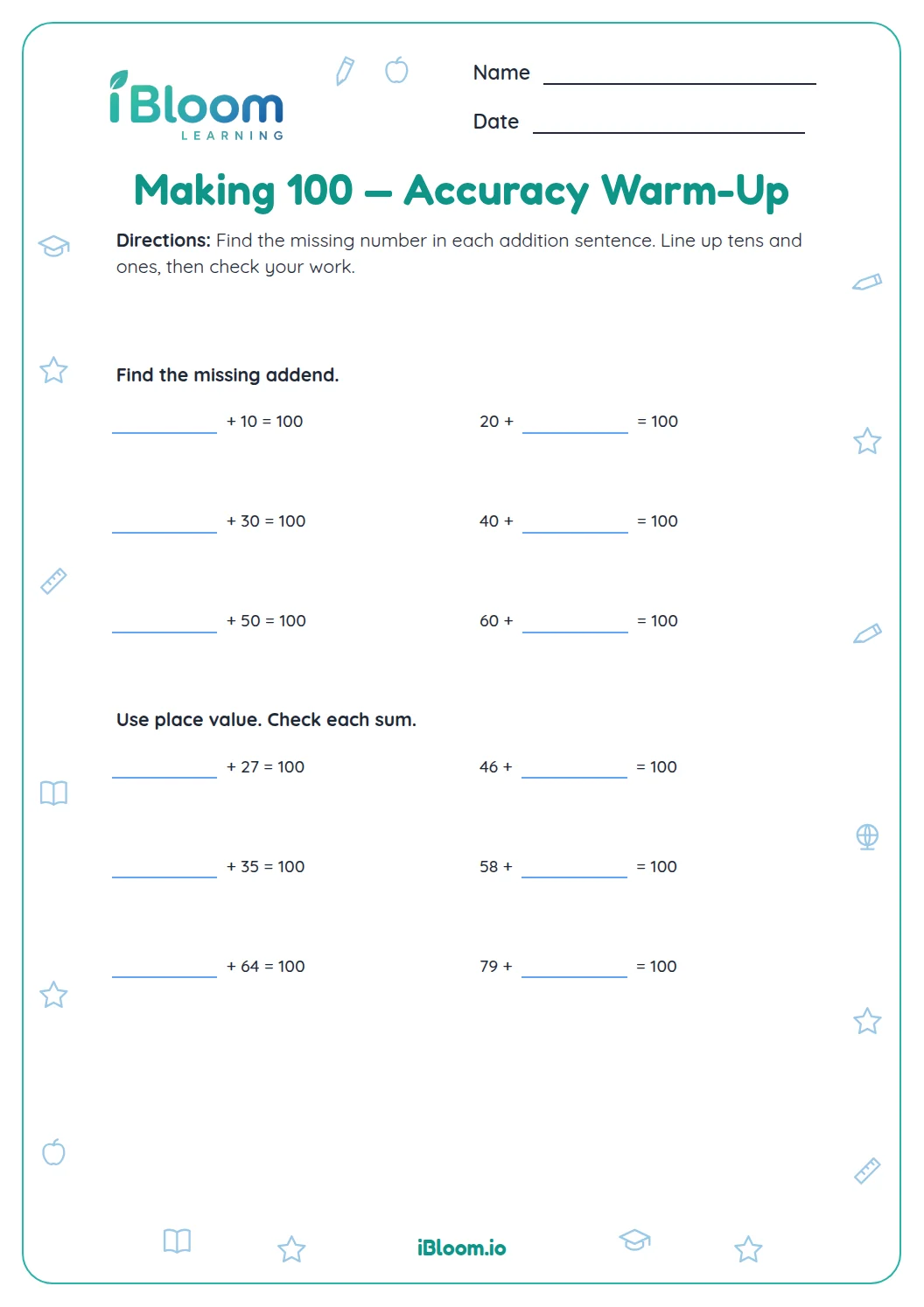
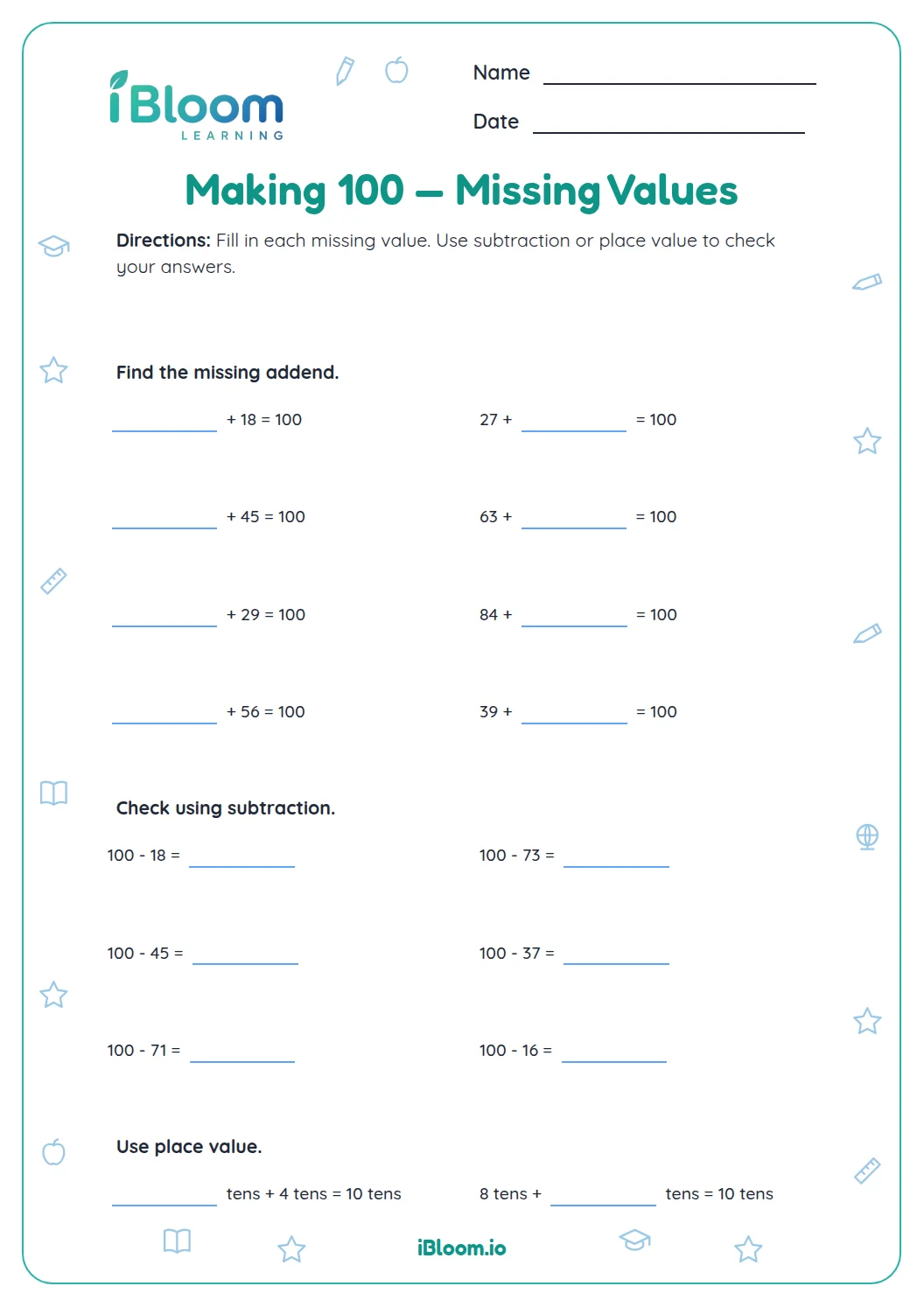
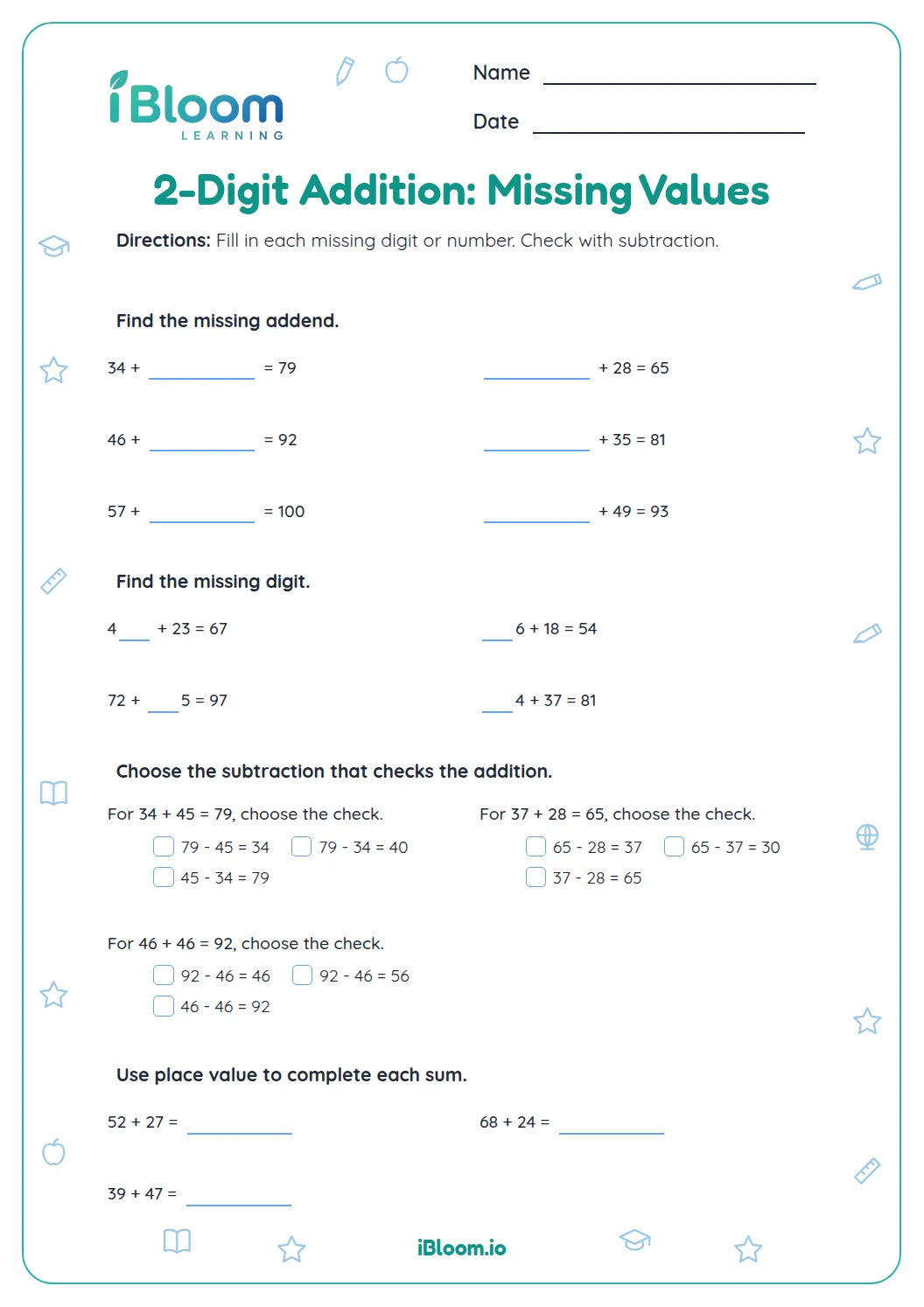
In Part B, find how much each first addend needs to reach 100. Use tens and ones or count up to the target.
- 1For 64 + ___ = 100, count up from 64 to find 36.
How can I check my addition?
Check the pair by adding its parts. A correct pair totals 100; for an error, compare the stated sum with the actual total.
How to use this worksheet
- 1Read the claim and identify its target total.
- 2Add the numbers or use a complement strategy.
- 3Compare the calculated total with the stated claim.
- 4For a missing addend, find how much is needed to reach 100.
- 5Check that the two addends total 100.
Check your editing
The mistake
Forgetting to regroup a ten from the ones.
The fix
Write the extra ten above the tens column before adding.
The mistake
Adding the tens but ignoring the ones.
The fix
Solve both place values and combine them for the total.
The mistake
Marking a claim correct because it looks reasonable.
The fix
Calculate the sum before comparing it with the stated answer.
Curriculum alignment
This worksheet practices 2.NBT.B.5 through the listed tasks.
Check two-digit addition within 100 and correct sums using place value.
On this sheet: Students use place-value addition within 100 to assess and complete pairs that make 100.
Show the official wordingHide the official wording
Fluently add and subtract within 100 using strategies based on place value, properties of operations, and/or the relationship between addition and subtraction.
What to practice next
Make more practice
Further reading
Questions parents and teachers ask
What does “making 100” mean on this worksheet?
The worksheet practices addition of two-digit numbers with totals no greater than 100. Students check proposed sums and solve addition problems, using place value and regrouping when needed. Calculate the total before deciding whether the claim is accurate. Use the answer key to review regrouping and compare the final sum.
Are all the claims in Part A incorrect?
No. Part A includes both correct and incorrect claims. Students need to calculate each sum before deciding whether the person’s answer is accurate. Calculate the total before deciding whether the claim is accurate. Use the answer key to review regrouping and compare the final sum.
How many questions are included?
There are 14 questions in two parts. Students check seven addition claims and then find the correct sums for seven more two-digit addition problems. The answer key lists each decision and total. Calculate the total before deciding whether the claim is accurate.
What strategy should students use?
Students can add the ones first, regroup a ten when the ones total is 10 or more, and then add the tens. Estimating or recomputing provides a useful check on the final sum. Calculate the total before deciding whether the claim is accurate.
How long does this worksheet take?
About 15 minutes is a practical estimate for the 14 items. Students may need extra time to explain how a claim is wrong or to review a regrouping step with an adult. Calculate the total before deciding whether the claim is accurate.