

About this worksheet
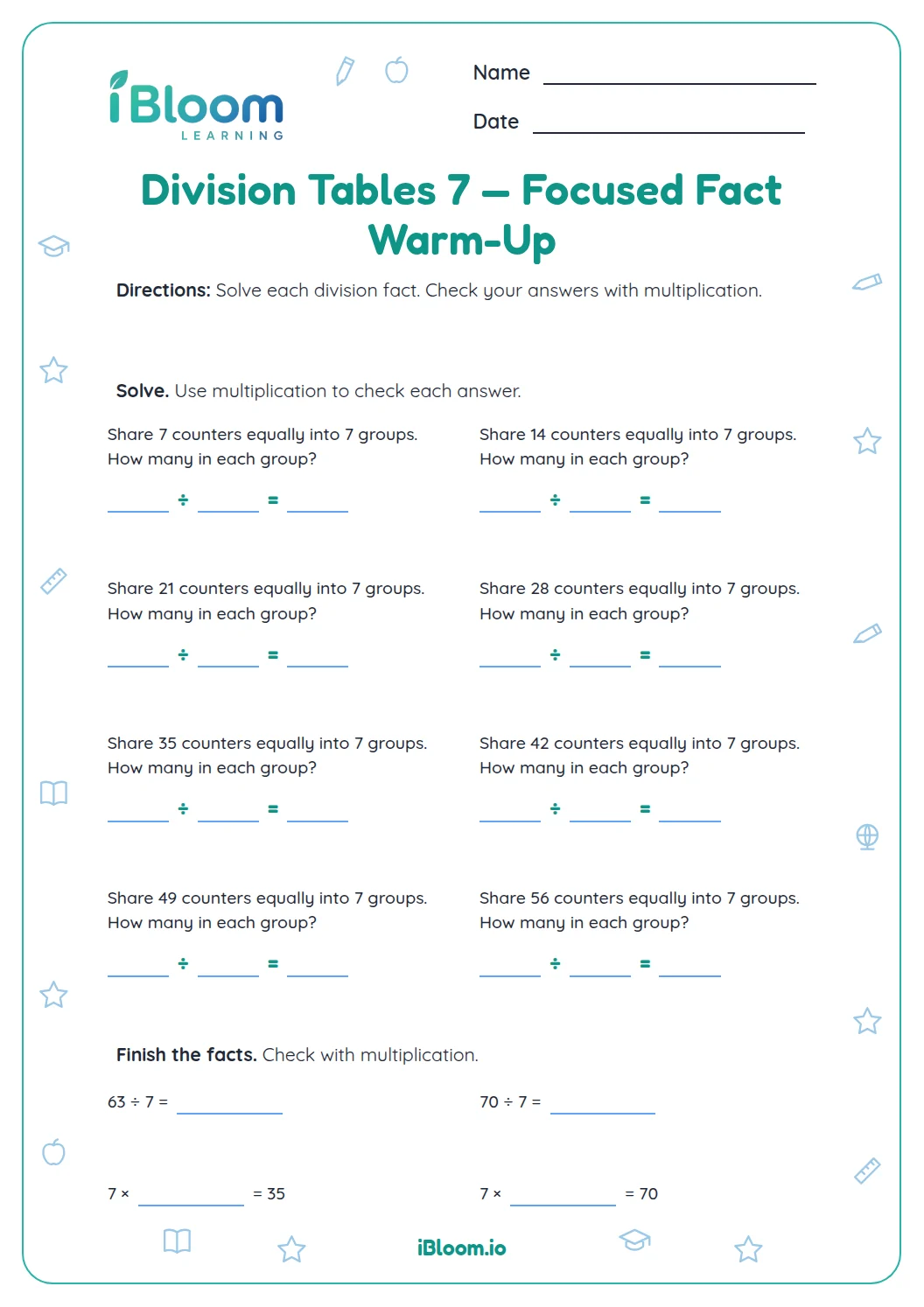
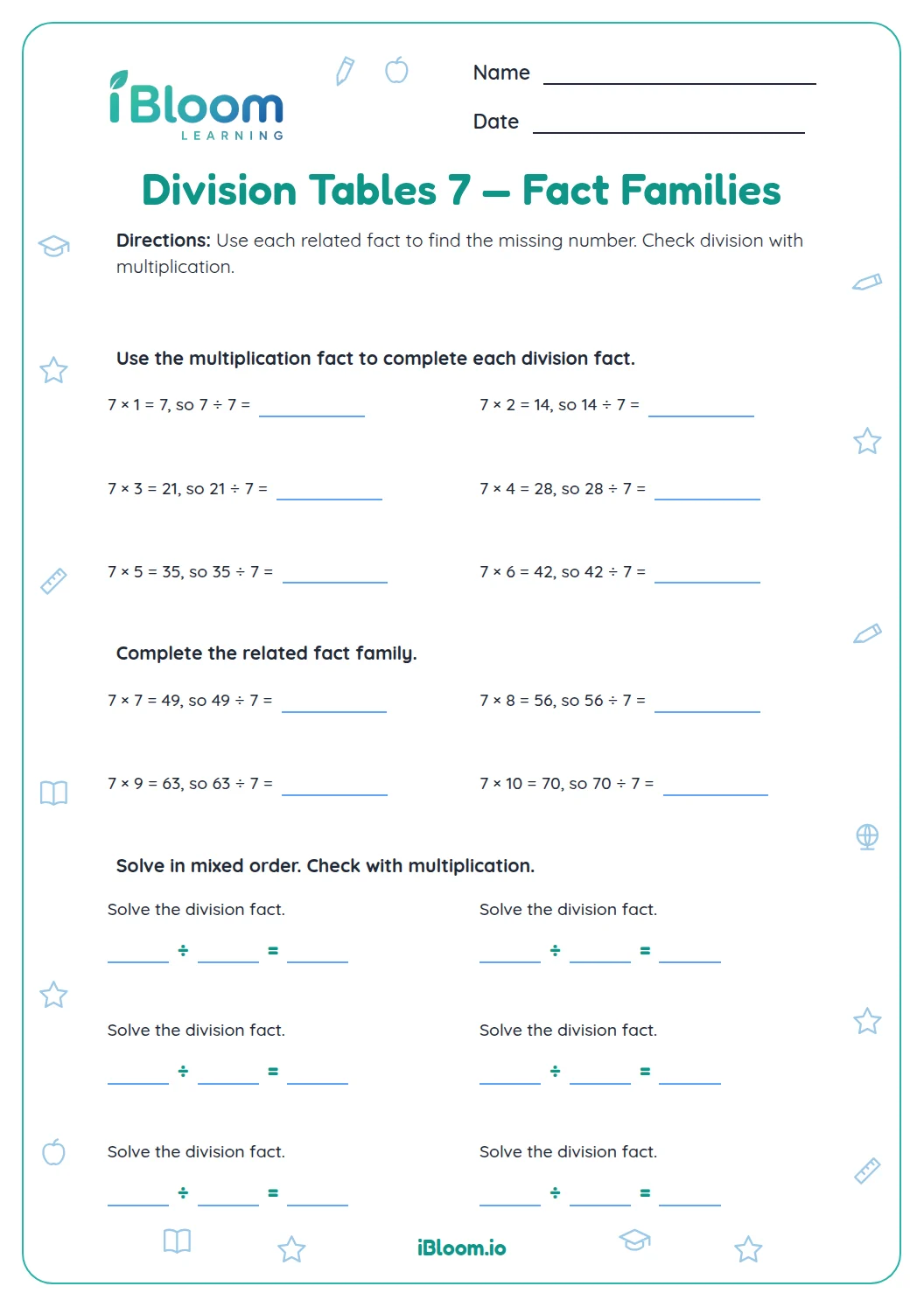
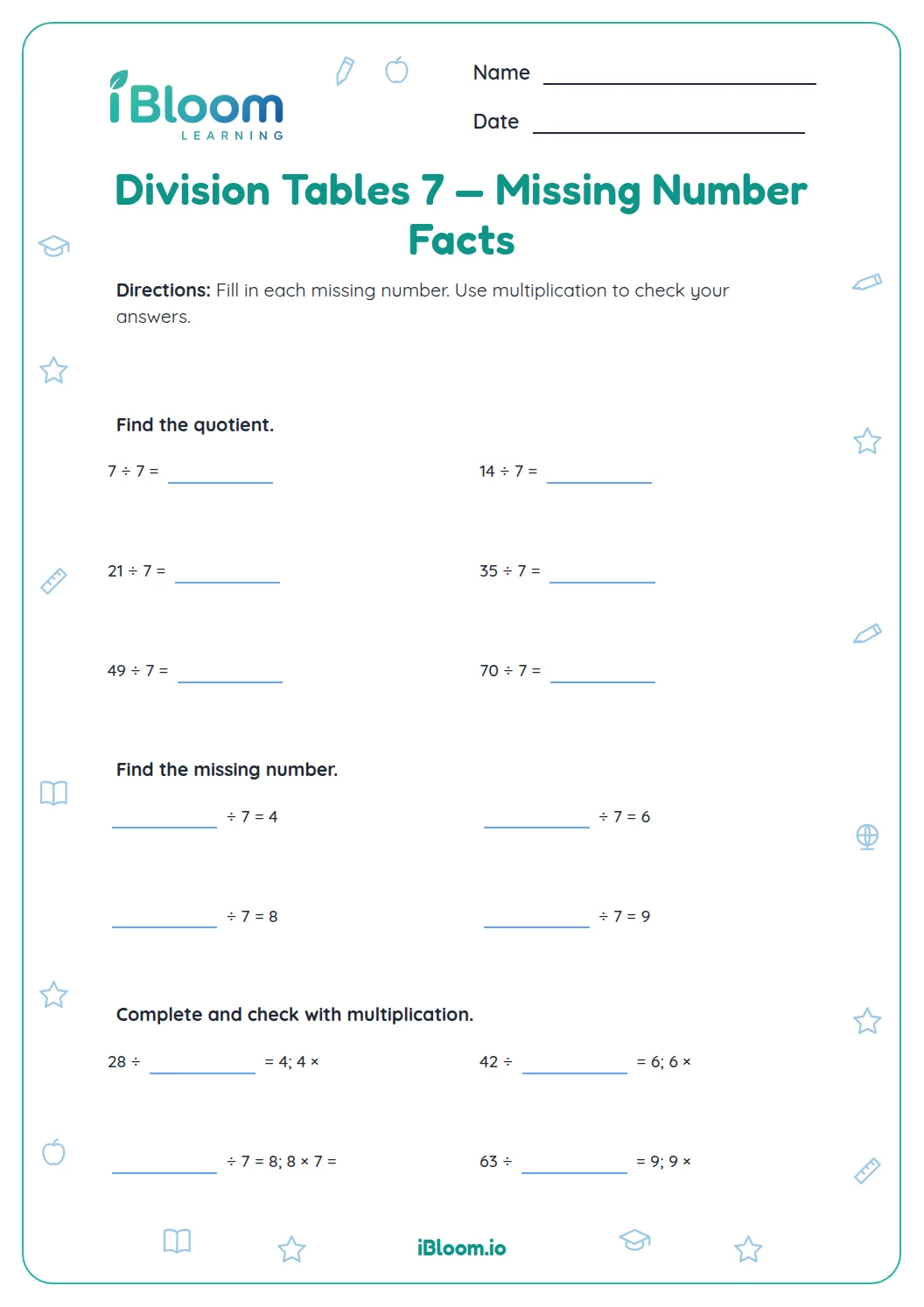
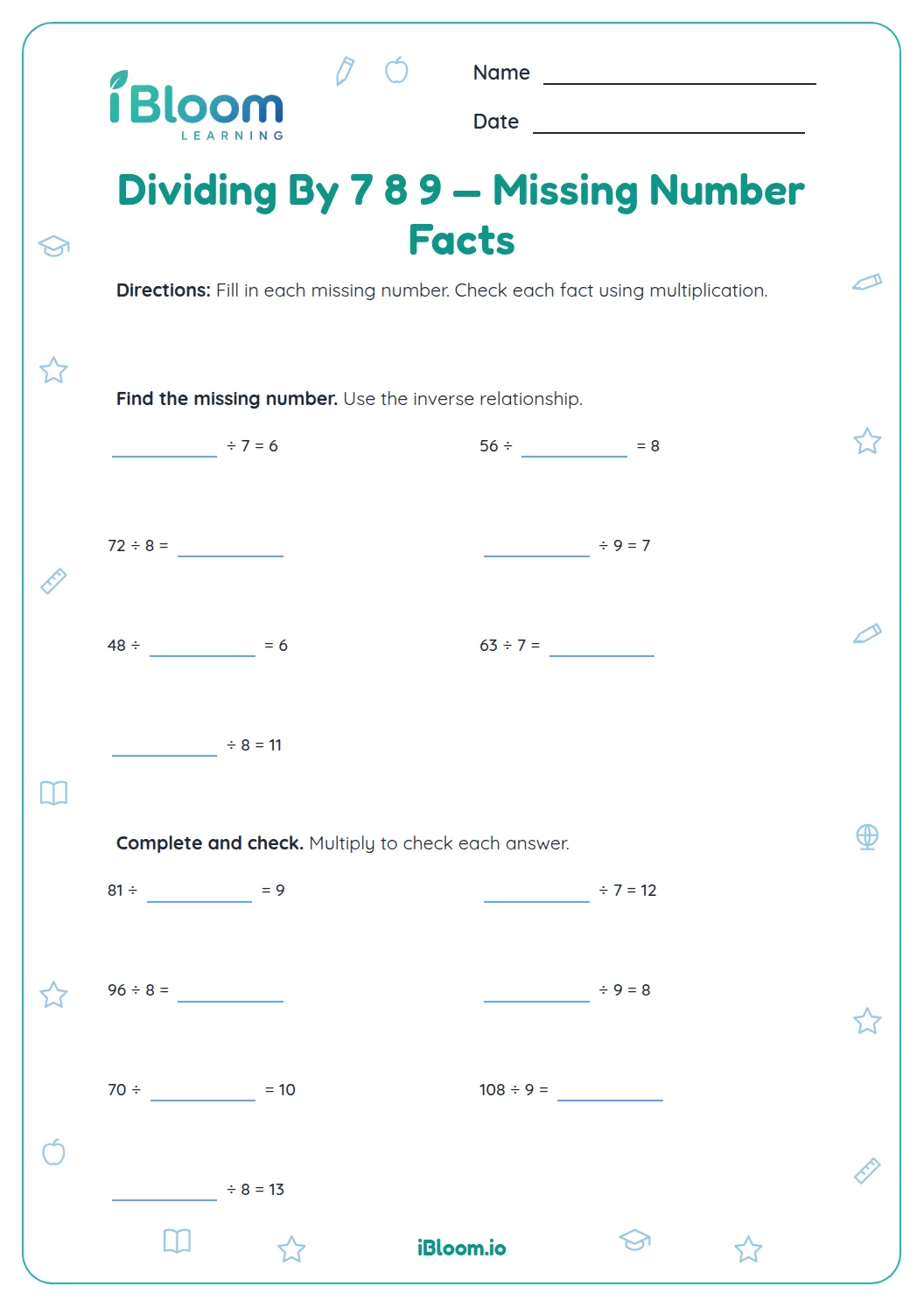
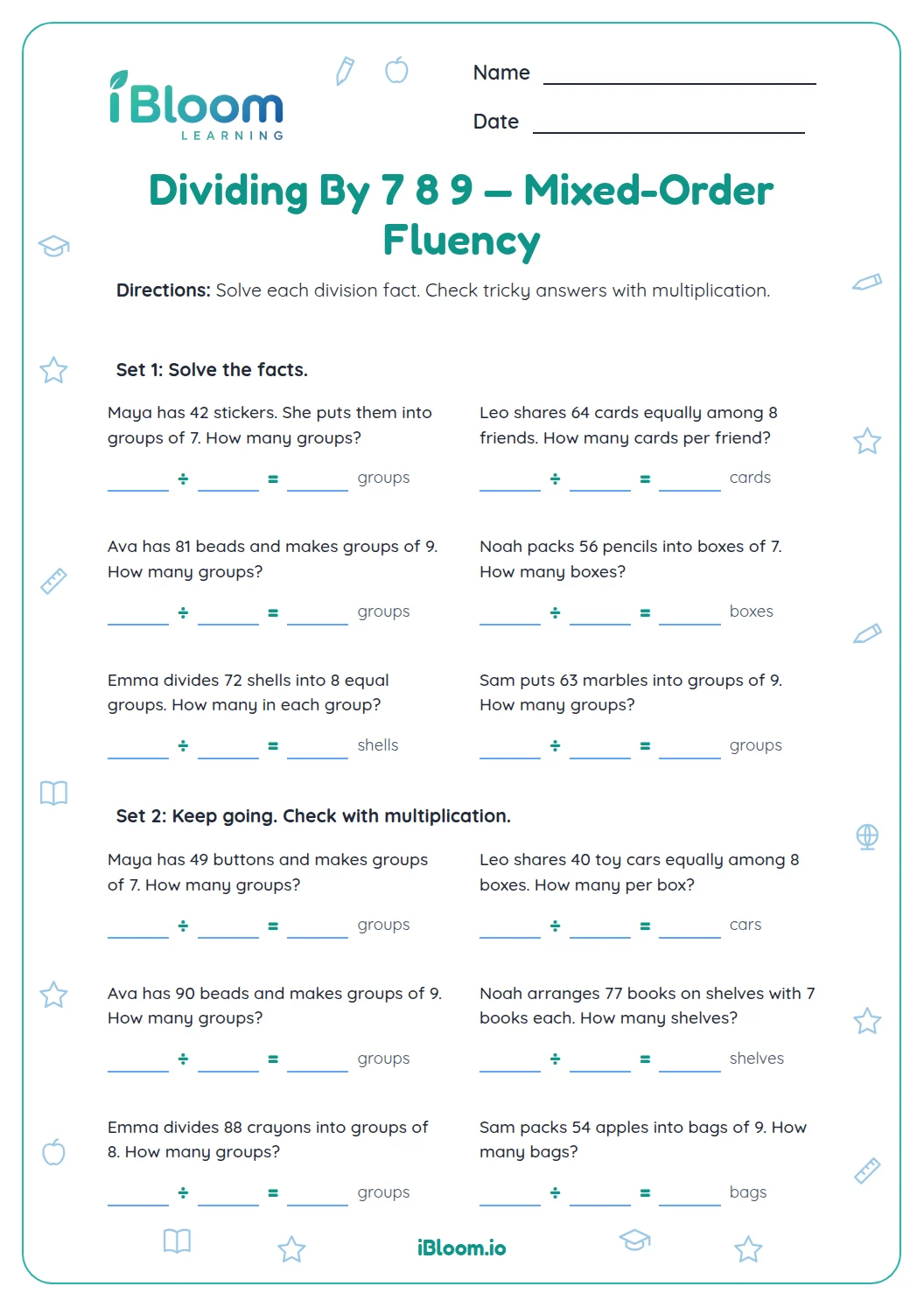
This free printable is for Grade 3 learners practicing division facts with 7. Part A moves from 7 ÷ 7 through 42 ÷ 7; Part B connects multiplication and division facts; Part C mixes quotients with a non-whole-number check. It supports CCSS 3.OA.C.7 through fact fluency and related-fact reasoning. The 16-question worksheet includes a separate answer key.
Aligned to 3.OA.C.7
How does the first part build the 7s facts?
The opening six number sentences use multiples of 7 from 7 through 42. Solving in order can help a learner notice that each quotient increases by one as the dividend increases by seven.
- 128 ÷ 7 = ___
- 2Think: 7 × 4 = 28
- 3So 28 ÷ 7 = 4
How do multiplication and division facts connect?
A fact family uses the same three numbers in related equations. If 7 × 8 = 56, then 56 ÷ 7 = 8. Questions 7–11 ask children to supply a missing factor, dividend, divisor, or product.
What does the final check ask learners to notice?
Questions 12–16 mix direct division, a nonmultiple of 7, and multiplication. For 32 ÷ 7, the quotient is not a whole number because 28 and 35 are the neighboring multiples of 7.
How to use this worksheet
- 1Say the divisor, 7, before solving each item.
- 2Recall or build the matching multiplication fact.
- 3Write the missing factor, dividend, divisor, or quotient.
- 4For a division answer, multiply the quotient by 7 to check.
- 5Use the key to review any fact that needs another try.
Common mistakes and quick fixes
The mistake
Reading 42 ÷ 7 as 7 ÷ 42.
The fix
Name the total first, then ask how many groups of 7 make that total.
The mistake
Using a nearby product as the quotient.
The fix
Check by multiplying the proposed quotient by 7.
The mistake
Writing a whole-number answer for 32 ÷ 7.
The fix
Compare 32 with 28 and 35; it falls between two multiples of 7.
Common Core math alignment
The worksheet connects division facts with related multiplication facts.
Fluently divide within 100 using multiplication facts, including facts with 7.
On this sheet: The page practices division facts with 7 and asks children to use multiplication as a check.
Show the official wordingHide the official wording
Fluently multiply and divide within 100, using strategies such as the relationship between multiplication and division (e.g., knowing that 8 × 5 = 40, one knows 40 ÷ 5 = 8) or properties of operations. By the end of Grade 3, know from memory all products of two one-digit numbers.
What to practice next
Make more practice
Further reading
Questions parents and teachers ask
What facts are on the Division Tables 7 page?
There are 16 questions: six direct quotient facts, five missing-number equations, and five mixed checks. The facts include the 7s through 70 ÷ 7, plus a nonmultiple check. The separate answer key lists the expected response to each item.
What is the answer to 32 divided by 7?
It is not a whole-number quotient. Seven times 4 is 28 and seven times 5 is 35, so 32 lies between those multiples. The final section asks learners to notice that this division does not have a whole-number answer.
How can multiplication check division by 7?
Multiply the quotient by 7 and see whether it returns the dividend. For example, 42 ÷ 7 = 6 can be checked with 6 × 7 = 42. This related-fact check works throughout the direct division section and helps catch a reversed operation.
Is this worksheet timed?
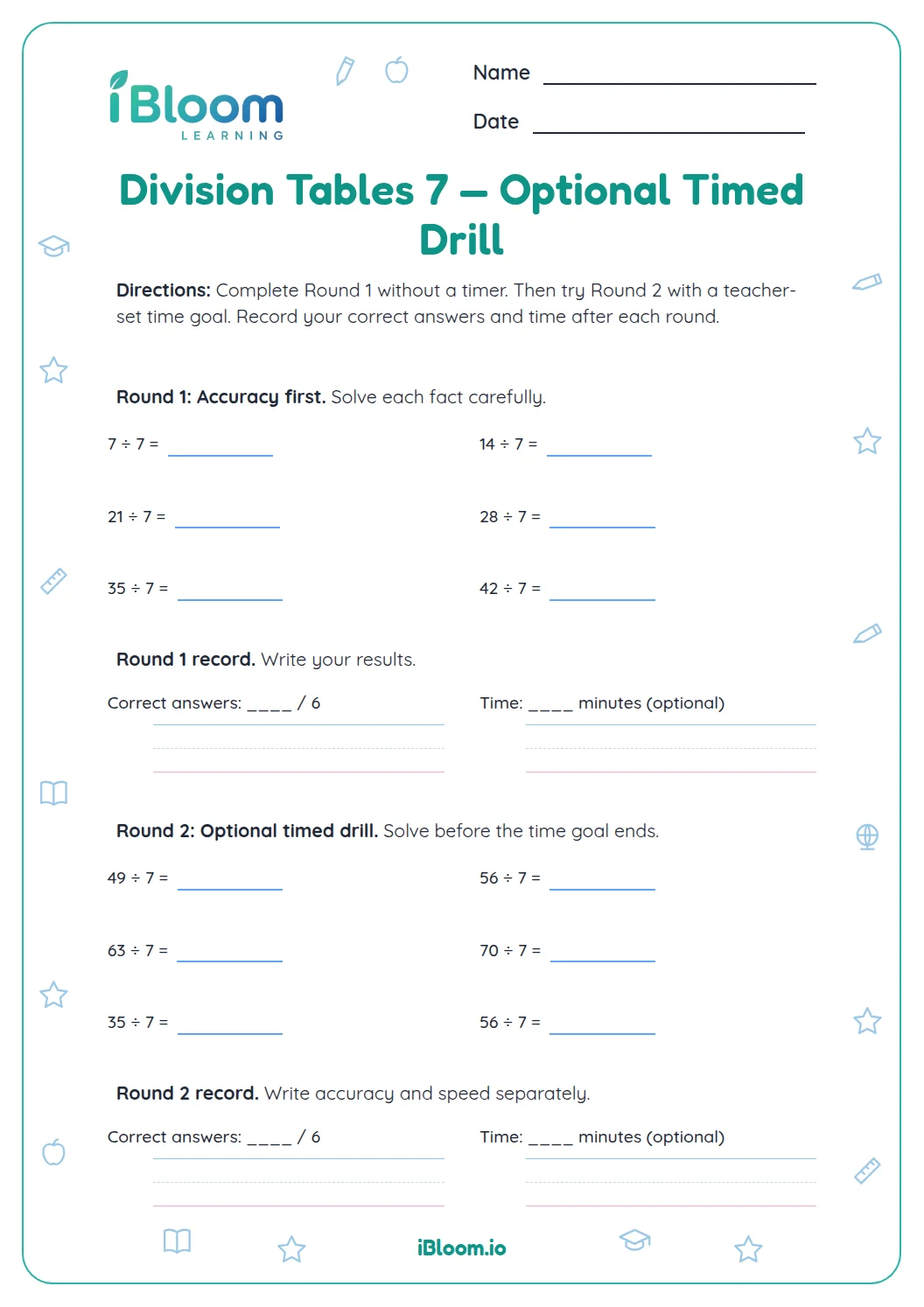
No timing is needed. The page is a mastery check with room to think through each fact. A learner may solve it at a comfortable pace, then use the answer key to find specific facts that need more practice.
Does it include an answer key?
Yes. The answer key is a separate two-page section and lists the expected response for all 16 questions, including “not a whole number” for 32 ÷ 7. Children can check their work after completing the worksheet. The key also supports quick correction.