



About this worksheet
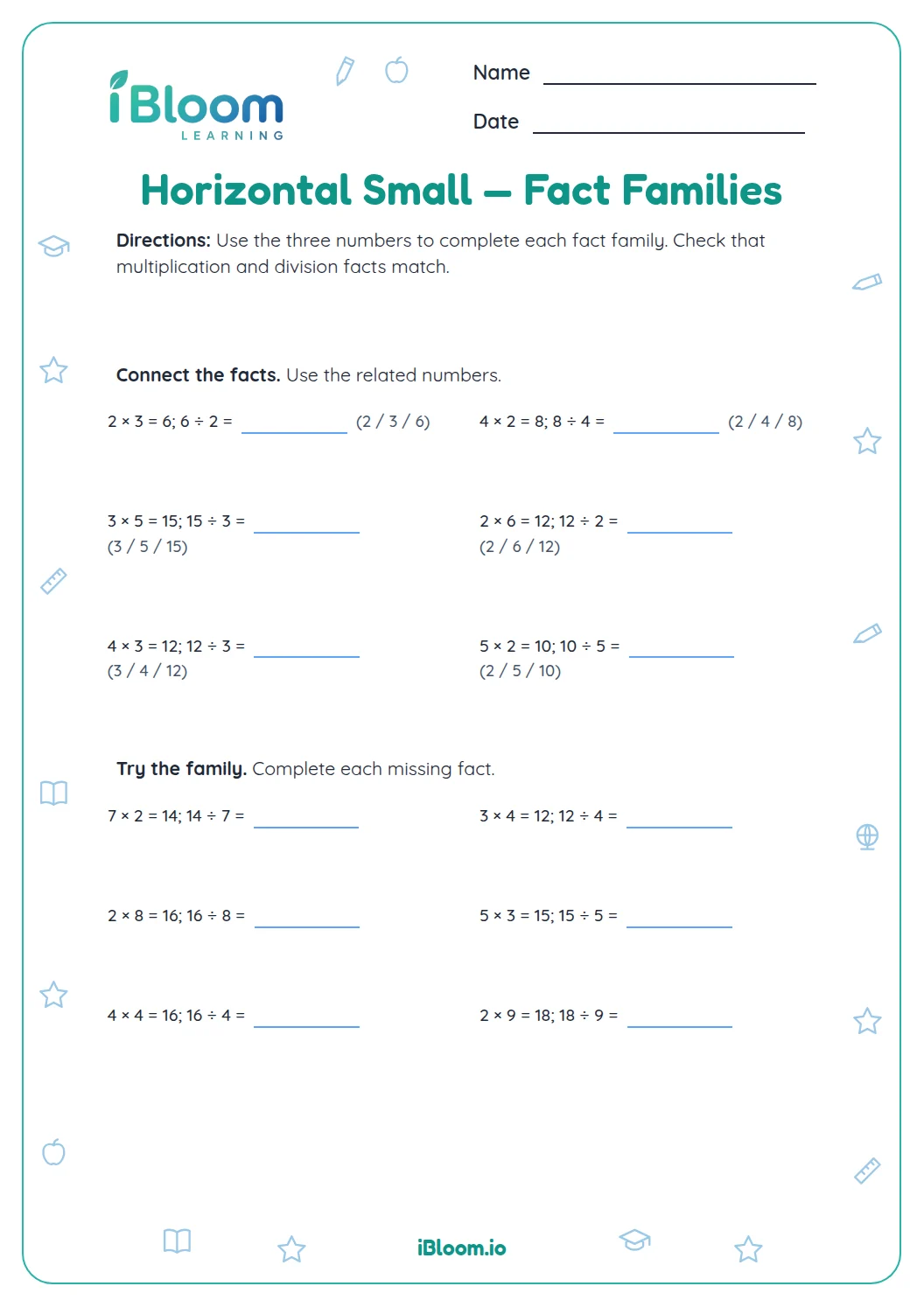
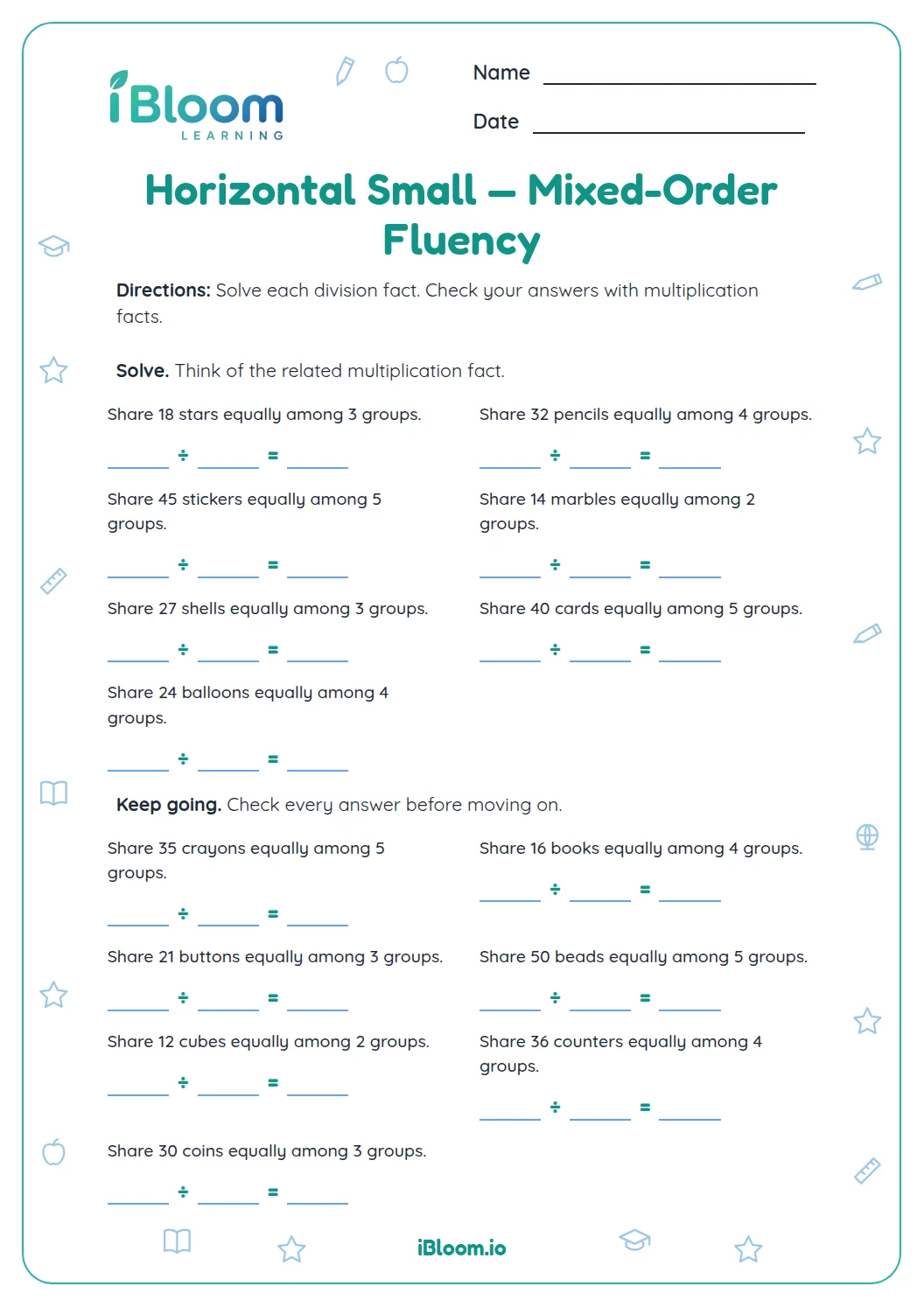
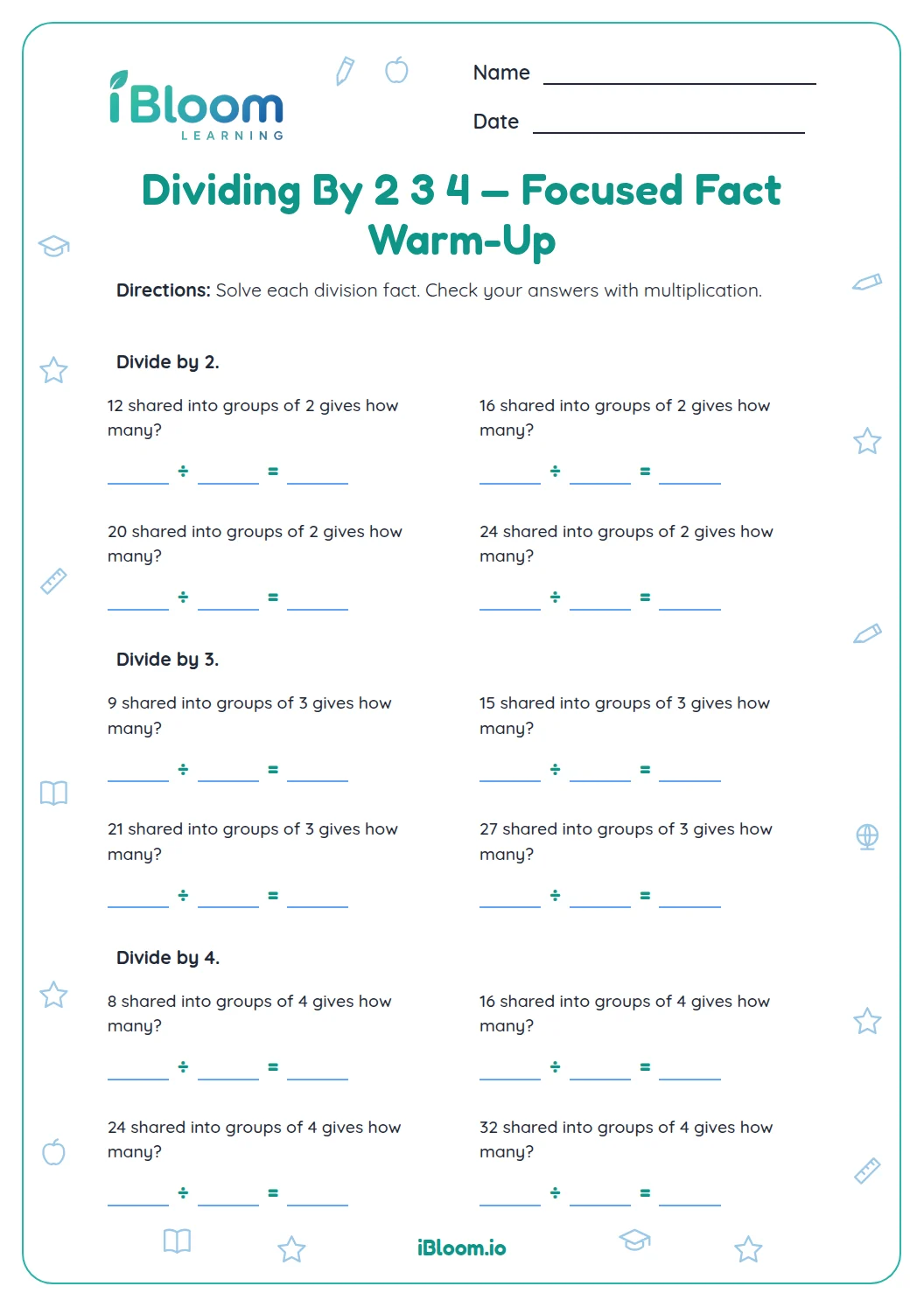
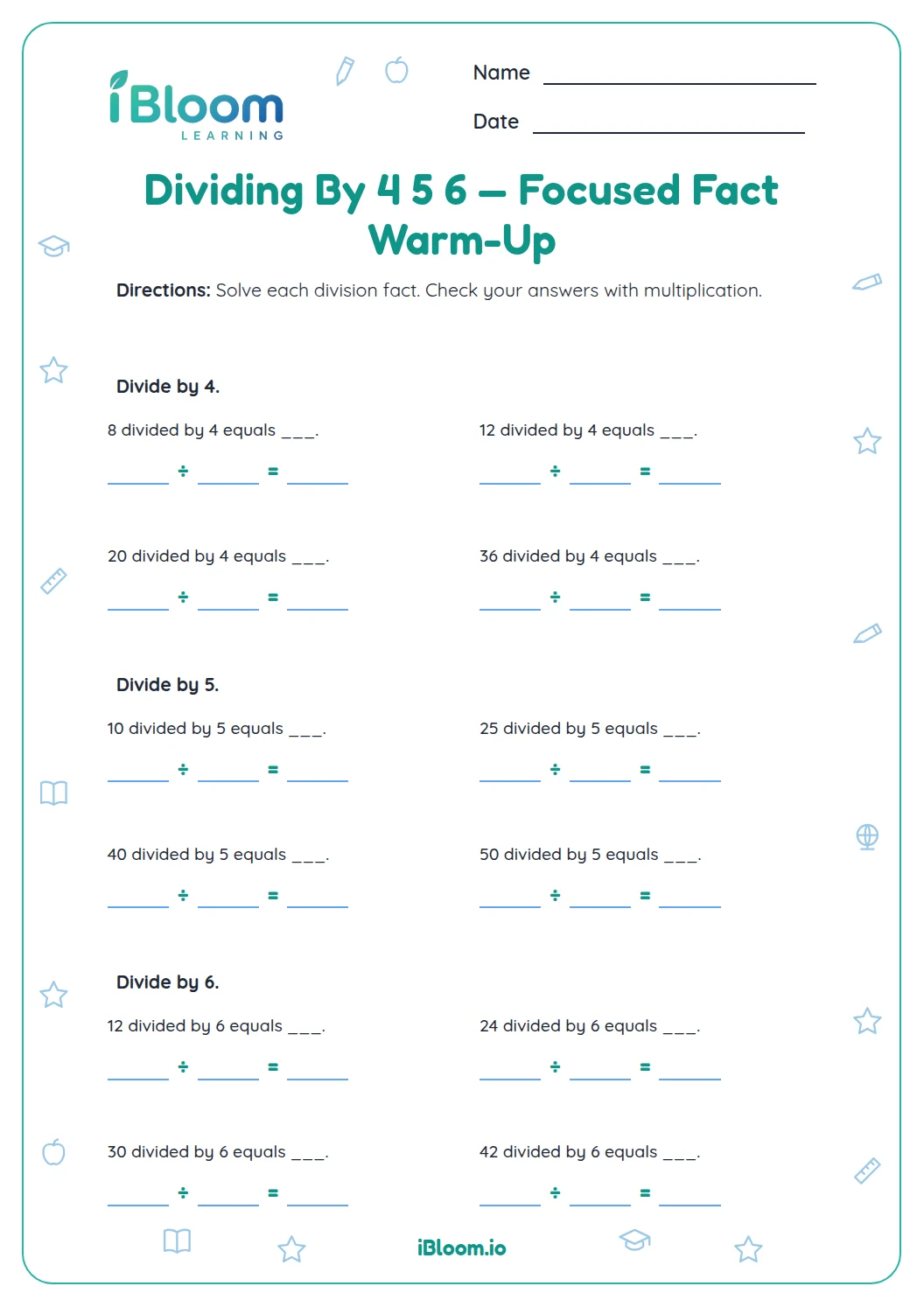
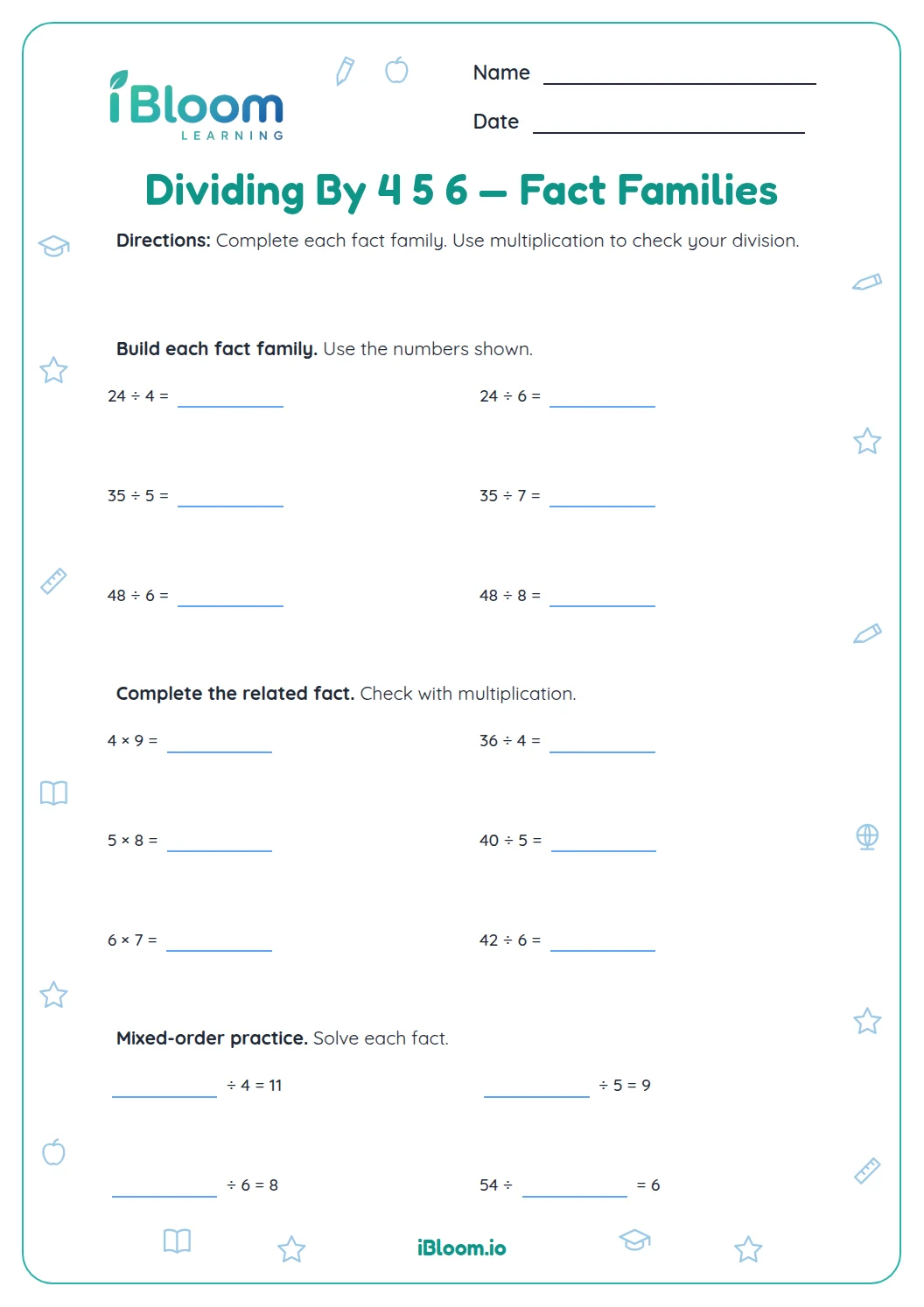
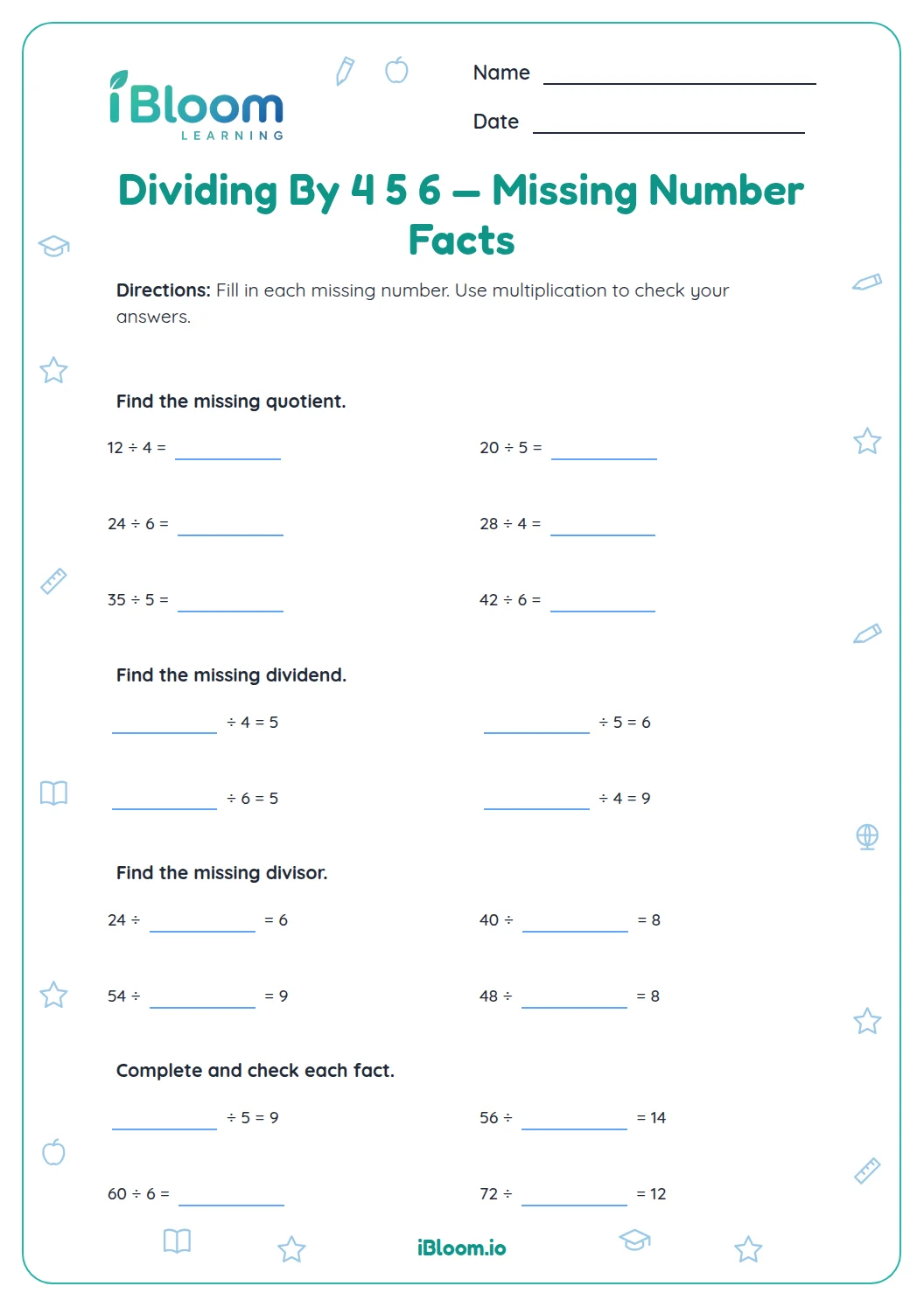
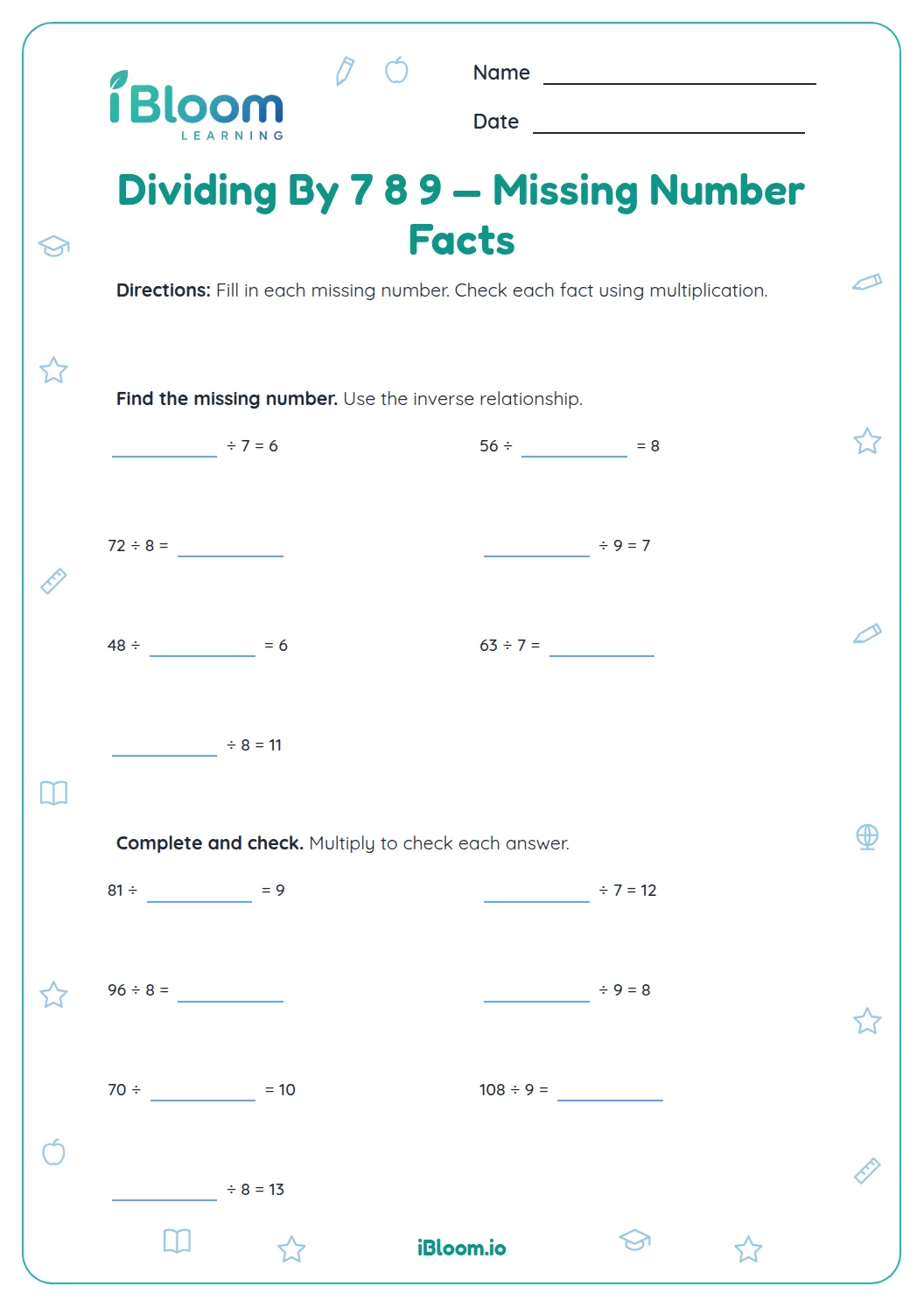
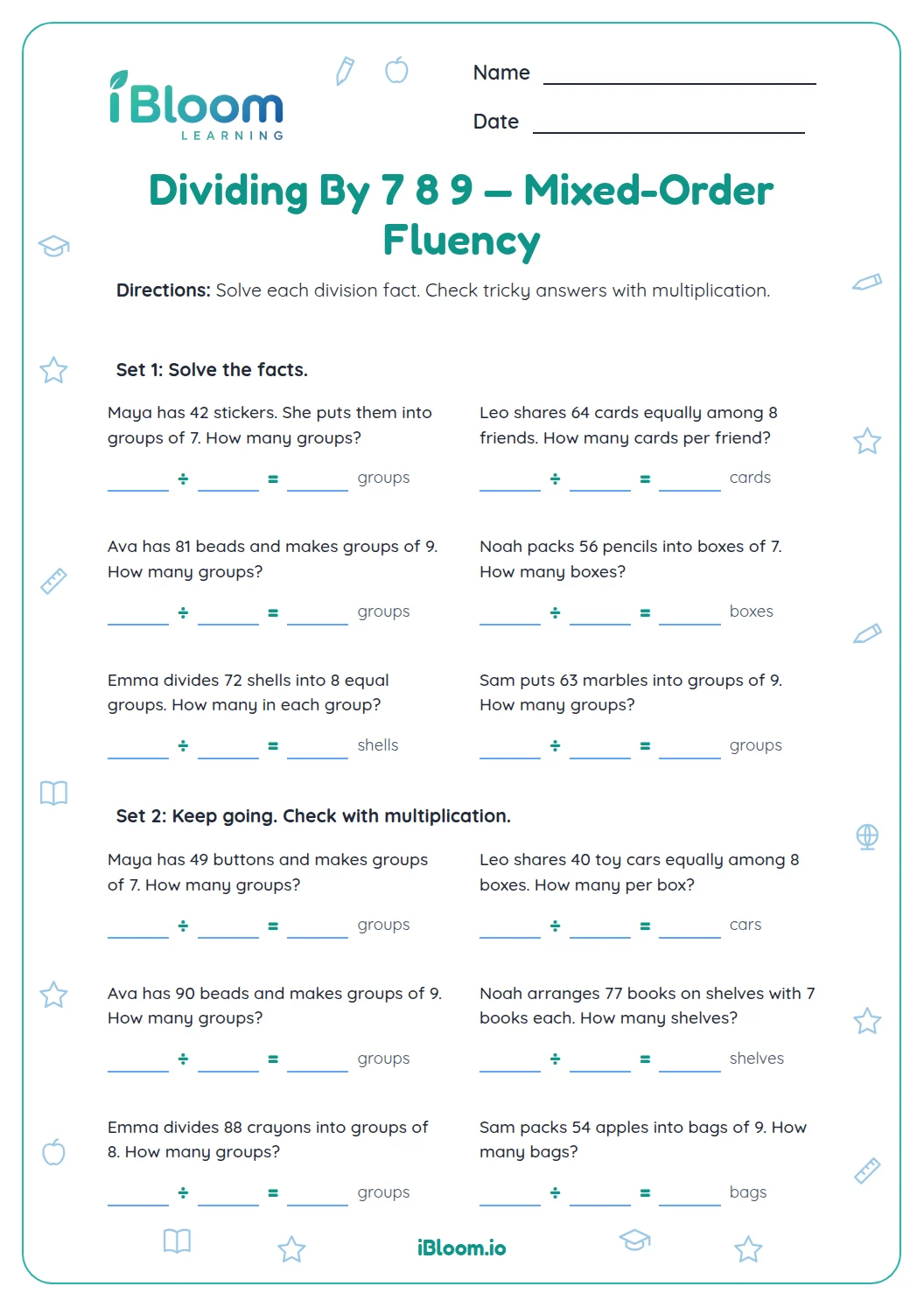
This Grade 3 division worksheet keeps the horizontal missing-number format and multiplication checks of the original. Across 20 facts, students find quotients, divisors, and dividends, then complete related multiplication equations. A separate answer key supports quick checking. The practice aligns with Common Core 3.OA.C.7.
Aligned to 3.OA.C.7
How do the four parts use division facts?
Part A gives the dividend and divisor, so students find the quotient. Parts B and C move the blank to the divisor or dividend. Part D uses multiplication equations to check the related fact.
For example, 36 ÷ ___ = 6 asks which number times 6 equals 36. Since 6 × 6 = 36, the missing divisor is 6.
- 136 ÷ ___ = 6
- 26 × 6 = 36, so the missing divisor is 6.
How to use this worksheet
- 1Read the position of the blank before calculating.
- 2Use multiplication to find a missing divisor or dividend.
- 3Write one number in each blank.
- 4Check the quotient by multiplying divisor and quotient.
- 5Compare each result with the answer key.
Common mistakes and quick fixes
The mistake
Dividing the dividend by the quotient to find a divisor incorrectly.
The fix
Use divisor × quotient = dividend to check the missing number.
The mistake
Writing the quotient where the dividend belongs.
The fix
Use the equation’s blank position to decide which number is missing.
The mistake
Skipping the multiplication check.
The fix
Multiply the divisor by the quotient and confirm the dividend.
Common Core alignment
The facts give students practice recalling and checking multiplication and division relationships.
Fluently multiply and divide within 100 using related facts.
On this sheet: Students solve division facts and use multiplication equations to check related facts.
Show the official wordingHide the official wording
Fluently multiply and divide within 100, using strategies such as the relationship between multiplication and division (e.g., knowing that 8 × 5 = 40, one knows 40 ÷ 5 = 8) or properties of operations. By the end of Grade 3, know from memory all products of two one-digit numbers.
What to practice next
Make more practice
Further reading
Questions parents and teachers ask
What types of division facts are included?
The 20 equations are split into four parts: six missing quotients, five missing divisors, five missing dividends, and four multiplication facts that check division. Every problem is horizontal, so students can focus on identifying the missing part and using a related fact.
How does multiplication help find a missing divisor?
A division fact can be rewritten as divisor times quotient equals dividend. In 36 ÷ ___ = 6, multiply 6 by 6 to make 36, so the missing divisor is 6. The worksheet encourages this relationship throughout the divisor and dividend sections.
What is a missing dividend?
The dividend is the number being divided. In ___ ÷ 7 = 4, multiply the divisor 7 by the quotient 4 to find 28 as the dividend. Part C gives five such equations with familiar single-digit divisors. This section uses familiar single-digit divisors and quotients.
Are the problems within Grade 3 fact fluency?
The equations use whole-number multiplication and division facts within 100. The final part asks students to complete related multiplication equations, which provides a direct check on the division relationship used in the earlier problems. Students can check each answer using its related multiplication fact.
Is there an answer key?
Yes. The answer key lists the value for every blank in the same order as the worksheet. Students can compare each answer and use multiplication to revisit any quotient, divisor, or dividend that needs another check. It follows the same order as the worksheet sections.