




About this worksheet
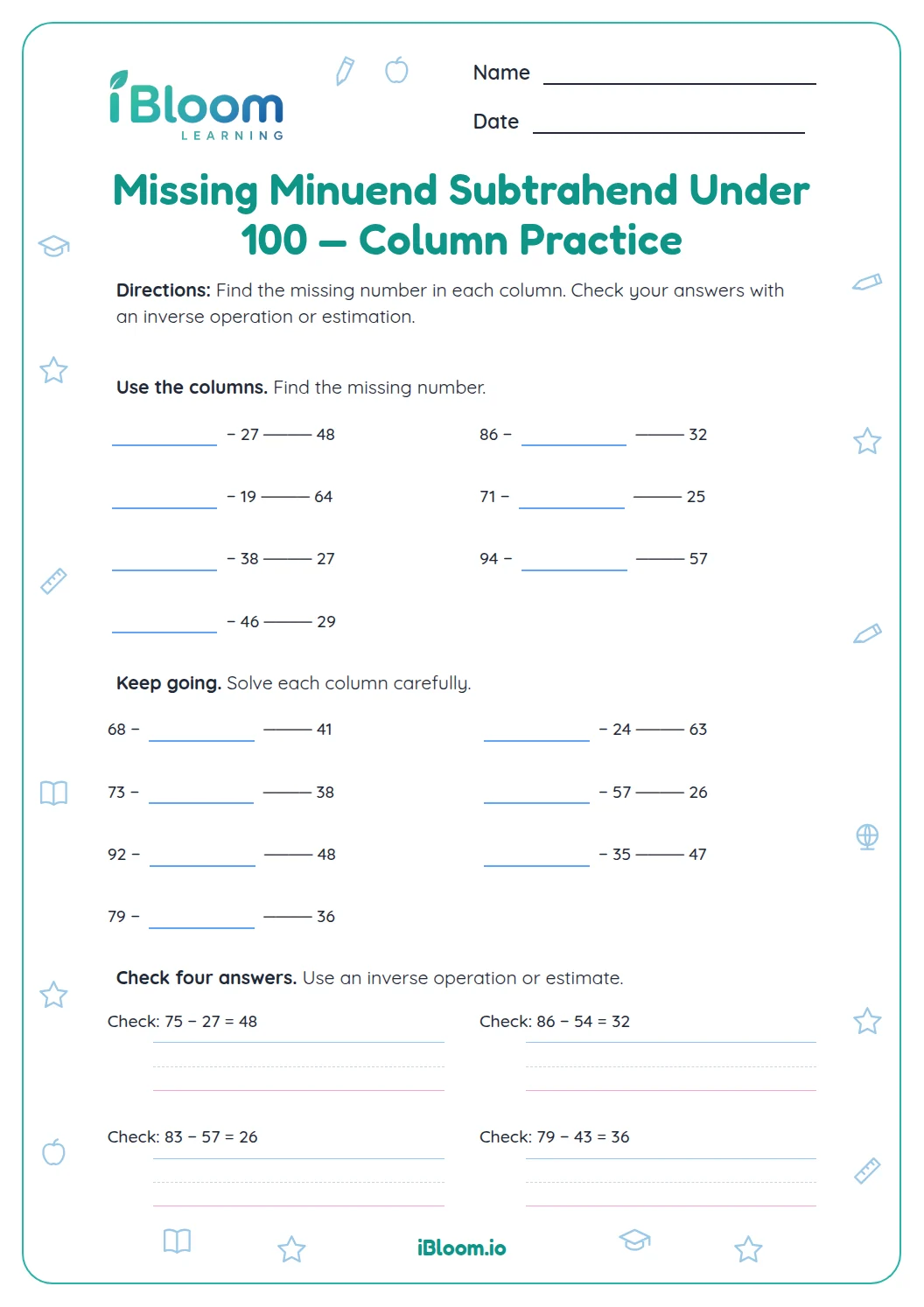
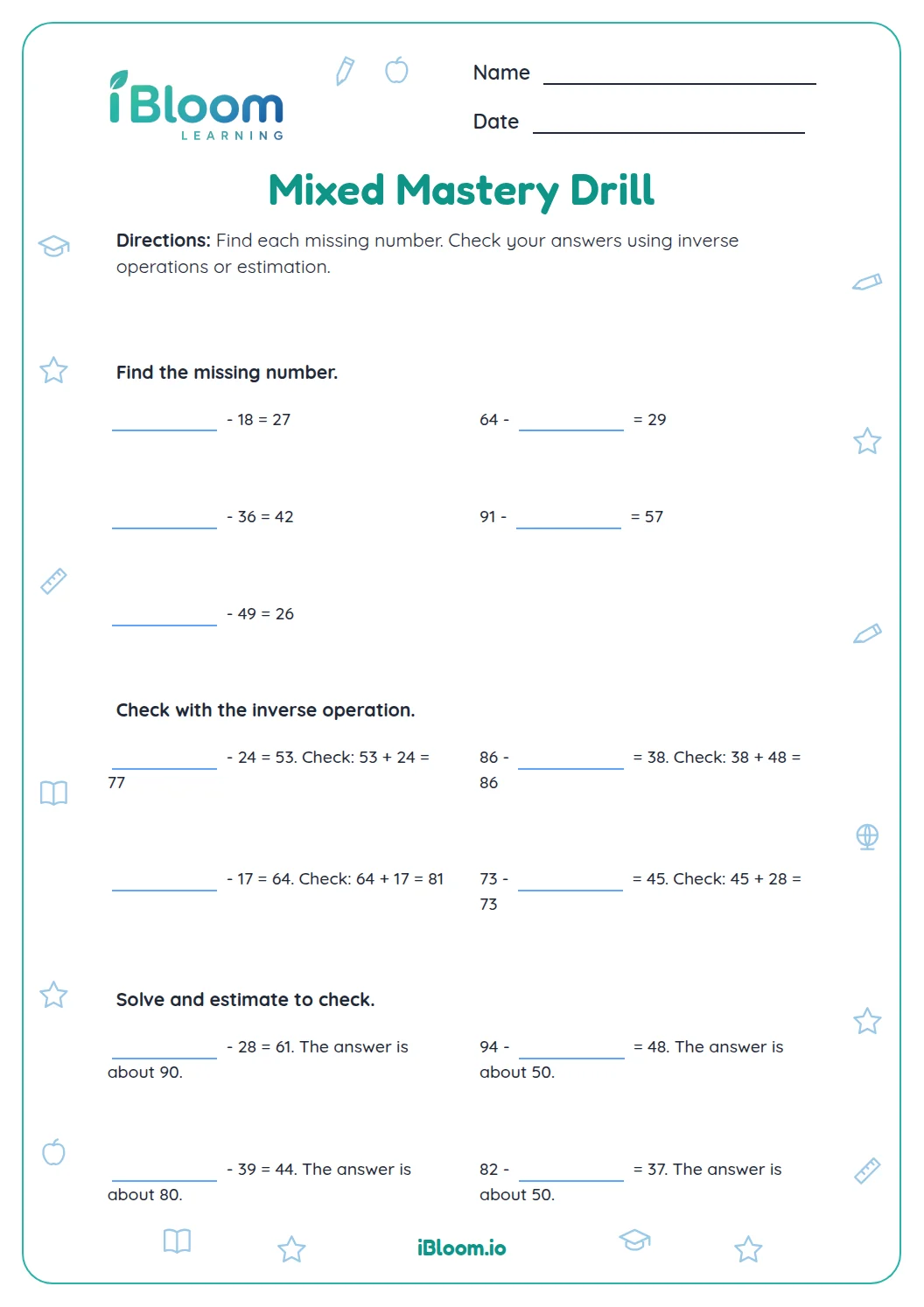
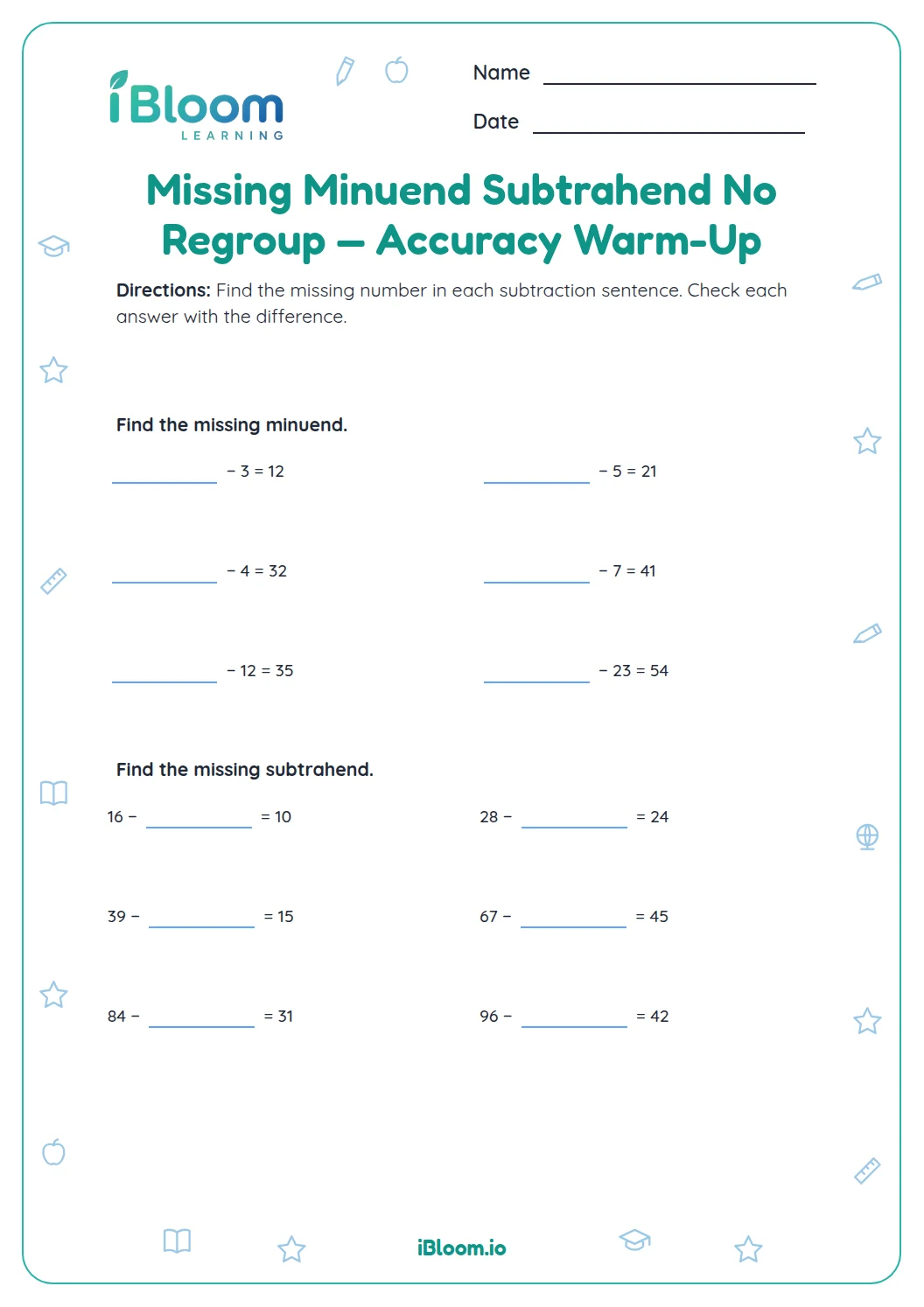
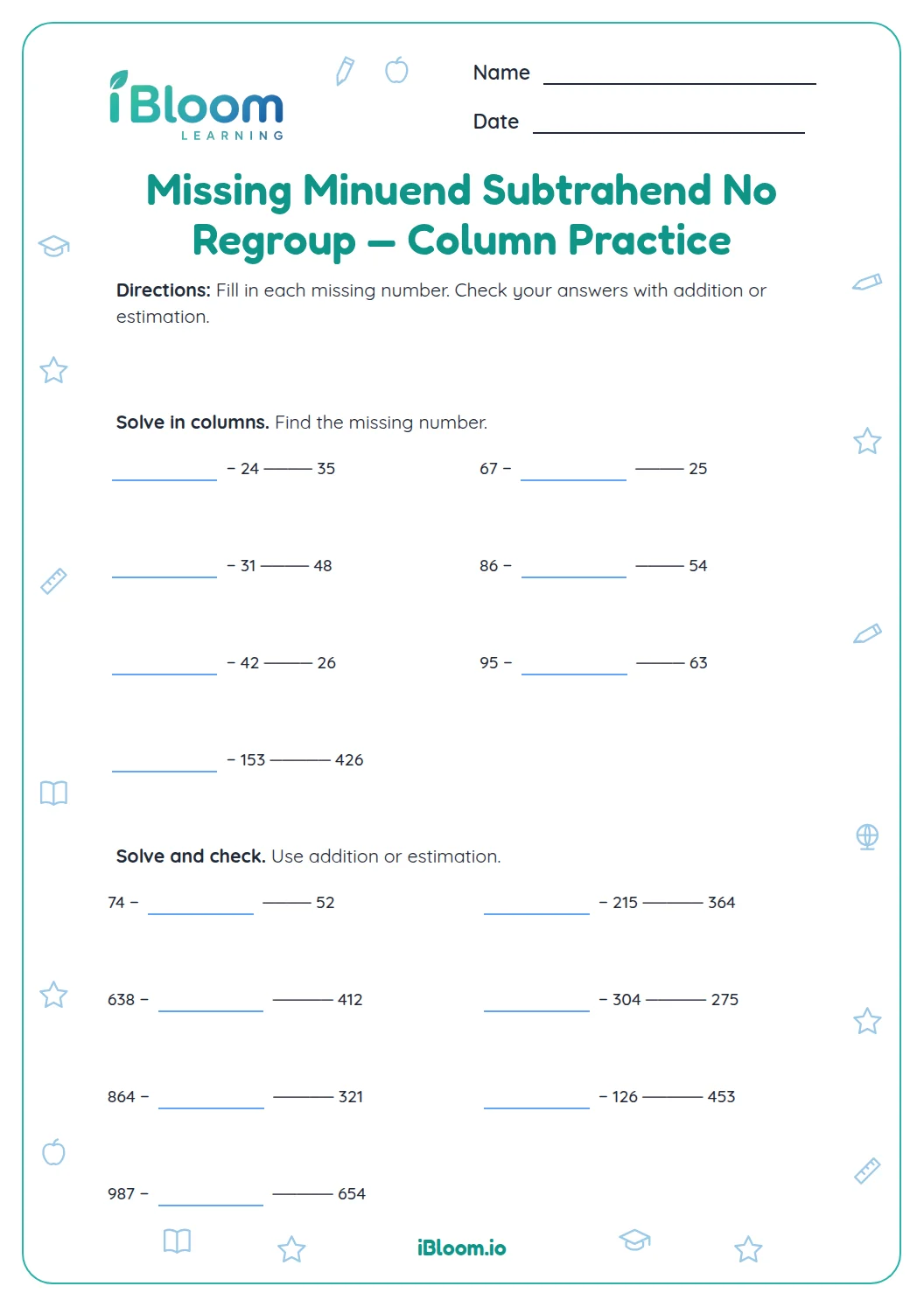
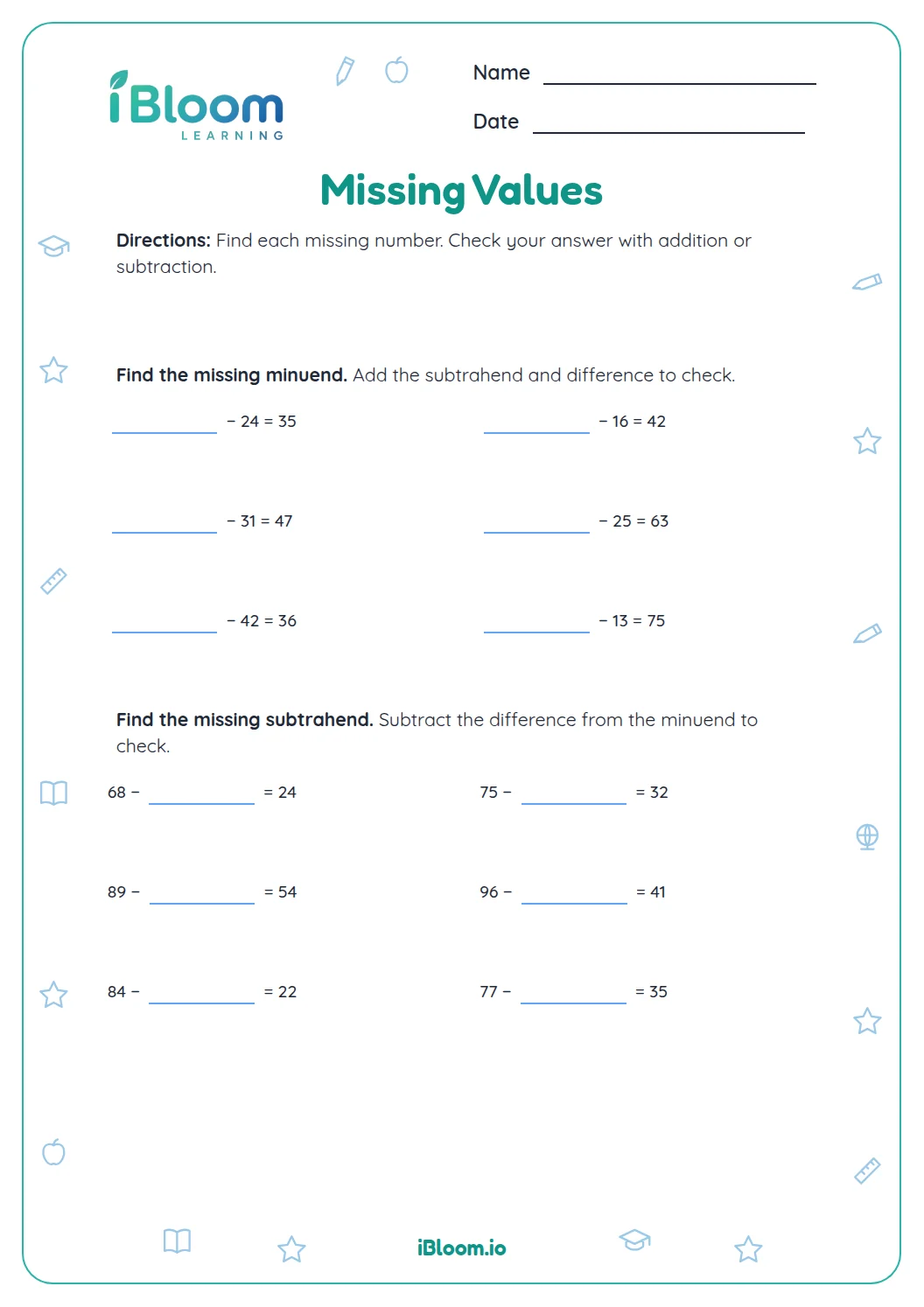
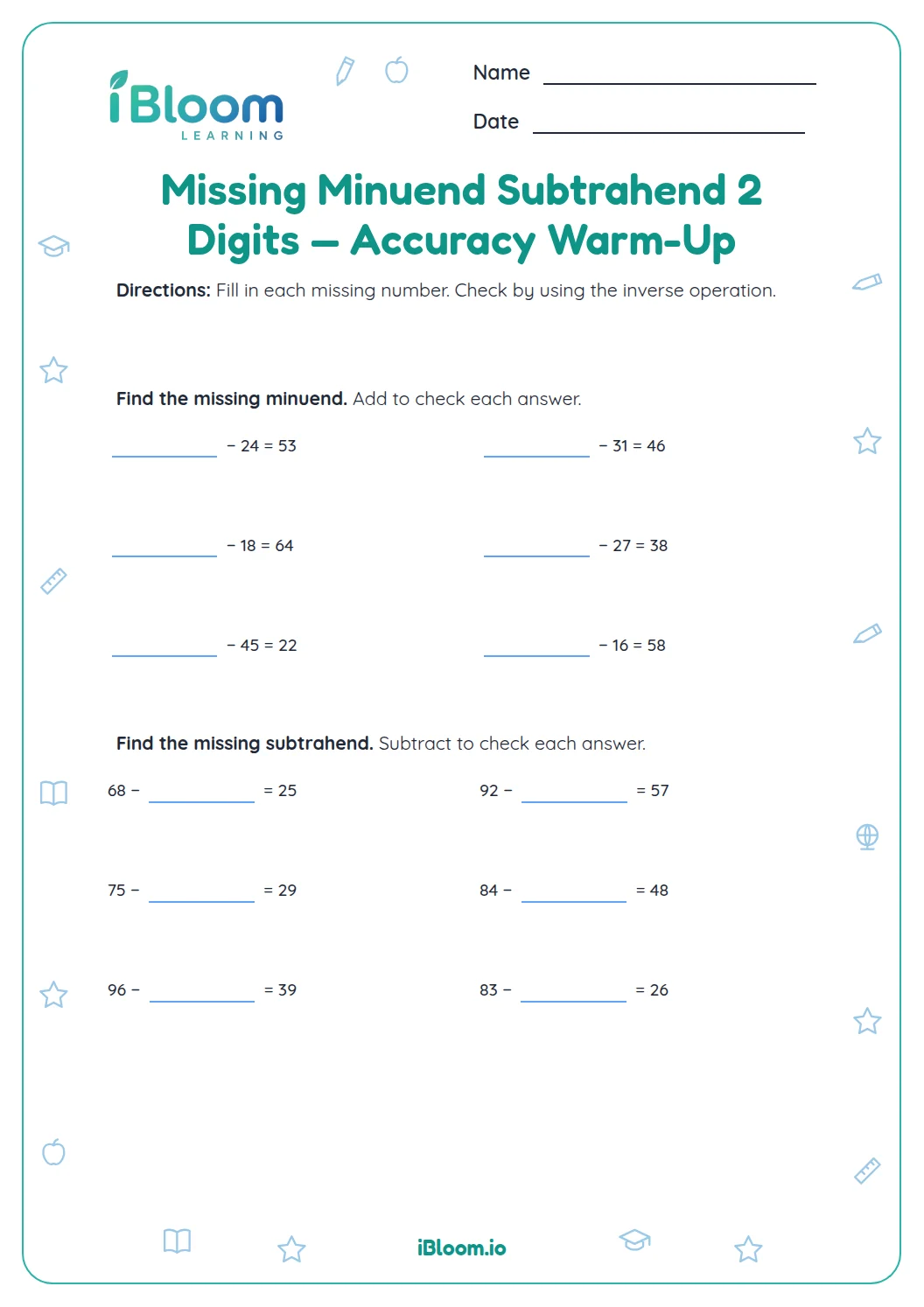
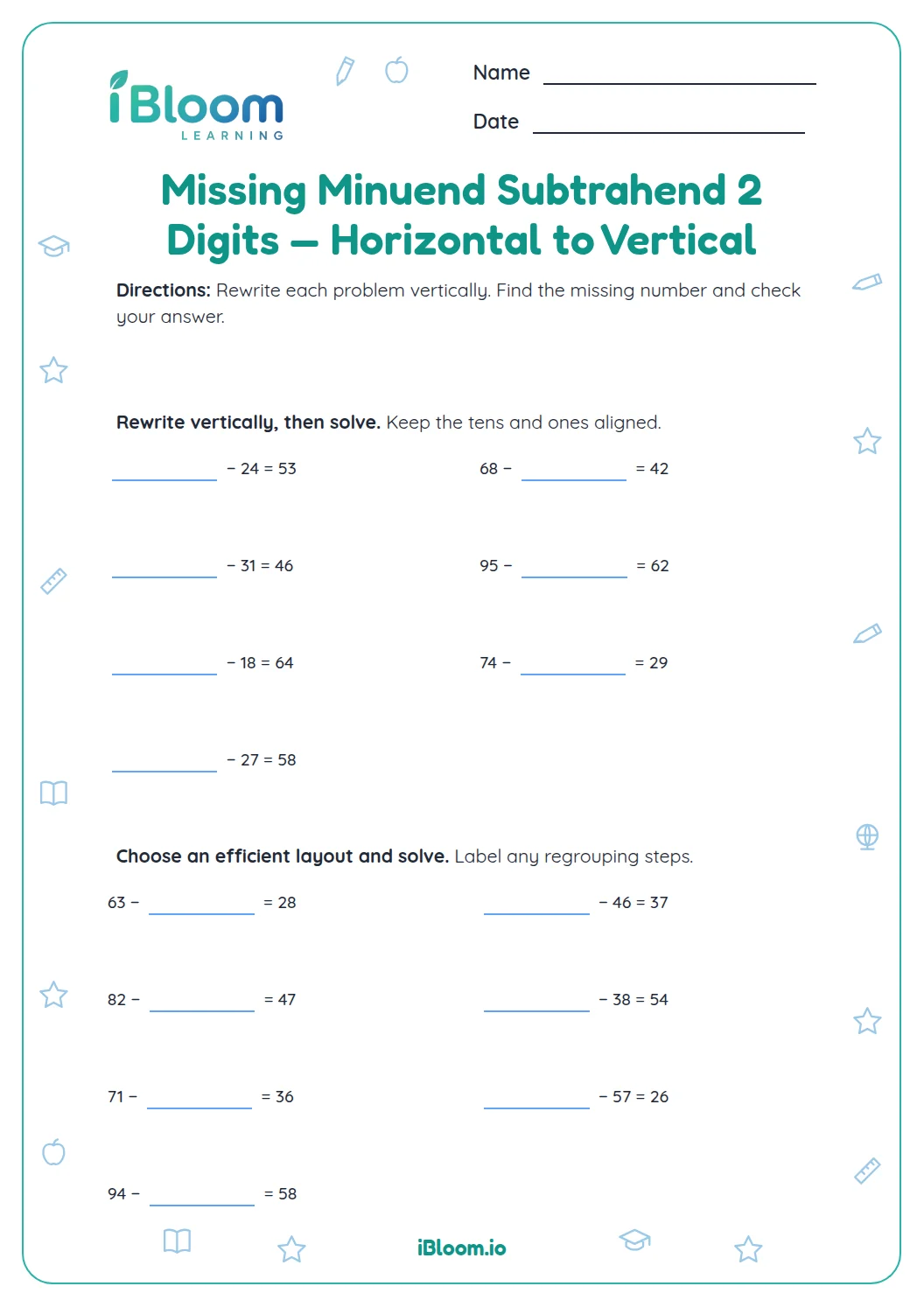
This worksheet gives learners 12 subtraction equations with a missing minuend or subtrahend, followed by four error checks. The numbers stay below 100. Children use the relationship between addition and subtraction to find each blank, substitute it back into the equation, and judge common slips. The work practices CCSS 2.NBT.B.5 strategies for adding and subtracting within 100.
Aligned to 2.NBT.B.5
How do you find a missing minuend?
The minuend is the number being subtracted from. In ___ − 14 = 17, add the difference and the subtrahend: 17 + 14 = 31. The missing starting number is 31.
How do you find a missing subtrahend?
The subtrahend is the number taken away. In 43 − ___ = 27, subtract the difference from the starting number: 43 − 27 = 16. Check that 43 − 16 is 27.
- 181 − ___ = 46
- 2Subtract the difference from 81: 81 − 46 = 35.
- 3Check: 81 − 35 = 46.
- 4Answer: 35
What subtraction errors does the sheet ask children to catch?
Part A finds six missing minuends, Part B finds six missing subtrahends, and Part C checks four subtraction claims. The final choices focus on believable mix-ups between a difference, subtrahend, and starting number.
How to use this worksheet
- 1Identify whether the first or second number is missing.
- 2For a missing minuend, add the subtrahend and the difference.
- 3For a missing subtrahend, subtract the difference from the minuend.
- 4Put the number back into the original equation.
- 5Check the subtraction or use addition to confirm.
Common mistakes and quick fixes
The mistake
Subtracting the visible numbers in the same order every time.
The fix
First identify which number is missing; the method depends on its position.
The mistake
Finding the difference but writing it in the missing minuend blank.
The fix
For ___ − b = c, add b + c to recover the starting number.
The mistake
Checking with an equation that reverses the relationship.
The fix
Subtrahend + difference must equal the minuend.
Common Core alignment
The equations use addition and subtraction relationships to find values within 100.
Use addition and subtraction relationships to solve two-digit equations within 100.
On this sheet: Learners find missing parts in two-digit subtraction equations and use subtraction or addition to check.
Show the official wordingHide the official wording
Fluently add and subtract within 100 using strategies based on place value, properties of operations, and/or the relationship between addition and subtraction.
What to practice next
Make more practice
Further reading
Questions parents and teachers ask
What is a missing minuend?
The minuend is the starting number in a subtraction equation. In ___ − 14 = 17, the missing minuend is 31 because 31 − 14 = 17. The worksheet begins with six equations where the starting number is blank. Children can check each result by subtracting the visible subtrahend.
How do you find a missing subtrahend?
Subtract the difference from the minuend. In 43 − ___ = 27, compute 43 − 27 to get 16, then check 43 − 16 = 27. Part B gives six equations with the number being subtracted left blank. Substitution into the original equation confirms the result.
Why use addition to check subtraction?
Subtraction and addition undo each other. The subtrahend plus the difference should equal the minuend, so the check can confirm a missing value. For example, with 81 − 35 = 46, check 35 + 46 = 81. Ask the learner to name each part before writing the check.
What kinds of mistakes are in the final part?
The last four questions show believable slips, such as subtracting the wrong pair or reversing a check equation. Learners choose which operation or equation makes sense. The answer key identifies the correct reasoning for each example and can guide a quick correction conversation.
What is the worksheet’s number range?
Every missing-number equation uses two-digit numbers under 100. There are six missing minuends, six missing subtrahends, and four error-analysis choices. This keeps attention on subtraction relationships and checking rather than larger-number computation, while still including regrouping in the examples. Every answer stays below 100.
How many pages are included?
The plan is two worksheet pages plus two answer-key pages. The worksheet includes sixteen questions across three parts. Allow about 20 minutes, with time to substitute answers back into equations and review the error-analysis choices with the answer key and explain one check aloud.