




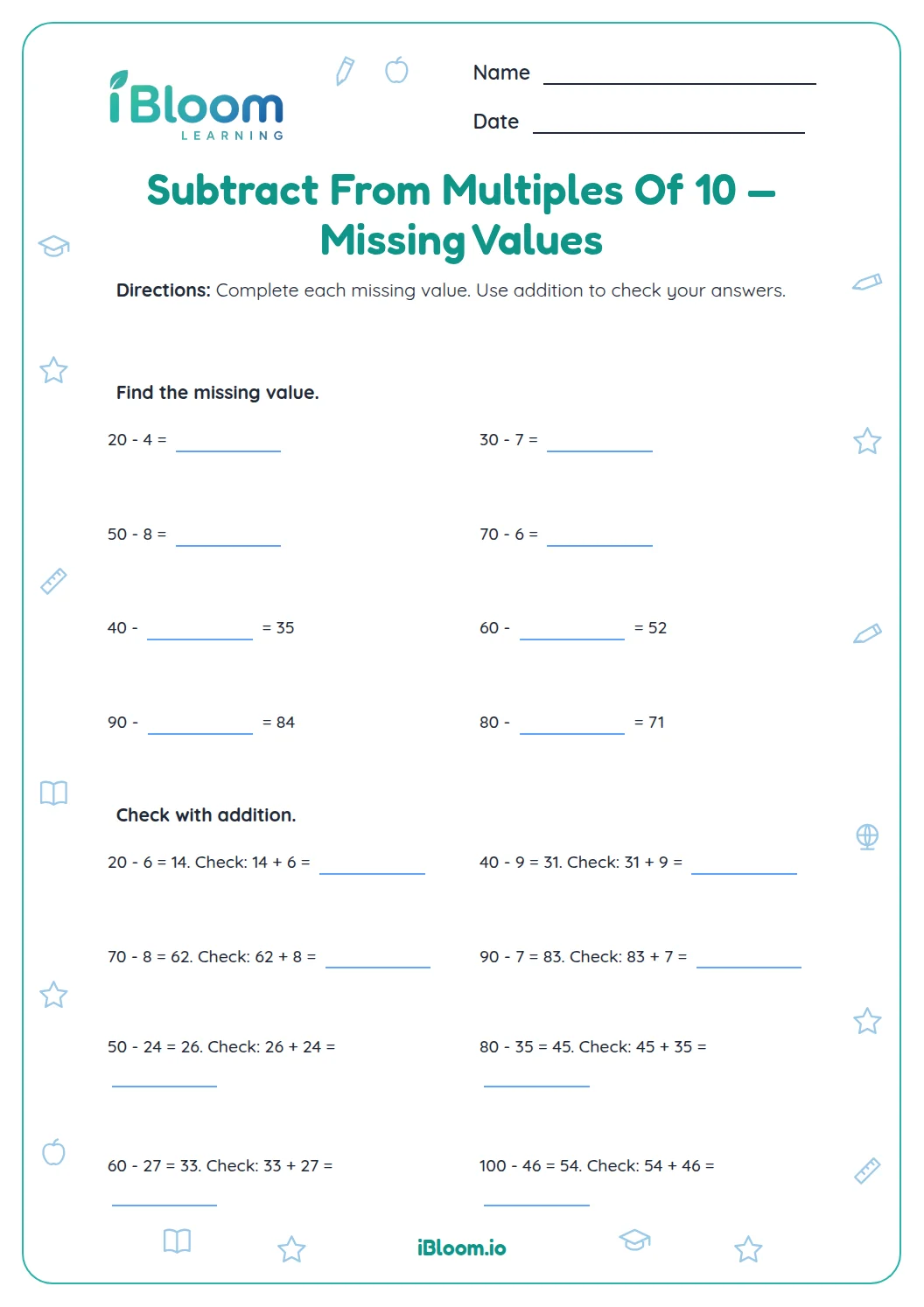

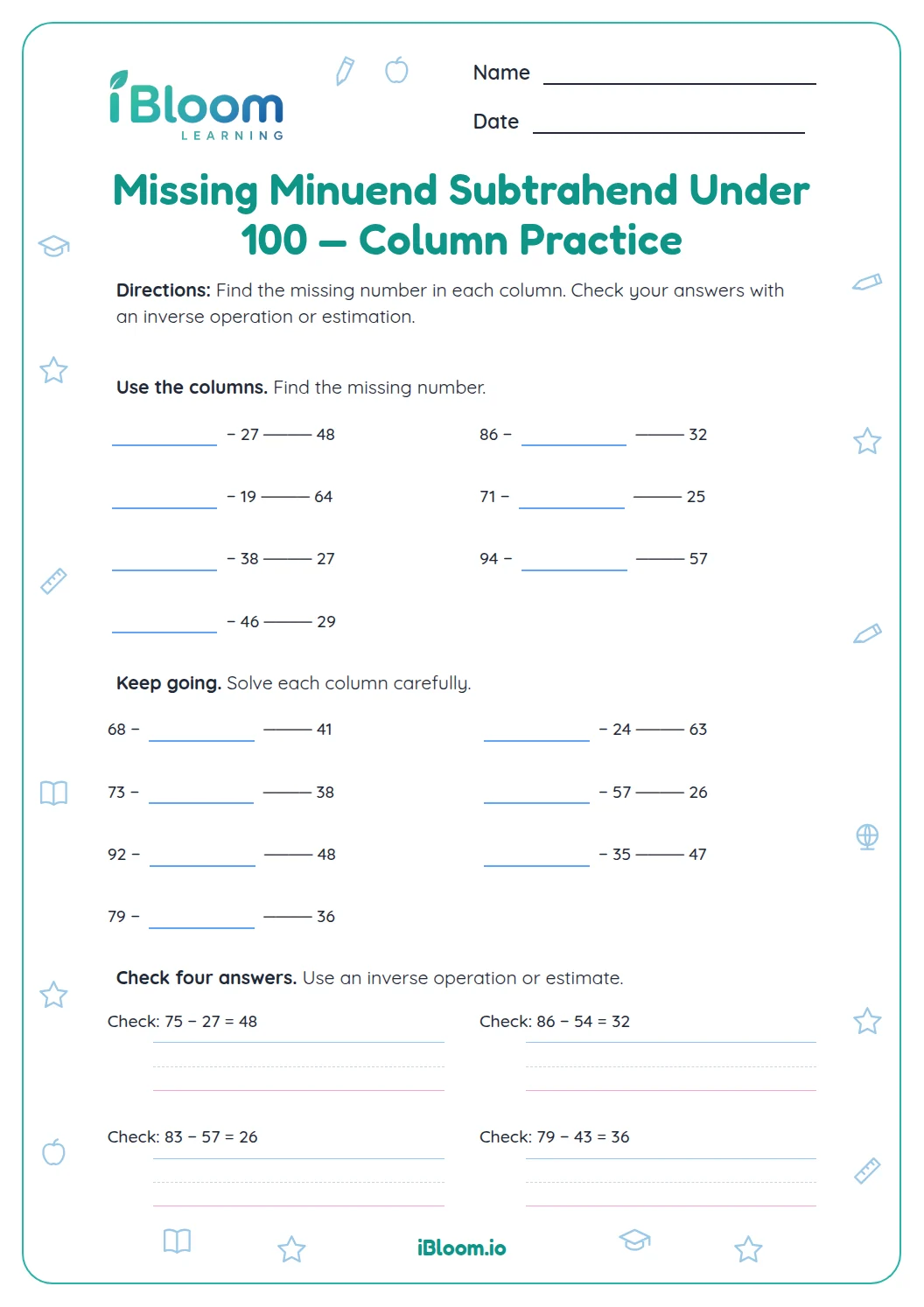

About this worksheet
This free subtraction worksheet gives students in Grades 2–4 eighteen questions about facts within 20. Part A asks them to find the first wrong step in six worked methods, including methods that are already correct. Part B has six differences to repair. Part C asks students to choose steps that subtract the right amount. The sheet practices Common Core 2.OA.B.2 through mental strategies, including making ten, using doubles, and subtracting an extra one and adding it back. A separate answer key marks every choice and gives the repaired differences.
Aligned to 2.OA.B.2
How do you find the first wrong step?
Read the subtraction fact before checking the numbered steps. A method must both calculate correctly and take away the amount named by the subtrahend. In question 2, each individual subtraction is true, but the steps take away six instead of five.
Three methods in Part A are already correct. One of them, 17 − 6, subtracts seven to reach ten and then adds one back. The net amount taken away is six.
- 1Target: 13 − 5
- 2Step 1: 13 − 3 = 10. This takes away 3.
- 3There are 2 more to take away, because 3 + 2 = 5.
- 4Step 2 should be 10 − 2 = 8, not 10 − 3 = 7.
- 5Answer: Step 2
How does adding back check a repaired difference?
Add the difference to the number taken away. A correct answer brings you back to the starting number. In question 11, 16 − 8 = 8, and the addition check is 8 + 8 = 16.
All six facts in Part B need repair. They include subtracting zero and one, adding instead of subtracting, and differences that are one too high or too low.
What makes a subtraction method correct?
Part C offers three methods for each fact. Each choice contains true arithmetic, so students must also check that it takes away the right total. For 14 − 6, subtracting four and then two removes six altogether.
For 20 − 9, subtract ten and add one back. This leaves 11. The eighteen questions include every one-digit subtrahend from 0 through 9, with starting numbers from 7 through 20.
How to use this worksheet
- 1Explain that the subtrahend is the number after the minus sign.
- 2For question 1, check that subtracting 6 and then 1 takes away 7.
- 3Complete Part A, checking the arithmetic and the amount taken away.
- 4Repair Part B and say each addition check aloud.
- 5For Part C, explain why the chosen method removes exactly the required amount.
Mistakes to notice and fix
The mistake
Accepting two true calculations that subtract the wrong total.
The fix
In question 2, add the amounts taken away: 3 + 3 = 6, but the target is subtracting 5.
The mistake
Treating subtracting zero as making the answer zero.
The fix
In question 7, nothing is taken away, so 9 − 0 = 9.
The mistake
Subtracting an extra one without putting it back.
The fix
For 20 − 9, subtract 10 and then add 1: 20 − 10 + 1 = 11.
Common Core alignment
Use subtraction facts within 20 and addition checks to find and repair errors.
On this sheet: Students check worked mental strategies, repair differences, and choose valid subtraction methods.
Show the official wordingHide the official wording
Fluently add and subtract within 20 using mental strategies. By end of Grade 2, know from memory all sums of two one-digit numbers.
What to practice next
Make more practice
Further reading
Questions parents and teachers ask
Does this worksheet use every one-digit subtrahend?
Yes, the eighteen questions include every subtrahend from 0 through 9. Starting numbers range from 7 through 20. Students check six worked methods, repair six facts, and choose six valid methods, so they practice both the facts and the reasoning behind them.
Are all the worked methods in Part A wrong?
No, three of the six worked methods are correct. Students choose Both correct for questions 1, 4, and 6. For the other questions, they identify the first wrong step. Have them check how much is taken away as well as whether each calculation is true.
Why is Step 2 wrong in question 2?
Step 2 subtracts one too many. The target is 13 − 5, and Step 1 has already taken away 3 to reach 10. Only 2 more should be removed. Although 10 − 3 = 7 is true, it does not finish the intended subtraction.
Why does one correct method add instead of subtract?
Adding one back corrects an extra subtraction. In question 4, taking 7 from 17 reaches 10, but the target was to subtract only 6. Adding 1 back gives 11. Question 17 uses the same idea for 20 − 9: subtract 10, then add 1.
Should this subtraction activity be timed?
Use it without a timer so students can inspect the steps and compare methods. Allow about fifteen to twenty minutes, with discussion as needed. The key marks each correct choice and supplies all six repaired differences; ask students to explain a chosen method before checking it.